Archives » Orhan Pamuk

My Name is Red by Orhan Pamuk

Faber and Faber, 2002, 508 p. Translated from the Turkish Benim Adim Kirmizi by Erdağ M Göknar.

My Name is Red cover

Well, this is an interesting concoction. The events take place in Istanbul in the time of Sultan Murat III. The first chapter is entitled I am a Corpse and is narrated by a murder victim. This sets up the novel as a whodunnit but Pamuk is far too subtle a writer for that to be his sole concern. The remainder of the book is narrated from a wide variety of viewpoints; several manuscript illustrators, the effectively widowed daughter of one of them, her son, her suitor, their go-between, the corpse, a dog, a tree, a counterfeit gold coin, death, the colour red, a horse, Satan – and two dervishes. In various of these the reader is occasionally addressed directly. The non-human narrators turn out to be parts of a manuscript illustration designed to show the splendour, magnificence and power of the Sultan, to impress Westerners, especially Venetians. Not a simple read then, by any means. Add to this the fact that three corpses undertake narration duties since during two of the relevant chapters the particular narrator is also killed – and describes the experience – and the artistry becomes evident.

In ways this reminded me of The Name of the Rose as it is the manuscript that is at the heart of things. So we have passages dealing with the philosophy of illustration and miniaturism, its place in the Islamic traditions, on whether or not it is blasphemy to ape the Venetian/Frankish form of realistic painting and use perspective, to show Allah’s view of the world, or the world as it is. The murders are direct consequences of this conflict. Plus there is a meditation on the acceptance of blindness as Allah’s reward to the miniaturist for his years of devotion to his art and frequent references to the Persian tales of Hüsrev and Shirin, and of Sohrab and Rüstem. There are, too, several instances of characters telling stories from the perspectives of folk named Alif, Ba and Djim. Some of these interpolations verge on the tedious but perhaps to Turkish readers they have more resonance.

The above may make it sound as if the book is difficult, but it isn’t if you are prepared to go with the flow as I was. I certainly will be reading more Pamuk, who clearly has considerable self-confidence. In what has been a feature of all his novels I have read so far there is a character named Orhan. This time it is not “Orhan Pamuk” though, but the Orhan within is eventually revealed to be the overall “author” of the book we are reading.

In the background but providing some impetus to the plot at times a preacher from Erzurum is blaming apostates and infidels for the supposed catastrophes of the last ten years and stirring up the mob. Casting blame on the other. Does this sound familiar to anybody?

Among Pamuk’s bon mots here are, “Only imbeciles are innocent,” “A letter doesn’t communicate by words alone. A letter, just like a book, can be read by smelling it, touching it and fondling it” and “Painting is the silence of thought and the music of sight.” He has the old miniaturist Osman say, “Painting is the act of seeking out Allah’s memories and seeing the world as He sees the world.” The book’s main love interest, the illustrator’s daughter, Shekure, tells us, “Marriage douses love’s flame, leaving nothing but a barren and melancholy blackness,” but, “The truth is contentment. Love and marriage are but a means to attaining it,” and that painters “substitute the joy of seeing for the joy of life.”

The translation is into USian and there were several curiosities or infelicities within it. Iron smiths may be a direct translation from Turkish but the English word is blacksmiths. Then we had, “your sympathy and understanding are much obliged,” “the both of you,” “artists who are discontent with,” “a superior element as all of you are familiar,” “would’ve hid that picture,” a use of “plenty” where “greatly” made more sense plus the misspellings “guilded,” “descendents,” “practice” as a verb, the “pitfulls” of love and women, “imposter,” “quandries.”
Best of the Year

It’s traditional at this season of the year to list what has most impressed over the past twelve or so months. Except I’ve only done it once before. Twelve months ago.

Once again I find ten books stood out over the year.

In order of reading they were:-

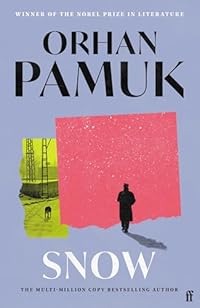
Snow by Orhan Pamuk
Gentlemen of the Road by Michael Chabon
Empty Space by M John Harrison
New Finnish Grammar by Diego Marani
Dark Eden by Chris Beckett
Spin by Nina Allan
The Feast of the Goat by Mario Vargas Llosa
Girl Reading by Katie Ward
Planesrunner by Ian McDonald
Fire in the Blood by Irène Némirovsky

4 are translations, 4 are SF*, 3 are by women. Make of that what you will.

*If you count the last section of Girl Reading, that would be 4 and a bit.

Snow by Orhan Pamuk

Faber and Faber, 2005, 436p. Translated from the Turkish, Kar, by Maureen Freely

Turkish poet, Kerim Alakusoğlu, who dislikes his name and wishes to be known only as Ka, has returned temporarily from Germany to undertake an investigation for the Istanbul newspaper Republican into a spate of teenage girl suicides in the remote city of Kars in Anatolia and also to report on an upcoming election there. The suicides are by girls who were being forced to remove their headscarves in order to attend state run school. Also on Ka’s mind is the possibility of reacquainting himself with the beautiful İpek, recently divorced from her husband.

The situation he finds himself in unlocks Ka’s writer’s block and poems flow from him – 19 in the few days the story encompasses. He notes these down in a green notebook and assigns them to positions along three axes, Memory, Logic and Imagination, on a diagram of a snowflake.

The narrative is mostly third person from Ka’s viewpoint but chapter 29, where the snowflake appears, and the concluding ones are first person by the author.

Kars is one of those unfortunate places which has seen many upheavals and changes of country in its history. Local factions include Kurdish nationalists, Islamists, secularists, even a few die-hard communists from the Soviet era. Ka’s visit coincides with a snowstorm cutting Kars off from the rest of Turkey giving opportunity for the various simmering discontents to come to the boil. In the middle of a live TV broadcast of a stage show dealing with the headscarf issue a local coup takes place.

The importance of football in modern Turkey is underlined by its several mentions in this book (as it was also in the other two Pamuk novels I have read.) Not a typical reference to find in a literary novel. Imagine the guffaws were the Beautiful Game to feature with any prominence in a British novel by a Nobel laureate.

Another presence here common to those two previous books is the appearance in the narrative of a certain Orhan Pamuk, a friend of Ka and telling his story for him. Is this the secret to winning the Nobel Prize? Put yourself into your books as a character?

Due to its history the tension between religion and secularism is particularly intense in Turkey and it is no surprise the story turns on this. The propensity for such disagreements to turn into violence is given due weight here as is the potential for long memories and grudges to be held.

There is more incident in this novel than in The Museum of Innocence but the background of Turkish society continues to be fascinating and as in that book the translation flows admirably.

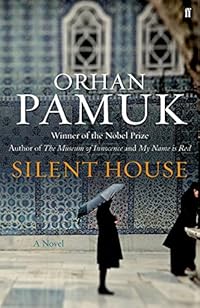
Silent House by Orhan Pamuk

faber and faber, 2012, 334p. Translated from the Turkish, Sessiv Ev, by Robert Finn

 Silent House cover

Silent House is Pamuk’s second novel (from 1983) but not published in English till 2012. The book centres round the visit from Istanbul to her home at Cennethisar of the grandchildren of Fatma Darvinoğlu. Fatma’s husband, Selahattin, was a doctor who, long before World War 2, frightened off his patients with his atheism and consequently squandered her inheritance of jewellery as a result of his lack of income. Their unusual surname was taken at the time when Atatürk forced though the adoption of the practice for Muslims in 1934 and Selahattin opted for “Son of Darwin.” Fatma recollects her husband’s catalogue of unacceptable behaviours in interior monologues while present day life goes on around her. Other viewpoint characters are Fatma’s grandson Faruk, an historian with a failed marriage; his brother Metin, who thinks he’s in love with a girl called Ceylan; her servant, the dwarf Recep, who is her husband’s illegitimate child; and Hasan, son of Recep’s likewise bastard brother Ismail, who has become involved with right wing petty agitators and is smitten by Nilgün, sister of Faruk and Metin.

As in The Museum of Innocence the tensions between Turkey and “the West,” tradition and modernism, religion and the secular, loom large. The political situation in 1980s Turkey is also important here. While I was not familiar with that background enough was conveyed for that lack of knowledge not to matter.

The translation is into USian which is fine for the most part but occasionally led to me being hauled away from Turkey by the intrusion of a particularly USian usage (eg “not a cent” – would a Turkish coin denomination not have sufficed here?)

The five narrative viewpoints do not provide as sustained a focus as the all-but single one of The Museum of Innocence but do give a broader picture of Turkish society.

In one of the newspaper reviews of books of the year I saw Silent House described as a comic satire. I must say I did not find it particularly comic; the tone certainly isn’t light and there is a dark tinge to proceedings. There are also hints of why Pamuk would win the Nobel prize.

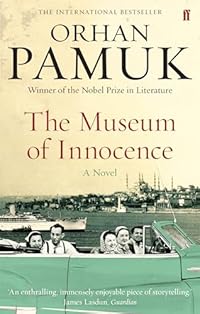
The Museum of Innocence by Orhan Pamuk

Faber and Faber, 2009, 734 p. Translated from the Turkish, Masumiyet Müzesi, by Maureen Freely.

 The Museum of Innocence cover

This is the tale of our narrator, Kemal Basmacı, a relatively well to do son of a Turkish business man, though he would say it was that of the love of his life, his distant not-quite relative, the shopgirl Füsun Keskin. As the novel starts Kemal is enjoying his carefree lifestyle, helping to run his father’s business, plus having sex with his intended, Sibel. A few weeks before their engagement party he meets Füsun again (they had been childhood acquaintances) and the pair take to making love in the afternoons. Being Turkey in the 1970s – though actually extra-marital relations were not entirely comment free then even in the West; certainly not in Scotland – the potential for ruin of her reputation is extreme. When Kemal falls in love with Füsun the outlines of a tragedy are in place.

Like a lot of novels set in repressive settings (not only for example in Egypt (The Yacoubian Building) but also Soviet era Czechoslovakia (The Unbearable Lightness of Being) the importance of sex infuses the story. More importantly here, it is the question of a woman’s virginity, or lack of it, on marriage that creates Kemal’s dilemma, Füsun’s family’s response to that problem a formidable obstacle to a happy resolution. The Museum of Innocence is trading on the perennial great themes of literature through the ages; love, sex and death. At one point the narrator opines that a love story with a happy ending is pretty well not worth telling. His mother (too late) tells him that in a country where men and women can’t be together socially, can’t even have a conversation, there is no such thing as love. If any woman shows interest the man is conditioned to pounce on her like a starving animal.

The Museum of Innocence of the novel’s title is Kemal’s shrine to Füsun’s memory. The narrative is like the museum’s catalogue, a description of the various stages of their relationship, exhibits of all the items Kemal has collected which connected her to him. In some places it as if the museum’s curator is speaking to us. A bit of meta-fictional post-modern gamesmanship occurs when an entry ticket to the museum is printed on one of the pages and also when the novelist Orhan Pamuk intrudes into his own novel as a very minor character. This is finessed in the final chapter by a not wholly convincing device which nevertheless confers a degree of perspective on Kemal’s story.

The evocation of Turkish life is interesting, its teetering on the brink of what Kemal’s crowd saw as modernity, its conflict with tradition. The vicissitudes of Turkish politics of the time, the civil strife, the military coups, the saturation with Atatürk’s image and memory, are mentioned but more or less in passing; indeed are there to point up that life went on notwithstanding them. Pamuk’s implicit critique of Turkish mores isn’t overstated, though. A salient feature was the tendency of the characters to smoke cigarettes. The fug of burnt tobacco almost leaps off the page: the book could come with a health warning. Is it the same still in Turkey, I wonder?

Kemal’s narration is measured, even, and his actions presented as reasonable but they are certainly obsessed and smack of a kind of madness. This is not unknown to Pamuk, of course. In the last chapter Kemal is referred to as “not quite right in the head.” Obsessive love is a kind of madness, I suppose. The novel and the Museum are presented as Kemal’s attempts to reclaim the sense of his own life from others’ interpretation of it. He may be deluded, but like Hamlet said, there is method in it.

The translation is into USian, but that was fine; Kemal had spent some time in the US in his youth. (There was only one sentence which struck me as awkward. In 700 odd pages that’s not bad going.)

In such a long story it is hard to avoid longueurs. That Pamuk broadly manages this despite more or less nothing happening to progress Kemal’s situation for many years is testament to his ability. I’ll be reading more of Pamuk.

free hit counter script