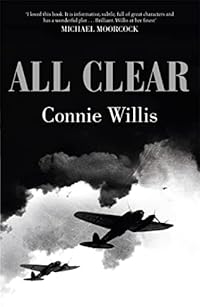
Gollancz, 2012, 792 p
Warning: the book is a time travel story. It is difficult to discuss without getting ahead of (behind?) yourself. The following may contain spoilers.
This is the continuation of Blackout. Had I not read All Clear so soon after I would have put it off for a long time which could have been a problem as little concession is made to anyone who by chance hasn’t read the first book of the pair. We plunge into the story with no preamble.
Our historian heroines/hero, time travelling from 2060 Oxford, are still stuck in 1940, either unable to get to their drops or waiting in vain for them to open, and still worrying that they have changed history for the worse and will not be able to get back to their own time before the continuum exacts its revenge. Polly Sebastian in particular is up against a deadline, having been dropped earlier in her own time to later in the war and the “laws of time travel” do not allow her to overlap time frames. All of the historians have in one way or another saved the lives of “contemps” and two of them have prevented fires spreading in St Paul’s Cathedral. One even travels to Bletchley Park where he (literally) bumps into Alan Turing and later becomes a vital part of the effort to convince the Germans the D-Day landings will be in the Pas de Calais rather than Normandy. Meanwhile in 1944 Mary hasn’t been killed by a doodlebug but she has gone on to inspire an RAF pilot to develop the “flipping” technique used to deflect their paths. As Polly, dropped into 1940, she therefore knows she has already affected later history yet is nevertheless the main worrier.
There is more Science Fictional stuff revealed in All Clear than there was in Blackout, which makes the nomination for the 2011 Hugo at least understandable (but not forgiveable;) the working out of the plot is neat enough – though there is at least one loose end – and Willis’s prose is never difficult to read. Aspects of her digression/interruption technique are essential to the plot but she lays it on with a trowel and also uses it in other circumstances – without it the book may have been considerably shorter.
Polly eventually comes to understand the true situation – but it has been a long time coming. It’s also a realisation that had occurred to the reader less than a quarter of the way through Blackout, ie approximately 1000 pages earlier. In addition these Oxford historians do seem to have an alarming lack of knowledge of wider history beyond the “prepping” they have done for their drops. (But then, “What ten year period did you study?” was always a jibe directed at history graduates.)
Given the number of bombs and explosions the characters have to endure, the levels of destruction we are shown, it is a matter of wonder that any of London managed to survive the war. However, Willis’s point that the ambulance drivers, rescue workers, ARP wardens, shopgirls, etc were no less heroic and no less important to winning the war than the fighting forces is well made. One of the reasons for carrying on though (apart from sheer bloody-mindedness, a prime motivator for the British in continuing to oppose Hitler) is what else can you do? The alternative is to despair, to give up, to give in. “Up yours!” is surely a healthier response. And these days there is no such thing as a civilian – we are all targets. Ever since the invention of the aeroplane and the submarine it has no longer been possible to outsource the risk of warfare purely to the armed services. (There are perhaps thousands of examples to argue that it actually never has.)
The most flagrant example in this volume of Willis’s lack of knowledge/research over things British is that she has one of her characters pay for an item in the 1940s using a tuppence (2d) piece. Prior to decimalisation in 1971 (when the face values changed in any case) there was no such coin. The denominations available in the 1940s were ¼d, ½d, 1d, 3d, 6d, 12d (1/-,) 24d (2/-,) or 30d (2/6) and, in extreme cases, 60d (5/-) but never 2d. Neither was two half-crowns (total 5/-) enough to cover two tickets at eight and six (8/6.) I’m also fairly sure that no London shops would have been open on Boxing Day 1940 given that it would have been a bank (and therefore public) holiday in England. Another example of her lack of feel for the minutiae of British life is that she doesn’t seem to appreciate how utterly unlikely it would be for someone of poverty-stricken childhood circumstances ever to make it into the highest echelons of the legal profession (to enter it at all, in fact.)