Archives » Neil M Gunn

The Green Isle of the Great Deep by Neil M Gunn

Polygon, 2006, 276 p, plus 5p Foreword by Diarmid Gunn. First published 1944.

In this book we return to the pairing of Young Art and Old Hector from a novel which I read in 2016.

After a night where the adults of Clachdrum talk about ongoing events in Hitler’s Germany and the terrifying thought that your mind could be broken, the pair go on a fishing expedition.

While attempting to catch a salmon they fall into the pool and apparently drown, waking up in another world, the Green Isle of the Great Deep of the title. This is a place which is recognisably Scottish rural, but with variations. A watcher tells them to travel to the Seat of the Rock and warned only to stay at the Inns along the way.

The land is fertile and fruit abundant but they are warned not to eat it, only to eat at the inns. However, Art is fractious, does not want to stay at the inns and eats the fruit, with no ill effects.

There are, of course, biblical connotations to this, but also questions of free will. On the Green Isle, life is regimented – an allegory of Nazi Germany, true, (there is talk of expansion into other lands,) but equally applicable to the feudally circumscribed life of the Highlands.

While Art makes the most of his ability to roam, escaping the clutches of the authorities Hector falls into their sway. He finds that fruit was forbidden “so that man would be restored to his original innocence,” be without blemish, the perfect worker, do all things he was told to do, all to ensure perpetual order. Hector is told “obedience is the highest of virtues.”

Art is sought out by the Hunt but continues to evade his pursuers, which leads to doubts spreading at the Seat.

There are echoes in the novel of George MacDonald’s Phantastes (though Gunn is much the better writer) and similarities to Gunn’s later novel The Well at the World’s End.

Many of Scottish fiction’s dealings with the fantastic feature meetings with the Devil. The Green Isle of the Great Deep is different in that here Hector demands from the Seat a meeting with God – and gets it. This gives Gunn the opportunity to philosophise about totalitarianism and freedom, knowledge and wisdom, thinking and feeling and the necessity for governance to be tempered by wise counsel, armed with which Hector and Art can return to life in Clachdrum.

Pedant’s corner:- a missing comma before a piece of direct speech, focused (focused,) “spoke to her husband an pointed to” (and pointed to,) “their bodies quivered and shrunk” (and shrank,) ogam (now spelled ogham.)

Morning Tide by Neil M Gunn

Chivers, 1993, 371p. First published 1931.

Like Highland River, this is a tale steeped in Gunn’s experience of growing up in the coastal village of Dunbeath in Caithness. The viewpoint character is Hugh MacBeth, youngest son of the family but old enough to be tasked with collecting mussels with which to bait his father’s fishing nets. Part One is a slow unfolding of the realities of living slightly away from the small community but nevertheless enmeshed in it and displays a deep knowledge of the fishing life and empathy for a child on the cusp of early manhood. Hugh’s sister Grace has been away working in a city but recently returned home. He is mildly disturbed by meeting her walking along the road one evening with Charlie Chisholm, with whom his other sister, Kirsty, apparently has an understanding. His father is an accomplished seaman but his mother is opposed to any venturing out in boats by his elder brother Alan, since the McHughs’ other son, Finlay, had drowned several years before. The dramatic climax comes when Alan has offered to take a place in another man’s boat due to a crewman’s indisposition. A storm brews up shortly after the boats are out and a magnificently described passage shows us the perils of trying to make safe harbour in a raging sea and the fears of the women – and men – on the shore. Alan’s boat grounds just outside the harbour mouth but lines cast out from the shore help all to safety. In the meantime Hugh’s father’s boat appears doomed to all the observers when it materialises out of the rolling swells. Yet he times the approach and angle to the small harbour entrance to catch a wave surging into its shelter.

Part Two sees Hugh’s initiation into the company of older men and involvement in a ploy to poach salmon from the upper reaches of the local river, on the return from which he overhears Kirsty and Charlie Chisholm having a serious conversation about their relationship. By this time Alan has resolved to make a life for himself in Australia, an outcome which his mother much prefers to a life on the boats even though she is unlikely ever to see him again.

Hugh’s interactions with his peers and elders and theirs with him and each other are all firmly rooted. Understated love, minor betrayals, low-key heroism, the exigencies of a hard life (when doctors are only available by calling at their houses and even then may be out on a call) are all implied rather than underlined. This is a fine novel.

Pedant’s corner:- Magus (elsewhere Magnus.) “Bows rained on his own face” (Blows rained,) page 40 refers twice to Sandy – this is the name given to another character not in the scene. It is Hugh who is, and Hugh who is meant. “Icredible” (Incredible,) “a light in Morags” (Morag’s,) “tears navigating he zigzag furrows” (the zigzag furrows,) a missing full stop. “Ner’er” (Ne’er,) “a breat of snow” (a breath.) His conused mind” (confused,) “thrust two half-crowns into this pocket” (his pocket.) “He seemed to playing a game” (to be playing a game,) “he grilse rolled in his jersey” (the grilse.) “Cast they bread upon the waters” (Cast thy bread) not yet riches (nor yet riches.)

Highland River by Neil M Gunn

Canongate Classics, 1996, 246 p, plus vi p Introduction by Dairmid Gunn. First published in 1937.

Though it is couched as a sort of biography of Kenn, a young boy growing up into manhood and early middle age, this is an unusual novel in that its focus is really on the river of the title – almost a character in its own right – and clearly rooted in the author’s upbringing in the town of Dunbeath in Caithness and his knowledge of the Dunbeath Water which runs into the sea there. Evocation of landscape is a major component of the Scottish novel in general but not always as to the fore as it is here. Gunn’s descriptions of the river are precise and detailed so that the reader almost feels present. Not that he neglects characterisation; Kenn’s mother, elder brother and father are sketched economically but powerfully and all the minor characters have the stuff of life. It is, too, a philosophical novel, crammed with the thoughts Gunn puts into Kenn’s head as he recounts his experiences. It joins the long roll of Scottish literature about times lost and a way of life remembered.

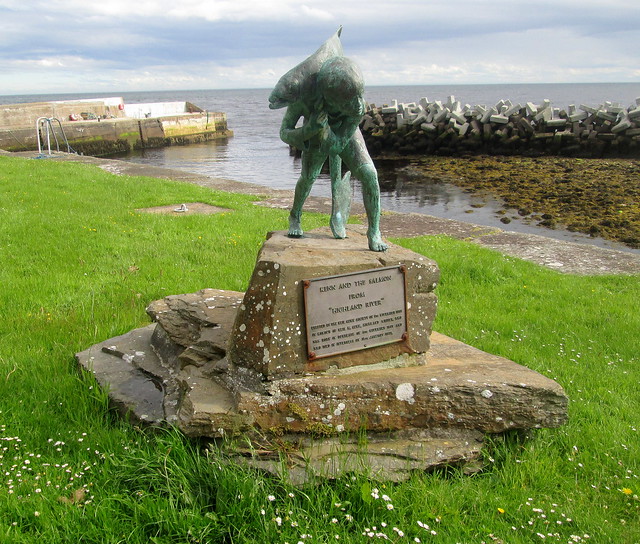
The first scene is of a very young Kenn’s struggle with a huge cock salmon in the lower reaches of the river. In the end he manages to land it and this marks his transition into boyhood. (This episode is also commemorated by a statue erected by proud locals alongside the harbour in Dunbeath. I featured the statue in this post.)

This is one of many instances where the catching of fish (whether trout or salmon) is portrayed, the elaborate precautions taken to avoid gamekeepers, the deep knowledge of the likely pools, the intricate procedures needed to spy the fish and entrap it. Another early scene shows the disconnect between geography lessons about the main industries of English cities and Kenn’s daily life. None of that mundane esoterica is relevant to existence in a small village. Kenn finds himself dreaming through such lessons and as a result becomes the subject of his teacher’s wrath, expressed as was the custom of the times via the institutionalised violence of the tawse.

In contrast, despite the reticence bred by Calvinism – “None of the mothers in that land kissed their sons. If it were known that a boy had been kissed by his mother, not a dozen school fights would clear him of the dark shame of such weakness,” a weakness seen as more the mother’s than the son’s, “Nor can Kenn remember having seen his father kiss his mother ….. affection was as shy and as invisible as death,” – his parent’s quiet attitude to Kenn’s academic success and his own reluctance to declare it speak volumes.

As for the rock of the family, “Kenn’s mother did not go to church simply because she believed she was not worthy ….. She had done nothing to make herself unworthy. She was seen in her life as a good woman and without reproach. Yet she believed herself unworthy.” The men, too, did not take communion; their lives, tainted by rough living (and the odd drink,) had “not contained enough solemnity of holiness to justify them in going forward.”

The narrative flits back and forth through time between Kenn’s childhood, his experiences in the Great War and his life as a physicist afterwards, but the transitions are not jarring. They seem to occur organically, scenes flowing smoothly into one another. It is a kind of stream of consciousness, but controlled, always alert to the point. The removal in the Highland Clearances of Kenn’s not so ancient ancestors from the land they had worked since time immemorial, henceforth to make their living through sea-fishing, is mentioned in passing but without it they would not have been in reduced circumstances.

Through it all the river exerts its pull, Kenn’s last journey in the book marking his progress at last up to its source where he thinks, “Out of great works of art, out of great writing, there comes upon the soul sometimes a feeling of strange intimacy.” Here, Gunn’s intimacy with his subject, his feel for his particular hinterland, reaches beyond the Dunbeath Water, beyond the village which shares its name, beyond Scotland, to become universal, recognised by Highland River’s award of the James Tait Black Memorial Prize for 1937.

Pedant’s corner:- In the Introduction; a quote is given partly as “you make me try to see him” (the text actually has ‘you made me try’,) “no so ancient” (not so ancient.) Otherwise; Sans’ (several times, Sans’s,) a missing comma before a piece of direct speech (x 3,) milennia (millenia,) Archimedes’ (Archimedes’s,) acction (action,) “this land of bare moors had their austere effect” (had its austere effect.)

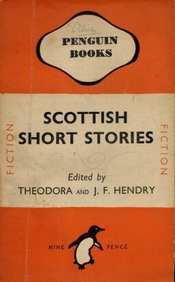
Scottish Short Stories Edited by Theodora and J F Hendry

Penguin, 1945, 123 p.

Scottish Short Stories cover

The back cover says this book was mostly edited by Theodora Hendry but she was killed in the London Blitz. The criteria for selection in the volume was Scottish stories with a Scottish setting or else it “would almost certainly have assumed an international aspect.”
The first, The Coasts of Normandy by George Blake, is the story of a tragedy which befell the narrator’s childhood friend and its effect on the child’s mother as reflected through the prism of a chance encounter with a stranger many years later on the coast of Normandy. It takes a slightly circuitous route to its revelation (which the reader intuits well before the narrative gets there) but this allows for such thoughts as, “The simple feel as warmly as the clever and the learned.” Another of its observations is a reminder that, for some soldiers at least, the Great War was not only a horrific trial and ordeal but also an opportunity to remake their lives in its aftermath.
In A Sunday Visit by Colm Brogan two boys are dragged along by their mother to the Mortons’ house, where the family has just suffered a bereavement. Amid all the whispering, the boys are left to their own devices.
A Hike to Balerno by Ronald McDonald Douglas sees two boys on the titular hike, the escapades they get up to, the banter between them, “daft, just plain daft.”
Clay by Lewis Grassic Gibbon is the story of Robert Galt, a man from a chancy background who takes a farm and devotes all his time to it, to the neglect of his wife and his daughter’s prospects.
Beattock for Moffat by R B Cunninghame Graham tells of the last journey of a dying Scot on the train up from London with his cockney wife and his brother come to take him home to die. The author observes of the accomodations married couples make with each other that “usually … good points, seen through prejudice of race, religion, and surroundings, appear … defects,” and refers to the Cockney wife’s reticence being explained by, “the English theory, that unpleasant things should not be mentioned, and that, by this means, they can be kept at bay.” The prose evidences that Scottish authors’ eye for landscape.
In The Sea by Neil M Gunn a twelve-year-old overcomes his fears, staggering through the night down to the harbour to witness the perilous return of his father’s and brother’s boats during a great storm. Here it is seascape (or land-meets-sea-scape) which the descriptive powers bring to life.
J F Hendry’s Chrysalis is a fragment of the childhood of a boy who wants to be good but fears he is bad because he sometimes is too enthusiastic in his activities.
Clock-a-Doodle-Doo by Willa Muir is set in a room full of clocks (all wag-at-the-wa’) which can speak to each other, having theological discussions over whether the Son or Moon is the primum mobile and aspiring to Pure Horological Thought.
Neil Munro’s The Lost Pibroch could be characterised as a Scottish version of the Pied Piper of Hamelin. Two pipers come to Half-Town. After a night of musical vying with the blind piper there he finally plays them the titular pibroch he “got from a man in Moideart.” It has “something of the heart’s longing and the curious chances of life” and sets up a wanderlust in those who hear it.
In The Matinee by Fred Urquhart a fifteen-year-old newly graduated into long trousers reverts to shorts to get into the cinema more cheaply, dragging his younger brother along for corroboration. Engrossed in a film where a factory owner exploiting the workers is presented as virtuous he fails to acknowledge his brother’s increasing personal discomfiture.
Eric Linklater’s Kind Kitty is an old woman who likes a drink, then dies through lack of it a few days after throwing a party for Hogmanay. She inveigles her way into heaven but finds the company there uncongenial, and the beer far too poor.

Pedant’s corner:- a missing full stop, “brigh” (is missing a final ‘t’,) missing commas before pieces of direct speech.

Dunbeath, Caithness

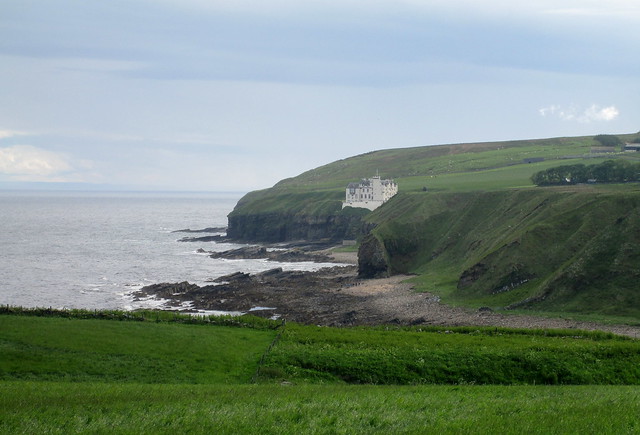
Just over the Dunbeath Water from the small harbour lies Dunbeath Castle. This photo was taken from up the hill the road ascends north of the village, where we had parked the car:-

Dunbeath Castle

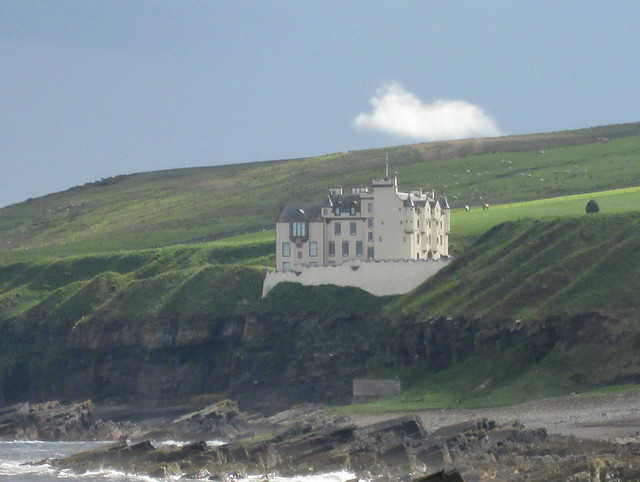
This is a closer view taken from the harbour:-

Dunbeath Castle Close-up

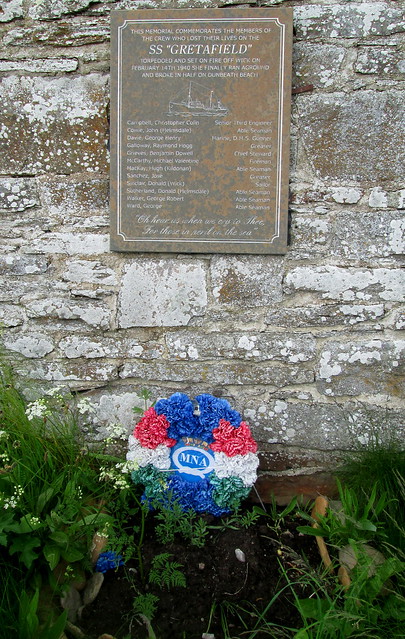
On a wall by the harbour is this memorial to the SS Gretafield which was torpedoed off Wick on 14/2/1940, set on fire, and finally ran aground on Dunbeath beach. 12 men died.

SS Gretafield Memorial, Dunbeath

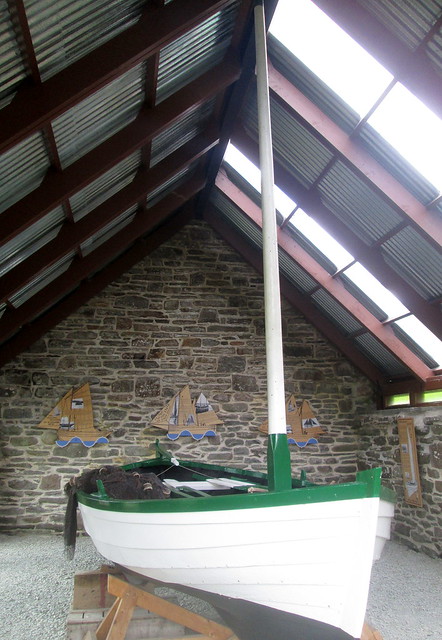
A small building had a kind of museum to the small boats people used to use for fishing out of Dunbeath. This is a model of the type. I kept thinking of The Silver Darlings:-

Model Boat, Dunbeath

Dunbeath, Caithness, and Neil M Gunn Memorial

On the way down from Orkney and Thurso we stopped at Dunbeath, Caithness. This was the birthplace of Scottish writer Neil M Gunn.

This stone was laid in his memory. “To commemorate Neil M Gunn, author of world renown, born into this community 8th November 1891.”

Neil M Gunn Memorial, Dunbeath

This statue, erected 100 years after Gunn’s birth, is in honour of the character Kenn from his novel Highland River:-

Kenn + Salmon

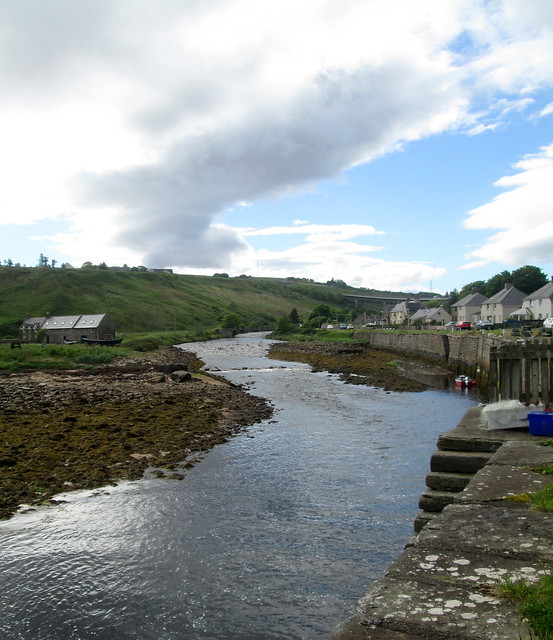
This is the river running through the village, the Dunbeath Water, possibly that same Highland river:-

Dunbeath Water

This information board was on a wall nearby. As well as mentioning Gunn it notes other local attractions:-

Information Board, Dunbeath

Young Art and Old Hector by Neil M Gunn

Souvenir Press, 1985 reprint from 1942, 255 p. One of the Herald’s “100” best Scottish Fiction Books

On finishing this uplifting book I reflected that it depicts a kind of relationship which either no longer exists or will expire shortly. Young Art is eight or so years old, hence not well versed in the ways of the adult world. His friend and confidant, Old Hector, the ancient of their small village, is a repository of sagacity, wisdom and local knowledge. Their warm, mutual affection shines through the prose describing their interactions. These days I fear the world of the young is so divorced from that of the old that common ground such as Art and Hector have here would be very hard to find.

Young Art and Old Hector is another chronicling of a way of life that was passing – had passed at the time of writing. This is one of the perennial themes of Scottish literature. Hector says to Art, “‘I know every corner of this land, every little burn and stream, and even the boulders in the stream. And I know the moors and every lochan on them. And I know the hills, and the passes, and the ruins, and I know of things that happened here on our land long long ago, and men who are long dead I knew, and women. They are part of me. And more than that I can never know now.’” Hector tells Art, “‘There are many places, many many places, with names that no-one knows but myself, and they will pass away with me.’” Whereupon Art asks Hector to teach them to him so that they won’t die. That instinct may have been what prompted Gunn to write this novel. Whatever, while people still read old books the past is never entirely dead.

There isn’t really much of a plot, what there is revolves around an illicit still set up to produce whisky for a wedding party, the authorities’ attempts to catch those operating it and their subsequent outwitting, but Gunn’s facility in entering the mind of a child is superb. An example of Art’s misunderstanding of grown up ways is his conclusion that courting must be a very bad thing. A conclusion only compounded when his hand is innocently held by a young girl. Gunn makes the comparison with the second childhood of the elderly but emphasises it does not entirely hold, especially in their differing perceptions of time.

Hector has a few good lines. “Old Hector maintained that money wasn’t everything… and in his young days people didn’t hanker after it so greedily as they did now.” To the objection that had they been more alive to it they might not have been cleared out of the Clash in the time of evictions he replies, “‘It was the lairds and the factors who were keen on the money, and it’s because they were keen on the money that they drove the people forth.’” Hector also says “‘I have not observed that it’s the people who are out to make money who are the helping kind…. the more they make the grippier they become.’” “‘Whenever the prime concern in life is money-making then you have trickery and brutality and wrong.’” “‘Human dealings are founded – founded – not on money but on what is fair and just all round.’” He relates how the legalisation of distilling in effect stole the people’s drink from them and had not left them “‘wherewith to buy it.’”

And here’s a thought that feels almost quaint in this modern age. “‘What’ asked Art, ‘is the most wonderful thing in the world.’ ‘A kind heart,’ answered Old Hector.”

Pedant’s corner:- On the book’s back cover; Donal (in the text it is always Donul.) Otherwise: dike (dyke is the preferred British spelling for an embankment or low wall,) primeval (I prefer primaeval,) “‘Are there? “I have never’, said Mary-Anne” (has the comma misplaced outside the quotation marks,) “and t but half the size” (has the space for the “i” of it but the “i” itself is missing,) “does not now what to make of me” (ditto the “k” of “know”,) “Every littl place (ditto the e of little,) paradisaical (I’ve only ever seen this as paradisiacal before but it’s an accepted variant.) A big thumbs up for “Amn’t I?”

Progress in Scottish Reading

A suitable post for St Andrew’s Day.

You may have noticed on my sidebar that I am reading Neil M Gunn’s Young Art and Old Hector.

This is one of The Herald’s “100” best Scottish Fiction Books.

Of the thirty books that were actually listed on that now defunct web page this means I will now have read twenty-nine (having made that my Scottish reading project for the year.)

The only one from that Herald list I have so far missed is Trainspotting by Irvine Welsh, which has appeared on all four lists I’ve been working from* – a distinction it shares only with the otherwise incomparable Sunset Song by Lewis Grassic Gibbon.

For some reason I have a reluctance to tackle Welsh’s book. I have seen the film that was made from it and wasn’t overly enthused. I’ll get round to it sometime.

*Those four lists:-
100 best Scottish Books;
The Herald’s “100” best Scottish Fiction Books;
Scotland’s favourite books;
and The Scotsman’s 20 Scottish Books Everyone Should Read (from 2005.)
This last is the one I shall be working from next year. I’ll post the list in the new year.

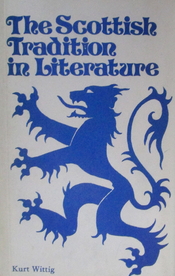
The Scottish Tradition in Literature by Kurt Wittig

The Mercat Press, 1978, 304 p, including ii p preface, ii p contents. A facsimile of the 1958 edition.

The Scottish Tradition in Literature cover

On the surface it seems a little odd that a book on Scottish literature should be written by a German but Wittig’s second sentence begins, “Scottish literature is part of our European heritage.” He goes on to say he does not wish to erect an invisible barrier that would isolate it from “the larger world to which it inseparably belongs,” but nevertheless, “We must do the literature we are studying the honour of recognising that it has both ‘a local habitation and a name.’” He notes, “Deep down in the heart and mind of many Scotsmen there is a kind of schism arising out of the clash of his conflicting loyalties,” but stresses that “someone from outside can distinguish between the typical and the specific.”

Wittig’s starting point for the Scottish tradition is John Barbour’s epic poem The Bruce, which is, he says, without parallel in the Middle Ages, finding its neglect by scholars (of whatever stamp) truly astonishing. The Bruce predates Chaucer’s great poems and its theme that knightly virtues are of no account unless supported by the ideals of “fredome” and “richt” – ‘A! Fredome is a noble thing!’ – sets it apart from its contemporaries. Barbour is the “first of a long series of Scottish writers who seem not only to be on terms of an informal intimacy with God (or the Devil), but even to be disposed, on occasion, to argue with him. No wonder that the Scottish people were later to find the spirit of the Reformation so congenial.”

Since it manifests itself in pre-Reformation works (of which – William Dunbar’s “Lament ‘Quhen he was sek’” (aka “Lament of the Makars”) with its Timor mortis conturbat me refrain apart – to my shame I was mostly unaware) it would seem therefore that the gloomy prognostications and demeanour of Scots (“the mistrust even of happiness”) are not so much derived from Calvinism but are much more deep-rooted, part of the character induced by harsh, dark winters and the sair fecht of scratching a living from the land. It’s almost as if Scots were marking time till a belief system to embody their experience came along; and thereupon embraced it with masochistic fervour.

Barbour also employs what Wittig identifies as a typical Scottish trait; understatement, particularly in regard to the emotions, and he possessed a keen enjoyment of sense impressions. In Robert Henryson he notes, “genuine emotions of the soul are rather suggested than expressed, but the airs men give themselves are heightened to grotesquerie.” Such sense impressions, personification, or animism – visualisation – is another thread that Wittig discerns in the Scottish tradition. Others include alliteration, an intense economy of expression. He notes that much Scottish poetry is interlinked with music, using traditional metres, often very complicated, internal rhymes, frequent refrain on a thematic word.

After Gavin Douglas – the last of the Makars – and David Lyndsay this spring tide, as Wittig puts it, of the tradition begins to ebb and Scots as a language began to diminish in importance and scope. While the Union of the Crowns meant the old cultural ties with France were cut, more significantly the printing presses were in London and, perhaps crucially, the Bible, and therefore the word of God – in Church and elsewhere – was in English and so English came to be associated with serious, dignified subjects. As a result “‘guid hamelie Scots’ seemed unfit for higher and more intellectual purposes.” In the meantime the Scottish Ballads – “A Treasure-trove” – helped to keep the language alive.

A resurgence came in the eighteenth century with once again as in the Makars an expansion of the language and its uses. This reached a “High Water Mark” with Robert Burns and Walter Scott before tailing off again. In the twentieth century “Another Spring” had its highlights in Hugh McDiarmid, Lewis Grassic Gibbon and Wittig’s prime exemplar Neil M Gunn.

Wittig emphasises the cross fertilisation of Scots with Gaelic. The two languages existed side by side for centuries, even at court. Many Scots sentence constructions have their roots in Gaelic which, according to Alexander MacDonald, is supreme over all other languages, “strong, fluent, copious, resonant, and so forth” but in the main “it is the one language in which, since the Tower of Babel, bard or satirist can scold best. Modern Scottish speech, too, is often said to be unsurpassed for deflating an opponent.” It is especially apparent in poetry, “The chief respects in which Scots differs from English poetry are that it shows a stronger feeling for colour (and for other sense impressions); imagery is sharper and more detailed, it is capable of greater metrical complexity, is apter to personify inanimate objects, takes a keener interest in nature, is full of the spirit of clannishness, and makes a speciality of flyting and extravaganza,” all features, Wittig says, even more strikingly characteristic of Scottish Gaelic poetry.

Wittig states that, “Perhaps no other European literature is so dramatic” yet contrasts that with the lack of Scottish drama, a delicate, developing flower at the time he was writing. Nevertheless quoting James Bridie (Dr O H Mavor) “we cannot perceive the Universe except as a pattern of reciprocating opposites.”

The Scot displays “sometimes an aggressive spirit of independence or egalitarianism,” and is adept at the art of flyting, a contest consisting of the exchange of insults, often conducted in verse, between two parties. Then again the mediaeval Scots proverb has it that, “nippin and scartin’s Scots fowk’s wooin.” “The Scots as a nation are passionately addicted to argument.” “The Scots argue not to find a compromise but in order to disagree, to make their point, to assert their rugged independence and individuality. It is an innate tendency to challenge blind acceptance.” Disputatious for the sake of it, “the fervid Scottish delight in arguing – with themselves if no other opponent is available – ” is prevalent in the works of Scott, the first Scottish writer who endowed landscape with a life of its own to the extent of making it one of the protagonists in his novels. (Wittig’s italics.) Landscape in Scott is much more than mere background, it is a formative influence.

James Thomson the younger wrestled with sin and guilt, and repeatedly saw himself as two separate personalities: “I was twain,/Two selves distinct that cannot join again;/One stood apart and knew but could not stir” typical of the emotional and intellectual dualism of Scots – the “Caledonian Antisyzygy” – which may have arisen due to coming to use one language to express thought, another to express feeling.

In the context of why a Scots tale seems to need a sharply portrayed character to tell it Wittig quotes Robert Louis Stevenson as saying, “the English speak with less interest and conviction, while the Scot puts his whole personality into it” and asks, “Is there any such thing as an absolute detached prose in Scots? Is it indeed, possible?”

Wittig occasionally casts aspersions. He calls William McGonagall the “shabbiest of public-house rhymesters” and says that here it is “not rock-bottom that we touch…. that would suggest something solid; with him, poetry is irretrievably sunk in mire,” while John Buchan’s English verse “reads like exercises in a foreign language.”

He notes how many Scots poets do not mention the sea at all. Neither do most writers of prose. (This may well, though, be related to the lack of fishing till well on in the eighteenth century.)

Drink is “a gateway to a new kind of world that provides distortion, new perspectives, and surprising insights.” Wittig says, “I do not know of any other country in which is found a similar attitude to drink: but when Magnus Merriman speaks of this violent Scotland with its hard drinking as a country worth living in and refashioning it reminds me at once of several Scottish acquaintances, poets and others.”

J Leslie Mitchell (Lewis Grassic Gibbon) produces the effect of a “reality that is both subjective and communal. This is the culmination of the inherently dramatic character of Scots, for all the time somebody is imagined to be speaking – or letting his thinking become audible – though his identity may not be specified.” A person can view himself as “you.”

This is a magnificent book. Wittig’s knowledge of his subject appears encyclopaedic, his insights are sharp, his advocacy of the existence of such a thing as a Scottish tradition in literature and his demonstration of its importance and enduring relevance a stirring redress to those who would claim otherwise.

Pedant’s corner:- Reflexion (reflection,) connexion (connection,) medieval, irreverance (irreverence, which appears four lines later!) simplyc alled (simply called,) for convenience’ sake (convenience’s sake,) sublter (subtler,) Blaweary (Blawearie.)
The Lament: A Scottish Tradition

I mentioned recently in my review of Christopher Rush’s A Twelvemonth and a Day that it fell into that long list of laments with which the Scottish novel is liberally bestowed – going back at least as far as the poem on the state of the nation written on King Alexander III’s death after falling from a cliff in Fife in 1286, but which may well be an oral tradition older still.

This sense of things lost seems to be an itch which Scottish letters is unable not to scratch.

Many of the books on the 100 best Scottish Books list fall into this tradition; of the ones I have read not only the Rush but also Iain Crichton Smith’s Consider the Lilies, Archie Hind’s The Dear Green Place, William McIlvanney’s Docherty, George Mackay Brown’s Greenvoe, Neil M Gunn’s The Silver Darlings, Lewis Grassic Gibbon’s Sunset Song certainly qualify. Arguably Jessie Kesson’s The White Bird Passes also fits the bill; its title certainly does.

Whether this dwelling on things gone by is due to a sense of lost nationhood or not is a matter for debate but the itch is played out not just in Scottish literature, the lament is a major strand in bagpiping and has a long history in song (eg The Flowers o’ the Forest.) The Proclaimers’ Letter From America – “Bathgate no more” etc – is merely a modern take on the form.

Another important strand in the Scottish novel is that of the döppelganger/the supernatural. Here James Hogg’s Private Memoirs and Confessions of a Justified Sinner, which can certainly be seen as a reflection on the duality of the Scots psyche after the Treaty of Union as well as an illustration of Scottish literature’s fascination with the Devil, is the prototypical – and arguably the finest – example though Robert Louis Stevenson’s Strange Case of Dr Jekyll and Mr Hyde is perhaps better known furth of Scotland.

On thinking about all this I realised that, despite being Science Fiction, my own novel A Son of the Rock was also such a lament (though it eschews any truck with the supernatural.) The book was certainly conceived in part as an allegory of the decline of shipbuilding on the Clyde which had occurred in my early lifetime but I had not consciously been aware of any wider resonances while I was writing it. I did though somewhat impertinently consider it as a “condition of Scotland” novel.

Perhaps Scotland’s condition has always been in decline, its writers always noticing what has been, is being, lost. I note here that Andrew Grieg’s Fair Helen is a retrospective lament for the loss of “wit and laughter, music and dance and kindliness” in the Reformation.

free hit counter script