Archives » Neil M Gunn

The Herald’s 100 Best Scottish Fiction Books.

The Herald – formerly The Glasgow Herald – is, along with Edinburgh’s The Scotsman, one of the two Scottish newspapers of note. (Aberdeen’s Press and Journal and Dundee’s Courier could never compare; not least in circulation terms.)

I found the following list of The Herald’s 100 Best Scottish Fiction recommendations just under a year ago at a now defunct webpage http://www.heraldscotland.com/books-and-poetry/your-100-best-scottish-novels where only thirty works were actually given; with a solicitation to readers for further suggestions. Perhaps the page has been removed. It provides some fuel for future reading, though.

Of the 30, I have read 19 (asterisked below – where I also include from the Herald’s webpage the comments which accompanied the nominations, complete with any typographical and other errors.) Where applicable I have also linked to my review on this blog of that particular novel. Those in bold also appear on the list of 100 best Scottish Books.

1 The Death of Men, Allan Massie, 2004*
Anne Marie Fox says: Compelling as suspense and profound as a philosophical exploration of political ideologies and terrorism, ‘post-Christian’ consumer society and family.
2 The White Bird Passes, Jessie Kesson, 1958*
Alistair Campbell, Elgin, concludes: Writing of the highest quality, pared to poetic essence. The unforgettable tale of Janie’s childhood in crowded backstreets richly peopled by characters who live on the margins.
3 The Well at the World’s End, Neil Gunn, 1951*
Janet Feenstra recommends Gunn’s most personal novel: The metaphor of light reflects Gunn’s quest for personal enlightenment. Its optimism has relevance for Scotland now more than ever.
4 The Bridge, Iain Banks, 1986*
Allen Henderson, on Facebook, says: I’m a big Banks fan and for me, The Bridge just pips the Wasp Factory.
5 Cold in the Earth, Aline Templeton, 2005
Julia MacDonald, on Facebook, says: a novel with a clear description of Scottish towns and folk.
6 Fergus Lamont, Robin Jenkins, 1979
Ian Wishart, Edinburgh made this choice.
7 The Antiquary , Sir Walter Scott, 1816
Bryson McNail, Glasgow, writes of the second Scott entry to our list: It has some of the finest descriptive writing ever – the scenes and vistas open before you. It also has a great story line.
8 Joseph Knight, James Robertson, 2004*
Megan Mackie says: It is both a great story and a powerful history lesson rolled into one…a narrative of family relationships, betrayal and social justice told within the context of Scotland’s involvement in the slave trade.
9 Body Politic, Paul Johnston, 1999
Elaine Wishart, Edinburgh, concludes: As well as a great crime novel it paints a very very believable picture of Edinburgh as a city run for tourists – brilliant satire and cracking characters. I read it in one sitting.
10 A Disaffection, James Kelman, 1989*
Mark Barbieri says: Any one of Kelman’s novels could make the top 100 but the story of frustrated school teacher Patrick Doyle is his finest. Sad, honest, funny, vital, incomparable and simply brilliant..
11 The Holy City, Meg Henderson, 1997
Diane Jardine, Glasgow, says: Captured my home town with unnerving accuracy and helped me appreciate its psychology and community just a little bit more.
12 Young Art and Old Hector, Neil M. Gunn, 1942
Myra Davidson, Livingston, concludes: Wonderful depiction of childhood and old age. A Glasgow child, I was evacuated to a croft on Arran and I am still grateful for the introduction to a way of life I would not otherwise have had.
13 Whisky Galore, Compton Mackenzie, 1947
Elizabeth Marshall says: A lovely book that deserves to be included.
14 The House with the Green Shutters, George Douglas Brown, 1901*
Joan Brennan: This has to be among the very top of the finest 100 Scottish novels
15 Consider the Lilies, Iain Crichton Smith, 1968*
Derek McMenamin nominates the writer’s best known novel, about the Highland clearances.
16 Gillespie, J. MacDougall Hay, 1914*
Alan Mackie, Kinghorn says: An epic tale. And just as dark, if not darker than Crime and Punishment as an insight into what it means to be human. Not the happiest book but in terms of style and sheer enjoyment it is right up there with the best for me.
17 The Private Memoirs and Confessions of a Justified Sinner, James Hogg, 1824*
Kenneth Wright justifies his choice: Theology might not sound like a promising subject for fiction, but Hogg’s critique of the hardshell Calvinism that was Scotland’s religious orthodoxy c.1700 is compellingly expressed as ghost story, psychological thriller, earthy kailyaird comedy and drama of personal morality.
18 One Fine Day in the Middle of the Night, Christopher Brookmyre, 1999*
Vicky Gallagher says: I really enjoyed Christopher Brookmyre’s books, especially this one and A Tale Etched In Blood And Hard Pencil – very funny – very Glaswegian!
19 The Heart of Midlothian, Sir Walter Scott, 1818
Robert Miller is convinced it’s a forgotten masterpiece: This book has a real Scottish heroine and is very accurately based in a interesting time in Scottish history.
20 Greenvoe, George Mackay Brown, 1972*
Siobheann Saville says: Tragic, funny, poetic, descriptive – a book that has it all. Some of the passages read like poetry and have to be re-read several times. The wit and setting of ‘Local Hero’ and the family sagas of ‘Stars look down’ – a personal favourite I can read many times and still be surprised.
21 Sunset Song, Lewis Grassic Gibbon, 1932*
The first – and best – part of the Scots Quair trilogy explores several key issues, such as Scottish identity and land use, war, and the human condition. All bound up in an accessible, moving human tale. An evergreen classic.
22 The Prime of Miss Jean Brodie, Muriel Spark, 1961*
First published in the New Yorker magazine, the novel’s heroine was memorably brought to life by Maggie Smith, complete with the girls who comprised her “crème de la crème”. It’s a bitingly funny examination of love, relationships, and power.
23 Trainspotting, Irvine Welsh, 1993
The graphic portrayal of a group of junkies made a huge impact, helped by Danny Boyle’s film. Welsh added a sequel, Porno, and a prequel, Skagboys, is due out in 2012.
24 Kidnapped, Robert Louis Stevenson, 1886*
It may have been written as a “boys’ novel”, but the book’s basis in historical reality and its ability to reflect different political viewpoints elevates it to a far higher place, drawing praise from such figures as Henry James and Seamus Heaney.
25 The Thirty-Nine Steps, John Buchan, 1915*
The first of five novels to feature Richard Hannay initially appeared in serialised form in Blackwood’s Magazine. A rollicking good read ¬- if rendered slightly outdated by its kanguage and attitudes – it inspired British soldiers fighting in the WWI trenches, and the various film versions cemented its place in the literary canon.
26 Lanark, Alasdair Gray, 1981*
Gray’s first novel but also his crowning glory: a marvellous mixture of storytelling, illustration, and textual subversion which set the tone for his future work. The author cited Kafka as a major influence, but just about any interpretation of his words is possible…and that’s the fun.
27 Black and Blue, Ian Rankin, 1997
Not everyone will agree with this choice, but Rankin is the acknowledged king of Tartan Noir, and the eighth Inspector Rebus book won him the Crime Writers’ Association’s Macallan Gold Dagger.
28 The Princess and the Goblin, George MacDonald, 1872
This son of Aberdeenshire’s fantasy is regarded as having had a seminal influence on children’s literature, with such luminaries as Mark Twain and GK Chesterton paying homage. Film versions of the book have not been huge successes, but it appears in the 100 Classic Book Collection compiled for the Nintendo DS.
29 Clara, Janice Galloway, 2002
Galloway first came to prominence with The Trick is to Keep Breathing, but Clara, based on the life of the composer’s wife Clara Schumann and which won her the Saltire Book Award, is seen as her finest achievement.
30 The Expedition of Humphry Clinker, Tobias Smollett, 1771*
Born in Renton, West Dunbartonshire, Smollett trained as a surgeon at Glasgow University, but moved to London to find fame as a dramatist. A visit back to Scotland inspired his final novel, a hilarious satire on life and manners of the time. His fiction is thought to have influenced Dickens.
Reading Scotland 2015

A lot of my Scottish reading this year was prompted by the list of 100 best Scottish Books I discovered in February. Those marked below with an asterisk are in that 100 best list. (In the case of Andrew Greig’s Electric Brae I read it before I was aware of the list and for Robert Louis Stevenson his novella was in the book of his shorter fiction that I read.)

Electric Brae by Andrew Greig*
A Sparrow’s Flight by Margaret Elphinstone
The Guinea Stamp by Annie S Swan
The Girls of Slender Means by Muriel Spark
The White Bird Passes by Jessie Kesson*
Attack of the Unsinkable Rubber Ducks by Christopher Brookmyre
Buddha Da by Anne Donovan*
Flemington by Violet Jacob*
Tales From Angus by Violet Jacob
Annals of the Parish by John Galt
The Book of Strange New Things by Michel Faber
Change and Decay in All Around I See by Allan Massie
The Hangman’s Song by James Oswald
Wish I Was Here by Jackie Kay
The Hope That Kills Us Edited by Adrian Searle
Other stories and other stories by Ali Smith
Young Adam by Alexander Trocchi*
The Gowk Storm by Nancy Brysson Morrison*
No Mean City by H McArthur and H Kingsley Long*
Shorter Scottish Fiction by Robert Louis Stevenson*
The Expedition of Humphry Clinker by Tobias Smollett*
Girl Meets Boy by Ali Smith
Fair Helen by Andrew Greig
The Dear, Green Place by Archie Hind*
Fur Sadie by Archie Hind
Greenvoe by George Mackay Brown*
Stepping Out by Cynthia Rogerson
Open the Door! by Catherine Carswell*
The Silver Darlings by Neil M Gunn*
Scotia Nova edited by Alistair Findlay and Tessa Ransford
After the Dance: selected short stories of Iain Crichton Smith
John Macnab by John Buchan
Another Time, Another Place by Jessie Kesson
Consider the Lilies by Iain Crichton Smith*
The Thirty-Nine Steps by John Buchan*
Poems Iain Banks Ken MacLeod
Mistaken by Annie S Swan
Me and Ma Gal by Des Dillon*
Tea with the Taliban: poems by Owen Gallagher
A Choosing by Liz Lochhead
The Cone Gatherers by Robin Jenkins*
Born Free by Laura Hird*
the first person and other stories by Ali Smith

That makes 42 books in all (plus 2 if the Violet Jacob and Archie Hind count double.) None were non-fiction, 3 were poetry, 2 SF/Fantasy, 19 + (4x½ + 3 doublers) by men, 13 + (3 doublers and 1 triple) by women, 2 had various authors/contributors.

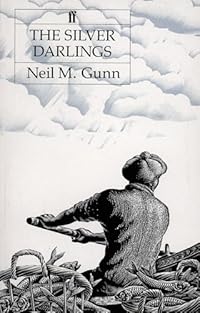
The Silver Darlings by Neil M Gunn

faber and faber, 1989, 590 p. First published in 1941. Borrowed from a threatened library.

 The Silver Darlings cover

Set just after the Napoleonic wars, this novel (one of the 100 best Scottish Books) describes the beginnings of the good times when the fishing of herring – the silver darlings of the title – brought a measure of prosperity to the villages between Brora and Wick on the seaboard of the Moray Firth. Many of these families had been cleared from Kildonan to make way for more profitable sheep and would otherwise barely scrape a living by crofting. In particular the novel focuses on Finn, the son of Catrine. The book opens with a scene where Finn’s father Tormad is press-ganged from the sea by a navy cutter. Tormad dies five days later from the blow on the head he received while resisting but this is not confirmed till Finn is a full-grown man. As a result Catrine’s relationship with accomplished fisherman Roddie is not acknowledged – even by themselves – to be what it is until the last few chapters. Incidents in Finn’s life to that point are interwoven with depictions of village life, fishing, sea voyages and the economics of the herring trade. It provided livelihoods not just for fishermen but for the local women as gutters, not to mention sundry curers, coopers, exporters and boatbuilders.

The time was one of religious revival and fervour as hardliners complained, “The Established Church of Scotland … was selling God’s kingdom for the comforts of a manse.” In the person of Sandy Ware we are given an exemplar of these strict killjoys. The austere developments are not altogether welcomed, though. Finn makes a couple of trips to the Western Isles where an old islander complains, “ – there are places in these islands where dancing of any kind is stopped by the new ministers. A terrible blight is coming upon the happiness of the human heart and upon the happiness of the world.”

In common with many Scottish novels the book contains detailed descriptions of landscape and, in this instance, seascapes. The two trips to Stornoway necessitate navigating through the notorious Pentland Firth and various accounts of storms pepper the tale.

On returning from his service in the navy one of Finn’s father’s companions on the boat that was pressed tells him, “Where all is compulsion and enforcement, it’s the bully that rules,” but it isn’t all serious stuff. We hear tell of, “Big John Angus McGrath – an elder in the church, too. Every time he took a dram, he would shake his head and say, ‘Nasty stuff! Nasty stuff!’ To my father’s knowledge he said it for over fifty years,” but the focus is mainly on Finn and the important business of growing up and making a place in the world.

Pedant’s corner:- back and fore (a northern thing, then, x2,) “the eyes in, clined to stare” (the eyes inclined,) “Youlikethatname?” (no spacing,) had entranced (no spacing,) one sharp prog (prod? ) wen (when,) “s even nets” (seven,) Cathechism, Catechism, a missing full stop, (x 4,) an unnecessary line break, couldnot speak (could not,) thier (their,) “We’ll go the Shetlands,” (go to the Shetlands,) Lock Skiport (Loch Skiport appears correctly twice later on the same page!) The spelling gunnels, rather than gunwales, is used throughout.

Read Scotland 2014 Overview

Twelve months gone and 29 books “Scottish” books read. (Or 30 if The Member and The Radical count as two; then again perhaps only 27 if A Scots Quair is treated as a single book.) That’s 2½ per month, give or take. And, if you discount the exceptions already mentioned, not a repeat author in the list.

2 were non-fiction; 4 outright SF/Fantasy; 18 were written by men (20 if the trilogy is separated) and 9 by women. (That gender disparity is lessened by 50% if you consider only authors still alive in 2014, though.)

I’m pleased to have caught up with John Galt and have already bought two more of his novels, delighted to have read A Scots Quair at last, made acquaintance with William Graham, Neil M Gunn, Carole Johnstone, Jackie Kay, Agnes Owens, Muriel Spark and Alan Spence and refound Naomi Mitchison. My main discovery, though, was Andrew Greig whose That Summer is the best book by a writer new to me (Scottish or not) since I first encountered Andrew Crumey.

My review of Kate Atkinson’s Life After Life is still to appear. See later this week, or even tomorrow.

There is apparently a Read Scotland Challenge 2015. I don’t think I’ll make 29 this year. I’ve got a lot of other reading to catch up on.

The Well at the World’s End by Neil M Gunn

Polygon, 2008, 333 p. First published 1951.

 The Well at the World’s End cover

The book starts off at a well, which appears to be dry but whose water is so transparent it is invisible. This strange encounter reminds Peter Munro and his wife Fand of an old Gaelic legend of the well in the land beyond ours, the Land of Youth. Munro sets off on a quest to see if anything remains of this well at the world’s end, to go through the human boundary (which may be an illusion.)

The novel treats of two of the triumvirate of literature’s perennial concerns – love and death, but not the third, sex – and in part reads like a series of short stories bound together as a travelogue. On his journey Munro sees The Wild Man, meets a shepherd, hears of a practical joke played out in a supposedly haunted house, is knocked out by illicit whisky distillers, witnesses a woman reinvigorating her marriage in a traditional way, facilitates young love and encounters rivalries (and a reconciliation) in neighbouring seaside towns.

While the book skirts round fantasy territory, things appearing out of mists etc, the overall treatment is realistic. The denouement brings the whole round in a circle and reintroduces fantasy overtones, inviting the reader to identify Munro with the Wild Man he glimpsed earlier but in one sense wriggles out of the conclusion which that entails.

Memorable phrases included, “A man should get away from everything occasionally, even from his wife,” “There are two things the Gael likes naked and one of them is whisky,” “We don’t drink alcohol for its reality. We drink it for the effect it creates, the illusion it engenders,” “A nod’s as good as a blink when there’s a blind salmon on the back doorstep,” and the reflection, “Every village in the Highlands, every crofting area to the farthest Western Isle, had kin in the ends of the earth, and long before world wars were the fashion.”

The text employs those impeccably Scottish words kist (spelled as cist,) widdershins and deisil (sunwards) and has Munro muse on the fact that alcohol is known as water of life in several languages, uisgebeatha, eau de vie, aqua vitae, but the Sasunnach (not having a water of life of his own) struggled to pronounce uisge and so deemed it whisky. At one point Gunn touches on the phenomenon of dual personality which has echoed through Scottish literature down the years since the Act of Union when he has Munro reflect, “as though in oneself were two quite different men, who were yet the same man.” Even without these indicators the book could not be mistaken for anything other than emblematically Scottish, though.

I confess I had to look up the phrase “agenbite of inwit,” which I had never seen before.

Pedant’s corner:- Sasunnach is an unusual spelling. “Shore up” was used in the sense of “rise up.” There was a barely brew (barley,) an unpredictible, doppleganger, genuiness and a failure of subject to verb agreement in “his knees, his whole body, was trembling finely.”

free hit counter script