Archives » Michel Faber

The Apple by Michel Faber

Crimson Petal Stories. Canongate, 2011, 206 p, plus xi p Foreword.
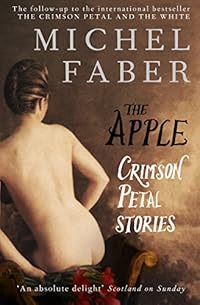
 The Apple cover

Faber’s foreword tells of the countless letters he was sent praising his novel The Crimson Petal and the White, or lamenting its inconclusive ending, the entreaties he received to let his readers know what happened next. This volume contains stories featuring characters who appeared in the earlier book (which I have not read, but did watch the television adaptation) but only those tales that demanded to exist. The rest he had to let slip away.

It has to be said that, here, Faber’s writing is masterful. In a few deft strokes he conjures up the times he is writing about and the characters he depicts.

Christmas in Silver Street sees sixteen year-old but nevertheless experienced prostitute Sugar give little Christopher, the brothel’s drudge of a linen-fetcher, a surprise Christmas gift of chicken and pastries.
In Clara and the Rat Man Clara has fairly recently been reduced to prostitution by an insensitive reference from a former employer. The Rat Man, a veteran of the Afghan War gives her a shilling a week to grow the nail of her middle finger and, once it has grown, ten more to insert it in a particular place while his dog is engaged in pit ratting.
Miss Emmeline Curlew’s father worries that if she doesn’t marry while young she never will, as she has inherited his aquiline nose, long face and strong jaw. Along with a photograph, Chocolate Hearts from the New World are an addition to the courteous reply upon which she muses after receiving it from a US slave owner (a contrast to the usual vitriol directed to her) to her entreaties to give up slavery.
The Fly, and its Effect upon Mr Bodley is the tale of the discomfiture of that gentleman who is unmanned by the memory of a fly landing on the buttock of a prostitute displaying herself as he decided which orifice he preferred to penetrate, a discomfiture two days later in the same house in Fitzrovia unallayed by the allures of a new girl, whose name is Ping or Pang but whom the establishment calls Lily, whom they are teaching English starting with the essentials (a four letter word of course.) Mr Bodley is prevailed on to sleep things off but is unprepared, “‘I can’t sleep without a nightgown. It’s not natural.’”
In The Apple, Sugar is awoken by an evangelist singing beneath her window. She observes the singer with a child and is enraged by the blow the child receives from her carer after she drops the apple she has been given. This prompts Sugar to rush out to remonstrate but the pair have gone. This along with Sugar’s perusal of the latest Trollope novels and penny dreadfuls makes her resolve to seize her chance of escape should it arise. It is counter-intuitive (brave?) for an author to include the thought that Sugar has about reading as “an admission of defeat …. it shows that you believe other lives are more interesting than yours. All of it is trickery, a Punch and Judy show for the gullible masses.”
William Rackham hopes his Medicine does not contain morphine or cocaine as he ingested other narcotics just an hour before. Sitting at his desk he recalls the way his life was turned upside down by Sugar.
A Mighty Horde of Women in Very Big Hats, Advancing is narrated by an old man in a care home in the nineteen nineties. He was born the day Queen Victoria died and brought to England from his home in Australia in early 1908. At his new school he falls foul of the unwritten codes of English life. “That’s Britain for you … how much unease can be generated out of bloody nothing.” He remembers the day of a huge suffragette march in June 1908. In what might be seen as Faber’s riposte to those who questioned Crimson Petal’s ending. “I do understand how maddening it is to get so far, and not know what happened next.” The narrator’s mother Sophie had once revealed to him she had been taken away from her home by her governess, a Miss Sugar, because she had felt unsafe there. “Life defies our intentions to be rational; it misleads and teases us until we are driven to do foolish things.” He also berates the reader’s tendency to bring sex into everything. Born one day earlier he’d have been a Victorian, “And you know what those Victorians were like.”

After reading the stories in The Apple we know exactly what those Victorians were like.

Pedant’s corner:- “the Virginias” (in 1850? Didn’t Virginia only split into two States once the US Civil War began in 1861?) “‘I had to go see my father’” (go to see,) “outside of” (outside, no ‘of.’) “Go play with” (go and play with,) “came to nought” (naught. The sense is ‘nothing,’ not ‘zero.’ There is a difference.) Some missing commas before direct speech, “prime minister” (Prime Minister.)
Under the Skin by Michel Faber

Canongate, 2014, 300 p. One of the 100 best Scottish Books. Also in the Scotsman’s 20 Best Scottish Books.

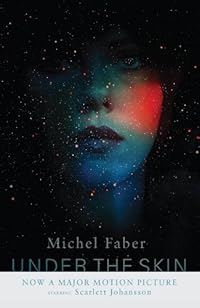
 Under the Skin cover

Well this is an odd tale. A woman named Isserley trawls up and down the A9 between Tain and Dunkeld searching for male – and only male, well-muscled at that – hitchhikers to pick up. The narrative is mostly from Isserley’s viewpoint but small interludes are given to the thoughts of her various pick-ups. She calls their species vodsels and it soon turns out she has been surgically modified – apparently to make her more attractive to these males – and has the intent to drug them via a concealed apparatus under the front passenger seat of her battered looking car. She then takes them back to a farm where members of her own species (which she of course knows as human) “process” them. Her backstory as a beautiful young woman betrayed by richer young men and plucked from a miserable existence in “the Estates” to undergo the mutilations which have rendered her acceptable to vodsel eyes (at least on brief scrutiny) is given a lot of space. However, other than the unsavoury nature of the job Isserley would have had to perform there (to produce oxygen from filth) no more detail is given about these Estates than that they are to be avoided at almost any cost.

Granted, the book is set in Scotland and Faber lives in the Highlands but apart from occasional descriptions of scenery (which, admittedly is a pronounced trait in Scottish literature) there isn’t anything particularly Scottish about it. The book’s other flaws also lead me to wonder why it should appear on that list of 100 “best” Scottish books. Apart from their sexual and economic dynamics, portrayed as more or less the same as that of us vodsels, we learn almost nothing about the species to which Isserley belongs to except that their planet is short of oxygen, water and living space, they have a fondness for vodsel meat, a reverence for creatures who walk on all fours, and their general appearance. Their ships are apparently capable of moving into and out of what is in effect a barn without anyone in the wider world noticing. The attractiveness of Earth as a planet to her species, broad skies, open water, water falling from the sky, is made plain though.

Isserley has learned English mostly from television programmes but lately she reflects, “there was no point trying to orient yourself to reality with television. It only made things worse.” She avoids contact with the Police by always travelling well below the speed limit and avoiding flashing blue lights but, even if she is careful to determine the (lack of) marital and employment status of her victims before drugging them, it does stretch credulity that she can pick up and remove from their everyday lives so many people from such a relatively small area in such a short time – she sometimes picks up two a day – without causing some sort of official concern.

Despite its Science-fictional scenario, like Faber’s later The Book of Strange New Things, this, his first published novel, fails to hit the SF buttons square on. It does contain some fine writing at the level of the sentence and garnered a lot of praise when it came out but I found myself unable to discern what purpose Faber had in mind when conceiving it. I couldn’t avoid the feeling that there is less to Under the Skin than meets the eye.

Pedant’s corner:- “as if her perfectly sculpted little nose had indeed been sculpted” (two “sculpted”s in close proximity,) “cruising safely off the bridge at the far end” (cruising safely off the far end of the bridge,) “All was not necessarily lost though.” (Not all was necessarily lost,) “it was no place for a claustrophobic” (the noun is claustrophobe,) hingeing (makes sense for a Scottish writer to spell it this way as hinging is Scots for [non-judicial] hanging.)

My 2015 in Books

This has been a good year for books with me though I didn’t read much of what I had intended to as first I was distracted by the list of 100 best Scottish Books and then by the threat to local libraries – a threat which has now become a firm decision. As a result the tbr pile has got higher and higher as I continued to buy books and didn’t get round to reading many of them.

My books of the year were (in order of reading):-
Bring Up the Bodies by Hilary Mantel
Electric Brae by Andrew Greig
The Thousand Autumns of Jacob de Zoet by David Mitchell
Station Eleven by Emily St John Mandel
Europe in Autumn by Dave Hutchinson
Traveller of the Century by Andrés Neuman
The Affair in Arcady by James Wellard
Flemington and Tales from Angus by Violet Jacob
The Book of Strange New Things by Michel Faber
Ash: A Secret History by Mary Gentle
Young Adam by Alexander Trocchi
Song of Time by Ian R MacLeod
The Gowk Storm by Nancy Brysson Morrison
The Bridge Over the Drina by Ivo Andrić
To Kill a Mockingbird by Harper Lee
Fair Helen by Andrew Greig
The Dear, Green Place by Archie Hind
Greenvoe by George Mackay Brown
The Tin Drum by Günter Grass
Europe at Midnight by Dave Hutchinson
The Cone-Gatherers by Robin Jenkins
A God in Ruins by Kate Atkinson
Go Set a Watchman by Harper Lee
Born Free by Laura Hird
We Are All Completely Beside Ourselves by Karen Joy Fowler

If you were counting that’s 25 in all, of which 15 were by male authors and 10 by women, 8 had SF/fantasy elements and 11 were Scottish (in the broadest sense of inclusion.)

Reading Scotland 2015

A lot of my Scottish reading this year was prompted by the list of 100 best Scottish Books I discovered in February. Those marked below with an asterisk are in that 100 best list. (In the case of Andrew Greig’s Electric Brae I read it before I was aware of the list and for Robert Louis Stevenson his novella was in the book of his shorter fiction that I read.)

Electric Brae by Andrew Greig*
A Sparrow’s Flight by Margaret Elphinstone
The Guinea Stamp by Annie S Swan
The Girls of Slender Means by Muriel Spark
The White Bird Passes by Jessie Kesson*
Attack of the Unsinkable Rubber Ducks by Christopher Brookmyre
Buddha Da by Anne Donovan*
Flemington by Violet Jacob*
Tales From Angus by Violet Jacob
Annals of the Parish by John Galt
The Book of Strange New Things by Michel Faber
Change and Decay in All Around I See by Allan Massie
The Hangman’s Song by James Oswald
Wish I Was Here by Jackie Kay
The Hope That Kills Us Edited by Adrian Searle
Other stories and other stories by Ali Smith
Young Adam by Alexander Trocchi*
The Gowk Storm by Nancy Brysson Morrison*
No Mean City by H McArthur and H Kingsley Long*
Shorter Scottish Fiction by Robert Louis Stevenson*
The Expedition of Humphry Clinker by Tobias Smollett*
Girl Meets Boy by Ali Smith
Fair Helen by Andrew Greig
The Dear, Green Place by Archie Hind*
Fur Sadie by Archie Hind
Greenvoe by George Mackay Brown*
Stepping Out by Cynthia Rogerson
Open the Door! by Catherine Carswell*
The Silver Darlings by Neil M Gunn*
Scotia Nova edited by Alistair Findlay and Tessa Ransford
After the Dance: selected short stories of Iain Crichton Smith
John Macnab by John Buchan
Another Time, Another Place by Jessie Kesson
Consider the Lilies by Iain Crichton Smith*
The Thirty-Nine Steps by John Buchan*
Poems Iain Banks Ken MacLeod
Mistaken by Annie S Swan
Me and Ma Gal by Des Dillon*
Tea with the Taliban: poems by Owen Gallagher
A Choosing by Liz Lochhead
The Cone Gatherers by Robin Jenkins*
Born Free by Laura Hird*
the first person and other stories by Ali Smith

That makes 42 books in all (plus 2 if the Violet Jacob and Archie Hind count double.) None were non-fiction, 3 were poetry, 2 SF/Fantasy, 19 + (4x½ + 3 doublers) by men, 13 + (3 doublers and 1 triple) by women, 2 had various authors/contributors.

The Saltire Scottish Book of the Year Award

This award is supported by Creative Scotland.

This year’s winner and the Saltire Scottish Fiction Book of the Year surprised me.

It was The Book of Strange New Things by Michel Faber (whose name Sally Magnusson on Reporting Scotland pronounced as Michael. Is that how he does so?)

My review of it is here.

The Book of Strange New Things by Michel Faber

Canongate, 2014, 592 p

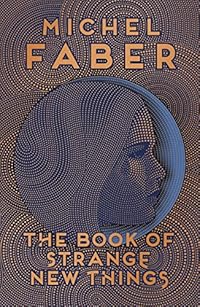
 The Book of Strange New Things cover

Despite having Dutch nationality, Michel Faber, by virtue of living in Scotland for 20 years and being published here, appears on the list of 100 Best Scottish books with his first novel, Under the Skin. That’s gone on my tbr list but I read this as it was one of the nominees for the Clarke Award this year.

Pastor Peter Leigh has been taken on by a mysterious company called USIC to become a missionary to the indigenous inhabitants of the planet Oasis. (This is a strange place with a day, and hence also a night, that each last 72 hours but, as described here, has a not very diverse ecology.) The selection process meant that Peter’s wife Beatrice – also interviewed by USIC – did not accompany him but they are able to write to each other via a communication device known as the Shoot.

Importing material from Earth to Oasis is very costly indeed and the base depends to a large extent on the Oasan crop, whiteflower, which (handily) can be converted to various Earth-like foods when harvested at different stages of its cycle. However the aliens (of whom we only hear of one group) have moved away from the USIC base and Peter has to spend over an Oasan day out of contact in order to further his mission. His immersion in this task leads to a gradual estrangement both from the humans at the base and from Bea.

The religious missionary to another planet concept may be new to mainstream readers of Faber’s work but Science Fiction readers have been on this sort of territory before; most notably with A Case of Conscience and The Sparrow, however here the crisis of conscience that interaction with aliens usually engenders in the missionary is undergone not by Peter but by Bea left at home on an Earth where various disasters – to the Maldives, Guatemala, Pakistan and a Britain falling apart economically and socially (along the way Tesco’s goes bust; I read this book a few weeks after my local Tesco’s closed) – are occurring and the couple’s cat Joshua comes to a sticky end.

Another unusual feature here is that the locals are actually avid to learn about Jesus and to hear from the King James Bible (the Book of Strange New Things as they call it.) The slow unravelling of their need for this good news holds what little SF tension the book provides. Faber is more interested in the aliens’ effect on Peter and the deterioration of his relationship with Bea. Faber renders the Oasans’ inability to pronounce the “s” “t” and “ch” sounds in English by using symbols (easily decipherable in context.) He then gives us Peter’s final speech to them almost entirely in these symbols but I wasn’t engrossed enough to try to decode them.

As a novel of how distance can undermine a relationship this is fine but, despite the aliens, it doesn’t really hit the SF buttons.

Pedant’s corner:- tourniquetted (tourniqueted?) imposter (impostor,) after a some hesitation, “glotch of submersion into the liquid-filled crib” (glotch seems to be a coinage, it doesn’t conform to the definition I found in the urban dictionary.) The text is full of Usianisms – lonesome, Styrofoam, Band-Aids, Caucasian, trunk, Cub Scout rather than just Cub, but uses British spellings, eg foetus. There is a reference to cameras with film in them (to be fair technology seems not to work well on Oasis) and to Georgia being in the Russian Federation as opposed to an independent state. I noted frequent instances of “seconds (or minutes) later” and a few of “within minutes/seconds.”

The Clarke Award for 2014

Hot from the BSFA website, here’s the shortlist:-

The Girl With All The Gifts – M.R. Carey (Orbit)
The Book Of Strange New Things – Michel Faber (Canongate)
Europe In Autumn – Dave Hutchinson (Solaris)
Memory Of Water – Emmi Itäranta (HarperVoyager)
The First Fifteen Lives Of Harry August – Claire North (Orbit)
Station Eleven – Emily St John Mandel (Picador)

I’ve read four of these! I’m delighted to see both Emmi Itäranta and Emily St John Mandel (who missed out on BSFA Award nominations) on this list.

free hit counter script