Posted in Bridges, Fife, Scenery at 12:00 on 1 April 2020
The Back Burn runs through the Balbirnie Estate on its way from the East Lomond round Markinch and on to the River Leven near Methilhill. It’s good for walks – even when you’re not cooped up by a lockdown.
After wandering under the A 92 and through a wooded glen it runs past the eighteenth hole of the golf course built over half of the estate:-

Then down a cobbled slope:-

Under a bridge:-

On:-

And on:-


Before swinging under another bridge to make a turn under Stob Cross Road across to the railway line and down the east of Markinch:-

One of the things you might not expect to see in Fife but is present in the estate is a Giant Redwood tree:-

There’s a wildlife pond between the boarded path and the redwood as seen from near the burn:-

Balbirnie Estate has a lot of rhododendron plants. They’re just about on the point of coming into flower this year. This was from 2019:-

No Comments »
Posted in Fife, War Memorials at 12:00 on 22 January 2020
I posted some photographs of the nearest War Memorial (Markinch) to Son of the Rock Acres here. I did not at the time post details of the dedications.
Great War dedication, “To the glory of God and in memory of the men from Markinch who laid down their lives in the Great War 1914 – 1919” below carved figure of St George.

World War 2 dedication, “Remember also those who laid down their lives in the Second World War 1939 – 1945,” plus names of the fallen below carved figure of St Drostan:-

Surround stones. These display the names of the Great War dead on their internal faces:-

No Comments »
Posted in Fife, History, War Memorials at 12:00 on 8 January 2020
Field Marshal Earl Haig‘s family were the proprietors of Haig whisky. Their Ramornie House was near the town of Ladybank (see the two previous posts) and even had their own waiting room at the local Railway Station, though it was built by a previous onwer of the Ramornie Estate.
Their whisky distillery was a few miles away in Markinch.
There are two memorials to the Field Marshal in Ladybank.
Haig Memorial Gates, Ladybank. The inscription reads, “These pillars and chains were erected by the ex-service men of Ladybank and district to the glorious memory of Field-Marshal Earl Haig.” Ladybank War Memorial is in the background:-

The Haig Memorial Garden lies behind Ladybank’s War Memorial. This is how the garden looked in 2018:-

Information Board, Haig Memorial Garden:-

A plaque on the wall gives the information that the gardens were refurbished in 1993 and re-opened by Menzies Campbell, then the local MP:-

No Comments »
Posted in Architecture, History at 12:00 on 28 July 2019
I’ve posted photos of St Drostan’s – aka Markinch Parish Church – before.
The kirk has a twelfth century tower. Archæological investigations have been ongoing recently resulting in this information board showing its possible construction and some details of the stonework.

A very short discussion on the archæological findings is here.
At the top of the entrance steps up to the kirk is an outbuilding, I think it’s the Session House, which has this unusual windowed niche in it. I think the crown above it represents some sort of royal connection:-

No Comments »
Posted in Architecture, Art Deco at 20:00 on 27 July 2019
This is kind of hidden away in Commercial Street, Markinch. If you drive straight through the town from either of its entrances you won’t see it as it’s on a street that goes between those two main roads.
J Hastie. Scottish Craft Butcher. Rule of three in upper windows, curved shop windows. It is still a functioning butcher’s:-

Other angle:-

Curved windows:-

No Comments »
Posted in Architecture, Art Deco at 20:30 on 25 July 2019
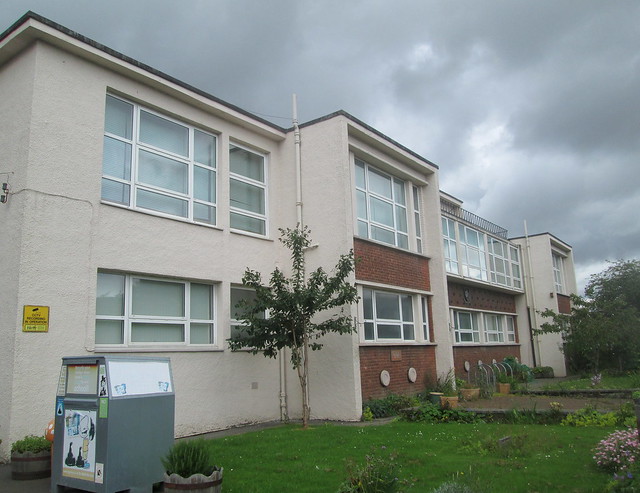
Markinch is the town nearest to Son of the Rock Acres. It’s a bit bigger than a village. Big enough to have a reasonably large Primary School which has some Art Deco styling.
I suspect, though, it was built in the 1950s when there was still a hangover of Deco style from pre Second World War days.
I took care to photograph it in summer when there were no children around.
Markinch Primary School from John Dixon Park:-

Seen from northwest. Rule of three in windows, brick “portholes”, flat roof, square chimney tower:-

West side Close-up:-

North side from northeast. Porthole window, canopy, rectangular chimney block, metal railing on wall, metal gate:-

Old “boys” entrance. Canopy with porthole window above, frieze:-

South side from southeast. Canopy, porthole window. Old “girls” entrance.

East side. Rule of three in some windows. White “portholes”:-
No Comments »
Posted in Fife, History at 12:00 on 21 February 2019
A project to resurrect the mediæval Fife Pilgrim Way is now well in hand.
There were two main routes across the county (or kingdom as the locals still refer to it at times,) starting at Culross and North Queensferry and ending up at St Andrews.
The ancient route went through the nearest small town to Son of the Rock Acres, Markinch, the ancient capital of Fife.
There are some hopes the restored route(s) will bring modern day pilgrims (and other tourists) to the town.
A year or so ago there was an information day about the Pilgrim Way at St Drostan’s church. On display were several representations of monastic and pilgrim life, rendered in knitwear.
Trees and pilgrims:-

Church:-

Monks:-
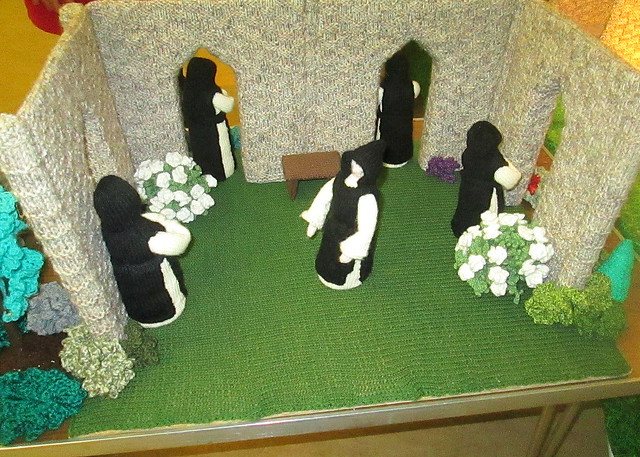
Monks’ garden:-

Monastery vegetable patch:-

No Comments »
Posted in Architecture, History at 12:00 on 13 February 2019
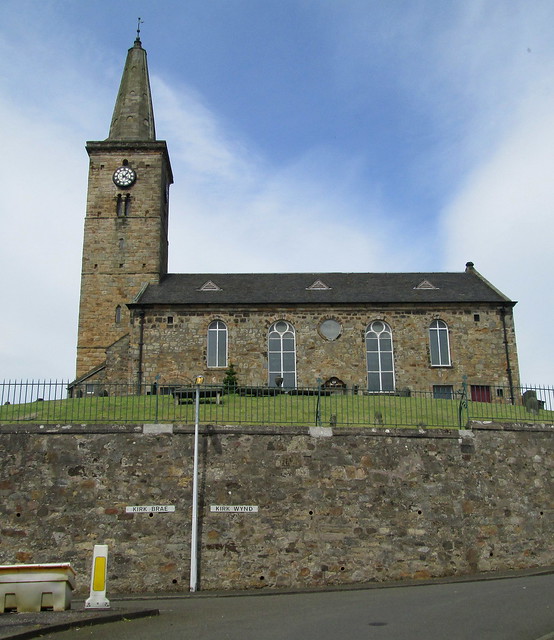
Markinch is the nearest small town to Son of the Rock Acres. It was once the capital of Fife where in mediaeval times justice was administered. Its most prominent landmark is St Drostan’s Church whose tower dates back to the 12th century.
St Drostan’s in the snow:-

St Drostan’s from Glass Street:-
No Comments »
Posted in War Memorials at 19:53 on 17 February 2014
The plaque on this side, nearest the road, commemorates the First World War. The individuals’ names are set into the stone plinths surmounting the surrounding walls.

The plaque on the far side commemorates the Second World War and incorporates the names of the fallen of that war, including a woman from the ATS – perhaps a ferry pilot.

Edited to add: I’ve now had a chance to look at the Scottish War Memorials Project and it says that Betsy L Wyse was a private in the Auxiliary Territorial Service.
No Comments »
