Archives » India

Sunderland Memorial Wall

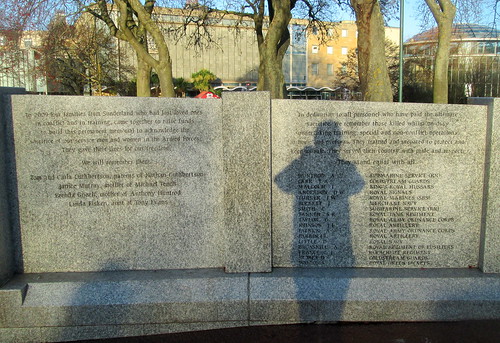
Between Sunderland War Memorial and Mowbray Park a memorial wall has been erected to commemorate those who have served in conflicts since the Second World War and to honour Sunderland’s post-World War 2 fallen.

The first section commemorates non-combat deaths in war:-

War Memorial Wall, Sunderland

The rest of the wall is a sobering reminder of the many conflicts in which British soldiers have lost their lives since 1945.

Palestine and India:-

Palestine and India Memorial Wall, Sunderland

Malaya and the Cold War:-

Malaya and Cold War Memorial Wall, Sunderland

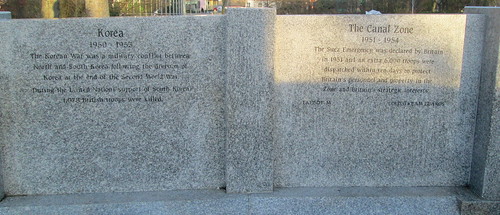
Korea and the Canal Zone:-

Korea and Canal Zone Memorial Wall, Sunderland

Kenya and Cyprus:-

Kenya and Cyprus Memorial Wall, Sunderland

Aden, Radfan and Suez:-

Aden, Radfan and Suez Memorial Wall, Sunderland

Borneo, Northern Ireland and Oman Dhofar:-

Bornoe, Northern Ireland, Oman Dhofar Memorial Wall, Sunderland

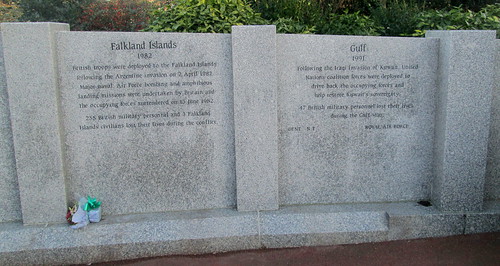
Falkland Islands and Gulf War:-

Falkland Islands, Gulf War, Memorial Wall, Sunderland

Bosnia, Kosovo, Sierra Leone:-

Bosnia, Kosovo, Sierra Leone Memorial Wall, Sunderland

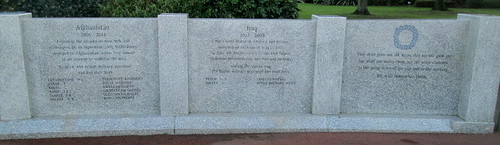
Afghanistan and Iraq, plus Ode of Remembrance:-

Afghanistan and Iraq Memorial Wall, Sunderland

The Menin Gate (ii)

Exterior Walls on upper level; all covered in names:-

Menin Gate Exterior Wall

As are the walls on the stairs down to the road level:-
Menin Gate Stairs

In the upper garden area are two memorials to British colonial troops.

Nepalese Memorial by Menin Gate:-
Nepalese Memorial by Menin Gate

India in Flanders Fields Memorial by Menin Gate:-
India in Flanders Fields Memorial by  Menin Gate

Individual Indian and Burmese soldiers’ names on the Gate:-
Menin Gate, Indian and Burmese Names

Deep River by Shusaku Endo

Peter Owen, 1994, 220 p. Translated from Japanese by Van C Gessel.

Deep River cover

I read Endo’s Silence (published 1966) and The Samurai (1980) years ago now but this is the first book of his I have read since. Endo’s writing is unlike most Japanese authors in that it is coloured by his Christianity, specifically Roman Catholicism. Silence dealt directly with the missionary times in Japan, The Samurai with the cultural differences between Japan and “the West.”

Deep River engages with yet another culture, that of India, mainly following a group of Japanese tourists there ostensibly to visit Buddhist sites but each of whom has his or her own concerns. Isobe has lost his wife to cancer but on her deathbed she whispered she was convinced she would reincarnate; he has learned of a possible candidate in India. Mitsuko has a connection to Ōtsu, a man she tormented in her college days who is now doing good works in Varanasi (the book spells this city’s name as Vārānasī throughout.) Numada is a children’s writer who wants to set free a myna bird as an act of restitution. Kiguchi is haunted by his experience on the Highway of Death in the retreat from Burma and wishes to have a reconciliatory memorial service to the fallen of both sides.

(Aside:- It is perhaps understandable that little of the hideousnesses that Kiguchi remembers from the retreat is remarked on in non-Japanese writings. In the aftermath of an ill-advised offensive which duly went wrong the soldiers were left to their own devices and suffered accordingly. But then even in their good times Japanese soldiers were notoriously ill-served by their superiors. In retreat they were just forgotten.)

While the first part of the book chronicles the back-stories of the four main characters it is India that is the true centre of the novel. All four encounter the overpowering nature of that country. The deep river is not only the Ganges at Varanasi but the mass of humanity. Yet even here Endo’s Catholicism makes itself felt. Ōtsu has his own particular take on theology, failing his seminary education by being unable to accept European views and seeing God in all religions not exclusively in one. Nevertheless he clings to what he sees as his Christian beliefs.

The trip coincides with Indira Gandhi’s assassination. This coupled with his experiences on the Highway of Death makes Kiguchi come to the somewhat jaundiced conclusion that, “It was not love but the formation of mutual enmities that made a bonding between human beings possible.”

While the manifestations of Japanese, and indeed Indian, culture may appear odd to western eyes, reading books like this shows that at their hearts people really do not vary much the world over. Here it is religion that is the biggest estranging factor.

Refreshingly the translation is into British English but there were some entries for Pedant’s Corner:- négligé (négligée,) when he laid (lay) in wait, her name in Rajini (is,) when… gets me alone this (like this,) resembling that of his dead wife’s (a possessive too far,) we’d better just lay low (lie,) of the the taxi, “a harmonium, an instrument resembling a harmonica” (it isn’t clear whether this is supposed to mean two different instruments or if a harmonium resembles a harmonica – which it doesn’t,) to eat they daily bread (their.)

Sing, Lofty!

You may have noticed on the clip from 1975 of The Sweet’s Action I posted a week or so back that at no 27 on the charts that week was a duo called Windsor Davies and Don Estelle.

The song concerned was Whispering Grass and since the act featured someone dressed up as a sergeant-major and a diminutive soldier in a solar topee it would seem to be one of the unlikelier hits of that – or any – year. The song, though, reached number one and stemmed of course from a TV show; the sitcom, It Ain’t Half Hot, Mum. Unlike Dad’s Army, with whom it shared the writing team of Jimmy Perry and David Croft, It Ain’t Half Hot, Mum does not benefit from constant repeats but mention it to anyone who watched British television in the 1970s and they’ll be able to reel off the characters’ names instantly (or the major ones anyway.)

The show featured:-
Bearer Rangi Ram
Gunner (later Bombardier) Beaumont, aka Gloria.
Sergeant-major Williams, “Shuuuuut Uuuuup!”
Gunner Parkin, aka Parky. (“You’ve a fine pair of shoulders there, boy. Show ’em off. Show ’em off.”)
Mr Lah-di-dah Gunner Graham, aka Paderewski.
Gunner Sugden, aka Lofty.
Colonel Reynolds.
Captain Ashwood.
Char Wallah Mohammed.
Punkah Wallah Rumzan.
Gunner Mackintosh, aka Atlas.
Gunner Clark, aka Nobby.
Gunner Evans, aka Nosher.
And from the first few series, Bombardier Solomons, aka Solly.

It Ain’t Half Hot, Mum was an ensemble comedy on the usual Perry and Croft lines (not only Dad’s Army but also Hi-de-Hi and You Rang M’Lord; Croft also co-wrote ‘Allo ‘Allo) and featured the (mis)adventures of a Royal Artillery Concert Party in the Far East during the Second World War.

The casting of Michael Bates as Rangi was criticised even at the time as people felt an Indian actor would have been more appropriate. Yet Michael Bates was born in India – and spoke Hindi before he learned English – and was well versed in Indian culture. The paucity of Indian actors in Britain at the time is shown by the few who regularly turn up in bit parts: some actors playing several different characters over the show’s eight series.

That the show has not been repeated ad nauseam in the way that Dad’s Army has is perhaps due to the fact that it is now held to be racist, or at least non-pc. Indeed even as late as April of this year BBC bosses have decided that the show will never be re-run for that reason. Yet given its setting (Deolali, India, 1945, and later up the jungle in Burma) racist language or attitudes are hardly to be wondered at.

The 1940s were not pc. The Raj was not pc. Quite how this supposedly excessive racism can be squared with the fact that the British are uniformly ineffectual – the officers are idiots, the concert performers woeful except for the singing of Gunner Sugden, the sergeant-major is a bit thick and continually frustrated in his efforts to make his charges soldierly – while the Indians, especially Rangi and the Punkah Wallah, who has perhaps the best lines in the show (most contributed by Dino Shafeek who played the Char Wallah) are obviously more intelligent and frequently get the better of their colonial masters, is difficult to fathom.

An irony here is that one of the original performers of Whispering Grass was the group The Inkspots whose name is itself arguably racist from today’s perspective.

Another factor in the long, and now seemingly permanent, absence of the series from the small screen may be that sergeant-major Williams frequently refers to the concert party under his charge as “nancy boys” or “poofs,” mouthing this last in the closing sequence and, from series 3 on, even in the opening titles. Again, a sergeant-major in 1945 would undoubtedly have done this. To represent it is only being true to the historical record.

Confession time. The good lady and I ordered the full series set of DVDs of It Ain’t Half Hot, Mum as a Christmas present to ourselves and are steadily working our way through it. We’ve reached series 6. I have to say it’s still funny.

If you want to check them out various excerpts from the show are available on You Tube.

Anyway, here are the said Windsor Davies and Don Estelle from the Christmas Top of the Pops of 1975.

Sing, Lofty!

Windsor Davies and Don Estelle: Whispering Grass
The Dervish House by Ian McDonald

Gollancz, 2010. 472p.

After Africa (Chaga – aka Evolution‒s Shore -, Kirinya and Tendeleo’s Story,) India (River Of Gods, Cyberabad Days) and Brazil (Brasyl), in The Dervish House McDonald now turns his attention to Turkey: specifically Istanbul.

The novel is set several years after Turkey has finally gained EU membership and joined the Euro (perhaps a somewhat more remote possibility now than when McDonald was writing) in an era when children can control real, mobile, self assembling/disassembling transformers and adults routinely use nanotech to heighten awareness/response in much the way they do chemical drugs at present. The fruit of what may have been a prodigious quantity of geographical and historical research is injected more or less stealthily into the text.

The main plot is concerned with a terrorists group’€™s plans to distribute nano behaviour changing agents designed to engender a consciousness of mysticism, if not of the reality of God/Allah. The resultant, what would otherwise be magic realist visions of djinni and karin, is thereby given an SF rationale.

In the interlinked narratives of those who live in and around an old Dervish House in Adam Dede Square, and covering events occurring over only four days, there are subplots about contraband Iranian natural gas, corrupt financial institutions and insider dealings, the circumscription of non-Turkish minorities, tales of youthful betrayal and frustrated love, not to mention the discovery of an ancient mummy embalmed in honey, which last gives the author the opportunity to deploy a nice pun on the phrase honey trap. The usual eclectic McDonald conjunction of disparate ingredients, then, and somehow amid all this he manages to finagle football into the mix as early as page two. Fair enough, though; Turkey’s fans are notoriously passionate about the game.

While not quite reaching the heights of Brasyl or River Of Gods, The Dervish House still has more than enough to keep anyone turning the pages.

One typographical quibble: the formula for carbon dioxide ought to be rendered as CO2 rather than CO2, though. To a Chemist like me there is a world of difference between the two.

Mr. Irresponsible Strikes Again

Not content with threatening to use the atom bomb on Iran and China while he was only a Parliamentary candidate, I see our wet-behind-the-ears Prime Minister has now opened his mouth yet again only to put his foot in it.

Whatever your private thoughts, when you are in the position he is you really have a duty to temper your speech.

And moreover, to talk down (even insult) Pakistan when you are in India! It beggars belief.

On the world stage he really is a liability.

Don’t they teach them anything useful at Eton?

free hit counter script