Posted in Architecture, History, Trips at 12:00 on 18 December 2021
The land on which Chesters Fort was uncovered belonged to a man called John Clayton. His house is right beside the site of the fort:-
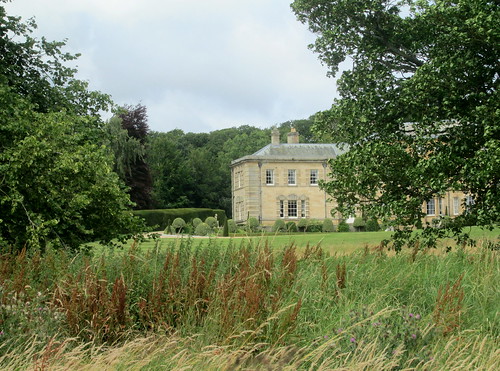
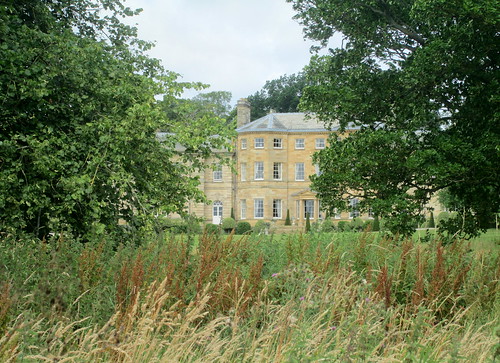
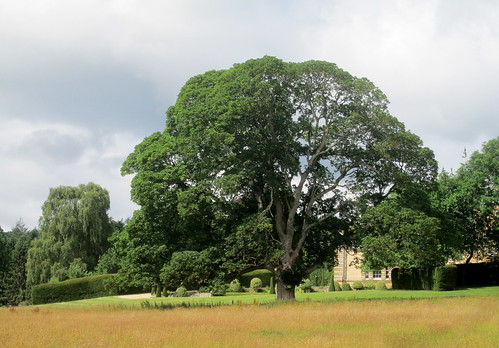
There’s some elegant topiary, not to mention a lovely tree, in its grounds:-
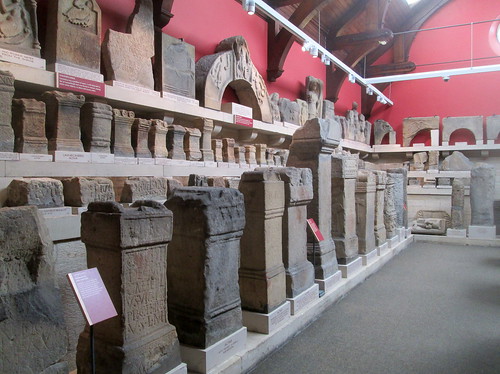
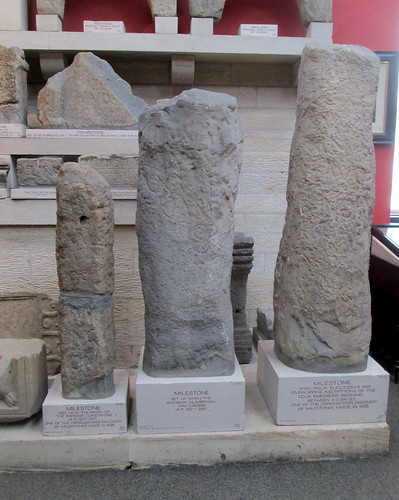
Just beyond the English Heritage entrance to Chesters Fort, past the path leading to the ruins is the Chesters Museum where many of the artefacts uncovered by the excavations are displayed.
Hadrian’s Wall Milestones:-
Statue of Juno Regina, Juno Regina was a popular deity among the Roman soldiery:-

There was a piece of soldier’s graffiti carved in the shape of a man’s genitals on one of the displayed pieces which I was going to go back to photograph. Unfortunately this was just after last year’s lockdown was lifted and a man with no mask started to cough loudly in the museum room’s enclosed space so I thought I had better make myself scarce and hence missed my opportunity.
No Comments »
Posted in Architecture, History, Trips at 12:00 on 16 December 2021
Previous posts on Chesters Fort are here, here, here and here.
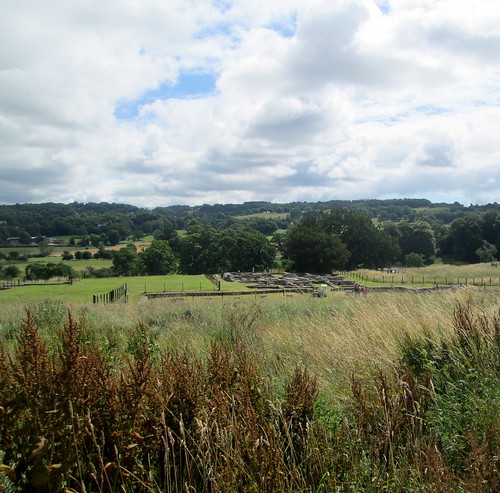
Commandant’s house from distance:-
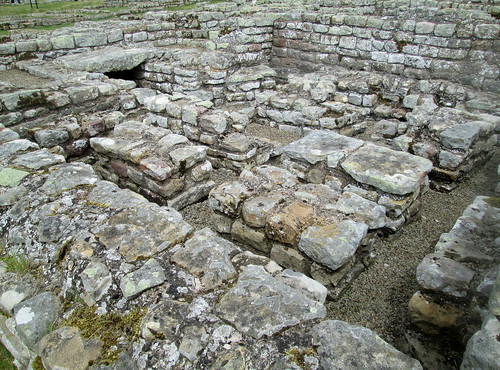
Closer view. Stacked bricks are likely part of the hypocaust (heating) system:-

Side nearest River North Tyne:-

Remains of the floor:-
These niches are part of the bath complex. I forgot to include them in the psot about the baths at Chesters:-

No Comments »
Posted in Architecture, History, Trips at 12:00 on 11 December 2021
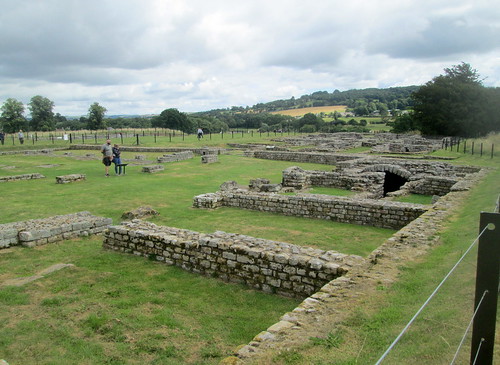
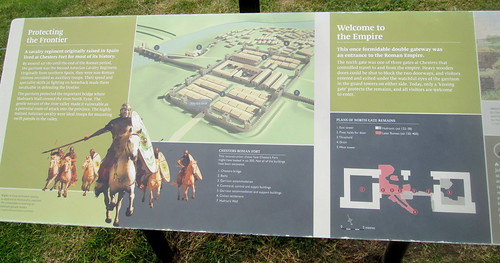
The information board shows how this would have looked in the fort’s heyday:-

It’s a little less imposing now:-


No Comments »
Posted in Architecture, History, Trips at 12:00 on 7 December 2021
See previous posts on Chetsers Fort here and here.
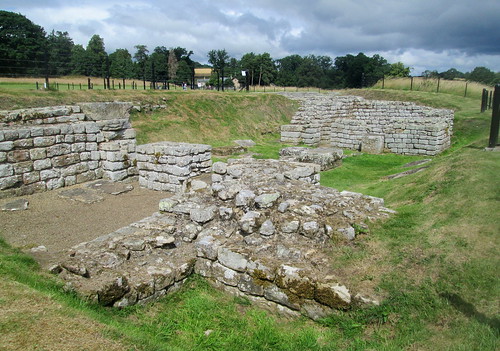
Main east gate. This is nearest the River North Tyne:-
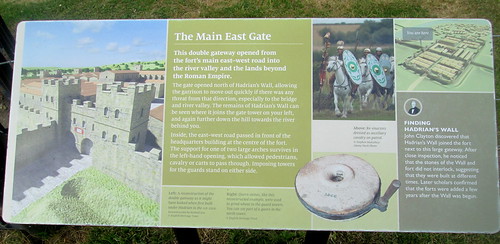
Main East Gate information board:-
West gate:-

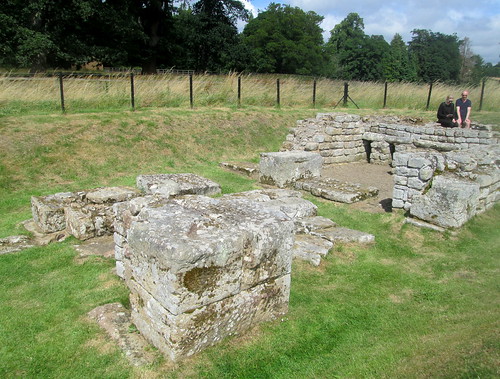
Posts; foundations for something or other:-

Vicinus houses lay outside the fort; local civilians or retired soldiers providing services to the fort would have set up houses/shops etc close by:-


No Comments »
Posted in Architecture, Bridges, History, Trips at 12:00 on 1 December 2021
The main body of Chesters Fort lies on a hill just above the river River North Tyne.
River from Chesters Fort:-

This shows the spot where a Roman bridge crossed the river:-
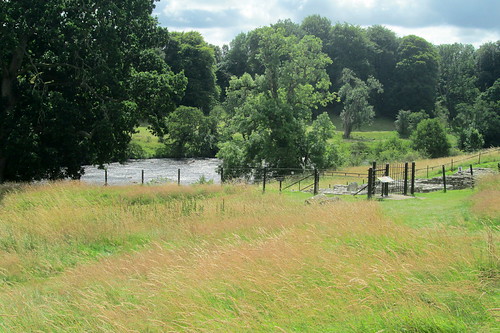
Eastern part of Hadrian’s Wall and bridge abutment:-

Closer view:-
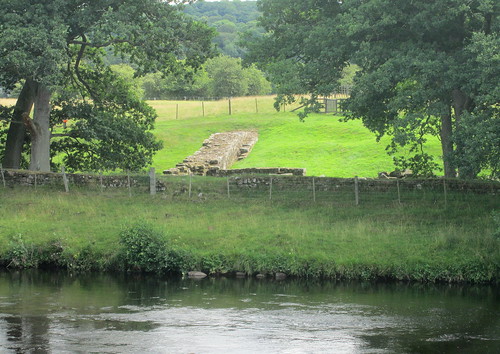
Bridge information board showing how it looked:-

Between the bridge and the fort proper you can still see a part of Hadrian’s wall:-

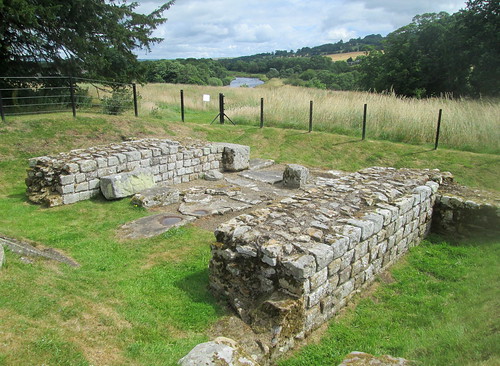
Also down by the river are the baths the soldiers used:-

Lower part of baths complex:-
1 Comment »
Posted in Architecture, History, Trips at 12:00 on 28 November 2021
Chesters Fort was one of the Roman forts stationed along Hadrian’s Wall. It lies a few miles north of Hexham, on a position commanding a crossing point on the river North Tyne.
It was a posting for a troop of cavalry originally raised in what is now Spain.
As a result the remains of the stables take up a fair bit of the site towards the entrance:


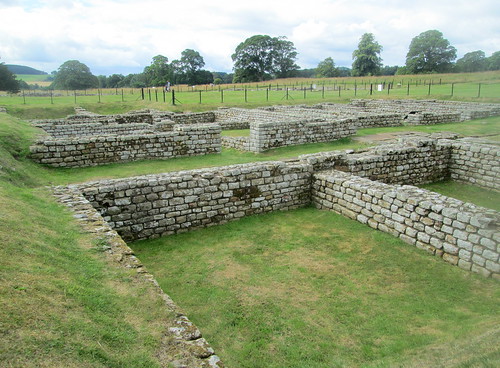

This one was taken from further up the hill, stables to left, Commandant’s House to right.
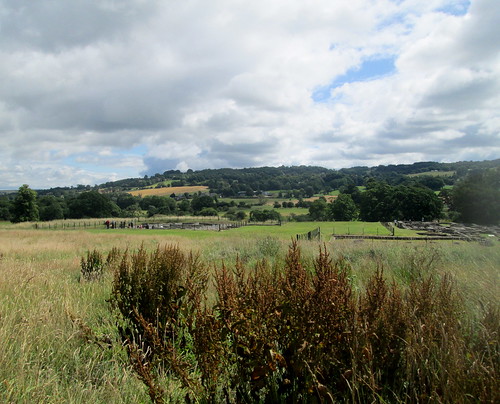
An interval tower:-

Tower at South-East Angle of fort:-

1 Comment »
Posted in Trips at 12:00 on 24 November 2021
Due to the legacy of Hadrian’s Wall the north of England is festooned with Roman ruins. They range from the reaonably large – the forts along the wall, not to mention the remnants of the wall itself – to quite small. One of the latter lies just off the B6318 at Carrawburgh, Northumberland. It is the remains of a Mithraic Temple. The B6318 runs south of Hadrian’s Wall and is very straight (see here at the Carrawburgh car park) presumably by following the course of a Roman original
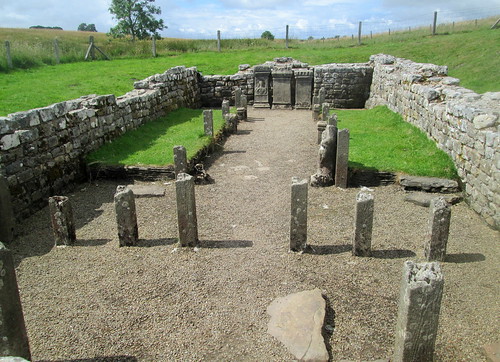
Temple from path:-

Centre isle from entrance:-
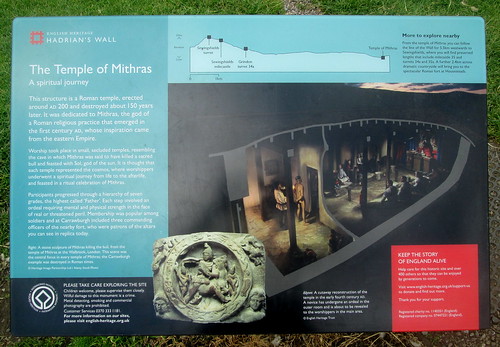
The information board has a representation of how the inside of the temple would have looked when in use:-
Altar:-
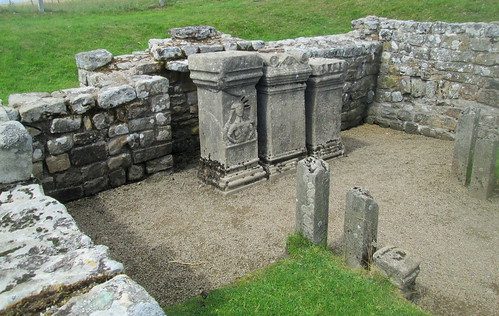
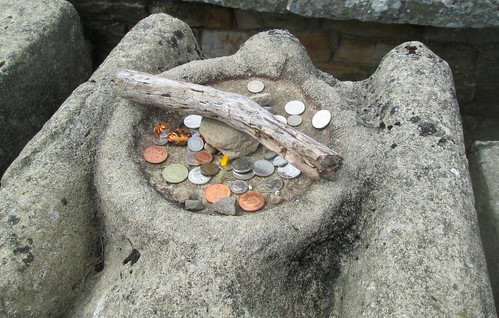
At its centrepiece the altar has a small dish which presumably was originally intended to receive votive offerings. Certainly modern visitors have been leaving coins, sweets and, for some reason obscure to me, a piece of wood:-
2 Comments »
Posted in Altered History, Harry Turtledove, Reading Reviewed, Science Fiction at 12:00 on 28 April 2013
Gollancz, 2008, 321 p.
Unlike the previous volumes in Baxterâs “Timeâs Tapestry” series which were spread over several centuries and as a result had a disjointed feel, the action in this one is spread over only a few years in the late 1930s and early 1940s. The tale is tighter and more cohesive as a consequence.
The prologue features an Irishman called OâMalley who at MIT has invented a machine he calls a âloomâ with which – with the contribution of the dreams of an Austrian Jew called Ben Kamen â he has managed to send a message back to pre-Roman Britain. It isnât long before both the loom and Kamen have been snatched by the Nazis and incorporated into their greater plan of altering history to ensure the triumph of the Reich.
The meat of the book is set in and after the invasion of Southern England by German forces once the BEF had been destroyed on the shore at Dunkirk. A hasty (and to my mind unlikely) deal by Churchill with the US sees them given military bases – US sovereign territory – south of London. As Hitler is seeking to avoid war with the US the German advance halts when they encounter these. This struck me as more of a sop to possible US readers of the book than something that would have occurred in such a scenario. The presence of a female US newspaper correspondent and her son in the cast of characters also points in this direction. A demarcation line cutting off South-East England is where the war situation settles down.
Off-stage Churchill falls as Prime Minister, to be succeeded by Lord Halifax who nevertheless continues the war – which goes on more or less as in our timeline; Barbarossa, Pearl Harbor, Stalingrad, El Alamein all get a mention, Japanâs invasion of Australia is new though. Again it may be more likely that Halifax would have sued for peace, but perhaps that would have been unthinkable with a substantial part of the UK â not just the Channel Islands â under German rule.
While Weaver can be read as a one-off with no detriment to the reading experience there are several nice touches where Baxter has his characters travel to locations which appeared in earlier books in the series; places like Birdoswald on Hadrianâs Wall and Richborough in Kent (Roman Rutupiae.)
This is the sort of thing that Harry Turtledove essays so frequently. Baxterâs characters are more rounded than Turtledoveâs generally are and the extra twist of the loom makes for an added commentary on the contingency of historical events.
No Comments »
Posted in Films at 14:00 on 14 April 2011
Off to Dunfermline for this adaptation of Rosemary Sutcliff‘s novel The Eagle of the Ninth. I don’t remember if I’ve read the book; if so it was as a child. I have a vague recall of a television production of the story in my youth but forgot all the details except that it involved the legend of the loss of a Roman legion, complete with imperial eagle, in the wilds north of Hadrian’s Wall (or would it be the Antonine Wall?)
I read recently the latest historical thinking is that the legion may never actually have been lost, just absent from the records. It might simply have been redeployed elsewhere in the Roman Empire. Still, print the legend, eh?
The film’s plot is simple. Marcus Aquila, the son of the lost (and hence disgraced) legion commander comes to Britain, is wounded, saves the life of a gladiatorial combatant who becomes his slave and the pair go off to search for the lost eagle. Cue male bonding and the dawning of mutual warmth and respect. There was a strong Breakback Mountain type of undertone towards the end.
Echoes of current imperial adventures in Iraq and Afghanistan (now add Libya?) are of course present – especially in the patrician Romans’ lack of understanding of the ways of the indigenous population.
The scenery was stunning – even if it was shot in Super Gloom-o-Vision. Lowering clouds and twilight vistas abounded. Plus lots of rain.
It may seem silly but I could have done with a little less violence; not that there was much actual blood spurting. Why must the cinema sound be so loud, though? This was particularly true of the adverts and trailers beforehand – almost deafening.
The acting was convincing enough throughout. I had never seen either of the leads, Channing Tatum and Jamie Bell before. Donald Sutherland was spectacularly ill cast, though, as Marcus Aquila’s uncle.
No Comments »

