Posted in Architecture, Art Deco, Bridges, Trips at 21:42 on 5 August 2010
Last week the good lady and I took ourselves off to North East England for a couple of days.
We’d meant to make the trip a couple of weeks ago but a certain news event there gave us pause.
We actually passed through Ponteland – which has a brick Art Deco town hall but there wasn’t an easy place to stop to photograph it – and saw signs for Rothbury. I can’t say I’d ever heard of either until early last month.
First stop was Newcastle (upon Tyne.)
Well, it was actually Gateshead where we parked adjacent to the Baltic Centre for Contemporary Art. This is the view from the west side of the building.

And this is from the Millenium Bridge.

The interior of the gallery is impressive – they’ve done a good job of converting the original flour mill but the contents left me cold.
One of the exhibits was art work by John Cage, more famous for musical compositions (or more accurately for 4 minutes 33 seconds of silence.) His pictures consisted of muddy daubs, streaks and circles. The good lady opined that he must be a genius; he can take the piss in two disciplines, music and art.
The Tomas Saraceno spider web left me cold (as did the fish tanks with spiders in them.) Cornelia Parker’s circle of squashed brass/silver instruments was quite effective – especially when viewed from the floor above.
I’ve enjoyed visits to the Scottish National Gallery of Modern Art on Belford Road, Edinburgh and its companion the Dean Gallery over the road so I’m not a complete philistine but this was distinctly underwhelming.
Then it was over the Millenium Bridge to Newcastle. The first picture is from the walkway just by the Gallery.

The second is from the Newcastle side further up the river.

I quite like modern bridges like this. The Clyde Arc (or Squinty Bridge) in Glasgow is another in similar vein.
2 Comments »
Posted in Art Deco, Glasgow at 00:21 on 21 December 2009
Here are two more pictures I’ve found (on flickr) of the building I started this series off with.


Nice ending to my sentence above, wasn’t it? Not one, but two prepositions.
This is the sort of language that, it is said, up with which Winston Churchill would not put.
No Comments »
Posted in Art Deco, Glasgow, Scotland at 22:48 on 29 April 2009
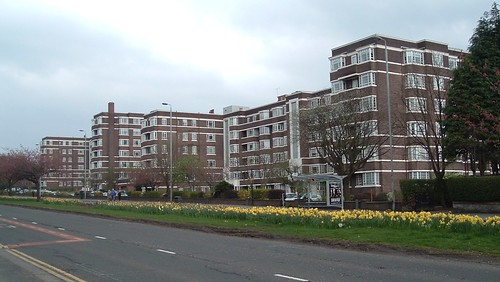

These flats are the nearest equivalent Glasgow has to the building ITV used for Poirot’s apartment in the TV adaptations (Florin Court, Charterhouse Square.)
They are on the right after you pass Anniesland Railway Bridge on the way from Dumbarton into Glasgow along Great Western Road. I passed there many a time on my way into the city when I was living in the West.
This is a close up of the front entrance of the western building:-

There is a similar entance at the western end of the frontage:-

The last photo is of the Eastern building:-

But how many of the flats inside still have internal Art Deco aspects like those in the ITV Poirot series? (Which were in any case probably mocked up in a studio.)
A picture of Kelvin Court taken in 1955, from the other side of the bridge, is at The Glasgow Story. The Ascot Cinema (no 11 in this series) nowadays lurks just to the left after the bridge but it didn’t when this photo was taken.
There are some Flickr photos of Kelvin Court here and here.
Also a composite one on the Scran website.
No Comments »
Posted in Art Deco, Cinemas, Glasgow, Scotland at 10:00 on 16 April 2009
I finally got over to Glasgow and took some (not very good) photos.
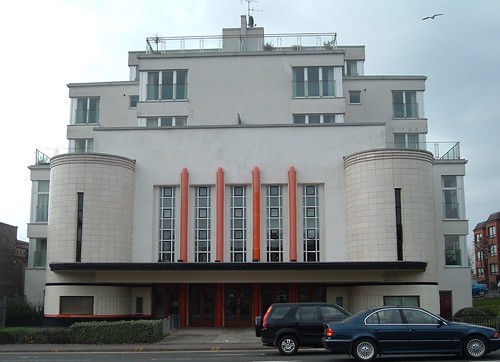
This is a former cinema now very sympathetically converted to flats.
The Art Deco/modernist styling of the conversion can also be seen in this second photo.

A better picture than either of mine is on Flickr. It helps that that one was taken in sunshine!
You can read about The Ascot’s history as a cinema at the Scottish cinemas and theatres project website. There are some nice pictures there of the building lit up at night. The historical photos there show that the orange pillars are a relatively new embellishment! They are effective, though. The foyer looks great in the black and white photos.
More information is available at The Glasgow Story where the original configuration of the roof line can be seen.
There is another good picture of the update at Cala Finance.
No Comments »
Posted in Architecture, Art Deco, Empire Exhibition, Scotland, 1938, Glasgow at 14:20 on 23 September 2008


Designed by Weddell and Inglis in 1937, the Beresford was opened to provide hotel accommodation for visitors to The Empire Exhibition of 1938 which was held in Glasgow’s Bellahouston Park.
The building is a stunner. A great example of high Art Deco. The present red on the facade may be a teeny bit over the top; I think white Art Deco buildings like this really ought to have pastel colours as highlighters, though it does look more pastelly in the close-up.
You can view the Beresford in its heyday at the Glasgow Story where it looks as if it has been somehow snatched from the streets of New York or Chicago and plumped onto Sauchiehall Street to sit rather like an alien spaceship.
Some more views including an interior shot are on this site.
For a while the Beresford had been converted to accommodation for students of Strathclyde University when it was known as the Baird Hall, at which time parts of the frontage, especially the rounded columns, seem to have been painted in a more restrained mustard colour.
As my Alma Mater (The University, as it still styles itself) is its city rival, I have to say that the chance of staying in the Baird Hall would have been the only reason to attend Strathclyde.
The building was sold on in 2003 and has now been refurbished to form 112 apartments.
Some more of its internal deco elements are on show here and there is also an apartment view.
For a 3D-ish colour sketch look no further.
There are numerous pictures of the Beresford on flickr including some night views.
What an absolute belter of a building.
No Comments »
Posted in Art Deco, Glasgow at 14:45 on 26 August 2008
For almost longer than I can remember I have been interested in the style known as Art Deco, which enjoyed its brief flurry in the inter-war years of the 20th century.
Almost the only reason for catching an episode of Poirot on TV is that you may get a glimpse of something in this style in the back- or foreground. The same is also true of the fashions worn by Geraldine McEwan in the Mapp and Lucia adaptations from quite a few years ago now. (Though I suppose both of these programmes may be enjoyed for their own sake.)
Art Deco encompassed fashion, interior furnishings, ornaments, personal items, advertising and architecture and found a lavish expression in the film musicals of the time – think Busby Berkeley or Fred and Ginger – and indeed of the Picture Palaces in which these were viewed.
Art Deco era personal items such as compacts can be beautifully stylised (with the emphasis often focused on geometry) and some of the advertising posters are stunning. However, it is in the buildings that I find an elegance and boldness which, to my mind, architecture seemed to lose until around the last 20 years or so.
Anyway, I was over on the M8 west of Glasgow in the last week of my holiday and missed the Luma building on the way up. This surprised me as it used to be a fairly kenspeckle sight from the motorway, albeit badly dilapidated.
I took special care to sight it on my return as I was worried that it might have been pulled down despite a redevelopment some years ago – when it even got a programme to itself on BBC Scotland. As it turned out the worry was unnecessary as it had only been obscured by some trees which had matured. Or else I used to make that journey in winter.
There are not, to my knowledge, all that many big Art Deco buildings left in Scotland. The Luma is a pleasing survivor.

Photo by yellowbookltd.
They’ve done an excellent job on the facade but unfortunately it has “had its eyes poked out.” (© K Skirving)
For some reason replacement windows for these buildings do not seem to be quite in keeping with the originals. Perhaps it’s something to do with double glazing but it’s a bit strange as the original manufacturer appears to be still going strong and should presumably be able to provide adequate replacements.
Apparently for the Luma they did make the effort but the result doesn’t look quite right to me. I think it’s because the original glazing on the circular tower would have been curved. The replacements comprise a series of flat windows angled to each other. Also the horizontal bars on the new windows are a touch too wide.
A short history of the building can be found at http://www.ihbc.org.uk/context_archive/65/luma/tower.html
For another colour picture see http://www.flickr.com/photos/re_teacher/35527605/
No Comments »
