Posted in Architecture, Art Deco, Glasgow at 23:33 on 28 January 2015
Two buildings I spotted on our December trip to Glasgow.
This one is on the corner of Argyle and Virginia Streets:-
This is the Argyle Street elevation:-
And this one is in Argyle Street. Stitched to get it all in:-
There are good “streamlining ” lines near the roof line:-
The scrolling is good, as is the fan shaping. And note the stepped roof line:-
The repeated scrolling and streamlining enhances the symmetry:-
No Comments »
Posted in Architecture, Art Deco at 22:14 on 25 January 2015
West end of Art Deco style building in Renfrew Street, Glasgow:-
Centred view showing good detailing between the window layers. The Inscription above the door reads “Incorporated Dental Hospital.”
East side of building:-
No Comments »
Posted in Architecture, Art Deco, Glasgow at 19:58 on 21 January 2015
Glasgow Film Theatre, also known as the GFT, is housed in one of those monolithic Art Deco buildings. Like the Rothesay Pavilion it’s unusual in not being rendered in white.
The entrance on Blythswood Street has great verticality:-
View from Renfrew Street:-
Blythswood Street elevation. Great tiling and columning, nice curve at top:-
Renfrew Street aspect. Good tiled doorways here and rectangular window housings. Note tiled pillar detailing in the rectangular box bit just below the roofline. Pity about the bins on the pavement!!
Renfrew Street roofline detailing. Again note tiled decorative pillar and curved element.
The building on Blythswood Street next to the GFT also has deco features with a great vertical element above the door. The top windows are good too:-
No Comments »
Posted in Architecture, Art Deco, Glasgow at 20:27 on 15 January 2015
Sadly what was Glasgow’s largest department store is Lewis’s no more. The good lady remembers it always had a great Christmas window. The ground floor is now taken up with shops of various kinds and the upper levels are occupied by Debenham’s.
East end, from Argyle Street. I couldn’t get back far enough to get it all in so this is a stitch:-
Argyle Street elevation:-
The windows have fine detail:-
West end from Argyle Street:-
No Comments »
Posted in Architecture, Art Deco, Cinemas, Glasgow at 22:30 on 14 January 2015
Apart from the Beresford Hotel, Sauchiehall Street had a couple of other Art Deco buildings. This is a stitch of Marks and Spencer’s:-
And here is a close-up showing some detail:-
Dunnes Stores is on the corner of Sauchiehall and Cambridge Streets:-
Roof-line and window detail:-
There is a lovely finish to the highest part:-
The ABC cinema predates deco – originally built in 1877 before conversion to a cinema in 1929 – but is still a fine building. (Two photos stitched to get it all in):-
The Scottish cinemas website says it is closed. It seems to house a music venue now.
No Comments »
Posted in Architecture, Art Deco, Cinemas, Glasgow at 20:54 on 13 January 2015
Once the Paramount, before it became an Odeon, this is a building which is not as glorious as it used to be.
Full view from Upper Renfield Street:-
Corner element from Renfield Street:-
Renfiled Street aspect. Note the two men abseiling down the frontage, perhaps cleaning it:-
Detail of corner frontage:-
This is still a stunning looking building even if it needs a lot of tlc. I believe, however, only the facade remains as the Scottish cinemas website records. Compare this with this.
No Comments »
Posted in Architecture, Art Deco, Glasgow at 19:43 on 12 January 2015
In early December we were in Glasgow for two days.
I took the opportunity to photograph the Beresford Hotel in Sauchiehall Street for myself.
This is the front view, from Elmbank Street:-

And a close up on the entrance, showing some of the building’s detail:-

There is lovely glazing above the doorway and fine ribbing on the pillars and the red-painted walls.

This is a side view from Sauchiehall Street:-

No Comments »
Posted in Reading Reviewed, Science Fiction at 12:00 on 23 October 2014
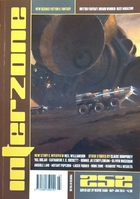
The Posset Pot by Neil Williamson1
Possibly the unexpected results of a Large Hadron Collider type experiment, bubbles from elsewhere or elsewhen are intersecting the Earth, excising parts of it when they disappear. The narrator navigates the ruins of Glasgow, looking for provisions, hoping for the chance to be reunited with the lover he lost to one of the bubbles years before. An unusual apocalypse this, made more so by the familiarity (to me) of its setting.
The Mortuaries by Katharine E K Duckett2
Another apocalypse, this one based on global warming. The remaining human population lives on a gloopy foodstuff named noot. The titular mortuaries are more like mausolea. A man called Brixton invented a process which could embalm bodies and keep them fresh. Viewpoint character Tem grows up not fully understanding the world around him until he visits the “bad” mortuary. The pieces of the story didn’t quite cohere. In this world of shortage would there still be enough resources for the upkeep of the mortuaries – not to mention cars and motorbikes for people to flee the doomed last coastal city?
Diving into the Wreck by Val Nolan3
A story about the discovery of the lost Apollo 11 lunar ascent module, Eagle, crashed somewhere on the Moon, and of the necessity for mystery. I wasn’t quite convinced by the (unnamed) narrator’s final decision but this is a fine tale of what it – sometimes – means to be human.
Two Truths and a Lie by Oliver Buckram4
This describes a doomed love affair – one of whose participants may be an alien – couched as a series of short paragraphs each followed by three propositions of which the story’s title and preamble invite us to believe only two are true.
A Brief Light by Claire Humphrey5
Ghosts are appearing in everyone’s houses. Ghosts which sometimes have the attributes of birds. This causes complications in the marriage of Lauren who is contemplating a lesbian affair with Jo. The ghosts interfere in both their lives.
Sleepers by Bonnie Jo Stufflebeam6
Strange white creatures with hooves have started to appear randomly. An insomniac woman whose father is in hospital seeks one out to see if it perhaps a version of him. While the present tense narration is perhaps justified by the ending it seemed to strike a false note in the second paragraph.
1 sheered for sheared and “cookie jar.” Cookie jar? Unlikely from a Glaswegian I’d have thought.
2 Written in USian
3 A wyne of hay may be a misprint for wayne. There was also the sentence, “Here so the long culmination of selenological time.” What????
4 I had to look up “s’mores.” It’s some sort of USian confection.
5 Ditto “toonie” – a Canadian two-dollar coin.
6 Written in USian
No Comments »
Posted in Trips at 12:00 on 17 September 2014
I’ve been in Holland.
Well, strictly speaking, since it was on the borders of the Friesland and Groningen provinces, make that The Netherlands.
The good lady’s eldest brother lives there. We had been supposed to visit for years but life got in the way.
We needed to renew our passports first. I sent the applications away late in July. Despite all the talk on the news about delays we got the new ones inside a week. (As I remember it was four days.) Maybe the Glasgow Passport office is more efficient than down south.
So another country visited. Apart from the constituent parts of the UK (though I only just made it into Wales) I’ve been to Sweden (Stockholm,) the Soviet Union (Leningrad as was) and Denmark (Copenhagen) on a school cruise when I was at Primary School, Portugal (the Azores, Madeira, Lisbon) and Spain (Vigo) on a Secondary School cruise, and as an adult to Germany (near Stuttgart) and France twice (Normandy for the D-Day beaches and Picardy for World War I battlefields.)
Since the good lady didn’t fancy being on a RoRo ferry overnight we drove down to Harwich (with an overnight stop) and the same on the way back. I’m knackered.
No Comments »
Posted in Art Deco, Empire Exhibition, Scotland, 1938, Glasgow at 12:00 on 8 June 2014
Another postcard of a building from the 1938 Empire Exhibition held in Bellahouston Park, Glasgow. Great central tower, nice curved frontage. The full length flag standards have nice detailing halfway up the building.

No Comments »