The Football by Étienne Ghys
Posted in Football, Reading Reviewed at 12:00 on 18 January 2026
The Amazing Mathematics of the World’s Most Watched Object, Princeton University Press, 2025, 130 p, including 4 p Credits, i p Preface, i p Translator’s Note. Translated from the French LA PETITE HISTOIRE DU BALLON DE FOOT, (Odile Jacob, 2023,) by Teresa Lavender Fagan.
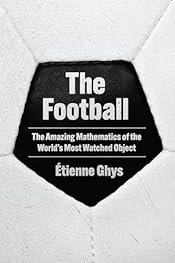
The translator’s note at the beginning informs us the history of both names for the game played with the titular object is fascinating but she has chosen to call the game football rather than soccer (as is only proper.) There was only one lapse.
This book could almost have been designed for me A football fan (well, a fan of the Sons of the Rock, so arguably not football) with a scientific background and therefore a grounding in maths. How could a discussion of the mathematics surrounding the football not interest me? Nevertheless it wasn’t a book I sought out; indeed I was unaware of its existence until I unwrapped it as a birthday present.
Amazingly (to me at least, I discovered it in this book) the rules of football state about the construction of the ball only that it must be made of a suitable material – but without specifying what constitutes suitability! (It must also be spherical and lie within a certain circumference and weight range with internal pressure between 1.6 and 2.2 atmospheres at sea level.)
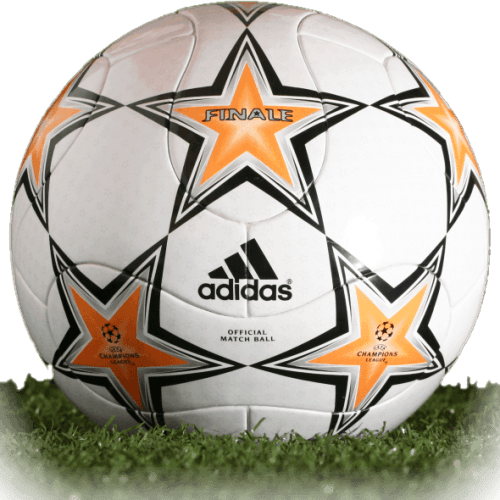
The book starts with the familiar Telstar ball, dating from the 1970 World Cup and containing twelve black pentagonal panels, twenty white hexagons and requiring ninety seams. It is impossible (despite the illustrations on UK road signs which indicate football grounds) to construct a sphere only from hexagons, or indeed solely from pentagons. In this regard the logo for the (so-called) Champions League is incorrect. The actual ball has five-pointed stars surrounding curved hexagons, three stars around each hexagon. The logo, in places, has four.
In terms of geometry the Telstar is in fact a truncated icosahedron (ie one with its points cut off) and then inflated to [near] sphericality. It is also extremely symmetrical, ensuring stability in flight, but the pattern for cutting out the panels is very complicated.
The balls for more recent World Cups are truncated versions of other Platonic solids. Teamgeist (2006) was a truncated octahedron, the Jabulani (2012) a truncated tetrahedron with eight panels which weren’t flat, the Brazuca (2014) a truncated cube! (Albeit that last had curved panels.) 2022’s Al Rihla was based on an icosidodecahedron.
So much for geometry. The other criterion considered here is drag. It is the interaction between drag and gravity that determines a football’s flight. Without drag the ball’s flight would be inherently unpredictable and, due to turbulence, slow down too quickly! The ninety seams on the Telstar ensured sufficient drag. The Jabulani’s fewer seams and relative smoothness made it seemingly erratic. (Drag reduces with smoothness.) French goalkeeper Hugo Loris called the Jabulani a catastrophe. More modern footballs like the Al Rihla, as a close-up photograph demonstrates, are dimpled (in a similar way to golf balls) so as to reduce drag.
This is an excellent book for those interested in both football and maths but I think its explanations, not to mention the copious illustrations and diagrams, are sufficiently clear to pose no barrier to the maths-phobic.
Pedant’s corner:- “The horizon is a straight line” (It isn’t; it’s actually slightly curved,) “the English government” (there is no such thing. [there is a UK government, though],) uses English plurals (rather than Greek) for the Platonic solids.