Archives » Fantasy

Locus 21st Century Poll (Fantasy)

And here is the Locus 21st Century poll for fantasy

1 Gaiman, Neil : American Gods (2001)
2* Clarke, Susanna : Jonathan Strange & Mr Norrell (2004)
3 Rothfuss, Patrick : The Name of the Wind (2007)
4* Miéville, China : The Scar (2002)
5* Martin, George R. R. : A Feast for Crows (2005)
6 Rowling, J. K. : Harry Potter and the Deathly Hallows (2007)
7 Bujold, Lois McMaster : The Curse of Chalion (2001)
8* Miéville, China : The City & the City (2009)
9 Fforde, Jasper : The Eyre Affair (2001)
10 Bujold, Lois McMaster : Paladin of Souls (2003)
10 Pratchett, Terry : Night Watch (2002)
12 Gaiman, Neil : Coraline (2002)
13 Wolfe, Gene : The Wizard Knight (2004)
14 Pratchett, Terry : Going Postal (2004)
15= Gaiman, Neil : The Graveyard Book (2008)
15= Lynch, Scott : The Lies of Locke Lamora (2006)

I have read only four here – and two by the same author. Notably one of these made it onto the SF list as well, which shows how hard differentiating SF from Fantasy can be. (The only one that I’ve not read which I might look out for is the Wolfe.)

Locus Poll (Fantasy)

That same Locus Poll also listed the top 15 Fantasy novels from last century.

Again asterisked means I’ve read them, ** that I can’t remember and (*) only the first of the trilogy.

1(*) Tolkien, J. R. R. : The Lord of the Rings (1955)
2* Martin, George R. R. : A Game of Thrones (1996)
3 Tolkien, J. R. R. : The Hobbit (1937)
4* Le Guin, Ursula K. : A Wizard of Earthsea (1968)
5* Zelazny, Roger : Nine Princes in Amber (1970) 971 70
6 Lewis, C. S. : The Lion, the Witch and the Wardrobe (1950)
7* Miéville, China : Perdido Street Station (2000)
8 Rowling, J. K. : Harry Potter and the Philosopher’s Stone (1997)
9* Crowley, John : Little, Big (1981)
10* Adams, Richard : Watership Down (1972)
11 Goldman, William : The Princess Bride (1973)
12* Martin, George R. R. : A Storm of Swords (2000)
13 Beagle, Peter S. : The Last Unicorn (1968)
14** White, T. H. : The Once and Future King (1958)
15 Pratchett, Terry (& Gaiman, Neil) : Good Omens (1990)

I don’t have quite such a high hit rate here – unsurprisingly, as I prefer Science Fiction to Fantasy: but there is of course a lot of crossover between the two and the boundary is blurred. Even so I would have said Perdido Street Station was SF rather than Fantasy.

Looking for Jake by China Miéville

Pan, 2006, 307p.

Looking For Jake cover

This is a collection of Miéville’€™s shorter fiction culled from various previous publications, with some original to this book.

Looking for Jake. After an unspecified disaster has depopulated London an unnamed narrator goes looking for his missing friend Jake. The very Art Deco Gaumont State cinema in Kilburn is given several mentions and an image of it appears on the book’s cover. See also the picture at the end of this post.

In Foundation a First Gulf War veteran haunted by his experiences there is known as a house whisperer because he talks to buildings. Their foundations talk back.

The Ball Room, a story written along with Emma Bircham and Max Schaefer, has the eponymous play area of a furniture warehouse not entirely dissimilar from IKEA cause its clientele to experience strange and compulsive goings on.

Reports of Certain Events in London is a typographical riot of fonts, scripts, reports, “handwritten”€ letters, interpolations and transcribed pamphlets and employs an unusual framing device. Narrator “€œChina Miéville” inadvertently opens a package delivered to his address but intended for a Charles Melville and finds himself fascinated by the contents – the proceedings of a group devoted to tracking the shifting location of, and combats between, London’€™s feral houses.

Familiar has a witch making a familiar out of a mixture of his own body fluids. It disgusts him and he gets rid of it but it comes back to haunt him. Ho-hum.

Entry Taken From a Medical Encyclopædia is errr…. an entry from a medical encyclopædia. Complete with footnotes and references. The infection described is caused by pronouncing a word in a certain way, which thus propagates itself in the victim’s brain.

In Details a young boy takes food every week from his mother to an old woman who keeps herself close, in the dark, barely opening her door before snatching the food, closing it again and getting him to read to her. She once saw something nasty, not in the woodshed, but in the details of a brick wall. She has been hiding from the patterns out to get her ever since.

Go Between sees a man receive from a mysterious organisation messages concealed inside his purchases. He fails to deliver the final one and wonders if he did the right thing.

An old man buys himself a seventieth birthday present, an old window with stained glass. He discovers he can see Different Skies through it, but there are potential horrors on the other side.

An End to Hunger has a genius computer programmer infuriated by the eponymous charity’€™s campaign. He works to expose its sponsors’ hypocrisies. They don’€™t like it.

In ‘€˜Tis the Season Christmas and its accompanying paraphernalia have been privatized. Yuleco owns the rights and so ChristmasTM, SantaTM, MistletoeTM, RudolphTM etc are all under licence – even tinsel is illegal without one, never mind a tree. An unnamed father has won a prize to Yuleco’s official party. On the way there he and his daughter get caught up in the anti-privatisation protests. Slight, in a fun way. I just hope it doesn’€™t give anybody in power any ideas.

Jack in Miéville€’s city of New Crobuzon, familiar from Perdido Street Station and The Scar, is a Remade. Altered as a punishment – feathered wings for arms or oily gears for innards and skin changed, or otherwise bizarrely surgically changed – Remades are looked down upon by the “normal”€ citizens. Jack Half-A-Prayer fights the system, standing up for the underprivileged. The city can tolerate so much as a release valve – but Jack goes too far.

On The Way To The Front is a graphic short story illustrated by Liam Sharp which would take longer to describe than it did to read. The reproduction is in black ink and might have benefited from colour (which would obviously have been too expensive.)

The Tain is much the longest story in the collection, a novella set in the aftermath of Earth’s invasion by the creatures who live behind mirrors, the Tain of the title. A Londoner is strangely immune to their attentions and sets out to parley with their leader. One of the Tain is also a viewpoint character. Not your usual alien encounter story.

While not every story hits the mark, as a whole the collection illustrates Miéville’€™s range and writing ability. It also highlights his fascination with London and his recurring theme of otherness, the not-quite-identical.

And here is the majestic (in that monolithic, Stalinist kind of way) Gaumont State Cinema.

Gaumont State Cinema

Where Have All The Good Times Gone?

Science Fiction is dead – again.

Or at least moribund according to Paul Kincaid in his review of both of the Year’s Best SF collections for the LA Review of Books.

Actually I have some sympathy with parts of his argument – which does chime with what I said about this year’s BSFA Award short story nominees.

I also agree that when the SF tips over into Fantasy or wish fulfillment, the “six impossible things before breakfast” scenario, we might as well give up.

He may also have a point about a lot of modern short story – or novel length come to that – SF being retreads of well-worn themes. (But the writer in me says that if I nevertheless have something to say, a newish angle on a trope if you will, doesn’t that story deserve to be told? We can’t all be dazzlingly inventive all the time. And while of course SF ought to harbour, even showcase, the experimental the virtue of a story starting at the beginning and going right through to the end is often a relief as a reader.)

Where we really differ, though, is in Kincaid’s seeming request for optimism. I don’t know about Paul but I can’t see much to be optimistic about right now; nor for the foreseeable future.

I obviously can’t say often enough SF is never about the future. It’s about now. And the here and now is profoundly depressing.

I suppose a little hope would not go amiss but where is it to come from? The Arctic ice is melting at a rate of knots, extreme weather events are multiplying and we haven’t been back to the Moon for 40 years.

We might not deserve it perhaps but we may be getting the only SF that is presently possible.

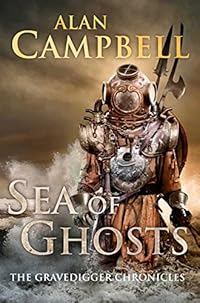
Sea of Ghosts by Alan Campbell

Tor, 2011, 431p.

 Sea of Ghosts cover

On a world where a race known as the Unmer was vanquished decades ago their artefacts still haunt the human inhabitants. Much-valued Unmer “trove”€ is scattered randomly over the sea-bed and material called brine, poisonous to humans, is emanating from ichusae, or sea bottles, and making the sea level rise slowly but inexorably. Protective clothing must be worn if there is danger of contact with brine as humans develop “€œsharkskin”€ on any exposed surfaces, which leads to pain and death. Those fully immersed, however, still carry on a life as “€œthe Drowned,”€ swimming about freely under the brine, but are feared and persecuted by the authorities.

Telepaths known as Haurstaf helped defeat the Unmer and act as a kind of secret service (or, since they act for both sides in conflicts, more like an inquisition.)

This is a fantasy world with a difference. Yes there are dragons and slaves, but while the political structure is still monarchical (Emperor Hu) there are guns – and boats with engines. Refreshingly not the usual mediæval milieu, then.

In addition the Unmer trove has a technological basis. A rationale is given for the otherwise magical overflowing of brine from unstoppered ichusae and for the properties of Unmer artefacts. One of the characters knows about the wave-particle duality of light and muses on gravitation. These aspects of the novel make it Science Fiction rather than Fantasy. In feel, however, it leans more towards the fantastical.

In the prologue one of the so-called Gravediggers of the subtitle, Colonel Thomas Granger, offends Emperor Hu and they have to spirit themselves away to the city of Ethugra to escape his ire. The novel proper starts when an enslaved woman recognises Granger as the man she had a relationship with years before and pleads with him to save herself and her daughter, Ianthe, whom Granger surmises to be his child too, by buying them. Ianthe turns out to have powers to find trove, powers which will interest the Haurstaf and the local Mr Big, Ethan Maskelyne.

The novel sometimes has aspects of a quest story, at others of the military insert and retrieve mission. Pleasingly, very few of the characters are mere ciphers (though Emperor Hu is something of a caricature of the spoilt aristocratic brat.) Campbell knows how to draw a reader in to his story and to keep the attention.

Unfortunately, at the production level, the text is ill-served by having words – frequently “€œthe”€ or “a” – missing or repeated and other typographical errata of various sorts. Another example of the tendency of publishers to look on their publications simply as “€œproduct” and wheel them out without due care.

Novels are not product. At least, the good ones aren’€™t.

Rant over.

Sea of Ghosts is a superior fantasy, well worth a read. The paperback is now available.

A Dance With Dragons by George R R Martin

Harper Voyager, 2011, 959p (plus 56p of genealogies.)
Book 5 of A Song of Ice and Fire and a wristbreaker. For my thoughts on book 4 see here.

The action this time is mostly set over the sea from Westeros; following the adventures of Tyrion and Daenerys in Andalos and Valyria but Jon Snow’s problems at the Wall and other matters in the North are also prominent.
The writing is not always as assured as it was in Books 1-4 but still drags you in. Martin’s adaptation of his usual chapter heading (the viewpoint character’s name) – resorting at times to uses such as “The Wayward Bride” and “The Spurned Suitor” instead – also muddies things. In these cases it can take a little time to work out who the section is about especially as Martin’s modus is to start with a scene not immediately following the one his character had most recently appeared in before then filling in the gap.

Martin again employs the sly trick at a chapter’s end of apparently killing off a character only to reveal several sections on that death has been averted.

I’ve always visualised Tyrion as looking like Antony Worrall Thompson, an image I just can’t get rid of when reading about him. As in A Storm of Swords the complexities of his character means the reader’s expectations can be confounded but he remains consistently interesting. Daenerys, though, here seems curiously indecisive.

With 956 pages to get through a sense of marking time begins to grow but in this volume the overall story arc of A Song of Ice and Fire is cranked up by the emergence of a lost Targaryen heir to the Iron Throne closer in line than Daenerys.

Martin’s focus is perhaps inevitably on nobles and their doings. While the scope of his vision is broad we do not see much of the small folk, who appear mostly in the background. Then again in a mediæval world how likely is it that such people would be able to become movers and shakers, drivers of plot?

The possible Science-Fictional aspect to Martin’s cycle is again alluded to in mentions of the First Men. As well as the obvious comparison with the Wars of the Roses minor parallels with our own world are understated but present. (The Valyrians left not only their steel but also roads which have survived centuries.)

In earlier volumes of A Song of Ice and Fire it was possible to imagine there might be but as the saga wears on it becomes clearer that there’s not much scope for hope in Martin’s invented world. The outcomes seem unremittingly depressing. Perhaps in Vol 6, The Winds of Winter?

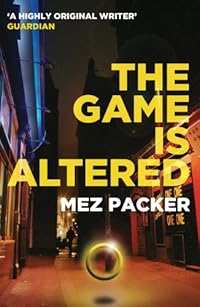
The Game Is Altered by Mez Packer.

Tindal Street Press, 2012, 348p. Reviewed for Interzone 240, May-Jun 2012.

The Game Is Altered cover

Lionel Byrd’s mother died three days after his birth. He was adopted by her best friend, Judy, and brought back to Britain from Kenya. However he is mixed race and his adoptive family are all white. Only his father, David, and sister, Lilith, regard him with any affection while his mother and her two sons treat him coldly. In childhood the two boys subjected him to “games” in which he was the butt of their cruelty, describing him (apparently after Blade Runner) as a replicant and, at one point, nearly hanging him. His recall of these events is hazy as an accident when he was ten has deprived him of many of his childhood memories.

As an adult he is estranged from his adoptive family, apart from his sister, and lives a lonely existence in a grotty flat in a rundown district near a “Health Centre” which is a cover for people-trafficking and prostitution. He is aloof at work despite attempts to befriend him, his closest companion is his cat Buddha, and he fantasises about a girl he has seen in the street with whom he is convinced he has made a connection. While friendly with his barber, a West Indian whose speech is rendered demotically and doesn’t like Lionel’s taking up of dreadlocks, he has a close relationship only with Lilith and escapes from mundane reality into an immersive computer game called CoreQuest where his avatar is Ludi, a much more active persona. His father’s final illness leads to Lionel’s re-entanglement with his adoptive family and revelations about the circumstances of his adoption.

The novel is on the whole well written but its structure is problematic. It is divided into chapters dealing with Lionel’s life, each usually followed by an epigraph relating to gaming, then a segment from the game. These latter – escalating through the game’s levels – are related from Ludi’s viewpoint in a partly debased form of English. Irritatingly, Packer does not always sustain this street language throughout the game segments’ lengths.

We are intended to draw parallels between the characters in Lionel’s world and avatars in the game but these sections do not add to the story. References to the possibly elusive nature of reality – the phrase, “It’s only a game,” appears in Lionel’s narrative several times; a character says, “People are so programmed,” – are not enough to justify the conceit embodied within them nor the presence of the gaming chapters. There is also the problem that in games there is no jeopardy. Why should the reader care about the characters within them when they are not real and can be resurrected at will?

As a result the novel as presented is unsatisfying, particularly to readers of speculative fiction, who are used to the mixing of the real with the fantastic – or paranoia – and even the melding of reality with games. Packer seems either to be unaware of or unconcerned with the literary antecedents.

This is a pity as the main narrative is well handled and, until it begins to unravel somewhat in the latter stages, convincing. It could stand alone, without the game aspect, and be entirely coherent – though of course not SF. The attempts to suggest a degree of futurity, such as the coinage “Google device” for a hand-held computer-like phone, are ill thought-through (even when shortened to “Google”) and there is insufficient foreshadowing of Lionel’s ultimately shaky grasp on the real world.

The website of the book’s publisher (Tindal Street Press) states it does not consider submissions, among other genres, of Sci-Fi (sic) nor Fantasy. In those circumstances it does seem strange to be reviewing one of their books for Interzone. Yet its back cover blurb says “for readers of …, Cory Doctorow, China Miéville and Neal Stephenson.” Very odd. But then again despite its trappings “The Game Is Altered” overall does not read as SF, nor Fantasy.

Ray Bradbury

The good lady has just told me Ray Bradbury has died.

Bradbury was one of the grandfathers of fantastical fiction, even when I was a lad. I would agree with his own assessment that, except for Fahrenheit 451, he wasn’t a Science Fiction writer, as most of his work was fantasy.

Partly because of that I haven’t read all of his work, not much in fact. Fahrenheit 451 obviously, but also The Martian Chronicles and The Illustrated Man.

I like these quotes from him in the obituary linked to above:-

“Fantasies are things that can’t happen, and science fiction is about things that can happen.”

“When I was born in 1920, the auto was only 20 years old. Radio didn’t exist. TV didn’t exist. I was born at just the right time to write about all of these things.”

Had he never written another word Fahrenheit 451 would still have stood as a proud memorial. A novel about the importance of the written word, and the abomination that any book burning, of any book at all, represents. It is also about the indomitability of the human spirit.

Ray Douglas Bradbury 22/8/1920 – 6/6/2012. So it goes.

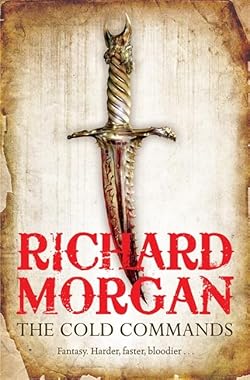
The Cold Commands by Richard Morgan

Golllancz, 2011, 406p.

 The Cold Commands cover

In Morgan’s last novel, The Steel Remains, the previous in his Land Fit for Heroes sequence, it was the differences between it and the usual fantasy opus that stood out. In The Cold Commands what struck me instead were the similarities.

For we have a mediæval type setting, an emperor, background wars, Dark Lords, sword wielding and sorcery, eldritch enemies from out of time; all soaked in blood and guts. The swearing also seemed a little overdone this time. There is, though, a hint at a science-fictional gloss to it, but only a hint. Yet unlike a fair swath of fantasy it is a convincing world Morgan has created here. But I wouldn’t want to live in it.

It is all revealed in the same gritty way as in The Steel Remains. We still have two gay agonists – though neither of them actually gets much sex here – and there is fine writing, if a touch too digressive at times. Morgan is at pains to describe his world, and it is a very detailed setting, every minor character has a credible past, and his or her own motivations, every muddy environment is suitably filthy.

Deep in the mix are musings on the impossibility of determining the difference between a demon and an angel except by their actions and on the inefficacy of torture.
The ending, when it came though, was rushed, the final confrontation over quickly. A pity, after nearly 400 pages.

It was only a minor scene in the narrative, but I found the gang rape problematic. It is not enough to have one character tell another, “Soldiers rape.” Perhaps they do. It is quite another matter to have your protagonist abet the act – encourage it even – whatever sins the victim may have committed against him or his family in the past; and for her to reveal that she has been raped before (as if that ameliorated anything) – and not just the once – whether she is being truthful to her past or only defiant. Yes, this reveals a degree of ambiguity in our identification with the protagonist, and at his moral complexity but!

Our heroes may have feet of clay and may have to do unspeakable things out of necessity, but when given a choice, don’t they still need to be better than the bad guys?

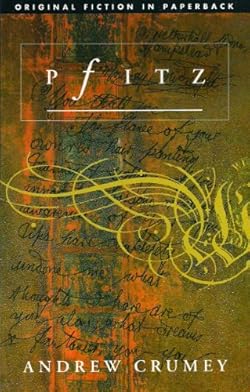
PfITZ by Andrew Crumey

Dedalus, 1995, 164p

 PfITZ cover

This novel begins somewhat like a fairy tale, “Two centuries ago a Prince” is pretty close to, “Once upon a time.” However, the characters here do not “live happily ever after” and the philosophical musings the book contains are more elevated than the admonitory morals of the usual fairy tale.

The Prince concerned is keen on designing fantasy cities, so much so that whole armies of people are employed to create on paper the perfect city, Rreinstadt – not just the infrastructure but also the doings of its inhabitants and visitors. (This being in the nature of a fairy tale, where the money for this endeavour comes from is not explained.) The first two chapters, which set the novel up, contain no dialogue but manage to intrigue nonetheless.

Our hero is Schenk, a Cartographer, poring over maps of Rreinstadt, who on an errand one day is smitten by a pretty young Biographer, Estrella. He is also curious about the partly erased entries on one of his maps, that of the hotel room of a visitor to Rreinstadt, one Count Zelneck. He interprets the names concerned as Pfitz and Spontini. To impress Estrella and give him a reason for continuing to visit the Biography section he invents a story for Pfitz and Count Zelneck and writes it for her. His Pfitz – and therefore ours as we can read Pfitz’s adventures in occasional chapters – is an inveterate story teller in a magic realist kind of way. Spontini turns out to be one of the “authors” of books in Rreinstadt’s library (no detail is too small for the chroniclers of the Prince’s city) whose oeuvre is created by a team of writers. Spontini is apparently destined for madness.

So we have tales within tales and characters coming to wonder if they themselves are creations in someone else’s fiction. All very self-referential and post-modern. And, of course, begging a very Science Fictional question as to whether our world is itself a fictional creation or not.

Where the treatment began to unravel for me was that events in the “real” world – that of the Prince’s city planners – its jealousies and murder attempts, started to mirror the “invented” one (which being cause and which effect, a moot point.) This seemed to me to labour the parallels too much.

Had I not previously read Crumey’s Mobius Dick, Sputnik Caledonia and Music, in a Foreign Language I might have been more taken with PƒITZ. It is still a worthwhile novel; it just doesn’t reach the heights those books did.

free hit counter script