The Game Is Altered by Mez Packer.
Posted in My Interzone Reviews, Reading Reviewed, Reviews published in Interzone at 12:00 on 3 July 2012
Tindal Street Press, 2012, 348p. Reviewed for Interzone 240, May-Jun 2012.
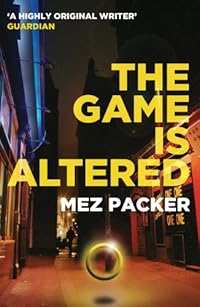
Lionel Byrdâs mother died three days after his birth. He was adopted by her best friend, Judy, and brought back to Britain from Kenya. However he is mixed race and his adoptive family are all white. Only his father, David, and sister, Lilith, regard him with any affection while his mother and her two sons treat him coldly. In childhood the two boys subjected him to âgamesâ in which he was the butt of their cruelty, describing him (apparently after Blade Runner) as a replicant and, at one point, nearly hanging him. His recall of these events is hazy as an accident when he was ten has deprived him of many of his childhood memories.
As an adult he is estranged from his adoptive family, apart from his sister, and lives a lonely existence in a grotty flat in a rundown district near a âHealth Centreâ which is a cover for people-trafficking and prostitution. He is aloof at work despite attempts to befriend him, his closest companion is his cat Buddha, and he fantasises about a girl he has seen in the street with whom he is convinced he has made a connection. While friendly with his barber, a West Indian whose speech is rendered demotically and doesnât like Lionelâs taking up of dreadlocks, he has a close relationship only with Lilith and escapes from mundane reality into an immersive computer game called CoreQuest where his avatar is Ludi, a much more active persona. His fatherâs final illness leads to Lionelâs re-entanglement with his adoptive family and revelations about the circumstances of his adoption.
The novel is on the whole well written but its structure is problematic. It is divided into chapters dealing with Lionelâs life, each usually followed by an epigraph relating to gaming, then a segment from the game. These latter – escalating through the gameâs levels – are related from Ludiâs viewpoint in a partly debased form of English. Irritatingly, Packer does not always sustain this street language throughout the game segmentsâ lengths.
We are intended to draw parallels between the characters in Lionelâs world and avatars in the game but these sections do not add to the story. References to the possibly elusive nature of reality – the phrase, âItâs only a game,â appears in Lionelâs narrative several times; a character says, âPeople are so programmed,â â are not enough to justify the conceit embodied within them nor the presence of the gaming chapters. There is also the problem that in games there is no jeopardy. Why should the reader care about the characters within them when they are not real and can be resurrected at will?
As a result the novel as presented is unsatisfying, particularly to readers of speculative fiction, who are used to the mixing of the real with the fantastic – or paranoia – and even the melding of reality with games. Packer seems either to be unaware of or unconcerned with the literary antecedents.
This is a pity as the main narrative is well handled and, until it begins to unravel somewhat in the latter stages, convincing. It could stand alone, without the game aspect, and be entirely coherent – though of course not SF. The attempts to suggest a degree of futurity, such as the coinage âGoogle deviceâ for a hand-held computer-like phone, are ill thought-through (even when shortened to âGoogleâ) and there is insufficient foreshadowing of Lionelâs ultimately shaky grasp on the real world.
The website of the bookâs publisher (Tindal Street Press) states it does not consider submissions, among other genres, of Sci-Fi (sic) nor Fantasy. In those circumstances it does seem strange to be reviewing one of their books for Interzone. Yet its back cover blurb says âfor readers of â¦, Cory Doctorow, China Miéville and Neal Stephenson.â Very odd. But then again despite its trappings âThe Game Is Alteredâ overall does not read as SF, nor Fantasy.
Tags: Fantasy, Interzone, Mez Packer, Other fiction, Science Fiction, SF
