Archives » Fantasy

Interzone 285 Est Arrivé

The latest Interzone (no 285, Jan – Feb 2020) popped onto my doormat this morning.

Interzone 285 cover

 The Menace From Farside cover
Skein Island cover

As well as the usual fiction and features this one contains my reviews of Aliya Whiteley’s Skein Island and Ian McDonald’s The Menace From Farside.

I am expecting a couple of books for review in Interzone 286 through the post any day now.

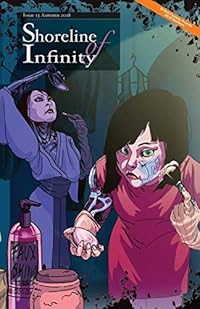
Shoreline of Infinity 13; Autumn 2018

The New Curiosity Shop, 2018.

 Shoreline of Infinity 13 cover

In Pull up a Loga Noel Chidwick says that the tradition and sense of myth in Scottish story-telling underlies Shoreline of Infinity, tales of wonder told round the fire as the cold swirls around, and invites us in. Reviewsb has Katy Lennon finding the worlds depicted in the anthology Improbable Botany edited by Gary Dalkin feeling “real and conscious”, Samantha Dolan is impressed by Cat Hellisen’s collection Learning How to Drown, Steve Ironside appreciates rather than enjoys the lampoon The Church of Latter-Day Eugenics by Chris Kelso and Tom Bradley, but still tilts his crown to it, Rachel Hill finds Autonomous by Annalee Newitz to be an accomplished thriller, tackling thorny contemporary issues without offering simple solutions, Callum McSorley welcomes us to the Wild East of the collected novellas of Apocalypse Nyx by Kameron Hurley, formula plotting and all, Marija Smits says Sealed by Naomi Booth is a powerful book with an original, hard-hitting premise, Lucy Powell describes The Freeze-Frame Revolution as hard and fast-paced narrative that really makes you think, gripping till the last page, Georgina Merry defines Fifty-One by Chris Barnham as a fun read – with flaws.
Multiverse has poems by Tris Crestd, Charlotte Ozment and Nate Maxson, while a total of three 6 word stories (written respectively by Gregg Chamberlain, Dane Divine and Michael Stroh) appear, one each, at the bottoms of pages 44, 71 and 131.

In the fiction:-
Harry’s Shiver* by Esme Carpenter. A man commissioned to steal some sort of (unspecified) valuable raids the ‘unbreachable’ Caste Arco. To aid him he makes use of devices he calls Shivers. I’m afraid for me this story was marred by far too much obtrusive info dumping, some unnecessary phrases, the occasional odd word choice and more than a smattering of cliché.

In The Time Between Time*2 by Premee Mohamed windows onto another planet have begun appearing all over Earth. Eleven year-old Dalton finds one in her back garden and tries to keep it secret.

Daughter3 by Laura Young is narrated by a woman taking her terminally ill mother from Japan to her home in San Francisco to care for her. Things turn strange during the flight and even stranger when they land.

Splitting Up*4 by Bo Balder is narrated by a Split – a part of someone’s personality which by medical intervention has been reduced to only restricted access to that person’s body but takes over for designated purposes – in this case interacting/having sex with a boyfriend.

In Goodnight Rosemarinus5 by Caroline Grebell a future human, evolved into a sea-dweller, is held captive by an alien Observer. This story is followed by a one page article “We Have a Winner”d on the artist, Jimmy McGregor, who won the competition to illustrate the story.

Tim Major’s Cast in the Same Mould* describes the peculiar circumstances in which life is discovered on Mars.

The Beachcomber Presents Mary Shelley’s Frankenstein6 by Mark Toner, Stephen Pickering & Tsu Beel discusses Mary Shelley’s Frankenstein, the original and its various adulterated adaptations.

Next comes an interview with the authore (conducted by Noel Chidwick) and extracts from the novel Origamy7 by Rachel Armstrong.

Preceded by a very short author intervewf (by Chris Kelso,) The Silk Tower of Beijing8 by Preston Grassman is dedicated to the late Iain M Banks. Seeming to take inspiration from that author’s A Gift From the Culture an inhabitant of an Earth taken over by aliens strikes at the core of their hold over humans

Pedant’s corner:- I proofread the stories marked* before publication so assume there are no remaining errata there. Otherwise; aHanks’ (Hanks’s.) b“made up of diverse range” (made up of a diverse range,) pays of (pays off,) “an authors motivation” (author’s,) “each … aren’t window dressing” (each isn’t,) “this editions extra interview material” (edition’s,) “the majority of the public are unconcerned” (the majority … is unconcerned,) Watts’ (Watts’s,) eons (aeons,) “the inherently claustrophobia nature” (the inherently claustrophobic nature,) “where the human’s sleep” (humans,) “the twists and turns … is at times genuinely shocking” (are genuinely shocking,) “the ultimate climax of the book and the afterword to is one that is” (that ‘and’ requires a plural verb, ‘are ones that are’,) “one could be forgiven into thinking they were reading sections” (again, ‘one’ is a singular antecedent and should not be followed by a plural pronoun,) “the group split” (splits.) cIn the author blurb “bird nests” (normally ‘birds’ nests’.) dfocussed (focused.) eMobius’ (Mobius’s.) f“the nations arts” (nation’s,) skillful (skilful,) Ian M Banks (x2, Iain,) Banks’ (Banks’s.)
1Written in USian. 2Written in USian. Or is it Canadian? Instantly dated by its mention of Stephen Hawking. 3Written in USian. 4 Written in USian. “The uited people” (The suited people.) 5focussed (focused.) 6“ice flow” (ice floe that would be,) “whom in turn draughts it” (who in turn drafts it,) “as Victor grew as did his love for Science” (as Victor grew so did his love for..) Victors’ (Victor’s,) “evidence there of” (thereof,) Victor breaths his last” (breathes his last,) “There’s very few movies” (there are very few movies,) “near all of” (nearly all of.) 7haurspicy (haruspicy,) auger (after the previous page’s mention of four types of divination I strongly suggest this is intended to be ‘augur’. An auger is a different thing entirely.) 8Written in USian, “a flock of drone-birds hover” (a flock hovers,) a missing full stop (x 4.) “The cross-hatched ruins of the Bird’s Nest appears” (the .. ruins… appear,) “none of them are as monumental” (none .. is as monumental.) “As I think of the world as I want to be” (‘as I want it to be’ makes more sense.)

Alasdair Gray

Sad, sad news.

Alasdair Gray has died.

If he had never done anything else in his life his first novel Lanark (arguably four novels) would have made him the most important Scottish writer of the twentieth century’s latter half, if not the whole century. (Perhaps only Lewis Grassic Gibbon rivals him in that respect.)

But of course he published 8 more novels, the last of which I read in 2009, 4 books of short stories – see this review of one of them – 3 of poetry (I reviewed a couple here and here,) many pieces for theatre, radio and television plus books of criticism (as here) and commentary (eg see here).

Yet that was not the least of it. There is also his work as an artist and illustrator to take into account. His drawing/painting style was unique and uniquely recognisable; much admired and sought after.

A polymath and curmudgeon, learned and contrary, Gray was one of a kind.

Even as his work lives on we will miss his acerbic presence.

And I still have his The Book of Prefaces to peruse.

Alasdair Gray: 28/12/1934 – 29/12/2019. So it goes.

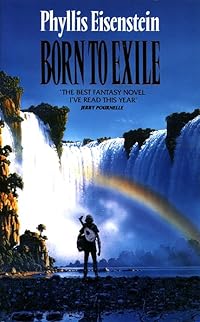
Born to Exile by Phyllis Eisenstein

Grafton, 1992, 219 p.

 Born to Exile cover

These are the adventures of Alaric the minstrel, a foundling discovered on a wooded hillside with a severed hand clutching his leg. Taken in by a childless couple desperate for someone to care for he later is befriended by a minstrel called Dall who recognises his unusual ability – liable to be described by the society they live in as witchcraft. Alaric has the power of self-teleportation – handy for extricating himself from dodgy situations but a dangerous attribute.

In his wanderings after Dall’s death he comes to a castle where the local princess takes a fancy to him. Their liaison uncovered he has to flee precipitately but cannot forget her. Eventually he meets a former midwife with a strange tale to tell. She has only one hand. Cut off when a child she had just delivered disappeared along with it and banned from her home kingdom for failing to take proper care of her charge. Through her he comes to his ancestral home and finds a family he didn’t know he had (all of whom have his ability – but it must be kept secret.)

Born to Exile is a pleasant enough read, Alaric is a reasonably engaging protagonist – with a conscience (though the sexual politics of his world are typical of fantasy novels of this vintage) – and the ending provides scope for a sequel.

Pedant’s corner:- One entry. One only. Remarkable. “He bent her back till they lay prone on the bed” (face down? I think not; supine on the bed perhaps.)

Ian Sales’s 1980s

In a previous post I posted about Ian’s first list in response to the BBC’s 100 books that shaped the world.

These are his influencers from the 1980s.

Bold means I have read them. Only 7 out of 24 here.

The Undercover Aliens, (aka The House That Stood Still) AE Van Vogt (1950)
The Winds of Gath, EC Tubb (1967).
The Book of Alien, Paul Scanlon & Michael Gross (1979)
The Dune Encyclopedia, Willis E McNelly, ed. (1984)
The Future Makers, Peter Haining, ed. (1968)
Dhalgren, Samuel R Delany (1975)
The Right Stuff, Tom Wolfe (1979)
The Far Pavilions, MM Kaye (1978)
Iceberg, Clive Cussler (1975)
The Complete Book of Science Fiction and Fantasy Lists, Malcolm Edwards & Maxim Jakubowski (1983)
Radix, AA Attanasio (1981)
The Barbie Murders, John Varley (1980)
Serpent’s Reach, CJ Cherryh (1980)
The Science Fiction Sourcebook, David Wingrove (1984)
The War for Eternity, Christopher Rowley (1983)
Under a Calculating Star, John Morressy (1975)
Where Time Winds Blow, Robert Holdstock (1981)
Knight Moves, Walter Jon Williams (1985)
Kairos, Gwyneth Jones (1988)
The Space Mavericks, Michael Kring (1980)
The Female Man, Joanna Russ (1975)
The Fifth Head of Cerberus, Gene Wolfe (1972)
The Five Gold Bands, Jack Vance (1950)
The Left Hand of Darkness, Ursula K Le Guin (1969)

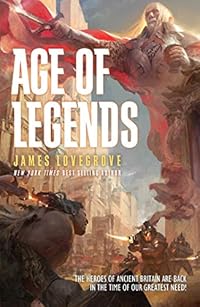
Age of Legends by James Lovegrove

Solaris, 2019, 405 p.

 Age of Legends cover

The novel starts with a scene in which parakeets in London are being systematically culled. They are alien, you see. They don’t belong in Britain. At least not in a Britain run by Prime Minister David Drake, head of the Resurrection Party, out to restore the country to “proper” British values and rid it of all undesirables. This last category, of course, includes anyone not born in the UK. Ajia Snell’s mother has been deported “back” to India – a country she had never visited. Bicycle courier Ajia’s father was white British, and therefore she is tolerated. Just. Her dusky skin tends to attract suspicion in certain quarters though. When out on her self-imposed mission to paint graffiti criticising Drake, she is spotted by cops and shot while trying to escape them. This leads to her capture, imprisonment and beating. Her heart stops.

It is of no consequence. The police can do anything they like in this law-and–ordered world. Two cops are delegated to dispose of the body. While they are dumping her in a sewer she wakes up, frightening them off.

Resting on a park bench, she is saved from a further beating at the hands of a vagrant by a man calling himself Smith. He calls her “good fellow” and tells her she is one of a new kind, people who did indeed die but have somehow come back to life with special attributes, attributes drawn from British mythological figures and folk tales. She is Puck, aka Robin Goodfellow, and has the ability to move at incredible speed. Smith is able to rework broken metal and shattered glass into new objects.

Nominative determinism is a central feature of the reincarnations in this book, who are known collectively as eidolons. Their leader is called Auberon LeRoy. A man named Fletcher is extremely handy with a bow and arrow, Daisy Hawthorn has power over growing things, Wee Paul Klein can diminish in size, Neve Winterton has the ability to freeze and unfreeze things. In order to save the soul of Britain they and their like are set to do battle against the armoured cars and Humvees of Drake’s security force, the Paladins.

Interspersed with the story of Ajia Snell (both of whose names mean speed) we are given the experiences of Drake, his wife Harriet, and Security Chief Major Dominic Wynne. In their telling I found these scenes to be reminiscent of the fiction of Harry Turtledove. Before entering politics Drake had been a successful businessman and collector of religious artefacts. He believes himself to be a devout Christian (in his youth a hard row to hoe, in his opinion) but his actions belie any tenets of that faith beyond those of the Old Testament fundamentalist types who seem able to ignore totally any (all?) of the compassionate things that their Messiah is reported to have said and encouraged. Drake’s prize possession is the Holy Grail. Returning to Britain after purchasing it abroad, his helicopter had crashed, with Drake the sole survivor. It is kept under lock and key in a secure building in the grounds of his family home. Not only does he talk to it, it talks back to him in the voice of his companion on that trip, Emrys Sage.

I note there is no mention of the Monarchy in this depiction of a Britain under Fascist rule. An odd omission. Perhaps we are meant to assume it’s been abolished. The implication is that it has been sidelined and of no relevance, certainly no kind of brake on anything.

I suspect Lovegrove intended his tale as a warning of how close the UK is to a future of this sort. Its appeal I suppose lies in the invocation of mythic British heroes and the prospect of the fascist state’s overthrow. However, the treatment suggests that we need to depend on the supernatural to rescue us from such a fate. If that’s the case we’re more lost than I had feared. It’s also depressing that in order to overcome it those heroes have to resort to methods almost indistinguishable from their persecutors. I suppose that was ever the way though.

Pedant’s corner:- Many instances of “‘time interval’ later” throughout. Otherwise; “‘that there was any unnatural about your speed’” (anything unnatural,) a missing comma before a piece of direct speech, “‘You’re coming with’” (coming with me,) “where an assortment of … were parked” (an assortment … was parked.) “Mr LeRoy helped pored” (helped pour,) “air conditioning kept the temperature steady between 16 and 200C (a 4 degree range is hardly steady,) a pope (a Pope,) “used by the Saint Veronica” (Saints’names are not usually prefixed by the definite article; ‘used by Saint Veronica’,) “there were a number of ikons and Bibles,” (‘there was a number’ or, here, ‘there were numbers of…,) “told you do” (told you to do,) unadvisable (inadvisable,) “that Auberon LeRoy fit the bill” (fitted the bill.) “A trio of Paladins were zeroing in” (A trio … was zeroing in,) “skidded into the life” (into life.) “Mr Le Roy sai without looking round” (Mr LeRoy said..,) “of out both politeness and deference” (out of both,) jpeg (x3, it was a video file, I believe that’s an mpeg, or a gif,) “his his great shoulders” (only one ‘his’ required,) lay low (lie low,) “for another women” (woman.) “The armoured slowed” (armoured truck slowed,) “said to much” (too much,) travelling into the troop-carrier” (in the troop-carrier,) “the tongue-lashing he’d excepted” (expected,) “an elicit thrill” (illicit thrill, this was used correctly later, as was elicit,) “was quite bit older” (quite a bit older,) “all she owned in the way of acreage were two window boxes” (all she owned … was two window boxes,) “‘but all indications is that’” (all indications are that,) “like steel hawser” (like a steel hawser,) “the onyx, jewel-encrusted cup” (the jewel-encrusted onyx cup,) “over a licking flames” (‘over a licking flame’, or, over licking flames’,) “as if unconscionably” (‘unconsciously’ makes more sense in the context. Unconscionably = ‘without conscience’ rather than ‘without thought’,) “an besuited MC took up the microphone on small stage” (a besuited MC took up the microphone on a small stage,) “Drake’s Paladin’s killed them all” (Paladins.) “‘Add your ability own to ours’” (Add your own ability to ours,) behind the fathering “‘and you’d be alerting the bastards the fact’” (and you’d be alerting the bastards to the fact.) “Smith look up at Fletcher” (looked up.) “Lieutenant Noble raised spoke hurriedly into his lapel mic” (raised what?) “Harriet laid on the bed” (Laid? Laid what? ‘Harriet lay on the bed’,) “pointed to see the town far below” (pointed to the town..,) whiskey (x3, whisky.) “They drove onto town” (on to town, or, into town.) At television stood in the corner” (A television,) “‘to contact President Vasilyev on the morning’” (‘in the morning’ is more usual.) “‘The flashed up a fucking mugshot of me, didn’t they?’” (They flashed up..,) “on Wolfson arm” (Wolfson’s arm,) “raring like a demon” (roaring makes more sense,) “‘the method of murder in Bradford suggest the same perpetrator’” (the method … suggests,) “towards an door” (a door,) “a strong of high-pitched gibberish” (a string,) “and hugged hers shins” (her shins,) “or rather where its head has been” (had been.) “‘On you way.’” (On your way,) “a newsagents” (newsagent’s,) “the creature shrieked and rage” (in rage.) Edward Winterton opened her eyes and smiled sat her” (opened his eyes and smiled at her,) “that had rang out” (that had rung out,) parliament (Parliament,) “in ones and two” (ones and twos,) “aptitude with the weapons” (it’s usually aptitude for, not with, something,) “icy and other creepers” (ivy,) “until such a time” (usually ‘until such time’,) “at the top of their voices” (‘tops of their voices’ is more grammatical,) “the line of a ha-ha diving it from sloping lawns” (dividing it,) “jersey cows” (Jersey cows,) “a small force of Russian insurgents have crossed the border” (a small force … has crossed,) a missing full stop (x2,) “more Paladin” (Paladins,) “opened fire of the castle’s defenders” (on the castle’s defenders.) “The reply was hard to make out about the rattle of gunfire” (above the rattle.) “The study door open and an voice” (door opened and a voice,) “You will seek to form a coalition with Labour and the Liberal Democrats” (Labour and the Liberal Democrats are still around in this scenario? They’ve not been banned?)

Chris Priest’s list

In response to the BBC’s list of 100 books that shaped the world Christopher Priest has blogged his 100 ‘key’ titles.

As usual the ones in bold I have read. (20 here. Others are on my tbr pile.) If asterisked I have read part of the works mentioned. Question marks mean I can’t remember if I read it in the long ago.

01. Penguin SF Ed. Brian Aldiss
02. Non-Stop Brian Aldiss
03. New Maps of Hell Kingsley Amis
04. The Green Man Kingsley Amis
05. The Four-Dimensional Nightmare J G Ballard
06. Vermilion Sands J G Ballard
07. The Twins at St Clare’s Enid Blyton
08. The Castle of Adventure Enid Blyton
09. The Mountain of Adventure Enid Blyton
10. 2666 Roberto Bolaño
11. Last Evenings on Earth Roberto Bolaño
12. Don’t Point that Thing at Me Kyril Bonfiglioli
13. Fictions Jorge Luis Borges
14. The Sheltering Sky Paul Bowles
15. The Silver Locusts Ray Bradbury
16. The Naked Island Russell Braddon
17. The Dam Busters Paul Brickhill
18. Project Jupiter Fredric Brown
19. What Mad Universe Fredric Brown
20. Rogue Moon Algis Budrys
21. Dark Avenues Ivan Bunin
22. The People’s War Angus Calder
23. That Summer in Paris Morley Callaghan
24. The Outsider Albert Camus
25. Alice in Wonderland Lewis Carroll
26. No Moon Tonight Don Charlwood
27. Bomber Pilot Leonard Cheshire
28. The World in Winter John Christopher
29. The Second World War Winston S Churchill
30. The City and the Stars Arthur C Clarke
31. Mariners of Space Erroll Collins
32. Enemies of Promise Cyril Connolly
33. Fifth Business Robertson Davies
34. Complete Holmes Stories Sir Arthur Conan Doyle*
35. Nickel and Dimed Barbara Ehrenreich
36. Who Killed Hanratty? Paul Foot
37. Modern English Usage H W Fowler
38. The French Lieutenant’s Woman John Fowles
39. The Magus John Fowles
40. Diaries Joseph Goebbels
41. Adventures in the Screen Trade William Goldman
42. The Killing of Julia Wallace Jonathan Goodman
43. Good-Bye to All That Robert Graves
44. A Sort of Life Graham Greene
45. The Quiet American Graham Greene
46. The Door into Summer Robert A Heinlein ???
47. Catch 22 Joseph Heller
48. A Moveable Feast Ernest Hemingway
49. Hiroshima John Hersey
50. Pictorial History of the War Walter Hutchinson
51. Biggles and the Cruise of the Condor W E Johns
52. Dubliners James Joyce
53. Ice Anna Kavan
54. A History of Warfare John Keegan
55. Fame Daniel Kehlmann
56. 10 Rillington Place Ludovic Kennedy
57. Jack the Ripper – The Final Solution Stephen Knight
58. Steps Jerzy Kosinski
59. The Painted Bird Jerzy Kosinski
60. Changing Places David Lodge
61. Small World David Lodge
62. The False Inspector Dew Peter Lovesey
63. High Tide Mark Lynas
64. Revolution in the Head Ian MacDonald
65. Calculated Risk Charles Eric Maine
66. The Caltraps of Time David I Masson
67. Owning Up George Melly
68. The Cruel Sea Nicholas Monsarrat
69. Pax Britannica James Morris
70. Song of the Sky Guy Murchie
71. A Severed Head Iris Murdoch
72. Collected Stories Vladimir Nabokov
73. Collected Essays George Orwell
74. Nineteen Eighty-Four George Orwell
75. The Tale of Samuel Whiskers Beatrix Potter
76. Invisibility Steve Richards
77. Pavane Keith Roberts
78. The Man Who Mistook His Wife for a Hat Oliver Sacks
79. Collected Sonnets William Shakespeare*
80. Hamlet William Shakespeare
81. Pilgrimage to Earth Robert Sheckley
82. Frankenstein Mary Shelley
83. Larry’s Party Carol Shields
84. Mary Swann Carol Shields
85. On the Beach Nevil Shute
86. Loitering with Intent Muriel Spark
87. The Autobiography of Alice B Toklas Gertrude Stein
88. Earth Abides George R Stewart
89. Dracula Bram Stoker
90. The Murder of Rudolf Hess Hugh Thomas
91. Battle Cry Leon M Uris
92. No Night is Too Long Barbara Vine
93. Twins Peter Watson
94. The War of the Worlds H G Wells
95. The Time Machine H G Wells
96. Uncharted Seas Dennis Wheatley
97. Disappearances William Wiser
98. The Crazy Years William Wiser
99. The Day of the Triffids John Wyndham
100. The Kraken Wakes John Wyndham

Ian Sales’s List, Part 1

Ian Sales has taken a different tack in his approach to the BBC’s list of 100 Books that Shaped Our World.

He’s annotated his and split it up into the decades in which he read them, starting with the 1970s (thus there are books from the sixties in this first tranche.)

Again, those in bold I’ve read. Those in italics I have watched on TV. I doubt I read them as such.

Not surprisingly, since Ian and I are both into SF, I have a pretty good strike rate here; 8 out of 15.

The Golden Bird, Jan Pieńkowski & Edith Brill (1970)
The Weirdstone of Brisingamen, Alan Garner (1960).
Destination Moon, Hergé (1950).
Edgar Rice Burrough’s Tarzan of the Apes, Burne Hogarth (1972)
The Red Moon Mystery, Frank Hampson (1951)
Doctor Who and the Zarbi, Bill Strutton (1965).
Gray Lensman, EE Doc Smith (1951)
The Trigan Empire, Don Lawrence & Mike Butterworth* (1965).
Jack of Eagles, James Blish (1952)
Time and Again, Clifford D Simak (1951)
Tactics of Mistake, Gordon R Dickson (1971).
Final Stage, Edward L Ferman & Barry N Malzberg (1974).
Dune, Frank Herbert(1966).
Traveller: Characters & Combat, Marc Miller (1977).

Ian has more recently posted his 1980s list. I will get round to that.

*In the weekly magazine Look and Learn.

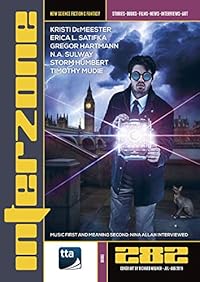
Interzone 282, Jul-Aug 2019

TTA Press, 96 p

 Interzone 282 cover

In her guest Editorial Kristi deMeester tells how her story in this issue was generated. Andy Hedgecock considers cities in Future Interrupteda. In Aliya Whiteley’s Climbing Storiesb she ponders the mysterious processes that go into constructing – and choosing from – a tbr pile.
In Book Zone Andy Hedgecock lauds Nina Allan’s The Dollmaker as literary fantasy at its most ambitious, erudite and entertaining and also interviews the author, I compare Chris Beckett’s Beneath the World a Sea to the best fiction for its exploration of the nature of humanity but am slightly less enthusiastic about The City in the Middle of the Night by Charlie Jane Anders for lacking something in urgency, Juliet E McKenna finds secondary world fantasy The Resurrectionist of Calligo by Wendy Trimboli & Alicia Zaloga highly enjoyable, Ian Hunter rejoices in the delights of New Maps: More Uncollected John Sladek edited by David Langford, Maureen Kincaid Spellerc respects the novels by Ian McDonald (of which Luna: Moon Rising is the third) but cannot love them and welcomes the SF-ness of AfroSFv3 edited by Ivor W Hartmann but also for the reminder that while society and SF have made great strides in increasing representation recently, there is still some way to go.
In the fiction:-
The Verum1 of Storm Humbert’s story is a new kind of drug which delivers experiences which seem real. The narrator is the purveyor of choice for verum, until Regina comes along. The denouement is not what you might expect from this set-up.
The weasel virus turns women’s reproductive organs to mush while killing them. As a preventive measure all as yet unaffected women have had hysterectomies, hence there will be no new humans ever again. Our narrator is working on a Sesame Street-like TV series called Gumdrop Road which is using the preserved bodies of dead children (their brains implanted with computers connected to their nervous systems) to simulate former normality. This is the world of Can You Tell Me How to Get to Apocalypse?2 by Erica L Satifka. The afterword tells us it has been brought to us by the letter P and the emotion despair.
The Frog’s Prince; Or, Iron Henry by N A Sulway is a kind of modern day fairy tale, or variant of one. The titular frog’s ‘prince’ suffers from an unusual curse: to have “no daughter of a woman born.” After turning the frog into a boy – and a lover – he several times turns him into a woman in order to bypass the curse.
A girl is lost in the eponymous mall of The Princess of Solomon Pond Mall by Timothy Mudie. Living things wink out of existence when she sees them. Her only contact with the outside world is through the food drops and robot parachuted in to her by the military looking to exploit her powers.
In Heaven Looks Down on the Tomb by Gregor Hartmann all human life on Earth has long since been eradicated. Those on the moon survived and now a few of their descendants have come down to Earth to try to harness any possible useful bacteria. Factions on the Moon complicate things, though.
In FiGen: A Love Story3 by Kristi deMeester the titular FiGen is a company which claims to be able to predict the likelihood of a spouse having an affair from a genetic sample. Our female narrator attempts to pre-empt the situation.

Pedant’s corner:- aJeffries’ (Jeffries’s, several instances) “Jeffries’ vision is in tune twenty-first century pessimism” (Jeffries’s vision is in tune with twenty-first century pessimism.) b“that is understandable given situation” (given the situation,) Nichelle Nicols’ (Nicols’s,) Billy Dee Williams’ (Billy Dee Williams’s.) cRobrerts’ (Roberts’s,) Garth Ennis’ (Eniss’s.)
All the fiction was written in USian. 1“a smattering of leaves huddle” (a smattering huddles,) maw (it’s a stomach, not a mouth.) 2“lay down” (lie down.) 3“expensive whiskies[sic] drank neat” (drunk neat,) “as if I needed reminding of whom you were” (extra marks for the use of ‘whom’ elsewhere but here it is the subject of ‘were’; so, ‘of who you were’.)

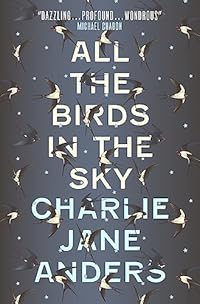
All the Birds in the Sky by Charlie Jane Anders

Titan Books, 2016, 429 p.

 All the Birds in the Sky cover

This, Anders’s first novel, is a blend of Fantasy and Science Fiction which starts off reading like YA fiction but soon enough makes clear that it deals with adult matters too. Patricia Delfine very early in her life realises she is a witch when birds begin to talk to her and she can talk back. She also has a conversation with a speaking tree – The Tree. In school her path crosses that of Laurence Armstead, a so-called techno-geek, who invents for himself a two-second time machine for travel only into the future, and later builds an AI he calls CH@NG3M3. For both of them schooldays are a kind of purgatory, as they are picked on and bullied. Their home lives are little better, both using the other as a means of convincing their parents they are out doing what is desired for them rather than what they wish for themselves. Mixed in with all this is an assassin called Mr Rose who gets a job as counsellor at their school in order to monitor their activities. Despite appearing intermittently in the novel Mr Rose’s function is not really clearly defined.

Later the children’s lives diverge as Patricia finds the company of other witches (whose old division into Healers and Tricksters was patched over many years before.) She is always being warned by them of the dangers of Aggrandisement. It seems just about anything she does can be interpreted in this way. Laurence is recruited by Milton Dirth to work on his project to build a wormhole machine to take humans to another planet. In the background there is a large degree of environmental degradation which makes this construction seem worthwhile and in daily life an electronic device called a Caddy somehow engineers people’s lives to be better through apparently serendipitous meetings and the like. How all these things are connected and Patricia and Laurence’s coming together in adult life are central to the story.

There are some observations on human nature. In one of their conversations Laurence says to Patricia “‘no matter what you do, people are going to expect you to be someone you’re not. But if you’re clever and work your butt off, then you get to be surrounded by people who expect you to be the person you wish they were.’”

Oddly, despite the novel being written in USian I noticed the British usages, “a total wanker,” “for some emergency nookie,” and “one intense wank fantasy.” In addition I was delighted to see the phrase “head for the Dumbarton.” (The Dumbarton is a bridge over San Francisco Bay – the southernmost. Its name derives from Dumbarton Point, itself named after my home town.)

Though it has some flaws, All the Birds in the Sky is overall an impressive debut.

Pedant’s corner:- epicenter [sic] (it was a centre,) a missing comma before a quotation mark, a capital letter after a colon, “none of the computers were connected” (none .. was connected,) “‘to lay low’” (lie low,) Patricia at one point is said to have reasonably fullish breasts but later they are described as small, “Here’s what Isobel said to Laurence, just before the earthquake hit” is a poor – a dreadful – way to start a flashback.

free hit counter script