Archives » Cold War

Sunderland Memorial Wall

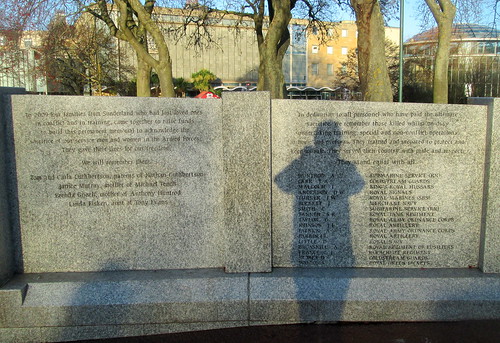
Between Sunderland War Memorial and Mowbray Park a memorial wall has been erected to commemorate those who have served in conflicts since the Second World War and to honour Sunderland’s post-World War 2 fallen.

The first section commemorates non-combat deaths in war:-

War Memorial Wall, Sunderland

The rest of the wall is a sobering reminder of the many conflicts in which British soldiers have lost their lives since 1945.

Palestine and India:-

Palestine and India Memorial Wall, Sunderland

Malaya and the Cold War:-

Malaya and Cold War Memorial Wall, Sunderland

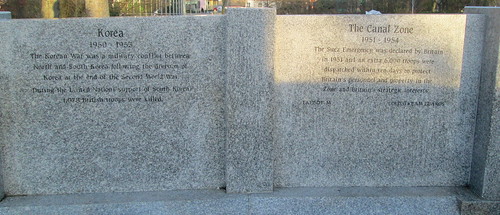
Korea and the Canal Zone:-

Korea and Canal Zone Memorial Wall, Sunderland

Kenya and Cyprus:-

Kenya and Cyprus Memorial Wall, Sunderland

Aden, Radfan and Suez:-

Aden, Radfan and Suez Memorial Wall, Sunderland

Borneo, Northern Ireland and Oman Dhofar:-

Bornoe, Northern Ireland, Oman Dhofar Memorial Wall, Sunderland

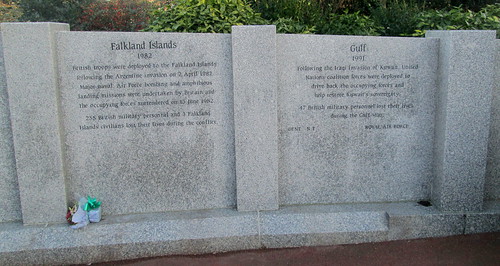
Falkland Islands and Gulf War:-

Falkland Islands, Gulf War, Memorial Wall, Sunderland

Bosnia, Kosovo, Sierra Leone:-

Bosnia, Kosovo, Sierra Leone Memorial Wall, Sunderland

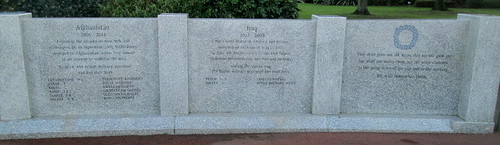
Afghanistan and Iraq, plus Ode of Remembrance:-

Afghanistan and Iraq Memorial Wall, Sunderland

Passings. John le Carré, Gerard Houllier, Otto Hutter

I was sad to hear yesterday of the death of John le Carré. He dragged the spy novel into the post-Second World War world and elevated it to the status of literature. His early novels had all the relevance the Cold War gave to the genre and he illuminated that looking-glass world of the secret services. In George Smiley he gave the world the epitome of the enigmatic, taciturn thinker.

When the Soviet Union fell the spy novel lost a lot of its wider resonance but le Carré adapted to the new circumstances. A total of over 20 successful best selling novels speaks for itself.

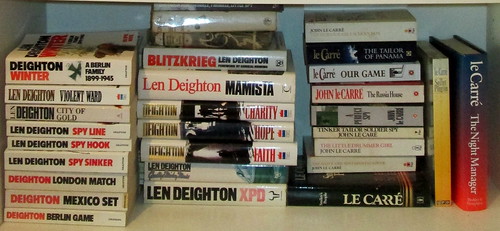
My collection of his books – apart from the omnibus edition of his early works the good lady started to read – is on this shelf.

David John Moore Cornwell (John le Carré): 9/10/1931 – 12/12/2020. So it goes.

Also gone today is Gerard Houllier, one of Liverpool’s more successful managers of the “fallow” period. While he never achieved the holy grail (for Liverpool supporters) of a League Championship he still oversaw an impressive haul of trophies for the club.

Gérard Paul Francis Houllier: 3/9/1947 – 14/12/2020. So it goes.

On Friday I read the Guardian obituary of Otto Hutter. He was one of my lecturers when I briefly (one year only) studied Physiology at Glasgow University back in the day. I don’t think I realised at the time he had been one of those who came to Britain via the Kindertransport. What an incredible contribution to British life those children went on to make.

Otto Fred Hutter: 29/2/1924 – 22/11/2020. So it goes.

Spy Fiction Bookshelf Travelling for Insane Times

This meme, originating with Judith, Reader in the Wilderness, has now been taken over by Katrina at Pining for the West.

Spy Fiction Books

Back in the days of the Cold War spy fiction was a big thing. The two main purveyors of the form – in the UK anyway – were my (sur)namesake Len Deighton (although he pronounces the “Deigh” part to rhyme with “day” rather than “die”) and John le Carré. I also have a le Carré omnibus of his early works shelved elsewhere.

These, too, are housed in the garage, below the last of my SF paperbacks (see last week’s post.)

I have read all the books by Deighton here. His book Fighter is not on these shelves because it’s a history of the Battle of Britain but then Blitzkrieg is also a history book and it is here. Winter is not a spy novel but reflects Deighton’s knowledge of Germany (specifically Berlin) in the first half of the twentieth century. Goodbye Mickey Mouse is a novel featuring members of the US Air Force which took part in the campaign in World War 2 in the lead up to the invasion of Normandy. SS-GB is an altered history set in a Britain where a German invasion of the UK in 1940 succeeded.

I’ve not read all the le Carrés. Spy fiction lost a lot of its resonance when the Cold War ended whereupon he moved on to other things. I always meant to get round to his later stuff but life (and other books) got in the way.

I Miss the Soviet Union

Remember those bad old days of the Cold War? The evil Commies who stamped on people’s rights and stifled individualism?

Well, maybe they weren’t so bad after all.

Yes, life in the Eastern Bloc wasn’t a picnic and freedom of expression is a good thing – provided it isn’t taken too far.

But… The existence of the Soviet Union kept big business in the West honest (to a point.) Inequality was much less pronounced in the UK then than it is now; in the US too I wouldn’t wonder. With the example of a competing economic system to hand there was a brake on excess, those inclined to it restrained their greed. When so-called Communism (a description which was woefully inaccurate, there was little communal about it, it was an autocratic oligarchy) collapsed, the brakes came off and CEOs and executives of big companies let their impulses off the leash. Thoughts of paying and treating fairly the true source of any wealth created by a company’s endeavours, the workers, evaporated. Instead, those workers were squeezed, marginalised, treated with contempt, their abilities to protest curtailed – at least in the UK.

There is a thought amongst certain people – on both sides of the Atlantic – that government is in and of itself a bad thing, “A conspiracy against the people.” (These are probably mostly the same people who want to do whatever they like with no comeback.)

A Trump Presidency may be the experiment that tests that idea.

To destruction.

Unfortunately it won’t be its advocates whose lives will be destroyed. In times of turmoil it rarely is.

Lack of government does not mean freedom, it means anarchy. It means no protection against predators and wrongdoers. It means those with the deepest pockets have no barriers to their avarice prevailing. (It also means they in turn have no protection beyond what they can buy.) In effect, though, it means slavery – either real or (poorly) waged – for the majority.

Regulation of human activity – in any sphere – is actually a necessary constraint. “Freedom from” is as important as “freedom to”.

Which leads to the thought; if you are a woman working in the Trump White House, how safe will you be in terms of your personal autonomy? How free will you be from coercion?

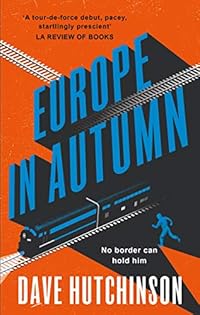
Europe in Autumn by Dave Hutchinson

The latest from the BSFA Awards list – 6 out of 8 read now – but probably the last.

Solaris, 2014, 384 p.

 Europe in Autumn cover

For a long time there was a dearth of detective stories in SF. This may have been because of the necessity that such a story work as both SF and crime novel, creating a gap which writers couldn’t seem to bridge. However any such lack has long since been filled. I don’t recall, though, many outright spy story/SF crossovers. Thrillers, yes (but they are a different beast again.) Yet here we have Europe in Autumn, reminiscent of nothing so much as a Cold War era spy story. This may be due to the fact that, a brief excursion to London apart, it is set mainly in Eastern Europe, areas which were formerly in Warsaw Pact countries. There is too a constant hint of menace, of surveillance, of people with hidden agendas, pervading it. All of which Hutchinson handles with aplomb.

After the devastation of the Xian Flu Europe has fissured into innumerable small statelets, “Sanjaks. Margravates. Principalities. Länder.” One of these polities is a trans-European railway line running from Portugal to Siberia, but never more than ten kilometres wide. In this Europe borders, razor wire, visas and bureaucracy abound; travelling is not simple. Rudi is an Estonian chef working in Kraków who is one day “invited” to join Les Coureurs des Bois, an organisation dedicated to smuggling mail, packages and sometimes people across the numerous borders. His training ends in a disastrous foray into the railway’s territory. Later “situations” also turn out less than well and he begins to wonder why.

This set-up is intriguing. A Europe returned to a pre-Napoleonic patchwork – only much worse; some of the polities extend to no more than a couple of blocks of flats. It’s certainly surprising. One thing I never expected to read was a piece of SF explicitly discussing the merits or otherwise of the Schengen Agreement. How all this sticks together, plus the relevance of maps of non-existent places, is all revealed in a tightly plotted, highly readable thriller style narrative. In parts Europe in Autumn reminded me of The First Fifteen Lives of Harry August – was there something in the air the year before last? – there are extremely faint echoes, growing stronger towards the book’s end, of Transition, plus parallels with The City and the City and similarities with PƒITZ.

Europe in Autumn is a good book – even a very good book – but I’m not entirely sure about its place on the BSFA Award ballot. It has SF trappings to be sure, invisibility suits amongst them, but, in essence, it’s a spy novel.

The phrase “he wardrove around the city” was a new one on me but I’m grateful for it.

Pedant’s corner:- Hutchinson has too much of a fondness for the phrase “tipped his/her/my head to one side,” to indicate a character’s desire for more information, clarification or knowledge of evasion. Also: we had “a raise” (but elsewhere Hutchison also uses the British formulation a pay “rise,”) “I don’t think anybody understands the offside trap any more,” (OK this was a piece of spy speak but shouldn’t it still have been offside law? The offside trap is an effort to employ the law in a team’s favour,) tokomaks (tokamaks,) “for the first time in many years feeling anything approaching sympathy for his father,” (shouldn’t that be something rather than anything?) watched them them go, “Here he was, sitting here quite comfortably,” Minster for Minister.
free hit counter script