Archives » Charles Edward Stuart

Nothing Left to Fear From Hell by Alan Warner 

A Surreal Chronicle, Polygon, 2023, 149 p, including 7 p Afterword.

Nothing Left to Fear From Hell is one of publisher Birlinn’s Darkland Tales which re-examine Scotland’s history from a modern perspective.

In it, a tall man, accompanied by several companions, is making hazardous journeys by small boat between the islands of the Outer Hebrides, mostly under the cover of darkness. They are on the run and at one point the man has to disguise himself as a serving girl, when he is given the name Betty Bourke.

We are of course following the flight of Charles Edward Louis John Sylvester Maria Casimir Stuart (to give him his full complement of names, never used in the text,) otherwise known as Bonnie Prince Charlie, down on his luck but ever hopeful fortune will favour him in the end.

Though the Young Pretender has featured as a character in many of them, most novelistic examinations of the Jacobite inheritance – a perennial subject of Scottish fiction – have focused on that cause’s adherents and their (mis)adventures. I certainly have not before read one in which the Prince is the protagonist. But my acquaintance with the subject is by no means exhaustive.

Warner inhabits the time and its susceptibilities very effectively, presenting a picture of Charles Stuart as a human being, with every necessity and function we all have, along with his convictions of divine right, plus the all but unthinking deference of his comrades. Not that the text confines itself to the viewpoint of the Prince. A particular highlight is a servant girl’s view of the kenspeckle and overly presumptuous Betty Burke

A quirk of this publication is that on even numbered pages between chapters – and before the Afterword – are depictions of that minute pest of the Scottish summer, the midge, with which the travelling party is plagued, starting with one and going up to ten.

In that Afterword Warner speculates on the conundrums of historical fiction, the difficulties of portrayal. As he says, “they were so like us, and they were so unlike us.”

But apart from the drier and necessarily more restricted approach of historical record and academe, fiction is the only way we can explore past times such as these.

This novella gives us Charles Edward Stuart as a believable, if misguided, human being. But he was trapped by his birth; as most of us are.

Pedant’s corner:- “was like a liquified putrescence” (liquefied,) “he crashed items akimbo” (he crashed items with his arms on his hips?) “the riding party were headed onwards making a cover of what might lay over the roads ahead” (the riding party was headed onwards making a cover of what might lie over the roads ahead,) “Robert Forbes’ remarkable” (Forbes’s,) “Winifred Dukes’ The Rash Adventurer” (Dukes’s.)
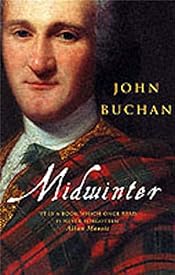
 

Midwinter by John Buchan

Certain Travellers in Old England

B&W Publishing, 265 p, plus iv p Introduction by Alan Massie.

Here is another Scottish novel which scratches the 1745 Rebellion itch but unusually this one is set entirely in England. Presented as a partially incomplete found manuscript it tells the story of Alastair Maclean who had lately been in the service of the King of France but had returned to British shores in order to facilitate the rising of Charles Edward Stuart’s supporters in Wales and the West of England.

Maclean’s mission is a dangerous one; a traveller on the byways in those days was always apt to come under suspicion. With the help of the Naked Men and their leader – the Midwinter of the book’s title – he escapes from apprehension by a man charged with taking any who can not give a good account of themselves to the local magistrate, and arrives at the house of Lord Cornbury, a known Jacobite sympathiser but also one who recognises the folly of the Prince’s enterprise. From then on Midwinter’s group pop in and out of the narrative.

The company at Lord Cornbury’s is supposed to be mainly Jacobite but later it transpires there is a traitor to the cause amongst them, one who thereafter continually dogs and frustrates – given the outcome of History how could he not? – Maclean’s efforts to get to Derby with supposedly good news. Lady Mary Conbury has an unusual take on Mary Queen of Scots. “‘Her frailties were not Stuart but Tudor. Consider Harry the Eighth. He had passions like other monarchs, but instead of keeping mistresses he must marry each successive love, and as a consequence cut off the head of the last one. His craze was not for amours but for matrimony. So, too, with his sister Margaret. So, too, with his great niece Mary. …. What ruined the fortunes of my kinsfolk was not the Stuart blood but the Tudor – the itch for lawful wedlock which came in with the Welsh bourgeoisie.”

A surprise visitor arrives in the form of a tutor to a seventeen-year old girl, Claudia Grevel. This ill-clad worthy is none other than Samuel Johnson, disturbed that Claudia has run off with a Mr Norreys and seeking help to catch the pair before they can be married, a task in which he is doomed to fail. Johnson and Maclean become friendly and travel together for the latter half of the book. Johnson’s appearance in the novel allows Buchan to insert into the text some of that gentleman’s aphorisms.

At a later point the pair fall into the hands of troops loyal to King George. Their commander is a General Oglethorpe whom they met at Cornbury. He berates Maclean on why Charles will not succeed. A new breed of belief, the Methodists, had arisen in the south – “with them is the key of the new England, for they bring healing to the souls of the people. What can your fairy Prince say to the poor and hungry?”

Maclean thinks both Midwinter and Oglethorpe spoke of England like a lover to his mistress and that the country was akin to a spell on sober minds. He tells Midwinter, “You in England must keep strictly to the high road, or flee to the woods – one or the other, for there is no third way. We of the Highlands carry the woods with us to the high roads of life. We are natives of both worlds, wherefore we need renounce neither,” and indeed Midwinter spends most of his time in that mystical realm, the greenwood.

This is a tale packed with adventure, incident, betrayal and peril, but also insight. And it displays an eye for landscape which, though in this case is the English countryside, is a hallmark of Scottish writing.

Pedant’s corner:- King Louis’ service (Louis is pronounced as if it had no ‘s’ at the end; therefore Louis’ will also be so and hence to make its meaning clear its possessive must have ’s at its end: Louis’s,) bourgeoisie (was this word in use in the late eighteenth century?) “Jack Norreys’ neck” (Norreys’s,) ditto Lady Norreys’, “The forest had woke up” (woken,) “came the gypsies crazy cackle” (gypsy’s.)

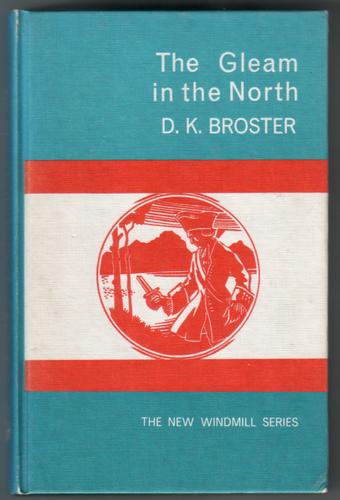
The Gleam in the North by D K Broster

Windmill, 1958, 302 p.

The Gleam in the North cover

This is the second of Broster’s Jacobite trilogy (the first of which, The Flight of the Heron, I wrote about here.) Again it follows the fortunes of Ewen Cameron of Ardroy and also once more starts with a scene set at the Loch of the Eagle on his estate. Ewen’s son Donald pushes his younger brother Keith into the loch as revenge for him throwing his favourite object, a sword hilt memento from the Battle of Culloden, into the loch. Ewen has to effect a rescue but Keith becomes ill and the local doctor is summoned but is on a call. Meanwhile Ewen’s cousin Archibald Cameron, still in the service of the young Pretender, Charles Edward Stuart, and so subject to government attainder, turns up at the house and, as a doctor himself, ministers to the child. When Doctor Kincaid arrives he surmises the Camerons’ visitor is indeed the wanted man and informs the authorities. So Ewen’s adventures begin once more, as he is taken in to Fort William to be questioned and eventually bust out.

In his peregrinations about the Western Highlands trying to avoid government soldiery Ewen comes across Viscount Aveling, half-brother of the Major Keith Windham whom he befriended in The Flight of the Heron and from whom he learns that Archibald Cameron’s whereabouts have been betrayed. In the process, though, he makes an enemy of Aveling. Trying to warn Archie, Ewen only ends up injured during his capture.

After convalescing, Ewen makes his way to London to attempt to secure Doctor Cameron’s release and one night rescues a gentleman from street thieves. This turns out to be Lord Stowe, Aveling’s father. Coincidences being stretched a mite too far here perhaps. The rest of the book is made up of Ewen’s encounters with Aveling’s mother, Jacobite turncoats and trying to intercede with the Duke of Argyll, a Campbell and so sworn enemy of the Camerons but the government’s man for Scottish affairs.

While not as immediate in its chronicling of historical events as was The Flight of the Heron Broster manages to keep the level of peril reasonably high. A description of the Aurora Borealis could be taken to be the gleam in the north of the book’s title, as well as an allusion to the residual glimmer of the hopes of the Stuart dynasty, but the aurora’s relatively quick disappearance “as if it had never been” does not, quite, apply to the ramifications of the 1745 Jacobite rising.

Sensitivity alert. In a piece of stereotyping racist to modern eyes, a black servant of Lord Stowe is named Sambo.

Pedant’s corner:- had …. sowed (sown,) “would none of the thanks” (would have none of,) an extra comma in “‘Yes,, you may do that’”,) “once for all” (once and for all,) “They an prove nothing” (They can prove nothing,) gillie (ghillie,) “requires, it for his chaise” (no comma necessary,) a missing single quote mark at the end of a thought followed by a missing start one at the direct speech following on from it, a missing comma at the end of a piece of direct speech where the sentence carried on, paplably (palpably,) Gailbraith (elsewhere Galbraith,) Lock Arkaig (Loch Arkaig,) caryatides (caryatids.)

Time Travel, Reviews, Hame and Rebellions

In an article in Saturday’s Guardian review, James Gleick examined the history of the time travel story since H G Wells more or less invented the form in The Time Machine. It was a skate over the subject really and veered into the territory of so-called Alternative History which of course I prefer to name Altered History but worth reading all the same.

In the same section of the paper was a review of Annalena McAfee’s new novel Hame. Many reviews are interesting, some make you think “definitely not”. Very few inspire you to go out and read the book concerned. Stuart Kelly’s did just that, as indeed did his review of Kevin MacNeil’s The Brilliant and Forever which I read a few months ago after also reading the same author’s A Method Actor’s Guide to Jekyll and Hyde due to the same review. McAfee’s Hame sounds intriguing and possibly funny. Definitely one I’ll look for.

I recalled McAfee’s name. She had an article in the Guardian Review some weeks ago which I wished to post about then but at the time could not find on the Guardian website but which now pops up fourth when you search her name there. The article was about the relative importance of Robert Burns and the possible balefulness of his mythologising (Aside. Why does no-one ever question this about Shakespeare?) and the continuing battle over whether Scots is a suitable medium of expression for literature.

My take is if the author wishes to use Scots it is entirely up to her or him. It may reduce the psossible readership but that is a question for author and publisher, not reader. Myself, though not very well versed in it, my mother being the daughter of two English parents, thus hardly a native speaker and unable to expose me to its richness, I do not consider Scots – as some do – as necessarily inferior form to English. It is at times much more pithy.

I have a quibble with McAfee over a detail in that piece, though. She stated that Burns was born “two decades after the failed rebellion against the Union.” While Prince Charles Edward Stuart’s Rebellion of 1745-6 was many things, not least the last flailing gasp of a failed dynasty, and the Battle of Culloden can even be considered as in some way (if you ignore its continuation into Ireland even into the twentieth century and possibly beyond,) the last of the Thirty Years War – though admittedly that was mostly fought out in German territories – it was not primarily against the Union. It was less general then that, more personal.

Glenfinnan (Gleann Fhionghain)

The day after our train journey we made the trip to Glenfinnan (or Gleann Fhionghain) by road. It was there, at the head of Loch Shiel, that the standard of Charles Edward Louis John Casimir Sylvester Severino Maria Stuart (aka The Young Pretender or, more commonly, Bonnie Prince Charlie) was raised in 1745 to start the doomed enterprise that was the Jacobite Rebellion which became known as the ’45 and ended at Culloden, the last battle to be fought on British soil.

In 1815 a monument was erected in memory of the clansmen who fought and died. It is now in the care of the National Trust for Scotland. Being members, we took in the Visitor Centre and climbed the monument. That’s a bit scary. The stairs are steep, headroom is limited and the space at the top isn’t large. The views from the top are brilliant though.

The good lady nicked some of these photos before I got to them.

This is the monument from the approach path:-

Loch Shiel from the top of the monument:-

Glenfinnan Viaduct from the monument:-

The vilage of Glenfinnan’s War Memorial is situated in a recess by the road on the way up to the village from the monument to the station.

It’s a dignified figure of a soldier with bowed head. His rifle is apparently wooden. The names are on the rear for some obscure reason.

free hit counter script