Archives » Alasdair Gray

The Dear, Green Place by Archie Hind

Polygon, 2008, 248 p, plus viii p introduction by Alasdair Gray. In The Dear Green Place and Fur Sadie.

Borrowed from a threatened library. (One of the 100 Best Scottish Books.)

 The Dear, Green Place cover

Many Scottish novels betray a love of the country’s landscape, some even start with descriptions of it. So too it is with The Dear, Green Place, except – the place in question being Glasgow – it’s a cityscape we are reading about. Glasgow’s name is supposedly from the Gaelic Gles Chu, (“the dear green place”) the location where St Mungo (St Kentigern in the Celtic) built his little church and founded the settlement which became the second city of the empire. As described here, “A Calvinist, Protestant city. The influx of Roman Catholic Irish and Continental Jews had done nothing to change it. Even they in the end became Calvinist.” (This is true not just of Glasgow but reflective of Scotland as a whole.)

Our protagonist, Mat Craig, thinks of the city that, “the foundries, steelworks, warehouses, railways, factories, ships, the great industrial and inventive exploits seemed to give it all a kind of charm, a feeling of energy and promise,” and finds pride in the thought that during the (1945-51) Labour Government’s first term of office domestic life changed from sordidness and squalor to become decent. Like many a working man of the times he is well read – the text is peppered with references to art and literature, in particular to Thomas Mann – and capable of finding the dynamic sublime in the dripping of raindrops from one rail of a fence to another. “The dynamic sublime. A wee Glesca one. All on a reduced scale.” On New Year celebrations he feels that it is, “good in the depth of winter to have a formal and ceremonious occasion for the release of inhibitions, but in Glasgow drink still leaves the sober certainty of the bitterness of life and the inexorable passage of time.”

His great ambition is to be a writer but his mother is against him getting above himself. She complains when he gives up his office job, “It’s a guid respectable job with a collar and tie.” He replies, “Aye. It’s respectable. And I’m fed up to the teeth with respectability. As soon as anyone shows any sign of gumption you want him to become respectable. Put a collar and tie on. It’s in case they’ll bite. They’re frightened they’ll bite. And so they will. The ones that don’t get collared.” But, he thought, he would always have to make concessions to others just because he loved them. “It was exactly thus that conscience makes cowards of us all.”

He marries and to make ends meet goes to work alongside his brother in a slaughterhouse. There are vivid descriptions of the processes involved in rendering an animal fit for human consumption. He meets with minor success with a few short stories written in a style he knows will sell but completing his novel is a more elusive task. Even stopping work and living on his and his wife’s savings isn’t enough. He feels a deep attachment to his art, “obliging him to accept the arrogant task of creating art out of deprivation rather than choose the easy way of leaving deprivation behind him…. To attempt the difficult, almost impossible task of making art out of his Scottishness rather than turn towards a sophisticated, successful but alien tradition.”

On the death of his father in a lorry accident he thinks, “everything in human life – the everyday common tasks, sex, love, contentment, aspiration, ordinary human intercourse, hope, laughter, were like dirty snivelling little secrets being uncovered by this sneering, wicked, expedient, mechanistic force that was the world,” and conceives “a story of this bonny wean, of a gifted child who’d scatter his useless gifts about the world; a story of prodigality, of waste, of squandering, which would contain all his sourness, pessimism and accusation; and his love too.”

An intensely literary book, The Dear, Green Place is about the struggle to stay yourself and be true to a vision, and the difficulties that lie along that path. And a reminder that knowledge and deep thinking do not belong exclusively to the well-heeled.

According to Alasdair Gray’s introduction (again I left this till after reading the book) Hind’s shorter works – plays, radio scripts and some short stories – are now lost. All that remains of his œuvre is contained within this book’s covers. The Dear, Green Place is the major part and acts in contrast to the stereotypical view of Glasgow and its inhabitants as portrayed in the likes of No Mean City. Gray tells us that Gles Chu has been previously translated as green hollow, green churchyard, greyhounds ferry, dear stream, and later, in Glasgow’s industrial, imperial pomp, grey forge or grey smithy but that the dear green place, Hinds’s own translation, is now generally accepted. Though sometimes, still – even now the smoke and the industry have largely gone – that description can seem inapt, the city does have an abundance of parks and leafy spaces.

The other large story in these covers is the unfinished Fur Sadie, the story of Sadie Anderson, a woman with perfect pitch – her ‘doh’ (in her head she can translate intervals and chords into sol-fa) – who, remembering her childhood friend Anna Berman playing the piano, in middle age buys one of her own and starts to get lessons – despite the incomprehension and teasing she receives from her husband, Alec, and sons, Hugh and Colin. In a pun on musical terminology and the position of a working class woman of her time Hind tells us Sadie had always known how to diminish. Despite many years of marriage and three children together Sadie and Alec had never seen one another naked, “A terrible modesty that excluded sexuality from the commonplace acts of the day and, denying ordinary acts of touching and looking, denied a way of expressing tenderness.” This “modesty” surrounding the human body (pudency would be an even more apt term) was an all too prevalent tendency in a Scotland steeped in Calvinism. The story’s title is not only a reference to Beethoven’s piano composition Für Elise but also to the way the word “for” is pronounced in Glasgow dialect. Fur Sadie acts as a companion piece to The Dear, Green Place in that it features another working class protagonist with aspirations to artistic endeavour but it has a more optimistic feel. It’s a pity it is incomplete (apparently Hind said, “It developed a slow puncture,”) as Sadie is an engaging character and this reader of the fragment was definitely left wanting more.

The final prose piece in the book, The Men of the Clyde, appeared in Scottish International, August 1973, and is an encomium to the workers of the Upper Clyde Shipbuilders work-in. Lastly there is a song lyric, The Dear Green Place, (composed with Peter Kelly) from a review Through with a Flourish presented at the Edinburgh International Festival in 1971.

Pedant’s corner:- compatability, (compatibility,) grills (grilles,) rough shod (roughshod,) in a list “paraffin. turpentine,” (paraffin, turpentine,) octopi (octopuses or, the Greek plural, octopodes,) the cuticle of the nails (cuticles would be more correct,) tick (tic,) Anna’s surname flicks from Bermant to Berman and back,) worried at lot (worried a lot,) piano stood (stool,) just that same (just the same,) waked in (walked in,) rubbing a corned (corner,) “Beethoven’s sly double use of the piece, which was for Elsie in the concession to unlearned fingers and that it was for Elsie in that it seemed to express, sensuously, her young bloom” (should not both these Elsies be Elises?)
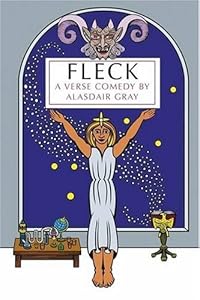
Fleck: a Verse Comedy by Alasdair Gray

A Comedy in Verse Derived from Goethe’s Tragedy of Faust. Two Ravens Press, 2008, 104 p.

Fleck cover

Gray is multi-talented; playwright, novelist, artist. A graduate of the Glasgow School of Art, he illustrates his own books (and those of others) in a distinctive style. His first novel, Lanark, instantly established him as one of the most important Scottish novelists of his or any generation. His left wing politics are not hard to discern and his enthusiasm for Scottish independence and Scottish culture has displeased some.

Fleck does what it says on the tin; reworks Faust in a modern idiom with the main character recast as a Scottish scientist, Fleck. Other characters include God, Nick and the journalists Pee and Cue. The book also includes a postscript by the author where he discusses the appearances of the devil in the Bible (there are only two,) Satan’s co-option by the established church to police sensuality, the evolution of the Faust story and its influence on Gray personally, and the drawbacks of Goethe’s version. Finally there are five Gray poems which deal with God. A packed 104 pages then.

Verse is a surprisingly good vehicle for Gray’s updated tale. (Or perhaps not surprising if you think of Shakespeare.) The rhythm of the iambic pentameter is a fine motor. And it throws up nicely judged juxtapositions, “Broadcasters think the public is a fool/ so sounding stupid is their golden rule.”

Very little that Gray has written is not worth reading. Fleck is no exception. Not just the play but the postscript and poems too.

Pedant’s corner: Labelling a year as Anus Domini looks like it may be a misprint but I wouldn’t put it past Gray to have used it deliberately. But oughtn’t tug-of-wars for supremacy be tugs-of-war? Bismark for Bismarck.

Merchandise at Kirkcaldy Library

For about a year or so – perhaps more – the shop at Kirkcaldy Library has had for sale items designed by locally based artist Susan McGill. The last time I was there I took this photo:-

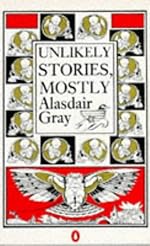
Unlikely Stories Mostly cover
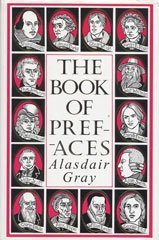
The Book of Prefaces Cover

To me the designs above are very reminiscent of those of Alasdair Gray. (See left and right.)
The McGill merchandise includes greetings cards, dish towels and trays. The writing on the tray says, “The Human Race may be a’richt, but this intae yer lug. The mair I see o’ some folks the mair I like ma dug,” or, in plain English, “The Human Race may be all right, but this into your ear. The more I see of some people the more I like my dog.” One of her greetings cards displays a side-on picture of a black and white dog with the second of her two sentences as the caption. A close-up on the tray is below.

The Mair I Like Ma Dug

Book Haul

On Saturday we went to the Christain Aid booksale which is held every two years at St Andrew’s and St George’s Church, George Street, Edinburgh. It was mobbed.

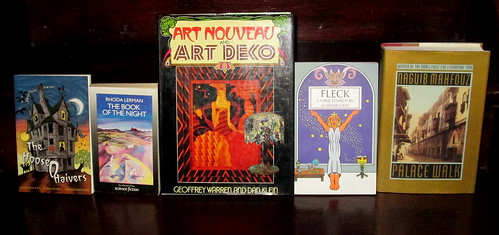
This was my haul:-

Book Haul

The Hoose O Haivers took my fancy just because of its title – it contains short stories by Matthhew Fitt, Susan Rennie and James Robertson.

Rhoda Lerman’s The Book of the Night is a Womens’ Press SF publication from 1986.

The Art Nouveau and Art Deco book was spotted by the good lady (who herself bought 13 books!) It has some lovely illustrations.

Fleck is a verse comedy by Alasdair Gray.

Palace Walk is the first of Naguib Mahfouz’s Cairo trilogy.

Goodness knows when I’ll get round to reading them.
The Hoose O Haivers and Fleck are quite short so I could fit them in easily enough I suppose. The Mahfouz looks like a long project though.

The book sale continues till Friday.

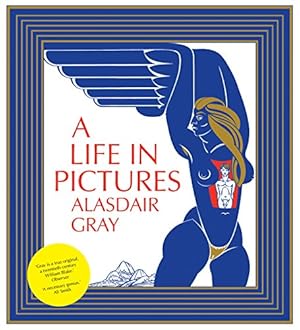
A Life In Pictures Alasdair Gray

Canongate, 2010, 304p

 A Life In Pictures cover

This is not an autobiography but a visual chronology of Alasdair Gray’s life. His earliest days are seen in photographs; after his artistic ability became apparent those paintings, drawings, leaflets, book covers, murals etc of which a record remains have all been reproduced in the book, each annotated with the date it was made and the medium he used. One chapter is devoted to the work of Alan Fletcher, a friend of his from Art School, who died young.

Accompanying the pictures are some explanatory words (which only incidentally add up to a potted biography.) Gray seems always to have been a not strictly representational artist – at school an art teacher told him his shadows were wrong or not present; he adopted multi-perspective views. He did attend the Glasgow School of Art, his peers recognising Charles Rennie Mackintosh’s masterpiece as a wonderful building for their purposes but none of them having been made aware of its designer nor that he had been Scottish until informed by a foreign visitor. That circumstance is almost incomprehensible today. Gray complains of the tutors being hidebound, wedded to the principles of Ruskin, uncaring (ignorant?) of Modern Art, with no mention of the Colourists, as a result of which he and his contemporaries were effectively reinventing earlier modes. There was too an implicit lack of encouragement, no idea of the possibility of making a living as an artist in Scotland. (Arguably there was none at that time.) It was only because Gray was not accepted into the Painting Department for his third year that he took up his signature murals. That seems to me to hang over all his later work as his style is distinctive, even his portraits display that blockiness. So, in a lesser way, do the few landscapes he has painted, which are not as obviously Gray works as the paintings and murals are. Many of his paintings actually remain unfinished since he did not have sufficient time to devote to completing them.

The book is, of course, a feast for the eyes but the text is marred by a few typos. (Proof reading such a complex project cannot have been easy, though.) It does not exist for the text however.

At time of writing Gray is still at work on the huge commission to adorn the walls and ceiling of the Oran Mor Arts and Leisure Centre at the top of Byres Road, Glasgow.

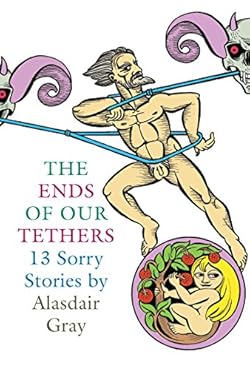
The Ends Of Our Tethers, 13 Sorry Stories by Alasdair Gray.

Canongate, 1985, 181p.

Every Gray book is a visual delight. This is another of those beautifully produced Canongate editions of Gray’€™s works, as usual with wide margins and illustrations by the author, though here there are no footnotes nor marginal annotations. In the main these so-called sorry stories feature, as the book’s title suggests, put-upon protagonists and include more than a few tales of unsatisfactory or failed marriages. They vary in length from two or so to 44 pages.

Gray’€™s narrators tend to have an air of detachment about them and it is unsurprising that their relationships are dysfunctional. Some have especially unfortunate habits. Job’€™s Skin Game‘€™s narrator is so fascinated by his own eczema he subject his scabs to almost Linnaean levels of classification.

Of the other stories that do not focus on marriage Aiblins features the suppression by an academic of a younger poet’€™s works and acts partly as a device to smuggle in some of Gray’€™s own (accomplished) poetry which he nevertheless deconstructs in typical Gray fashion. Wellbeing is about the necessity of not being sane in our crazy world and Big Pockets With Buttoned Flaps is an unusual erotic preference.

15 February 2003 is not so much a story as an account of an anti-Iraq war march. Here Gray mentions that the USSR invaded Czechoslovakia at the time of the Suez crisis in 1956. He is confusing this with the invasion of Hungary in that year. The (crushed) Prague Spring was in 1968.

With its illustrations of disconnection mixed with the odd desultory polemic, as an introduction to Gray’€™s world view this collection couldn’t be bettered.

Edinburgh Again

We took another stroll along the Water of Leith yesterday and there was the heron again. (I assume it’s the same one we saw before.)

<center

It was quite undisturbed while we were going past, standing stock still, making the photo easier. It only moved up on to the bank after we were along the path a bit.

We browsed the book and charity shops in Stockbridge for a while but I came away empty handed. The good lady picked up two books to add to her to be read pile.

This time we came back via the town and so passed the Dene Bridge at the upper level.

There’s no idea from here of how high above the water the roadway is nor of the immensity of the pillars.

Later we dropped into the Scottish National Gallery of Modern Art off Belford Road.

There are sculptures outside; including an unmistakable couple of Henry Moores.

One is at the front.

There is another beside the path which leads down from the car park to the Water of Leith.

Much of modern art leaves me cold but Moore’s sculptures are interesting.

Most of the stuff inside is a bit meh but the figurative paintings by the Scottish Colourists are an exception. (I’m used to these though as the excellent Kirkcaldy Museum and Art Gallery has a fine collection of Peploes as well as some others.)

There were too some pictures by Alasdair Gray on exhibition in the Gallery to tie in with the newly published book of his art work, A Life In Pictures.

Working Legs: a play for people without them by Alasdair Gray

Dog And Bone, 1997, 134p

Gray wrote Working Legs at the request of Birds Of Paradise a Glasgow-based theatre company which stages plays using physically disabled actors.

It is set in a society where to be in a wheelchair is the norm and those who can stand and walk are unusual and frowned upon. The plot concerns the trials and tribulations of Able McMann, who is hypermanic and cannot stop himself using his legs. This is a kind of inversion typical of SF (to which Gray is, of course, no stranger) and while the play is somewhat programmatic at times it does highlight issues surrounding society’€™s treatment of those who are different while incidentally satirising Thatcherite politics of swingeing cuts (now a timely concern again) and the machinations and manipulations of the tabloid press. The resolution could be sentimental were it not undercut by the reappearance of a minor character, but it does round things off satisfactorily.

The book is also copiously illustrated with Gray’s unmistakable idiosyncratic art work.

I don’€™t usually read plays and bought this only as a Gray completist. I did enjoy it, though.

Blooding Mister Naylor by Chris Boyce

Dog And Bone, 1990. 244p

Blooding Mister Naylor cover

Jack Naylor is a solicitor for a Glasgow legal firm (working from their branch in Dumbarton!) He has frequently acted for the activists of a local peace camp located in Glen Douglas. When two of their number are arrested for the murder of a noted and well-liked peace campaigner in Glasgow he is asked to take on the case. It is his first time acting for someone accused of murder; hence the title Blooding Mister Naylor. About halfway through the book as the plot began to complicate and fold back on itself I began to form the suspicion that the title would perhaps become all too literal.

One of the two accused, a woman, is released early on. The usual sorts of complications ensue. Naylor’s bosses do not want him to take the case, there are hints of MI5 and SBS involvement, multi-national corporations lurk in the background, Naylor’s movements are followed, his phone calls tapped and his professional integrity questioned in the press.

This is a work in the comical/thriller style later mined so enthusiastically by Christopher Brookmyre and as such is very readable, but is a shade or two darker.

Unfortunately the book is littered with typos and/or misspellings. Dog And Bone was, I fear, a publishing venture based on less than a shoestring though with a striking set of covers unmistakably designed by Alasdair Gray.

If you like Brookmyre, though, give this one a go.

Sadly there will be no more like this from Chris Boyce as he died in 1999. So it goes.

Consider Phlebas: Towards A Scottish Science Fiction

Throughout the 1950s, the early 1960s, through the late 60s efflorescence of the New Wave and into the 1970s and 80s a stream of English authors came to prominence in the SF field and had novels published in Britain. To my mind there was a clear distinction in the type of books all these authors were producing compared to those emanating from across the Atlantic and that certain characteristics distinguished the work emanating from either of these publication areas. While Bob Shaw was a notable Northern Irish proponent of the form during this period and Christopher Evans flew the flag for Wales from 1980 something kept nagging at me as I felt the compulsion to begin writing. Where, in all of this, were the Scottish writers of SF? And would Scottish authors produce a different kind of SF again?

Until Iain M Banks’s Consider Phlebas, 1987, contemporary Science Fiction by a Scottish author was so scarce as to be invisible. It sometimes seemed that none was being published. As far as Scottish contribution to the field went in this period only Chris Boyce, who was joint winner of a Sunday Times SF competition and released a couple of SF novels on the back of that achievement, Angus McAllister, who produced the misunderstood The Krugg Syndrome and the excellent but not SF The Canongate Strangler plus the much underrated Graham Dunstan Martin offered any profile at all but none of them could be described as prominent. And their works tended to be overlooked by the wider SF world.

There was, certainly, the success of Alasdair Gray’s Lanark in 1981 but that novel was more firmly in the Scottish tradition of fantasy and/or the supernatural rather than SF (cf David Lindsay’s A Voyage To Arcturus, 1920) and was in any case so much of a tour de force that it hardly seemed possible to emulate it; or even touch its foothills.

David Pringle noted the dearth of Scottish SF writers in his introduction to the anthology Nova Scotia where he argued that the seeming absence of Scottish SF authors was effectively an illusion. They were being published, only not in the UK. They (or their parents) had all emigrated to America. Though he has since partly resiled on that argument, it does of course invite the question. Why did this not happen to English SF writers?

It was in this relatively unpromising scenario that I conceived the utterly bizarre notion of writing not just Science Fiction but Scottish Science Fiction and in particular started to construct an SF novel that could only have been written by a Scot. Other novels may have been set in Scotland or displayed Scottish sensibilities but as far as I know I’m the only person who deliberately set out to write a novel of Scottish SF.

It could of course simply be that there was so little SF from Scotland being published because hardly anyone Scottish was writing SF or submitting it to publishers. But there were undoubtedly aspirants; to which this lack of role models might have been an off-putting factor. I myself was dubious about submitting to English publishers as they might not be wholly in tune with SF written from a Scottish perspective. I also thought Scottish publishers, apparently absorbed with urban grittiness, would look on it askance. I may have been completely wrong in these assumptions but I think them understandable given the circumstances. There is still no Scottish publisher of speculative fiction.

With Iain M Banks and Consider Phlebas the game changed. Suddenly there was a high profile Scottish SF writer; suddenly the barrier was not so daunting. And Phlebas was Space Opera, the sort of thing I was used to reading in American SF, albeit Banks had a take on it far removed from right wing puffery of the sort most Americans produced. Phlebas was also distant from most English SF – a significant proportion of which was seemingly fixated with either J G Ballard or Michael Moorcock or else communing with nature, and in general seemed reluctant to cleave the paper light years. Moreover, Banks sold SF books by the bucketload.

There was, though, the caveat that he had been published in the mainstream first and was something of a succès de scandale. (Or hype – they can both work.)

[There is, by the way, an argument to be had that all of Banks’s fiction could be classified as genre: whether the genre be SF, thriller, in the Scottish sentimental tradition, or even all three at once. It is also arguable that Banks made Space Opera viable once more for any British SF writer. Stephen Baxter’s, Peter Hamilton’s and Alastair Reynolds’s novel debuts post-date 1987.]

As luck would have it the inestimable David Garnett soon began to make encouraging noises about the short stories I was sending him, hoping to get into, at first Zenith, and then New Worlds.

I finally fully clicked with him when I sent The Face Of The Waters, whose manuscript he red-penned everywhere. By doing that, though, he nevertheless turned me into a writer overnight and the much longer rewrite was immeasurably improved. (He didn’t need to sound quite so surprised that I’d made a good job of it, though.)

That one was straightforward SF which could have been written by anyone. Next, though, he accepted This Is The Road (even if he asked me to change its title rather than use the one I had chosen) which was thematically Scottish. I also managed to sneak Closing Time into the pages of the David Pringle edited Interzone – after the most grudging acceptance letter I’ve ever had. That one was set in Glasgow though the location was not germane to the plot. The idea was to alternate Scottish SF stories with ones not so specific but that soon petered out.

The novel I had embarked on was of course A Son Of The Rock and it was David Garnett who put me in touch with Orbit. On the basis of the first half of it they showed interest.

Six months on, at the first Glasgow Worldcon,* 1995, Ken MacLeod’s Star Fraction appeared. Another Scottish SF writer. More Space Opera with a non right wing slant. A month or so later I finally finished A Son Of The Rock, sent it off and crossed my fingers. It was published eighteen months afterwards.

I think I succeeded in my aim. The Northern Irish author Ian McDonald (whose first novel Desolation Road appeared in 1988) in any case blurbed it as “a rara avis, a truly Scottish SF novel” and there is a sense in which A Son Of The Rock was actually a State Of Scotland novel disguised as SF.

Unfortunately the editor who accepted it (a man who, while English, bears the impeccably Scottish sounding name of Colin Murray) moved on and his successor wasn’t so sympathetic to my next effort – even if Who Changes Not isn’t Scottish SF in the same uncompromising way. It is only Scottish obliquely.

So; is there now a distinctive beast that can be described as Scottish Science Fiction? With the recent emergence of a wheen of Scottish writers in the speculative field there may at last be a critical mass which allows a judgement.

Banks’s Culture novels can be seen as set in a socialist utopia. Ken MacLeod has explicitly explored left wing perspectives in his SF and, moreover, used Scotland as a setting. Hal Duncan has encompassed – even transcended – all the genres of the fantastic in the two volumes of The Book Of All Hours, Alan Campbell constructed a dark fantastical nightmare of a world in The Deepgate Codex books. Gary Gibson says he writes fiction pure and simple and admits of no national characteristics to his work – but it is Space Opera – while Mike Cobley is no Scot Nat (even if The Seeds Of Earth does have “Scots in Spa-a-a-ce.”)

My answer?

Probably not, even though putative practitioners are more numerous now – especially if we include fantasy. For these are separate writers doing their separate things. I’ll leave it to others to decide whether they have over-arching themes or are in any way comparable.

PS. Curiously, on the Fantastic Fiction website, Stephen Baxter, Peter Hamilton and Alastair Reynolds are flagged as British – as are Bob Shaw, Ian McDonald, Christopher Evans and Mike Cobley – while all the other Scottish authors I’ve mentioned are labelled “Scotland.” I don’t know what this information is trying to tell us.

*For anyone who hasn’t met the term, Science Fiction Conventions are known colloquially as Cons. There are loads of these every year, most pretty small and some quite specialised. The Worldcon is the most important, an annual SF convention with attendees from all over the globe. It’s usually held in the US but has been in Britain thrice (Glasgow 2, Brighton 1) and once in Japan, to my knowledge. The big annual British SF convention is known as Eastercon because it takes place over the Easter weekend.

Edited to add (6/6/2014):- Margaret Elphinstone should be added to the list above of Scottish authors of SF. Her first SF book The Incomer appeared from the Women’s Press in 1987, the same year as Consider Phlebas, but I missed out on it then. My review is here.
See also my Scottish SF update.

Edited again to add (4/4/18) Elphinstone’s sequel to The Incomer is A Sparrow’s Flight which I reviewed here.

free hit counter script