Fall of Man by Rupert Croft-Cooke
Posted in Other fiction, Reading Reviewed at 12:00 on 5 May 2025
Macmillan and Company, 1955, 316 p.
 While this is a very well written account of the life of the narrator, Arthur’s, lifelong friend, Antony Scaw, the years have not been kind to its culmination.
Antony was one of those types who are, if not entirely self-absorbed, at least disinterested in the wider world. In Antony’s case even to the extent of not noting the sensitivities of the rest of his family in not speaking of their brother Jack, killed in the Great War.
The early chapters relate life in Antony’s home Ripstead, where his mother finds him difficult to understand. But Arthur is accepted as almost part of the family in part due to his friendship with Antony. The pair endured Wincaster, a minor public school, together before entering adult life after the war
Antony married a woman named Olivia, but they soon grew apart and she began going around with one Reggie Duggan. The group in whose circles he moved could not comprehend his attitude in allowing Olivia to behave as she wished but Antony was of the belief that it was not his business to dictate how other people lived. Later, long after the catastrophic end of his wife’s affair, Antony mentions to Arthur their “‘predecessors who refused to take the omnipotent “They” of life quite seriously’” and had suffered for it.
By this time Antony’s painting had made him moderately successful and after the Second World War he had moved to Long Baddeley, where he lived with a housekeeper Mrs Potter – who gets squiffy now and again – and a ten-year-old girl, Pippa, whose parents had abandoned her.
Local widow Sally Greenway takes a fancy to Antony but he is not interested and Sally’s attachment sours to disillusion and suspicion, suspicion which she fosters with the authorities and bolsters with her questioning of Pippa on taking her out for the day.
It is, of course, the paintings of Pippa which Antony has made, of Pippa unclothed, which become the most damning evidence against him.
Narrator Arthur is convinced of Antony’s innocent intent and the reader has to take that, Pippa’s attitude to him and Antony’s denials of impropriety at face value but at the same time must think a line has not only been crossed but been travelled far beyond. The tragedy unfolds as it must, all the circumstances of Antony’s home life and the prurience of police and court officials pointing only one way.
Despite Fall of Man being at heart a plea for the understanding, even tolerance, of non-conformity (Antony’s actions in the book did not harm anyone, least of all Pippa, it was the initial court proceedings which did that to her) it is more than likely that had Croft-Cooke been around to consider such a plot in the present day he would not have written it nor, if he had, found a publisher for it.
Pedant’s corner:- a missing comma before a piece of direct speech (x 2,) “a character in a wideawake hat with a tawny beard” (a little clumsy. How can a hat have a beard?) hu-ha (nowadays spelled ‘hoo-hah’,) wistaria (wisteria,) “for politeness’ sake” (to avoid that annoying apostrophe use ‘for the sake of politeness’.)
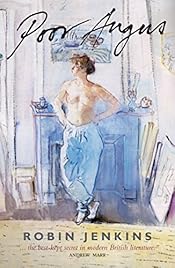 After a sojourn in Basah in the far East, painter Angus McAllister has returned to his Hebridean roots on the island of Flodday, whose only drawback is that the local women refuse to pose for him.
 The author is of course the doyenne of
  This, Shafak’s debut novel, has similarities with Aala Al Aswany’s
  In the future universe this novel describes people live in kinds of utopias where they don’t bother to learn many languages or even to read and write, delegating translation to AIs and work to machines, an existence which in effect renders the typical specimen of humanity, to a degree, infantile. Nevertheless, two different modes of faster than light travel dubbed α and β have been developed. The first utilises simultaneous time and space dilation and is (fractionally) slower than the second, which deploys extremely rapid spacetime bubbling. (Not that this is important. Any putative FTL technology is only ever a handy device for getting characters from A to B.) The α and β spacecraft types in which their passengers travel are called startships (note that second ‘t’,) which are essentially hospitals; space travel, of any sort, is dangerous, a spaceship’s passengers require protection. And the ships themselves, contrary to some earlier imaginings, are not transplanted marine vessels since a spaceship doesn’t need a rigid framework nor corridors. Here, instead, they consist of woven clusters of moveable Meissner tetrahedra linked together by smartcable. Utopias, though, need to be escapable or conflict will arise. And escape from a spaceship is difficult.
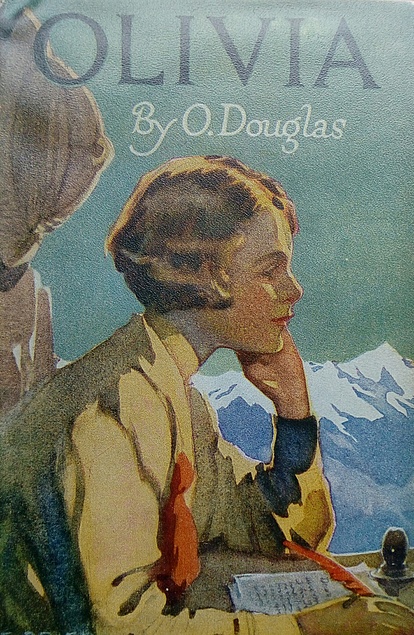 O Douglas was the
  In her introduction – which, as is usually the best approach with them, ought to be left until after reading the text – Susan Sontag states that novels that proceed largely through dialogue, or are relentlessly jocular or didactic, those whose characters do little but muse to themselves or debate with someone else, or are initiated into secret knowledge, those with characters having supernatural qualities or contain imaginary geography are – despite the long history of the picaresque tale and the many classic stories which exemplify these things – considered innovative, ultra-literary or bizarre, and are given labels to signify their outlier status
 Reading Scott these days is an exercise in completion or in acknowledging roots. The roots of long-form fiction, of Scottish story-telling, of the historical novel as a genre.
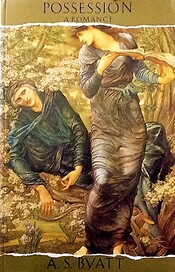 Insecure academic Roland Michell finds in a pile of unsifted-through papers relating to Victorian poet Randolph Henry Ash unfinished drafts of a letter from Ash to a hitherto unknown possible female lover, a relationship which would overturn the prevailing view of Ash’s life. For reasons obscure even to himself Michell removes the drafts from the pile and resolves to investigate further. He begins to suspect the intended recipient was the female poet Christabel LaMotte and enlists the help of LaMotte expert Dr Maud Bailey to delve into the mystery. With her help he comes across a complete set of letters between the two poets which reveal the extent of their affair.
 The author has previously displayed his middle Eastern background in a couple of books,