Guilty by Definition by Susie Dent
Posted in Other fiction, Reading Reviewed at 15:00 on 20 April 2025
Zaffre, 2024, 391 p.
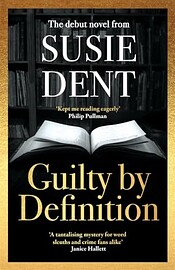 The author is of course the doyenne of Countdown’s Dictionary Corner and the title of this, her first novel, plays on that connection. As do the book’s contents. It is set in Oxford among the lexicographers of the Clarendon English Dictionary (presumably a thinly-disguised OED,) and each chapter is prefaced by a word – some obscure, others not – along with its definition, which encapsulates the events depicted. In addition most of the characters at one time or another think of the derivation of a word that comes into their thoughts. In this respect Guilty by Definition has similarities with Eley Williams’s The Liar’s Dictionary though here the insertion of such definitions seemed more intrusive. It is however likely to be exactly what readers might expect from a novel by Dent.
The plot relates to the sudden disappearance ten or so years earlier of Charlotte Thornhill, sister of this story’s main character Martha. After a long sojourn in Berlin Martha was appointed senior editor at the CED six months before the novel’s events, to the chagrin of her colleague Simon who had coveted the job.
The action kicks off when mysterious letters written in a cryptic style from someone calling themselves Chorus begin to arrive at the CED and at the homes of various people connected to it. They seem to point at a mystery involving Charlotte’s disappearance and hint that she was murdered.
The rest of the novel consists in the team trying to unravel the clues the letters from Chorus contain in order to discover what Charlotte had been doing in the months before her disappearance, what became of her and, finally, just who Chorus is. This involves a dealer in antiquarian books for whom Charlotte did some work before branching out on her own and the existence of a commonplace book compiled by Shakespeare’s sister Joan Hart for whom Guilty by Definition may be an attempt to reclaim for history.
Dent’s writing is efficient enough but nothing out of the ordinary. I suppose the book might be classified as cosy crime since any nefarious activities occur offstage
Note. One character uses the Scots term whisht – used in the imperative as an injunction to stop talking (though it’s more often pronounced and spelled as wheesht.)
Pedant’s corner:- whiskey (many times; whisky,) half-silouetted (silhouetted,) “casting a prism that danced and flickered on the wall” (prisms aren’t cast. Light is cast through them and is thereby refracted,) “lying prostate on the ground” (prostrate, surely,) “Douglas Adams’ The Hitchhiker’s Guide to the Galaxy” (Douglas Adams’s,) “‘perhaps that’s one of reasons’” (one of the reasons,) the digit ‘8’ appears several times, sometimes within a larger number; in each case it looks upside down – with the larger piece of its hour-glass shape to the top, not the bottom,) “a slip … bearing the name of the lender” (this being a system for allowing books in the Bodleian Library to be consulted, ‘of the borrower’ makes more sense.)
Tags: Countdown, Crime fiction, Guilty by Definition, Susie Dent, The Liar’s Dictionary

Adrienne Allan
18 June 2025 at 17:26
As a Scot, I was also irritated by the spelling of ‘whiskey’. However, I had to let it go when it was revealed that the character, Alex, drinks Jameson’s in particular, which is an Irish Whiskey rather than a Scotch Whisky. I was very surprised by the frequent appearance of ‘try and…’ instead of the correct ‘try to …’ – I know it’s in common usage but I didn’t expect it from characters whose job is analysing words and their usage! I think there was also an instance of ‘wait – or waiting- on’ instead of ‘wait/waiting for’.
Most of all, I wished the chapter headings had included the pronunciation of the words. It was frustrating to be caught up in the story at stupid o’clock with no means to check it when my phone was charging in another room!
jackdeighton
18 June 2025 at 20:23
Adrienne,
Notwithstanding Jameson’s I still think that, in the general use, ‘whisky’ is the spelling to be preferred.
I also deplore ‘try and’ instead of ‘try to’ but it’s probably going the way of ‘mediaeval’ now, whose second ‘e’ has all but disappeared (and I prefer mediæval anyway.)
I confess I missed the ‘wait/waiting on’ instances.
Thanks for looking in and commenting.