The Amazing Adventures of Kavalier and Clay by Michael Chabon
Posted in Gabriel García Márquez, Other fiction, Reading Reviewed at 10:00 on 18 January 2017
Fourth Estate, 2001, 646 p, plus iii p Author’s Note.
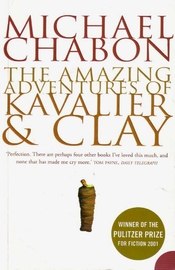
I was immediately struck by this book’s opening sentence, “In later years, holding forth to an interviewer or to an audience of fans at a comic book convention …. Sam Clay liked to declare … that back when he was a boy … that he had been haunted by dreams of Harry Houdini.” In its essential form this has similarities to the first sentence of Gabriel García Márquez’s One Hundred Years of Solitude, “Many years later, as he faced the firing squad, Colonel Aureliano Buendía was to remember that distant afternoon when his father took him to discover ice.” Not a bad model to aspire to. Chabon’s opening sentence is, however, less stark, more elaborate than Marquez’s, being replete with subclauses and apparent asides. In this it is at one with many of the ones that follow, exquisite, information packed, beautifully constructed sentences unfolding over several lines yet seeming almost effortless, not a word out of place nor too much. Yet other sentences are admirably short. This is a book that has some very good writing indeed. At the same time it is also a compelling story. And it has occasional footnotes. What’s not to like?
The Kavalier and Clay of the title are respectively Joe and Sammy, cousins, both artists, who invent a comic book hero known as The Escapist, inspired by Kavalier’s training as an escapologist in Prague in the 1930s. They meet when Joe Kavalier turns up at the Klayman household in New York after his fraught journey from Czechoslovakia (via Lithuania and Japan) the setting up of which required almost all the money his family could scrape together to save at least one of their number. There are echoes of Márquez’s magical realism in Joe’s escape from Nazi occupation; inside a coffin which also contains the (disguised) Golem of Prague. The Escapist character is a great success – punching Hitler on the nose and otherwise bashing Nazis speaking to a latent emotion – as are other creations of theirs such as Luna Moth, riding the boom in comic books of the time. Despite exploitation by their publisher (the standard contract handed over the rights to their characters) they still manage to make a fair bit of money. Joe is continually worried about his family in Prague and his cash mostly goes to finding out their well-being or otherwise and to bringing his younger brother Thomas and other Jewish children to the US. In amongst details of their personal lives – Joe’s affair with Rosa Luxemburg Sax and Sammy’s incipient homosexuality laying the ground for later developments – Chabon also delivers to us a history of the comic book.
Given my interest in Art Deco and Moderne architecture I was particularly delighted by the scene set in the abandoned remains of “that outburst of gaudy hopefulness”, the New York World’s Fair 1939-40.
In a sentence that has striking echoes for the world in which I was reading the book Chabon says, “One of the sturdiest precepts of the human delusion is that every golden age is either in the past or the offing.” Arguably the real delusion is that there ever was, or will be, a golden age.
The shadow of the wider world never lifts from Joe, even if on joining up on the final entry of the US into World War 2 the navy sends him to the Antarctic rather than to kill Germans. A novel of folk caught up in “interesting times” may be a shortcut to wider significance but, “The true magic of this broken world lay in the ability of the things it contained to vanish, to become so thoroughly lost, that they might never have existed at all,” is as true of more settled eras. And the events in Europe and elsewhere are backdrop to the human stories here. For all that, as well as a story of love and loss, tragedy and redemption (or a kind of catharsis,) at its heart The Amazing Adventures of Kavalier and Clay is a pæan to the comic book. And Chabon has made art out of its history.
Pedant’s corner:- the local Gestapo bureau (this was on the border between Poland and Lithuania, hence before the German invasion of Poland; so no Gestapo. Even if after the German invasion the border would have been between the Soviet controlled area of Poland and Lithuania so still no Gestapo,) beltoids (deltoids?) from which dangle … an array (an array dangles,) Longchamps’ (Longchamps’s,) “a Brooklyn Dodgers football game” (the Brooklyn Dodgers were a baseball team; still are, though they moved to LA,) lists of dramatis personae (dramatis personae plural would be dramatum personae,) “there were a fair number of moths” (x 2, there was a fair number,) aetataureate (an invention by Chabon meaning “of the golden age”,) missing start quote on a piece of dialogue at a chapter start (probably the publisher’s house-style, but annoying just the same,) a number of orders were issued (a number was issued,) maw (for an entrance. A maw is a stomach,) “‘Oh much more than see him’” (seen him makes more sense,) chile con carne (not spelled chile.)