A Personal History of Scotland Since 1950. Viking, 2025, 270 p, including 3 p Foreword, 16 p Index, 2 p Further Reading and 1 p Acknowledgements.
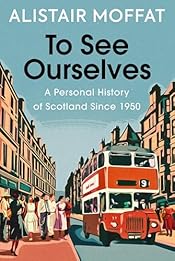
As the title suggests this is a History of Scotland over the past 75 years as seen through the author’s eyes. He was brought up in Kelso, firstly in what he says people dismissively called a prefab, then a council house, in a time before the rise of supermarkets, when the food was local, without a hint of air miles, and goods were dispensed from larger containers into smaller carriable ones by the shop assistant (in my experience this was usually a man.) At the time most houses did not have a fridge – never mind a freezer – so food was consumed more or less on the day it was bought, necessitating many visits to the shops each week. Moffat waxes most nostalgic about the milk from the local farmer, rich and creamy or richer and creamier – no skimmed milk back then – but that food products from the Empire were unremarked on, taken as read, as was Imperial paraphernalia such as the label on Camp Coffee bottles. He also remembers, as do I, that Christmas was a working day in Scotland until very late in the 1950s.
His father was of the generation that knew its place and still suffered from deference to the landed classes (the Duke of Roxburghe’s Floors Castle lies just outside Kelso.) When Moffat’s elder sister performed well enough in school to get to University her dad at first was against it but his wife prevailed on him so off the sister went and in due course Moffat followed. Corporal punishment by the tawse was an everyday feature of Scottish schools at that point and Moffat outlines the circumstances that led to its abandonment.
The mid-1960s expansion of university places and the provision of grants made working class attendance at University eminently affordable for Moffat’s contemporaries and he laments the present system whereby, notwithstanding the provision for tuition fees, Scottish students now rack up huge debts while gaining a degree. He is also of the opinion that student life ought to be about more than educational attainment rather than narrowed down to academic performance.
The coming of television altered daily life as did the advent of The Beatles, the sexual revolution, and the Abortion Bill sponsored by Moffat’s local MP, David Steel.
Agriculture too has changed, the coming of the little grey Fergie tractor with its device for transferring power to farm implements hastening the demise of the horse and the jobs that they necessitated, grooming, smithing etc.
The decline of church-going has been precipitate (apparently now attendance at Catholic services outstrips the Church of Scotland, a fact which would have astonished those formidable eighteenth and nineteenth century adherents of the Scottish Reformation.) He touches on the religious divide which still mars life in Scotland. Apparently in staunchly Protestant Larkhall the lowest traffic light of a set was smashed on a routine basis, ASDA was even discouraged from opening there due to its green livery.
Newspaper readership was once much higher in Scotland than in the rest of the UK, the Saturday evening ‘pinks’ a feature, and Sundays were dominated by the Sunday Post, adorned by its pullout “Fun Section” – The Broons, Oor Wullie and all, and its border editions covered rugby extensively.
Moffat tells us that the Sunday Post was a true newspaper, with broad coverage of foreign news. “Couthy, borderline obsessive about Scottish sports reporting and constantly upholding what might be seen as the values of the Kirk – the Sunday Post was all of those things. But parochial it was not.” He then adds the killer line, “The paper even covered events in England.”
He remarks on the liberation of the licensing laws – which has not led to the deterioration of behaviour its critics feared and predicted but, he says, to a more measured approach to alcohol consumption – and laments the decline in amateur sport.
He notes the transformation of women’s place in society, and the highlighting of domestic abuse which had once tended to be considered a private matter but is now treated more seriously.
His final chapter is titled Permacrisis and deals with the upheavals, political and otherwise, which the world has seen over the past decade.
As a summary of the Scots experience in the past seventy years To See Ourselves is an excellent primer.
Pedant’s corner:- Wilfred Brambell (Wilfrid Brambell,) the Glasgow Evening Times’ editorial (Glasgow Evening Times’s,) “Robbins’ expansion” (Robbins’s,) the Hawkins’ house ( Hawkins’s,) the Flower Pot Men (the Flowerpot Men,) I Love Lucy is implied to have been aired on STV (I remember it as being on the BBC,) “Captain W E John’s Biggles” (Captain W E Johns’s,) “each Autumn Scottish schoolchildren were allowed off school for the ‘tattie holidays’” (not in all Scotland, certainly schools in Dumbarton didn’t have that break, though an October week or two is now, I think, standard across Scotland,) spikey (spiky,) “more liberal that in England or Wales” (more liberal than,) “the orchestra reached a crescendo” (crescendos are not reached; they build,) “the Lionesses won the European Champions Cup” (actually the European Women’s Championship; the Champions Cup is for clubs,) “a Scottish businesswomen” (businesswoman,) “Liz Truss’ childish petulance” (Truss’s – as it was on the next page,) “seem not be episodes” (seem not to be episodes,) “Nana Hawkins’ house” (Hawkins’s.)


