Archives » Fantasy

BSFA Awards for 2022

The BSFA Awards for 2022 were announced on Saturday at this year’s Eastercon (Conversation) held in Birmingham.

The winners were

Novel:- City of Last Chances by Adrian Tchaikovsky

Short Fiction:- Of Charms, Ghosts and Grievances by Aliette de Bodard

Best Book for Younger Readers:- Unraveller by Frances Hardinge

Non-Fiction:- Terry Pratchett: A Life with Footnotes by Rob Wilkins

I’ll be posting my thoughts on this year’s BSFA AWards Booklet tonight.

Recent Arrivals

The Annual BSFA Awards booklet came yesterday.

A couple of days before that The Chinese Time Machine, a collection of short fiction by Ian Watson, had come through the letter box. This is for review in ParSec.

Lots of reading to do then.

The Magazine of Fantasy and Science Fiction, November 1970

Edited by Edward Ferman Mercury Press

In this issue the normal Book Review column is missing but Baird Searles reviews various films with an SF/fantasy connection. In his SCIENCE: But How? Piece, Isaac Asimov discusses the need, as he saw it, for birth control since the imperative to have children which obtained in history’s tribal societies no longer pertains in the modern age. As a result he mentions various non-harmful but also noon-child -producing sexual practices not normally to be found in the pages of a mid-twentieth century SF magazine.
There is also a cartoon by Gahan Wilson

In the fiction:-
The Mayday by Keith Roberts is one of his “Anita” stories. Here his perky witch is called through her crystal ball to rescue a young mermaid (she calls them Jennifers) captured by humans and kept in a cage. Roberts’s writing is always well executed with precise descriptions and well observed human behaviours.
Starting From Scratch by Robert Sheckley reminded me a little bit of Brian Aldiss’s Heresies of the Huge God except the premise is more or less reversed. A man is disturbed from his dream by a call for help from a creature whose world has been disturbed by a huge incursion from the sky.
Reading The Throne and the Usurper by Christopher Anvil it’s as if the New Wave of the 1960s never happened. The writing is perfunctory and heavy with exposition, the viewpoint character has it all too easy. The plot is about the megalomania of a telepath.
Where The Misfortune Cookie by Charles E Fritch is going to end up becomes obvious, if not from the title then from when the narrator’s first fortune cookie message comes true. The premise is followed logically but to modern readers the story usage (twice) of the word “coolie” jars more than a little.
With Time Dog by Richard A Lupoff, again the title gives the game away somewhat and again the narration is of its time. A sick child, Janet, blames a mysteriously appearing and disappearing dog she calls Soapy for taking her inhaler away. As her condition slowly worsens, Soapy brings her an advanced toy, another dog performs similar tricks and a obviously wrongly (to Janet’s father) dated comic book is left, plus an apparently identical inhaler.
In a reprint of The Venus of Ille by Prosper Mérimée, translated from the French by Francis B Shaffer, a traveller in southern France encounters a recently unearthed statue which may be of Roman origin. The statue it seems is capable of independent action. Unfortunately, the translation uses a number of US colloquialisms at odds with both the tone of the piece and its setting.
Alpha Bets by Sonya Dorman is one of the author’s stories featuring Roxy Rimidon of the Planet Patrol. The main focus is on a kind of future competitive Games with dangerous elements. Roxy organises the replacement of her brother’s injured team mate by a man from off-planet.

Pedant’s corner:- Lucas’ (Lucas’s,) Roberts’ (x 4 Roberts’s,) an unnecessarily italicised “Gafonel,” an opened parenthesis that is never closed, “social pressure were in favour” (either, ‘pressures’, or, ‘was in favour’,) sandas (sandals.)

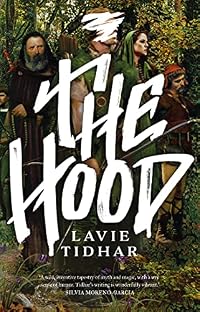
The Hood by Lavie Tidhar

Head of Zeus, 2022, 445 p.

After tackling Arthurian legend in By Force Alone Tidhar turns his reworking of the many and varied Matter of Britain onto that of Robin Hood. The book’s title is a little inappropriate, though, as that gentleman is not its principal focus. To be sure we have Maid Marian, Will Scarlett, Sheriff(s) of Nottingham, Much, Alan-a-Dale and, later, Little John and a Friar Tuck, but we also have the Lady Rowena, Isaac of York and his daughter Rebecca, plus Guy of Gisbourne (all taken from Walter Scott’s Ivanhoe – as Tidhar acknowledges in his afterword – but altered here) to contend with. Not to mention a riff on Frankenstein wherein a simulacrum of Jesus is animated from (authenticated) relics collected by a man called Gilbert Whitehand. And the other Hood, Little Red Riding. This is not quite the familiar tale, then. Emphasising this, the forest is the domain of the fae and Nottingham is festooned with images of The Green Man.

We start off in the time of anarchy where Stephen and Maude (not the historical Matilda, note) are vying for the crown of England and Will Scarlett takes part in a robbery of the London headquarters of the Knights Templar. This London is your typical fantasy city modelled on an imagined Dark Age, with ale-houses, cutpurses and rogues of various kinds and a casual attitude to life. How realistic this depiction is of day-to-day existence in such a place is another matter. However, “Men have murdered women with impunity since the beginning of time,” is sadly still an apposite observation.

From thereon, Knights Templar not being ones to cross, Will has to look out for his life. After his companions in the raid start to die off in inventive ways he decides to light out for Nottingham, barely surviving a multiple stabbing because his intended assassin has a soft spot for him. In this tale women are as hard-edged and ruthless as the men. Sometimes more so. But sweet and demure they are not.

We also have two characters who may be transgender – or at least cross-dressing. Alan a Dale, who plays a harp made from the bones of his sister and is seeking vengeance on the man who killed her, sometimes manifests as Alanah Dale and there is a priest called Birdie who is in touch with the fae and discovered to have breasts and female genitalia.

Rowena is far from the character found in Ivanhoe. She is a hard-nosed dealer in dwale, the drug of choice in Nottingham, and subject to as much double-dealing and betrayal as drug baronesses ought to be accustomed to.

Many of the men have returned from the Crusades and subject to the usual ex-servicemen grouses, “Nobody gives a shit about returning soldiers.” There is a constant background drip of information on events in the Holy Land and the fortunes of the various Kings of the times.

The characters tend to speak in a down to earth demotic style as of our times, which is anachronistic as far as the setting goes but this is fantasy; in that respect perhaps anything goes. There was a nice aside on the origins of dietary custom evolving from the Church’s ban on meat on Fridays. The common people soon worked out that fish was not meat and so indulged themselves, “everybody likes a loophole.” One of the Sheriffs has a side line in procuring piscicultural delicacies.

Tidhar can certainly illuminate character and spin a story but we also have here an abundance of allusion. I confess I admired the reflection of a prisoner on discovering himself to be incarcerated, “Then I awoke and found me here on the cold cell’s hide,” (a Spoonerism will always get me, one based on a Tiptree quote from Keats still more so) but the book is over-stuffed with this sort of thing. At times it seems as if no reference cannot be elaborated on. A meeting with a Jack and his friend Jill calls up a description of that male name’s connotations – some steal from giants, others go down hills, or bring frost, or light up like a lantern. Some even go around murdering people. But the page or so riffing on the Rumpelstiltskin story was surely unnecessary.

Pedant’s corner:- “off of” (just ‘off’, no ‘of’ please,) “are at each others’ throat” (throats,) “the plague comes and goes like the tides into London” (‘the’ plague. In 1145? There were earlier plagues but ‘the’ Plague came to England in 1348. Okay it’s an altered history but “Plagues come and go like the tides” would avoid this particular anachronism.) “In the Jewry a mob of good Christians attack shops” (a mob attacks.) “He think of Joan” (thinks,) ass (arse,) supressed (suppressed,) “with bones wove in their hair” (woven.) “Perhaps this bides well for the knight” (bodes well,) Raynard (elsewhere Reynard.) The rest of the men were knights and unsavoury looking civilian” (civilians.) “There’s a tapestry on the wall behind him that look like he’d” (that looks like,) “‘no matter whence it comes from’” (OK, it was in dialogue but ‘whence’ = ‘from where’, so, ‘whence it comes’.) Greensleeves (as a tune this is supposed to have been written by Henry VIII [born 1491] though it is most likely later. Another anachronism, then.) “The gate open” (opens.) “The small monk’s shoulder’s fall (shoulders,) Rebeca (x1, Rebecca,) “gristly corpses” (grisly, I would think,) “shakings his head” (shaking.) “In his time Rome had not yet even bothered to turn its attention to this shitty little island” (Julius Caesar first invaded Britain in 55 BC. Before his time, then,) dwarfs (dwarves,) “Little Boy Blues” (Little Boys Blue,) Poitier (Poitiers?) “A solider learns to sleep where he can” (soldier.)

The Stolen Lake by Joan Aiken

Jonathan Cape, 1981, 270 p.

This picks up the story of Dido Twite after Night Birds on Nantucket, the third in Aiken’s ‘Wolves’ trilogy. She embarks on His Majesty James III’s* ship Thrush en route for Britain. The ship is diverted to South America by a message requiring Captain Hughes to respond to a request for help from Queen Gunevra of New Cumbria. This South America was colonised by ancient Britons when the Saxons invaded Britannia. New Cumbria’s two neighbouring kingdoms are called Lyonesse and Hy Brasil.

Dido is befriended by the Thrush’s steward Mr Holystone but Captain Hughes has little time for her. Nevertheless, on landfall Hughes wants Dido to accompany him to the Queen’s court. New Cumbria is a strange place where girl children between five and fifteen are absent – said to be prey to flying creatures named Aurocs, so many girls are sent away to avoid this fate. Queen Gunevra desires the British to persuade King Mabon to restore her lake (which he removed as ice-blocks in retaliation for the abduction of his daughter Elen on her return from education in England.) Gunevra expects Dido to claim to be Elen to satisfy him. She wants the lake back so that her husband will be able to sail back to her across it, something she has been awaiting for hundreds of years. This referencing of the story of King Arthur is exploited further in the rest of the tale during which Dido as usual meets people who wish to do her harm.

The characters tend to the cartoonish but its intended readership (YA readers) will not mind about that.

*In Scotland this would have been James VIII.

Pedant’s corner:- A fair bit of the dialogue was in non-standard English. Otherwise, nothing to report.

Ilario: The Lion’s Eye by Mary Gentle

Gollancz, 2007, 669 p.

This is set in Gentle’s First History universe which she introduced in Ash: A Secret History. It is a stand alone novel though, merely sharing the same background.

We meet narrator Ilario trying to enter Carthage, a city under the dark shield of the Penitence and hence no view of the sun, and with naphtha lights providing illumination. Marcomir, the border guard she deals with, offers her a place at the boarding house of his mother. Once there, lust struck, they stumble to bed together. At first this might seem merely to show us that Ilario is a true hermaphrodite, having functional sets of both sex organs, but the encounter is to have plot ramifications. The morning after, Marcomir’s mother gives her a drugged drink and she wakes up to find herself a slave once again.

Freed by her/his King, Rodrigo Sanguerra of Taraconensis in Iberia, Ilario had fled after her/his true parentage was revealed, leading to her/his supposed father, Viderico, the King’s right-hand man, suborning her/his mother, Rosamunda, into trying to kill her/him to expunge the shame of engendering a freak. This wasn’t the first time Rosamunda had attempted this since after the birth, Ilario had been left on a hillside from which she was rescued by a couple who raised her/him as their own. In late childhood she/he was offered to the king as an amusement and, as a slave, no threat to anyone.

The beautifully intricate and cleverly designed plot revolves around the tension between the desire of Carthage to take over Taraconensis, the high politics of Ilario’s homeland – at first navigated from a distance – efforts to avoid assassination by Viderico’s agents, and Ilario’s desire to be an artist, exploring painting and the New Art of true representation (perspective.) Through it we are taken not just to Carthage but all over the Mediterranean of this scenario, to Rome, known as the Empty Chair since no Pope has sat there for centuries, to Venice, a growing power, to Alexandria-in-exile, seat of the Ptolemies in what is still called Constantinople by adherents of the Green Christ, whose religion mixes in aspects of the Christianity we know with elements of Mithraism.

This all comes about since Ilario is bought by the Egyptian eunuch Rekhmire’, a “humble buyer of manuscripts” (though a de facto spy) and a cousin to Alexandria’s ruler, the Pharaoh Queen Ty-Amenhotep. In Rome, while apprenticed to Masaccio, a master of the New Art, Ilario encounters a golem-statue designed as a weapon to be used against the Alexandrine monarch, meets in Venice a pseudonymous Herr Mainz who has a new, quick method of manuscript reproduction (ie he is really Gutenberg,) and her real father (and delighted to be so) Honorius, the lion of Leon and Castille, recently retired from fighting the Franks on behalf of King Rodrigo and whose personal guard accompanies him. Along the way Ilario discovers she/he is pregnant by Marcomir and, the dangers heightened manyfold for a hermaphrodite mother, is operated on by a Turkish doctor, Bariş, in the manner of Caesar. (Since this is less than halfway through the book much of the tension of that situation is thereby vitiated.) Both mother and infant survive, the daughter, Onorata, another complication that Ilario has to deal with. The lack of love Ilario confesses for Onorata is belied by the way in which she/he ensures there is always someone around to care for her. Honorius’s soldiers are exemplary in this respect. In Constantinople, all are astounded by the huge size of a ship which has lost its way in a storm, not least its complement of five thousand men. The ship’s captain is Zheng He and it is part of a Chinese fleet exploring the world. Both Alexandria and Tarconensis will seek to use this as a lever against Carthage. Somewhere in amongst all this Rekhmire’ restores freedom to Ilario again.

Much of Ilario’s thoughts veer towards drawing and painting and the implements and materials required but there are also many reflections on the lot of the hermaphrodite. Ilario gets to see things both ways, “Men alone together talk as if women are children; women together speak as if men are not-very-intelligent animals.” Gentle displays a flash of feminism towards the end when Rosamunda says that, freak or not, Hilario’s possession of a penis (however rudimentary a one) gives her/him agency, places her/him above women in the pecking order.

Ilario is an engaging character throughout and the others we meet in this portrayal of a world that never was (or, if we are to believe Ash: A Secret History, was expunged,) behave in ways that are entirely believable.

Finally, I must thank Gentle for introducing me to the wonderful word exomologesis which, however, I am sure I will never use again.

Pedant’s corner:- Anagastes’ (Anagastes’s. Except for Azadanes, Taraconensis and Gades, other names ending in ‘s’ – such as Honorius – are given s’s as their possessives,) calcium sulphate (as a paint additive/colouring. In this time period it would surely have been called gypsum.) “Not only is Rekhmire’ legally paid my wages” (Not only has Rekhmire legally paid,) “in their practise” (practice,) laying (several times; lying,) lay (several times; lie.) “The slow grey light of dawn illuminated in the sky” (no need for that ‘in’ surely?) elipse (ellipse,) cartilege (cartilage,) “because ‘is unwise’” (because ‘it is unwise’,) “to down out” (to drown out,) “to breath in” (to breathe in.) “I belated realise” (belatedly,) “woman accompanied by male relatives” (women accompanied,) “the polished finished of his helmet” (the polished finish,) jailor (jailer,) Aldro (elsewhere Aldra,) fontanels (fontanelles,) “I brought0my cloak” (type-setting error for ‘I brought my cloak’,) sung (sang,) “a crew of oarsman was in evidence” (oarsmen,) “moved two and fro” (to and fro.) “Instead I throw up, like a child” (the rest of the passage was in past tense; ‘threw up’.) “‘I’d wrap in anchor chain and dump it’” (wrap it in anchor chain,) sunk (sank.) “I could have done with somewhat to keep me occupied” (something is more natural than somewhat, here,) “looked at blankly at” (has one ‘at’ too many,) drunk (drank.)

Reading Scotland 2022

These are the Scottish books I read this year, in order of reading. 14 by men, 13 by women. Two were SF and one had a fantasy element. Two were non-fiction and another contained poetry.

Death is a Welcome Guest by Louise Welsh
Shuggie Bain by Douglas Stuart
The Comforters by Muriel Spark
Red, Cherry Red by Jackie Kay
Braking Day by Adam Oyebanji
Rose Nicolson by Andrew Greig
The Gourlay Girls by Margaret Thomson Davis
A Summer of Drowning by John Burnside
The Perpetual Curate by Mrs Oliphant
The Thistle and the Grail by Robin Jenkins
The Big Music by Kirsty Gunn
The Young Team by Graeme Armstrong
At the Loch of the Green Corrie by Andrew Greig
Something Like Breathing by Angela Readman
To Be Continued by James Robertson
Lobsters on the Agenda by Naomi Mitchison
Morning Tide by Neil M Gunn
The Good Times by James Kelman
Phoebe Junior by Mrs Oliphant
Robinson by Muriel Spark
Midwinter by John Buchan
Luckenbooth by Jenni Fagan
Clydesiders at War by Margaret Thomson Davis
Scottish Ghost Stories edited by James Robertson
Ancestral Machines by Michael Cobley
Islanders by Margaret Elphinstone
Billionaires’ Banquet by Ron Butlin

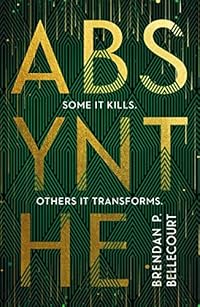
Absynthe by Brendan P Bellecourt

Head of Zeus, 2021, 413 p. Reviewed for ParSec 3.

One of the pleasures of the Alternative History tale is encountering real historical figures in a different context or circumstances, seeing how the author has woven them into the story, perhaps shedding a new light on what happened in our timeline. If judged by this criterion Absynthe fails to deliver. The setting is the US in 1928, ten years after a Great War ended, but despite mentions of everyday things that you might expect – wireless, airships, biplanes, Art Deco buildings and interiors, even horse-drawn cabs – the only familiar (to the reader) historical luminary alluded to in the text is Charlie Chaplin, whom one of the characters says has a new film coming out. In Absynthe all of the important (and all the bystanding) characters are entirely fictional.

Not that it matters, for this is a much transformed US. The capital has been renamed Novo Solis, the President is one Leland De Pere, a former soldier in that Great War, which was fought against the St Lawrence Pact, a somewhat unlikely combination of Germany, Canada, Britain and France. It is a US so altered that Bellecourt’s story could have been set in a completely imaginary country (or indeed on an imaginary planet) without making any difference to it.

Viewpoint character Liam Mulcahey is a veteran of the war whose memory of it is exceedingly patchy. In the course of the book we find that during his service he was a member of an elite squad known as the Devil’s Henchmen who had been given an experimental drug that meant they each saw, heard and felt what every other member of the squad did. De Pere and his enforcer side-kick Leo Kohler were officers in the Henchmen.

Bellecourt starts his tale at the inaugural journey of a high-speed flashtrain designed by the company owned by the parents of Liam’s friend Morgan Aysana, where the President is due to give a speech. During the ceremony we gain a first glimpse of weird when Liam witnesses a man entering one of the train’s carriages not through a door but through its side panelling. An ensuing kerfuffle, subsequently blamed on a revolutionary group known as The Uprising, leads Liam into the presence of Kohler and De Pere. On discussing the incident with the President, Liam finds his memories of it being altered, ending up feeling as if nothing untoward had happened. This is only the first instance of many in the book where the power to generate and maintain illusions tips the story over into Fantasy rather than SF.

In a subsequent meeting with agents of the Uprising Liam learns of the influence on De Pere of a shadowy group of powerful forces (somewhat disappointingly made up of the usual suspects of the elite and the media and given the rather mundane appellation of the Cabal) whose operations soon plague Liam and his companions. The novel sees the gradual recovering of Liam’s memories, which are accompanied by those of project instigator Dr Colette Silva, who utilised the properties of a bacterium named Echobacterum sentensis to blend the Henchmen’s consciousnesses. These memories reveal why the Henchmen’s memories were conveniently ‘lost’ at the end of the war as well as what subsequently became of Dr Silva. Meanwhile The Cabal as an enemy is supplanted by the revelation of the emergence of a superarching consciousness known as Echo.

The world portrayed here contains an odd mixture of technology – triplanes and those horse-drawn cabs but also more advanced stuff such as the armoured body suits called hoppers that the Devil’s Henchmen fought the war in, the corresponding goliaths of the St Lawrence Pact, those flashtrains, and war casualties whose damaged bodies have been augmented by what read like steam-powered prosthetics, which include lungs. Bellecourt uses the terms mechanika and mechanikal to describe these. Medical and psychological terminology in the text postdates that of the real 1920s. Also deviating from our 1920s is the degree of agency and autonomy the female characters have. Though Dr Silva remembers some prejudice against her during her researches, the treatment of women by the author and his characters is as if they are our contemporaries. (That is of course not a bad thing in itself but it does detract from any sense of historicity.)

Sadly the text at times also resorts to cliché (a veritable flock, the frequent use of ‘very’ to emphasise a noun, ‘miracle of miracles,’) or unwarranted archaisms, (he knew not why,) and contains a large amount of obtrusive information dumping. The absinthe of the (again oddly spelled) title does appear – if only twice – but plays no material part in the plot. Absynthe is perhaps not one for purists but if your readerly tipple tends towards towards action adventure with a hint of mystery and laced with body-count, this could be for you.

The following did not appear in the published review.

Pedant’s corner:- “Time interval later” count: when it got to over forty I stopped taking note. Bonus points for ‘not all was as it seemed.’ Otherwise; “where a line of long-nosed limousines were letting out the VIPs” (where a line … was letting out,) bi-planes (biplanes,) “when the crowd shifted their attention” (its attention,) “the sort of smile serviceman shared only with one another” (servicemen,) “a creature out of an Edgar Rice Burroughs’s Mars novel” (no need for that possessive ‘s’; so, ‘an Edgar Rice Burroughs Mars novel’,) “a lanky banker with dirty blond hair and offset eyes named Charlie” (his eyes were named Charlie?) “a rendition of “Whiskey in the Jar”” (I was told in the early 1970s by a folk purist that that song’s title ought to be “The Cork and Kerry Mountains”.) “He shined the flashlight” (shone,) “they’d resolved themselves to staying away” (‘resolved’ is an odd choice of verb; ‘resigned themselves’ is a more familiar phrase – or else remove the ‘themselves’ and make it ‘resolved to stay away’,) “the only evidence that … were” (the only evidence … was,) bacteria (is plural. Bellecourt treats it as singular.) “’What in Samuel Hill?’” (is missing a comma, ‘What, in Samuel Hill?’,) “the team of doctors were there” (the team … was there,) “for all intents and purposes” (to all intents and purposes.) “’Then lay with me’” (OK, it was in dialogue, but it’s ‘lie with me’,) sunk (x 2, sank.) “Behind the officers … were a bunch of suits” (Behind … was a bunch of,) restauranteurs (that word has no ‘n’, it’s spelled – and pronounced – restaurateurs,) “’be ready tell me’” (‘be ready to tell me’,) outshined (outshone.) “‘And who’s fault is that?’” (whose,) “‘you’ve got another thing coming’” (x 2, ‘another think coming’,) “there were signs of their troops and tanks amassing along the Canadian border” (the usual military terminology is of troops ‘massing’,) “mounted to its front face were a series of gauges and dials” (mounted to its front face was a series of gauges and dials,) the name ‘Clay’ italicised at one point for no reason. “Rarely did Alastair acted surprised” (Rarely did Alastair act surprised,) “wracked with guilt” (x 2, racked with guilt,) “while other others confused the mechanika’s operators,) (no need for the ‘other’,) Reyes’ (Reyes’s,) “the crowd of thralls were focusing” (the crowd … was focusing,) “was something like out of a penny dreadful” (was like something out of,) “as if she was convince she was dead” (convinced,) “he’d been so confident when he’d began” (either ‘when he began’, or, ‘when he’d begun’,) undefinable (the sense was of indefinable,) “would no more than fall into a rhythm than Grace would change things” (‘would no sooner fall into a rhythm than Grace would change things’.) “’They’re going kill you’” (going to kill you,) “echo” (x 1, an entity otherwise named Echo,) shrunk (shrank.)

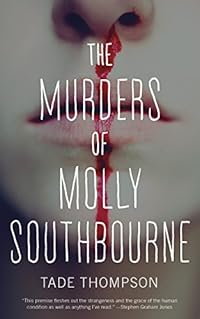
The Murders of Molly Southbourne/The Survival of Molly Southbourne by Tade Thompson

The Murders of Molly Southbourne
Tor.com, 2017, 117 p.

Molly Southbourne has been brought up from birth with the mantras:-
If you see a girl who looks like you, run and fight.
Don’t bleed.
If you bleed, blot, burn and bleach.
If you find a hole, find your parents.

She has a genetic condition that means copies of her, described as mollys, will grow – in days, from any source of sustenance to hand – to full sized human replicas. Replicas intent on killing her. Her only recourse will be in killing them first, hence the mantras, and then disposing of the remains. In extremis she has tattooed on her arm a number she can call on for help.

Molly’s story is told by way of a framing device wherein our narrator is being held captive – by Molly herself as we find out when she relates her past to the narrator after making sure she is quiescent.

Albeit laced with an abundance of violence this is an enjoyable mixture of fantasy, horror, paranoid thriller and spy story, given a Science Fictional gloss when it is revealed Molly’s mother was a spy sent behind the Iron Curtain to investigate a secret Soviet project to find a cure for fertility rates falling worldwide, then to steal it. Caught in the act, she instead injected herself with it, hence Molly’s condition.

Pedant’s corner:- Written in USian; spellings such as hemophilia etc (haemophilia, or better, hæmophilia.)


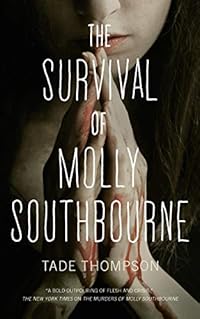
The Survival of Molly Southbourne by Tade Thompson

Tor.com, 2019, 122 p.

Our narrator calls herself Molly Southbourne but no clones form from her blood when it is shed. She is, though, the same molly whom the original Molly kept captive in the previous book before going off to confront the army of mollys whom we assume did Molly to death. This molly has all of Molly’s memories, of her parents Connor and Mykhaila Southborne, of all the mollys she murdered to prevent herself being killed.

This book, though, is slightly different in that at least to begin with there are interpolations [headed Transcript] of the thoughts of Professor James Down, an academic whom Molly set her cap at in Book One; fatefully as it happens because some of Molly’s blood must have leaked into him and he has what Thompson has dubbed in this book a hemoclone [sic] growing inside him – a molly which will kill him: as one did her previous lover, Leon, for the same reason.

Our viewpoint molly soon finds herself pursued by other women identical to each other; called tamaras after their originator. Tamara is trying to protect our molly as it is her belief that the organisation Molly thought was there to protect her is in fact designed to kill hemoclones.

This all seems to be set during the Cold War, contemporaneously with the Prime Ministership of Margaret Thatcher. Both Molly and Tamara had within them artificial cells, the ones Molly’s mother and presumably others as well as Tamara had been infected with. This renders the concept as fully Science Fictional. We are told these artificial cells act as matter converters. From a drop of blood they can make “a full human duplicate based on the genetic material of the Prime from almost any base material: wood, soil, organic waste, even metals.”

In this strange paranoid world our molly soon comes to trust no-one.

Pedant’s corner:- Again published in USian. “James Dawn” (elsewhere he’s James Down,) “a full human duplicate based on the genetic material of the Prime from almost any base material: wood, soil, organic waste, even metals” (this phrase reads as if a full human duplicate could be made solely from metal; it could not,) hemoclone (haemoclone or, better, hæmoclone,) “the lay of the land” (the lie of the land.)

ParSec 5

The fifth issue of ParSec magazine has now gone live. It can be found (and bought) here.

This one contains my reviews of:-

The Bruising of Qilwa by Naseem Jamnia,

Best of British Science Fiction 2021 edited by Donna Scott,

and Neom by Lavie Tidhar

free hit counter script