Archives » Fantasy

Interzone 292-293

TTA Press, 2022, 192 p

Again an Interzone double bill, but this is the last issue under the editorship of Andy Cox. The next will be published by Gareth Jelley – from MYY Press in Wrocław. There were no reviews this time.

In Wet Dreams by Rich Larson a man is asked to look after his (stoner) neighbours’ cat. It begins to glow and, very quickly, develops a growth.
The Pain Barrier by Alexander Glass seems to take inspiration from the tale of Orpheus where the prison/debtor city of New Penitence takes the place of the underworld. Joseph Walker enters it illegally to try to rescue Ariette, whose memories of him have been removed.
The same author’s The Faerie Engine is an odd concoction utilising a fairly standard fantasy representation of Borderlanders slipping between the real and the faerie realms but the mechanism of the title is real, made of cold iron, though in need of repair to preserve the twilight world for a little longer.
The Soul Doctors, again by Alexander Glass, is a story with noir sensibilities about shifters between parallel worlds in some of which souls are important and can be surgically harvested and transplanted from others where they are not.
Thank You, Clicking Person by Jeff Noon is narrated by an AI system learning how to be human by monitoring the clicks on the nine squares of website security verification tests. But it is perhaps too late. (This reminded me of an – unpublished – story of mine with a similar vibe. Damn!)
Subira’s Lattice by Val Nolan is set mostly on a partly terraformed Venus where a creeping crystallisation threatens the inhabitants and deep down in the bedrock evidence of a past civilisation has been found.
Walking in from the West by Charles Wilkinson draws on the author’s Welsh home background in this tale of a deluge-ridden future. A fastidious and narcissistic former businessman’s solitude (apart from a manservant in his own image) has been disturbed by the building by people with a New Age tendency of a family home just down a Welsh hillside from his own. The woman, Sylvia, has the gift of reassembly. The moment we’re told this we know where the story is going. It’s effective enough even so.
Wind, River, Angel Song by Cécile Cristofari is perhaps a reaction to Covid. A plague of some sort, carried by the wind, or rivers, is turning people into trees. But human life goes on.
The Thing About Ants and Astronauts by Justen Russell employs an over-egged metaphor in a tale about humans exploring the Blackheart Nebula.
The well-written and beautifully constructed Bridget Has Disappeared by Tamika Thompson is the story of a journalist who finds his wife literally vanishes from their home without explanation and then reappears later; but she denies all knowledge of this. Does she have some sort of weird ability or is she the tool of aliens bent on removing wasteful things from the universe?
Rusting by Lucy Zhang is the story of a metal sex-worker succumbing to an ailment called rusting, being shunned and then possibly disposed of. It doesn’t conclude so much as just stop.

Pedant’s corner:- “through Cuddy’ furry belly” (Cuddy’s,) Amenthes’ (x 2, Amenthes’s,) “what on Earth” (requires a question mark at its end that is missing,) “bits of grizzle” (gristle.) “None of them were smooth or polished.” (None of them was,) “for all intents and purposes” (the phrase is ‘to all intents and purposes’,) “in roughly equal measures” (the idiom is ‘in roughly equal measure’,) “bursts of torrential rains” (the idiom is ‘torrential rain’,) whiskey (x 2, whisky,) “seeping wheals of blood” (weals, doubtless,) spacecrafts (spacecraft,) epicenter [sic] (centre.)

Kindred by Octavia E Butler

Women’s Press, 1988, 260 p.

I picked this up from a bundle of SF books for which a friend who also reviews the genre wanted to find a new home. I had my suspicions that I had read it before,* but on going through the prologue I realised I certainly had. No matter. It was worth reading again. And now I have a copy for my own shelves.

Dana Franklin is a black woman married to a white man, Kevin, in 1970s California. One day, in their new apartment she begins to feel dizzy. When that wears off she comes to realise she is outside, by a river and hearing the screams of a child, drowning. Of course she rushes to help. The child is Rufus Weylin and it eventually turns out there is a link between them such that when Rufus is in danger it pulls her back in time to protect him. Saving Rufus’s life does not save her from the suspicion of his father Tom who points a gun at her and pulls the trigger. She instantly finds herself back in her present, with Kevin, and only a few seconds having elapsed.

A few hours later the same thing happens again – only this time Rufus is older and has set his bedroom curtains on fire. Dana puts them out. In their ensuing conversation she discovers he lives in the year eighteen fifteen, on a Southern plantation which his father owns. She is shocked by his use of the word ‘nigger’ (common of course in his circles at that time) and explains to Rufus that where she comes from it is not acceptable. He struggles with that concept.

Rufus’s surname brings to her the memory of a bible her great-great grandmother had bought in which was inscribed “Hagar Weylin, born 1831, parents Rufus Weylin and Alice Greenwood Weylin” plus the family tree from then on, and she realises she has to in some way make sure that Rufus can survive long enough to sire Hagar. Dana’s most immediate problem is how to survive as a black woman in that place and era.

Cue several zig-zags back and forth in time on one of which Kevin is brought along with her only for him to be stranded in the past when she is catapulted to the future again. During these the relationships between Dana and the people on the plantation grow and develop but Rufus comes increasingly to behave as a man of his time.

Of the indignities suffered by black people in the slave-owning South Butler spares Dana only rape (and that only just, since the incident triggers one of her return journeys) but the relentlessness of the oppression is perhaps difficult to convey fully in a piece of fiction. Then too, Dana’s special position as a guarantor of Rufus’s safety in part insulates her from its full force – as does her assigned status as Kevin’s property when he is there with her (which even so does not save her from a whipping.) The inhumanity and brutality of the system, the way it effectively policed itself, the helplessness slaves experienced and even the resentments between them at any perceived advantage another may have had are all given witness.

This is not a comfortable read. But it is not meant to be. Nor should it. We ought to be constantly reminded of what it means, of where it can lead, when any section of the populace is singled out for uncaring or harsh treatment.

Pedant’s corner:- “started to drawn again” (to drown again,) surprsied (surprised,) straring (staring.) “I lat flat” (lay flat.)

*It turns out it was as recently as in 2017! From when I was trying to support our local Library (since closed) which explains why I couldn’t find it on my shelves.

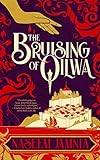
Naseem Jamnia’s The Bruising of Qilwa

You may have noticed on the Currently Reading part of my sidebar the cover of The Bruising of Qilwa by Naseem Jamnia. If not I include the cover to the right as usual.

This is the latest book that ParSec has sent me for review.

The author is new to me and is described on the book’s cover as a Persian-Chicagoan.

The contents lean towards fantasy and are tinged by that Persian heritage.

lost objects by marian womack

Luna Press, 2018, 139 p.

This is a collection of short stories with leanings towards fantasy and Science Fiction. I’m not sure why the ligature st and the one for ct which I cannot reproduce here have been employed on the front and back covers of this, unless it’s to hint at a certain strangeness within. Then there’s the determinedly lower case of the title and author’s name. A statement of some sort.

Orange Dogs is set in a prone-to-flood, global-warmed, environmentally degraded University city where the books have all gone, as has most technology. A man whose wife is on the point of giving birth (again) is haunted by the miscarried child he had to dispose of a year or so earlier. The Orange Dogs of the title are symbols of the end-times; huge swallowtail butterflies. (Their colours are actually yellow-brown with large blue spots.)

Little Red Drops plays with allusions to Little Red Riding Hood in its tale of a woman escaping to the Andalusian wilds to banish the memories of a faithless lover by using the ancient lore of blood for blood.

Told in sections titled 0001 to 0016 Black Isle tells how the engineered species designed by XenoLab, the company our narrator works for, are succumbing to a stranger disease. It evokes the landscape of the Beauly Firth very well.

Stones are a possible portal to other worlds from one where an exaggerated Iron Lady presides over a Great Britain divorced from external alliances and even from trade with the outside world. Narrator Raven belongs to a family who operate the Eye, a camera obscura surveilling the mining town of four vast Pit Heads extracting quartz, coal, ether.

In the less than two page long Love (Ghost) Story the narrator cannot shake off images of her dead lover to whom nothing can compare.

The Ravisher, The Thief sees a young woman called to render her language knowledge in service to her community. She – as do others of the priestly caste – has a mental link to a bird of prey.

Prefixed by Captain Oates’s supposed last words, Frozen Planet reframes Scott’s Antarctic Expedition as a blighted exploration of an alien planet – with added howling creature and either a hallucination or a portal to another world.

Marvels Do Not Oftimes Occur tells of how two kinds of vessel appeared in the sky over a central European city on April 5th 1561, and burned the churches before vanishing again.

Kingfisher has echoes of The Yellow Wallpaper in its tracking of the relationship of a married woman with her husband in a world where birds have disappeared.

A Place for Wild Beasts. A woman is plagued by a deer devouring the plants in her city garden.

Pedant’s corner:- “a flock of geese” (this was ‘in the leaden sky’. It’s a skein of geese, then, [and on the ground it would be a ‘gaggle’,]) “the island formerly known as England” (global warming must have been really profound in order to make England an island,) lightening (lightning, twice spelt as such elsewhere.) “She cleaned the steam off the window” (not steam; condensation. Steam (or water vapour when it’s below 100 oC) is an invisible gas – though people do refer to the drops of water it forms when it condenses as ‘steam’,) drunk (drank,) “Black Isle” (x 10 or so; the area as always been known as ‘the Black Isle’, never just ‘Black Isle’,) “Bauly Firth” (x 6; Beauly Firth,) insects-eaters (insect eaters.) “There seems to be two main types” (There seem to be two.) Robins have a drop of God’s blood in its veins” (in their veins,) “what looks like different kinds” (what look like different kinds,) “outside of” (x 3, just ‘outside’; no ‘of’,) “a experimental dose” (an experimental dose,) “if what her stupid uncle thought she needed was a babysitter” (doesn’t require the ‘was’,) “oblivious of” (it’s ‘oblivious to’,) “imping the feathers’ of a hawk’s tale” (no need for an apostrophe at the end of ‘feathers’,) a missing comma at the end of a piece of direct speech, “the prophesy” (prophecy,) “When the tall was made” (when the toll was made,) “save two: to wit : Goodwife Anna….” (save two, to wit: Goodwife Anna.) “What would he have made of it, I wonder.” (That is a question, so requires a question mark at the end.) “It was tuna season and each bar offered their personal take on how to prepare it” (each bar offered its personal take,) “how comforting was to fall into” (comforting it was to,) “was like a taking a draught” (no need for that first ‘a’,) “everyone seem to have difficult pregnancies” (seemed to have,) “they would let themselves been touched” (be touched,) “marinated in soy source” (sauce.) “I looked a Jonas” (at Jonas.) “I fell a moment of void there” (I felt a moment.) “I had never knew what to do with it” (either; ‘I never knew’, or, ‘I had never known’.) “I had taken a plastic bag to use it as a glove” (to use as a glove,) “although there were not fluff” (although they were not,) “but they seem to accumulate” (seemed to,) “when I notice a stain” (noticed,) “that reminded me to the liquid” (of the liquid,) “sat in the sofa” (on the sofa.) “I did not want any doctor too look” (to look,) “the dinning room” (dining room.) “I had tided them up” (tidied,) “they were not native to the local fauna” (???? ‘They were not native fauna’ is less unnatural.) “If she was going to learn something in the next few days, was the systematic way..” (in the next few days, it was.)

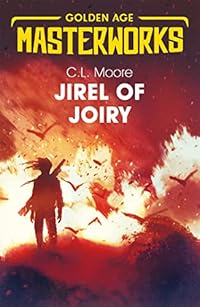
Jirel of Joiry by C L Moore

Gollancz Golden Age Masterworks, 2019, 205 p. First published in Weird Tales between 1934 and 1939.

This is a book containing six novellas from one of the early pioneers of women’s writing in the field of SF and Fantasy, in this case from before the Second World War. Viewpoint character Jirel is a fierce red-haired warrior woman who rules the territory of Joiry, which seems to be a fiefdom somewhere in France in mediæval times. Post Roman times certainly, since she wears the leg armour of a long-dead Roman legionary.

Black God’s Kiss starts with Jirel’s forces having been overcome and herself captured by the soldiers of Guillaume the conqueror who subjects her to a savage kiss before imprisoning her in a dungeon. Jirel escapes and travels to an underworld where she eventually meets the stone image of the black god, kisses it and absorbs its energy. After an arduous journey back home she bestows that fatal kiss on Guillaume.
Black God’s Shadow sees Jirel suffering what seemed to me an unlikely remorse for her killing of Guillaume, but she is haunted by the sounds of him in torment in the afterlife. She again travels to the underworld in order to seek to release Guillaume from his purgatory.
Jirel Meets Magic in another passage through another fantasy world following Giraud, a man whose castle she has taken, through a window into where the sorceress Jarisme holds power.
In The Dark Land a wounded Jirel is abducted from her death-bed and quickly restored to health by Pav, King of Romne, who wants her for his wife. Jirel isn’t keen on this.
Queen of the Starstone was written along with Moore’s husband Henry Kuttner. It is an SF/fantasy crossover wherein two men from the Mars of the future are brought back to Jirel’s time by a wizard who wishes them to recover from her the Starstone of the title.
Hellsgarde is a place of foreboding. To redeem twenty of her men whom he had captured, Guy of Garlot has sent Jirel there to uncover the treasure someone called Andred had hidden in the castle. She meets dread and ugliness but also a redeeming power. Attitudes of the time this was written are perhaps indicated by the sentence, “God in his wisdom does not for nothing mark a whole and healthy man with a cripple’s face.” And sinful Guy has a dark beauty for a fleshly garment that is “no design of the good god.” The story’s resolution is satisfying though.

Overall Moore has an irritating tendency to repeat a word within a line or two of text and we do not see Jirel perform many feats of swordswomanship or military prowess, we have to take it on trust she is accomplished militarily.

These stories are of their time but are significant for who wrote them and the nature of their protagonist rather than any intrinsic merit.

Pedant’s corner:- sorceress’ (sorceress’s,) swarm (rest of passage in past tense; swarmed,) “Pav’s smiled face” (smiled? Smiling surely,) “before Pav could come near enough to prevent” (to prevent it,) “as through on a giant axis” (as though.)

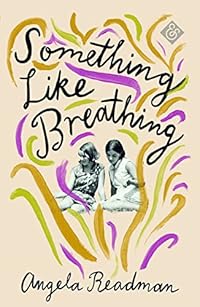
Something Like Breathing by Angela Readman

And Other Stories, 2019, 245 p.

This novel of adolescent friendship is told in alternating sections from two viewpoints, one written in retrospect by Lorrie who at the book’s start has just moved from further south to live on a Scottish island that is her family’s ancestral home, and the other as extracts from the diary of Sylvie Tyler, who lives in the next door property.

Sylvie’s mother is strict with her and reluctant for her to make friends – with anyone. It is only gradually, through an incident which Lorri witnesses and the episodes Sylvie confides to her diary, that we learn exactly why.

Both strands are well written and capture their character’s viewpoints all but perfectly. That ‘all but’ is one major caveat, which I shall come to.

The island is certainly Scottish. (Lorrie’s grandfather – Grumps – owns the distillery there.) Her observation that, “‘they’re alright’ was the most glowing review I’d heard anyone on the island give anyone. Compliments were spat out as reluctantly as saying the weather looked fine; acknowledging anything was okay was tempting fate,” could not encapsulate the national character of the 1950s (and later) any better.

Sylvie and Lorrie have their ups and downs but at one point as they grow older and boys begin to come into the equation Lorrie is swayed towards the more outgoing and freer spirited Blair Munro as a potential friend. Sylvie is the one who is more sensible, though. Adults and their ways are suitably mysterious.

Two things did not ring true for me. Despite no apparent connection with the place beyond her mother’s correspondence with someone living there and through them introducing tupperware to the island, Sylvie employs US terms such as ‘ain’t’ and ‘assignment’ (for homework) but above all, ‘kinda’. Sylvie also mentions a hound dog – not a traditional Scottish or even British usage – yet has the word fearty in the same sentence. These also bleed into Lorrie’s narrative – raise instead of rise, snuck for sneaked. Jarring. Then we had Lorrie’s mother and a workman, albeit one she’d known in school (and with whom it is obvious both still hold a torch for each other,) sit out one afternoon and sip beers. A woman drinking beer in public on a Scottish island in the 1950s? No. Just no. It wouldn’t have happened.

Though in both strands the writing is resolutely realistic Sylvie’s secret lends an element of the fantastical to the tale. Without it, though, the overall story would have to have been utterly different as it is the catalyst for the novel’s dénouement and Sylvie’s later fabled status on the island.

Pedant’s corner:- On the back cover blurb “two complimentary styles” (complementary.) Otherwise; span (spun,) fit (fitted,) Grumps’ (x 2, Grumps’s,) “agreeing to play for same stakes next week” (for the same stakes,) “tartar sauce” (tartare sauce,) “Sylvie begged Seth to let stay”(let us stay?) “We lay on our bellies” (the rest of the passage is in present tense; so, “We lie on our bellies.) “And none of them are good” (none of them is good,) “for as long possible” (as long as possible,) assignment (homework,) raise (rise,) snuck (x 2, sneaked,) “though they’d never spoke till that day” (spoken,) “take her hand and be lead” (and be led,) bannisters (banisters,) a missing comma before a piece of direct speech, imbedded (embedded,) lay (laid,) “be furious at me for me for getting her boyfriend in trouble” (no need for that ‘for me’,) “sour plums” (in Scotland these sweets were always ‘soor plooms’.) “Neither of us move” (moves.)

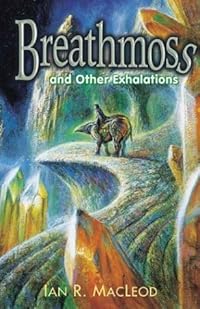
Breathmoss and other exhalations by Ian R MacLeod

Golden Gryphon Press, 2004, 315 p, plus iip Introduction, Big Lies, by the author. First published 1972.

In his introduction to this collection MacLeod says that works of fiction are complex lies and if you’re going to do it well you really ought not to stick to realism so much as make your lies as big as possible in order for readers to recognise something they’ve known all along.

In this book MacLeod’s lies are profound, considered, and each has a sense of inevitability about it, a revealed truth if you like. Not one of them is disappointing in any way.

Title story Breathmoss is set on the planet Habara where men are an extreme rarity – as they are in wider galactic society. Jalila was brought up in the high mountains by her three mothers (only one of them biologically so.) Gateways between the stars allow travel to other worlds in ships piloted by a chosen few tariquas.

The first action of the novella follows Jalila’s journey down from the mountains to the seaside town of Al Janb where after a few days she coughs up from her lungs the breathmoss which had helped her to breathe the rarefied mountain air, spilling it into the sea. From a site across the bay over the horizon rockets rise to the orbiting space station where the local Gateway lies. Macleod’s evocation of the sights and sounds of Al Janb, the society in which Jalila lives, its customs and trappings (dreamtents, tideflowers, that breathmoss) is masterful. Neither is he prepared to rush his story. The accumulation of detail is part of its strength.

One day Jalila notices a strange looking person fishing. The reader immediately knows this is a male, but Jalila has to be told, then her investigations reveal that he, Kalal, is in fact a boy not a man. Their friendship grows but does not develop in the way that the reader might expect. In fact her first lover is the local centre of teenage attention, Nayra. The crucial encounter of her life though is with an aged tariqua in a ruined castle someway out of town.

This is a beautifully told, wise story of coming of age, getting of wisdom, and time (or perhaps relativistic) travel.

In Verglas a lone settler on the planet Korai – always unnamed, though his wife Marion, and children Robbie and Sarah are given due recognition – comes to terms with his existence. It is an odd story, Marion, Robbie and Sarah having transformed into winged predators more suitable to the new world while their bodies remain more or less intact in a mound outside his base. A traverse across country – albeit inside a mechanical device – involves the use of many mountaineering techniques and terms and the inevitable accident provides tension.

The Chop Girl scratches that endless itch in parts of British culture to dredge up stories set in the Second World War. Our unnamed female narrator was a kitchen procurement orderly on a bomber base where she gained a reputation as a chop girl, a witch, a harbinger of death, after several men she had dallied with after a dance or evening together (with her always careful never to go the whole way) did not come back from their next flight. Then Squadron Leader Walt Williams comes to the base, a man with a charmed life, survivor of many freak accidents. She soon senses there is something strange about him, an other-worldliness. MacLeod’s atmosphere of realism blended with spookiness is excellently conjured up.

The Noonday Pool features an ageing composer, Sir Edward, who lives near Worcester and is obviously modelled on Elgar. (An afterword explicitly states that he was, but is in most ways different.) The story is seen through the personas of Peg, a girl seemingly inhabiting the wild, Sir Edward, and his housekeeper Mrs France. Sir Edward is having trouble negotiating his old age and composing any more music. Peg is an enigmatic presence with feral tendencies – and who may even be a werewolf – Mrs France a down-to-earth, practical figure. The Noonday Pool is somewhere in the woods nearby to where Peg takes Sir Edward one day. The story resists explaining itself but like all MacLeod’s work is beautifully written.

New Light on the Drake Equation is the story of Tom Kelly, told from the retrospect of his old age and a last encounter with the love of his life, Terr. Tom’s consuming interest has always been the search for extraterrestrial intelligent life, a search in which almost everyone else has lost interest now that no such life has been found elsewhere in the Solar System, not by the (modified) humans who have finally landed on Mars nor by the probe sent to Jupiter’s moon Europa. He still conducts his search from a mountain installation near St Hilaire, a village in the Massif Central of France which is also a centre for the night life of flyers, genetically modified people with wings, taking advantage of the thermals. In this world genetic adaptation is commonplace, even acquisition of a different language is achieved simply, by imbibing a vial of the appropriate serum, though Tom of course prefers the old ways. Replete with mentions of classic SF, in which Tom was enraptured in his youth, and a discussion of both the Drake equation and the Fermi Paradox, it is threnodic in tone and in that last encounter with Terr becomes a ghost story.

Isabel of the Fall recounts a myth, or, rather, is a commentary on one, from the world of Ghezirah. In the aftermath of the War of the Lilies, Isabel, unremarkable, not too intelligent but not dim, not beautiful but not ugly, is taken from her orphaned origins to be an acolyte of the Dawn Church, trained to sing in the light of Sabil in the mornings from her minaret, directing it towards the mirrors that distribute it over her valley of Nashir; and sing it out again at night. A minor fault in mirror 28 leads her to examine the courtyard of the Cathedral of the Word – a vast library – where she sees a young girl, Genya, dancing. Her apology to Genya for the lack of light goes on to become a friendship which is a betrayal of both their churches, and precipitates the fall of the title. Although the tale has aspects of fantasy various bits of high tech are present in the piece and its Science Fictionality is confirmed when we find Ghezirah is a Dyson sphere.

The Summer Isles, an Altered History, has a tonal quality similar to Keith Roberts’s Weihnachtsabend (see part way down this link) except here Britain – aggrandised as Greater Britain and run by the Empire Alliance and its leader John Arthur – has not collaborated with a fascist regime but itself become one. Narrator Griffin Brooke (known by his pen name Geoffrey Brook) is a homosexual whose past links to Arthur from before the Great War (which the Allies lost in 1918 – presumably as a result of the success of the German Spring Offensive) lead to him being embroiled in a plot to remove Arthur from power. The Summer Isles of the title are off the coast in Scotland and a supposed refuge to which ‘filthy Jews’ have been sent for resettlement. Other camps on the Isle of Man have a more sinister character. The usual grace notes of altered history occur, King Edward VIII and Queen Wallis, for example, along with Churchill as Prime Minister in the 1920s and not making a success of it. But in the main this is an extremely well told story about life, regret and loss.

Pedant’s corner:- flashes of lightening (lightning,) sunk (sank.) “The rockets rose and rose in dry crackles of summer lightening” (lightning.) “Jalila span around” (spun,) windowledge (window ledge.) “We’ve only got four kinds of taste receptor on our tongues” (was obviously written before the discovery of umami – [published 1996],) platypi (platypus is from Greek; the plural would be platypodes, I think, but in English platypuses is fine,) sprung (sprang,) sunk (x 2, sank,) “each time I forget” (rest of tale is in past tense; forgot,) maw (used as in ‘mouth’. A maw is a stomach,) “the fluid I’ve been given” (I’d been,) “and I lowering it” (no need for the ‘I’,) outside of (outside. Please,) “this strange new sliver creature” (silver,) cookhouse (kitchen,) WRAF (x 2. In World War 2 the women’s RAF was known as the WAAF, Women’s Auxiliary Air Force, not the WRAF. Doubtless this had to be translated for the story’s publication in the US,) “their twenty mission tour” (Bomber Command tours comprised thirty flights, not twenty,) NAFFI (x 10. The correct acronym is NAAFI, for Navy, Army and Air Force Institute,) hangers (x 4, hangars,) “and they’d have been all hell to pay” (and there’d have been,) “a slow and ugly butterfly pined on the needles of half a dozen searchlights” (pinned on the needles?) “Nissan hut(s)” (x 2, these were not Japanese. ‘Nissen hut(s)’,) bousers (bowsers,) “(his) dog ran up her” (ran up to her,) knarled (gnarled,) “her buxom heaving” (bosom.) “Where had it began?” (begun,) “had given up with whatever had once bugged them” (no need for that ‘with’,) “if one was to believe the figure of which was assigned to it” (no need for the ‘of’,) “they skived spare radio telescopy and mainframe processing time” (skive means to avoid, not to procure,) “though the message was going out in any cause” (in any case,) “which would had surprised Salvador Dali” (would have surprised,) “Edgar Rice Burrows” (Burroughs,) “Yate’s Wine Lodge” (Yates’s,) “huge near-stella aggregations of matter” (near-stellar,) “of whatever he’d drank the night before” (drunk,) “my two ex’s” (exes,) unfocussed (unfocused.) “‘Do, don’t they?’” (‘They do, don’t they’,) “until the booze finally wreaks some crucial organ” (wrecks.) “He gazed as the hills in the east” (at the hills,) boujour (bonjour,) “weird costumes and make-ups” (make-up,) “proud of him to” (too,) “a tiny representations” (representation,) interfered (interfered,) “within each their cells” (each of their cells,) “spread it vast roots” (its vast roots,) “the size of small planet” (of a small planet,) smoothes (smooths,) hurrumphs (usually spelled ‘harrumphs’,) “and we’re generally been ‘tolerant’” (we’ve,) “the warmth of this own flesh” (of his own flesh,) “for a week of so” (or so,) “the Cumbernald’s” (It two people called Cumbernald; so Cumbernalds,) “won the George Cross at Ypres” (in our world the George Cross is awarded to civilians, not soldiers,) “a homosexual affaire” (an attempt to glamourise ‘affair’?) Ramsey MacDonald (Ramsay?) “to keep the prols happy” (usually spelled ‘proles’,) newshordings (newshoardings.) “I brought myself an expensive new gramophone” (bought myself,) air raid practise (practice,) “the two PC’s” (PCs.) “A hesitate” (I hesitate.) “Presidents De Gaulle and Von Papen” (von Papen perhaps but in an alternative 1940 de Gaulle would still have been an almost unknown minor army officer,) “with its tall widows” (windows,) “the mossy urns and statutes” (statues,) “lightening blasts of flashbulbs” (although flashbulbs do light – and so lighten – things, I think ‘lightning blasts’ makes more sense and there are previous instances of this error to take account of.) “Still less that real” (less than real makes more sense,) “not waiting him to come out and help me” (not waiting for him.) “I was finally ready for axtive again” (active service again,) “to have made little impression of the world” (on the world,) “quavers that he’s like another” (that he’d like another,) pints of Fullers’ (Fuller’s,) “in the crowds sobbing howls” (crowd’s,) “the fireman’s angry voices” (firemen’s,) the Cumbernald’s (this time it was ‘of the Cumbernalds’, so Cumbernalds’.)

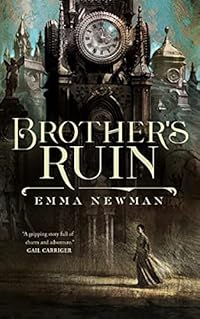
Brother’s Ruin by Emma Newman

Tor.com, 2017, 195 p.

This is a fantasy story with a steampunk vibe, as it is set in pseudo-Victorian times. Charlotte Gunn is an artist with a recent success in selling illustrations for a book. She has to keep this success secret from her family for fear of undermining her father’s breadwinning status and from her fiancé for similar reasons. Her biggest secret though is that she is an unregistered magus. (I feel that in her case it should really be spelled ‘maga’.)

The Royal Society of the Esoteric Arts is an all-powerful organisation protecting Queen and Empire through the magical powers of the magi. The earliest scene in the book sees Charlotte and brother Ben witness the tracking down of a baker’s son by the Society’s Enforcers using a magical implement known as the gauntlet which detects clandestine magical ability. Since untrained magi are said to be a danger to the Crown (and public) it is an offence to conceal such abilities. Adepts are routinely taken from their families (who are compensated for their loss on a sliding scale of talent) and trained up as servants of the Crown, though forbidden to marry. Those who conceal adepts are prosecuted. Charlotte feels her situation keenly but Ben’s faint traces of magical talent give her a possibility of masking her own from the investigators when her father calls them in to test Ben as due to a slight error on Charlotte’s part he perceives evidence of magic activity in the house.

Ben is in poor health, and it turns out their father took out a loan to allow Ben to go to University, from which his illness forced him to return. The calling in of the loan leads Charlotte to investigate the lender and thereby to knowledge of a conspiracy against the Society. Magus Thomas Hopkins, one of Ben’s testers, the most beautiful man Charlotte has ever seen, enlists her help to thwart the conspirators.

The tone of all this suggests an intended YA audience. There’s nothing to frighten the horses nor ground-breaking here but it’s entertaining enough, if a little slight.

Pedant’s corner:- span (spun,) “Archie’s hold tightened” (both before and after this no Archie is ever mentioned, but her brother is described as Archie on the book’s back cover,) “but that wouldn’t be for months and now, and Father had only days” (has one ‘and’ too many,) “she returned to Ben’s side who had lit the candle” (this phrase has its syntax severely awry,) bannister (banister,) a missing comma at end of a piece of direct speech where the sentence continued, “the most handsome man Charlotte had even seen” (‘had ever seen’, surely?) sprung (sprang,) “she hadn’t fully taken what he was doing in” (doesn’t need the second ‘in’.)

Feather Stroke by Sydney J van Scyoc

Avon, 1989, 266 p.

Scyoc’s default setting seems to be an agrarian/mediæval social organisation. Feather Stroke shares this with her previous novels but has an added dimension.

Dara is the daughter of a headsman of a village of smallpeople in a society where a generation or so ago people emigrated to a different continent to escape both the influence and domination of the powerful priesthood of the Sun God Tith and the associated suffocating social hierarchies. Local indigenous inhabitants called Ilijhari make occasional trading visits in the form of a man called Te-kia who is always closely accompanied by an eagle-like bird known as a quirri. Since Dara has strange dreams in which she inhabits the bodies of birds we know this to be significant.

Dara’s life is changed when Kels Rinari, an important, self-made trader from the city of Port Calibe, comes mob-handed with uniformed, armed men and a damen-kest to demand the hand in marriage of her sister Mirina in return for “protection.” This assertion of the renounced continent’s privileges is an unwanted harbinger of the old ways coming to the new home. Mirina can either accept the offer, refuse it, or take the third traditional option, suicide, which last would leave Dara to become the object of Rinari’s designs.

Mirina’s suicide leaves their father to take the news of her death to Rinari. On the way he persuades Dara to go to the Ilijhari for safety. Her journey is fraught but she meets and is befriended by Kentith, a renegade priest from the other continent.

Among the Ilijhari she finds she is descended from them, her true mother died in child-birth and she was given to the smallpeople to bring up since one of the village mothers had had a stillbirth around the time. It is with the Ilijhari that Dara’s affinity with birds is confirmed, her ability to inhabit their consciousnesses.

In a sequence which resonates with the history of the Americas in our world, Te-kia tells her, “The land was here, sweet and rich. And there were men and women appointed to guard the land. Wisely, they treated it as a thing of soul, living and aware, to be respected, to be preserved. …. They called themselves its children, but they understood they were its guardians as well. But after a while, others came from far shores who were stronger than the guarding peoples. The intruders were greedy and full of destructive powers. They had stolen from the earth itself and from its surrounding sphere, and they thought that whatever they chose to inflict upon the living earth and its creatures was only their right.”

On finding her father has not returned from Port Calibe Dara resolves to go there and confront Kels Rinari, relying on her Ilijhari nature to put him off marrying her. Kentith, despite the dangers involved for him demands to accompany her. The priests of Tith are anxious to capture him but in any case can bring down fire from the sun and use him as a vessel for that. Mpreover his distinctive priestly eyes make him a target for suspicious locals .

Once in Port Calibe, Dara finds Rinari to be a more complicated character than she had initially assumed and all three determine to undertake the business of combating the influence of Tith’s priests.

Feather Stroke is a pleasing enough fantasy not too demanding on the reader.

Pedant’s corner:- “‘I was only waiting for to ask’” (for you to ask,) “at it center,” (at its center.) “Perhaps the orchard was in some was as much a manifestation” (in some way as much a manifestation,) “two year later” (years,) “before Dara could calm him, before she should orient herself” (before she could orient herself.) “Finally she saw that it would surely dash itself against the walls – and not so harmlessly as Ti-ri-ki had done” (the opposite is the case: the smaller a creature the less likely it is to be damaged in a collision; Newton’s second law, F = ma.)

ParSec Again

The latest book I’ve received from online SF magazine ParSec is The Carnival of Ash by Tom Beckerlegge.

This is another author new to me, though he has had success as a children’s writer.

This is his first book aimed at an adult readership. Its content seems to lean towards fantasy.

free hit counter script