Archives » Exhibitions

The Clachan, Empire Exhibition, 1938

Despite its (for the time) Hi-Tech modernistic architecture, the Empire Exhibition, Scotland, 1938, was home to a very traditional type of building, that of the turf-roofed dwellings of the clachans of Highland Scotland. I featured a postcard contrasting the new with the old – the Tower of Empire overlooking Highland village cottages – here.

Clachan is Gaelic for a small settlement. A previous such village had been one of the hits of the Scottish National Exhibition held in Kelvingrove Park, Glasgow, in 1911 and the population of Glasgow was keen to see such an exhibit revived.

Three of Brian Gerald’s art-drawn postcards of the 1938 Exhibition focused solely on the Clachan. As well as cottages the Clachan featured a ruined castle, a loch, with a lovely stone bridge over a burn running into it, and the occasional bagpiper strolling about:-

An Clachan, Empire Exhibition 1938

Clachan and Boat at 1938 Empire Exhibition, Scotland

One of the cottages did double duty as the Exhibition’s Post Office:-

The Clachan Cottage Post Office

Cascade and Lake, Empire Exhibition, Scotland 1938

Another postcard of the Empire Exhibition, Scotland 1938. The Cascade and Lake on Dominions Avenue, art drawn by Brian Gerald:-

Cascade and Lake, Empire Exhibition, Scotland 1938

Impressionism in Edinburgh

Last week we attended the Exhibition titled A Taste for Impressionism: Modern French Art from Millet to Matisse at the Scottish National Gallery on Princes Street. The exhibition has been on for nearly two months and finishes on 13/11/22.

Some of the pictures on show weren’t quite what I would describe as impressionistic but all were worth looking at.

Two of the interesting ones for me were this Cézanne, Montagne Sainte Victoire, in which the abstract nature of the depiction of the fields in the flesh/paint looked to me to prefigure Cubism.

Cézanne, Montagne Sainte Victoire

Thsi painting, The Open Window by Edouard Vuillard, reminded me of John Henry Lorimer:-

Vuillard, The Open Window

Masterpieces at the Queen’s Gallery Holyrood, Edinburgh

Last September we visited the Queen’s Gallery by Holyrood Palace. On that visit the facility was offered to convert the attendance ticket to one that allowed entry for a year.

Accordingly last week we took the opportunity to take in the latest exhibition there, Masterpieces from Buckingham Place, currently on view until Sep 25. Each of the pictures was captioned with the identity of the King, Queen or Prince who purchased it. Some of the paintings below appear on the Art UK website, others I photographed myself (allowed as long as no flash was used)

Given his fate it is somewhat ironic that Judith with the Head of Holofernes, painted by Cristofano Allori (1577-1621,) was bought by Charles I. Judith’s face in this painting looks remarkably modern to me:-

Judith with the Head of Holofernes

Artemisia Gentileschi (Rome 1593-Naples 1652) Self-Portrait as the Allegory of Painting (La Pittura.):-
Self Portrait as the Allegory of Painting, Artemisia Gentileschi

Andrea del Sarto (Florence 1486-Florence 1530) Portrait of a Woman in Yellow:-
Woman in Yellow, Andrea Del Sarto

Rembrandt van Rijn (Leiden 1606-Amsterdam 1669) Agatha Bas (1611-1658):-
Agatha Bas, Rembrandt

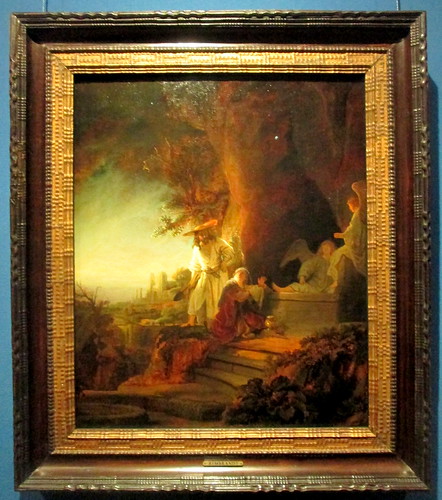
One of the most striking paintings of light in the exhibition was in this other Rembrandt, Christ and St Mary Magdalene at the Tomb. My photograph fails to do it justice:-

Christ and St Mary Magdalene at the Tomb

Parmigianini (1503 – 1540) Pallas Athene. For some reason this reminded me of the cyclist Laura (Trott) Kenny. Unfortunately my photograph has a reflection of the Gallery’s central light fitting:-

Pallas Athene

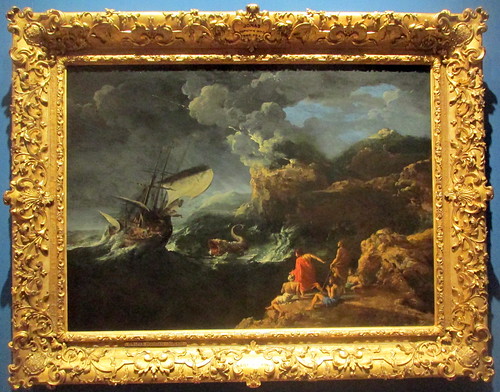
Gaspard Dughet (1615-1675) Seascape with Jonah and the Whale. There is a lightning flash across the upper part of this picture of which I tried to take a close-up, but it didn’t come out:-

Saescape with Jonah and the Whale

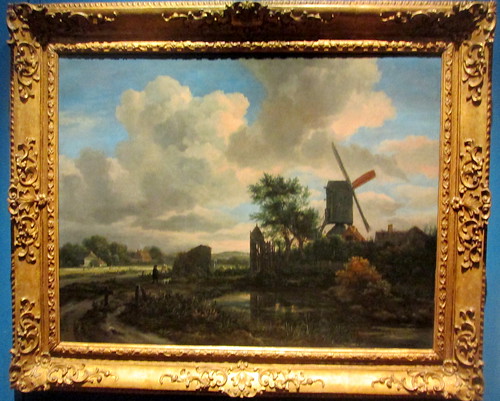
Jacob van Ruisdael (1628-1682) Evening Landscape, A Windmill by a Stream:-

Evening Landscape, A Windmill by a Stream

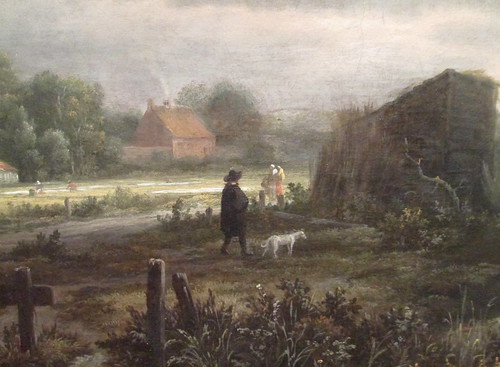
The information card for the above says “a single figure swathed in black walks away from us.” Examining the picture closely two (female) figures can clearly be seen behind the black swathed one! They are brilliantly conjured up too, with just a few dabs of paint. How could the writer of the description have failed to notice them? (Is it perhaps because they are clearly women?)

Figures Painted by Jacob van Ruisdael

There is a virtual tour of the exhibition here.

The Gourlay Girls by Margaret Thomson Davis

B&W, 2000, 237 p.

This is a sequel to Davis’s novel The Clydesiders, though it might as well not have been. The actual plot here does not require it. It could as easily have been anybody’s daughter who fled the house after her grandfather died in front of her when she had frozen at his fit and not fetched his medicine. As it is, Davis more or less uses it as a thread to tie this one to the first book in her trilogy.

Wincey (Winsome) is that much-loved daughter of Virginia and Richard Cartwright, whom everyone sees as close to her grandfather. Wincey knows his darker side though. When he takes that fatal fit she watches immobile as he dies, before fleeing off and taking the first tram she sees. She ends up crying on a street in Springburn where Florence Gourlay befriends her and takes her home – as an orphan otherwise destined for the workhouse. In a sense Wincey strikes lucky. The Gourlays – father Erchie, mother Teresa, eldest sister Charlotte, twins Euphemia and Bridget and Granny, Erchie’s mother, who gets all the best lines – are a friendly loving family and treat Wincey as one of their own.

It is the thirties though, and times are hard with Erchie unemployed. Salvation comes with the family’s sewing activities spearheaded by Charlotte but which, with Wincey’s help and Erchie’s knack for mending machines, is built up over the years into a successful business. Flies in the ointment are employee Malcy making up to Charlotte with an eye to the main chance and Wincey’s total aversion to men. She is cold even to Erchie, who has given her no reason to be. Very occasional chapters deal with the loss Virginia and Richard feel at Wincey’s disappearance, the strains it places on their marriage and their ongoing friendship with Virginia’s first husband James Mathieson, bound as they are by their socialist principles.

All this takes place in the shadow of the 1930s, the growth of Nazism in Germany and the shadow of forthcoming war. One bright spark is the Empire Exhibition of 1938 held in Glasgow’s Bellahouston Park, the mention of which in the book’s blurb enticed me to buy it in the first place. Literally bright; the night time illuminations were famously spectacular. Though Davis has clearly researched it (she may even have attended the event,) the scenes at the Exhibition itself are a little cursory. Then again a lot of the book is. Relationships are sketched out, developments telescoped, the treatment rushed, the information dumping and drawing of background somewhat crude. Sometimes conversations are too obviously designed to provide the reader with explanations. Though probably true to life as it was then the female characters seem much too eager for Wincey to be married off given she’s still in her mid-to-late teens.

Davis has been described as Glasgow’s Catherine Cookson. I’ve not read any Cookson. And I won’t in the future.

Pedant’s corner:- Davis uses the term ‘abusing’ of Wincey’s grandfather’s treatment of her. That’s an anachronistic word for what was more likely known in the 1930s as molesting or interfering with.
Otherwise; “of the abdication King Edward VIII” (abdication of King Edward,) “‘Any digestives,’ Granny asked” (a question mark, not a comma, after ‘digestives’,) “hokey kokey” (hokey cokey,) an end quotation mark in the middle of a piece of direct speech. “‘For years they’ve been these camps’” (there’ve been,) a missing comma before a piece of direct speech. “‘Did she do along with this story’” (go along.) “‘Hiding’ yer heid in the sand’” (Hiding, [or, Hidin’] yer heid.) “‘An aw wis right’” (An ah wis right,) “‘When’s she ever been a blether,” Granny wanted to know’” (a question mark, not a comma, after blether) “along side” (alongside,) “the Atlantic restaurant” (it’s a proper noun, so Atlantic Restaurant,) “‘You really do believe there’s going to a war, then’” (going to be a war.)

John Henry Lorimer Exhibition

Earlier this week the good lady noticed that there was an exhibition of the works of John Henry Lorimer at the City Art Centre Edinburgh. That was only just in time. The exhibition opened in November but finishes tomorrow!

I have mentioned this artist before. And not just the once.

On Thursday (17th) we made post-haste to see the exhibition before it closed.

One of the first of his pictures previously unfamiliar to me was The Long Shadows painted, like so much of his work, in the grounds of Kellie Castle in Fife. This photo does not do it justice:-

The Long Shadows

Lorimer was a good portraitist. One of the paintings on show depicted the ordination of elders in a Scottish Kirk. The figures were so lifelike in all their Calvinistic awfulness I couldn’t bear to inflict it on myself or you.

This portrait is of Lorimer’s architect brother Robert Stodart Lorimer, who designed over 300 War Memorials including the Scottish National War Memorial which lies in Edinburgh Castle:-

Sir Robert Stodart Lorimer

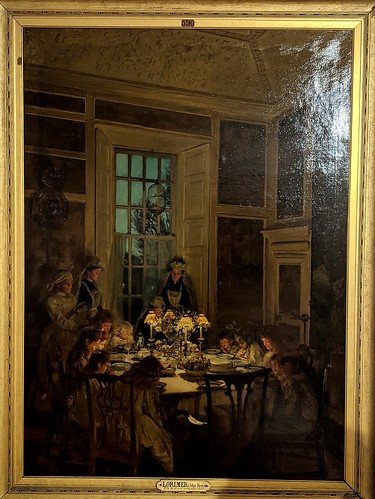
Typical of Lorimer’s painting of light and very like Spring Moonlight (see first link above) in its use of candlelight is Grandmother’s Birthday:-

Grandmother's Birthday

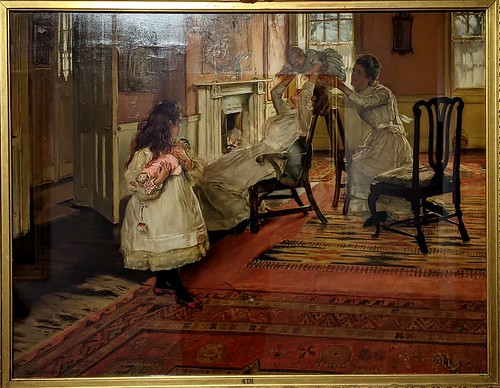
Maternal Instinct by contrast contains very Victorian subject matter. Unfortunately reflections in the glass spoil this a little:-

Maternal Instinct

The window in this one features in many of Lorimer’s paintings. I think this is The Birthday Party:-

John Henry Lorimer Painting

Despite no overt lighting depiction this domestic subject is unmistakably Lorimer:-

Painting by John Henry Lorimer

Another fine portrait – of a lady. Unfortunately I forget whom:-

Portarit by John Henry Lorimer

A well as oils Lorimer was very good with watercolour. This, The Gyles House, Pittenweem, is the house in Pittenweem to which the artist retired:-

The Gyles House, Pittenweem

Housework’s Aureole. In real life this treatment of light falling through a window onto a wall is superb. The photo is nothing by comparison:-

Housework's Aureole

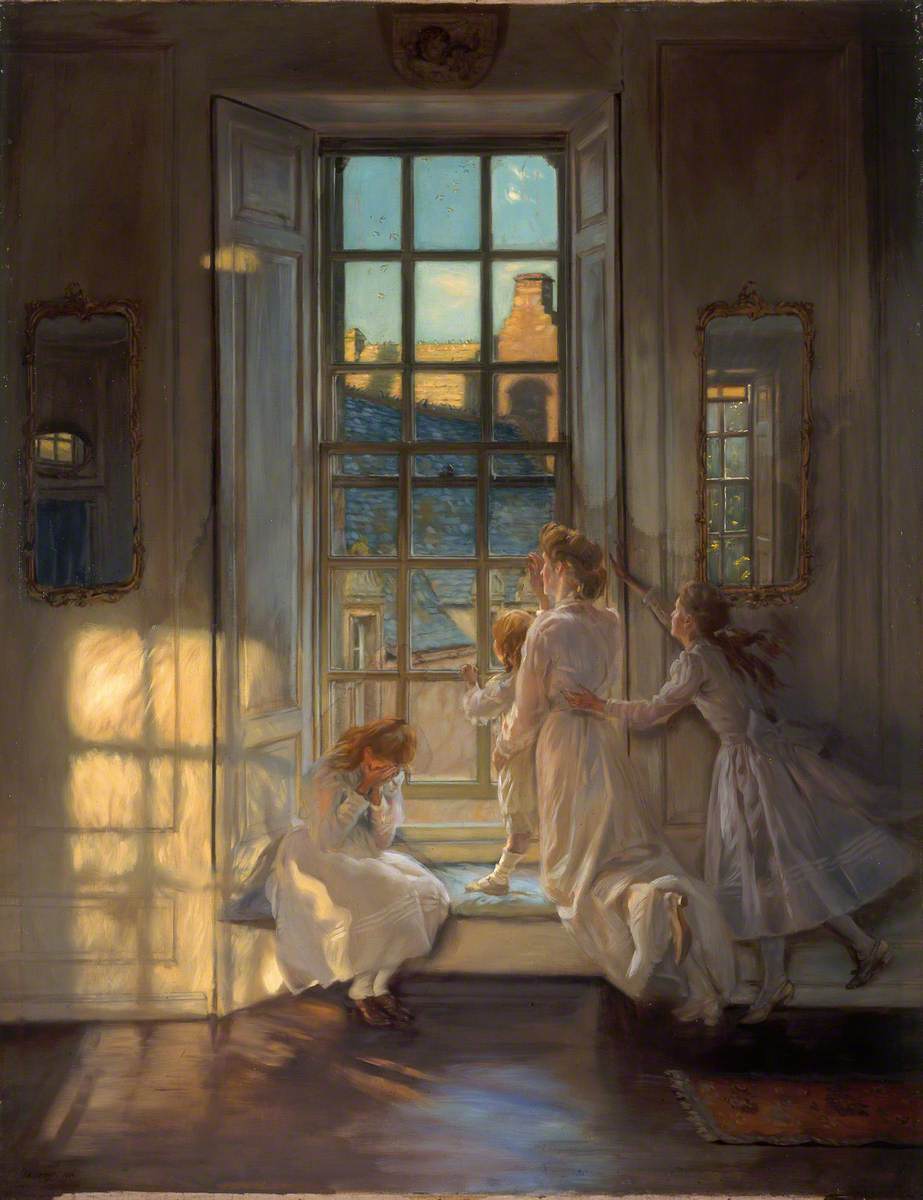
The exhibition’s poster image was Flight of the Swallows:-

Flight of the Swallows

Many more Paintings by Lorimer can be found at Art UK.

The Queen’s Gallery, Holyrood

The Queen’s Gallery lies over the road from the Scottish Parliament, Holyrood, and close by Holyrood Palace. It has recently been refurbished and styled with a blonde wood.

Art Deco style lamp in niche by entrance to the Queen’s Gallery:-

Niche Light by Entrance, Queen's Gallery, Holyrood

Lower part of stairwell:-

Lower Stairwell, Queen's Gallery, Holyrood

Upper part of stairwell:-

Upper Stairwell, Queen's Gallery, Holyrood

Stair guard rail:-

Stair Guard Rail, Queen's Gallery, Holyrood

Ceiling + Light:-

Ceiling + Light, Queen's Gallery, Holyrood

At the time we visited there was an exhibition of paintings illustrating the lives of Queen Victoria and Prince Albert.

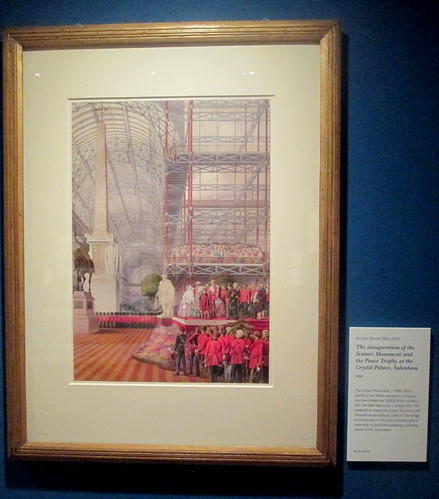
Painting of Scutari Monument at Great Exhibition. (The Great Exhibition is one of my interests so I had to photograph this):-

Scutari Monument at Great Exhibition

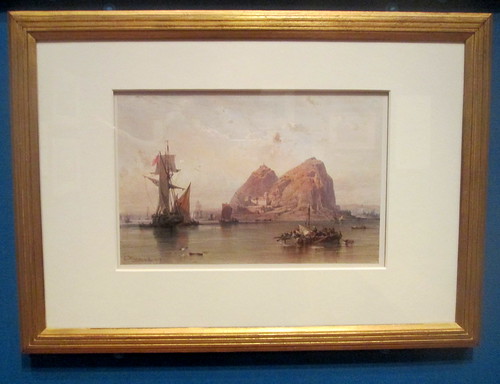
Similarly this painting by Edouard Hildebrandt of Dumbarton Rock and Castle was a must:-

Painting of Dumbarton Rock and Castle

Information card re painting above:-

Dumbarton Castle Painting Information, Queen's Gallery, Holyrood

Holyrood Palace; Mary, Queen of Scots; the Blood of David Rizzio and Other Exhibits

I realised when I was composing this that I hadn’t posted any pictures of Holyrood Palace from the grounds surounding it other than from the front courtyard, so here are two.

Holyrood Palace from Grounds. Ruins of Holyrood Abbey to right:-

Holyrood Palace from Grounds 1

East facade:-

Holyrood Palace from Grounds 2

One of the most gruesome events that took place in Holyrood Palace was the murder of David Rizzio.

Rizzio was a favourite of Mary, Queen of Scots, who was thought by some to be too close to, and too much of an influence on, her.

A plot was hatched to kill him and he was duly murdered in front of the Queen.

One of the exhibits in the Palace is Rizzio’s “bloodstain”:-

Rizzio's 'bloodstain', Palace of Holyroodhouse, Edinburgh, Scotland

I remember from my childhood visit to the Palace the story being told that there used to be what was said to be the remains of his clotted blood on the floor but that visitors would chip away at it on the sly to get a piece for themselves to take away. The curators got so fed up with replacing the ‘clot’ that they resorted instead to this red wash on the wooden flooring to mark the spot.

Towards the end of the Palace tour there is a room which contains royal memorabilia.

A display of British decorations (OBEs, CBEs etc):-

British Decoration Medals Display, Holyrood Palace

The regalia of the order of the Thistle:-

Order of the Thistle, Holyrood Palace

One of Queen Victoria’s dresses. She was not a big woman:-

Queen Victoria's Dress, Holyrood Palace

Holyrood Palace Tapestries

Many of the rooms in Holyrood Palace are hung with tapestries:-

Palace of Holyroodhouse,Tapestry , Edinburgh

Tapestry, Holyrood Palace

Tapestries, Holyrood Palace

This room also contained a piano (or spinet or clavichord):-

More Tapestries and a Piano, Holyrood Palace

History Bookshelf Travelling for Insane times

Another entry for Judith, Reader in the Wilderness‘s meme.

This bookcase is in our living room. Top shelf is Military History with my extensive collection of Pan’s “British Battles” series and more. The second shelf contains more Military History, books by Primo Levi plus some novels, the third is a miscellany, some omnibus editions, hard back Hilary Mantel books plus at the extreme right books on International Exhibitions:-

History Books (and some more)

The books below are in a display cabinet. These are mostly about World Wars 1 and 2 but also there is Thomas Pakenham’s The Boer War:-

History Books

Same display cabinet. Churchill’s History of the English Speaking Peoples, Conan Doyle’s The British Campaign in Flanders and Son of the Morning Star.

More History Books

free hit counter script