Archives » Art

The Hepworth Wakefield

We had an overnight stop at Wakefield on the way back up from Bath so that we could go to The Hepworth Wakefield. It was built in commemoration of artist/sculptor Barbara Hepworth who was born in the town. As well as many of her works it now houses the municipal art collection started in 1923.

The building stands by the River Calder and was designed by British architect David Chipperfield.

The Hepworth Wakefield

From over River Calder:-

The Hepworth Wakefield

From walkway over the river:-

The Hepworth Wakefield

Entrance and rear:-

The Hepworth Wakefield, Entrance

I took a video of the weir from the main road bridge:-

Gaia at Lichfield Cathedral

Whatever I had imagined Lichfield Cathedral would contain I certainly wasn’t prepared for a huge model of planet Earth. Called Gaia, it’s an imposing artwork by Luke Jerram.

Gaia at Lichfield Cathedral

Art Installation, Gaia, at Lichfield Cathedral

It brought home to me just how far up the planet from the South Pole the British Isles are. From most angles of the cathedral’s floor they couldn’t be seen:-

Gaia in situ at Lichfield Cathedral

Gaia from the cathedral choir:-

Lichfield Cathedral, choir , Gaia

John Lavery Exhibition, Scottish National Gallery (iii)

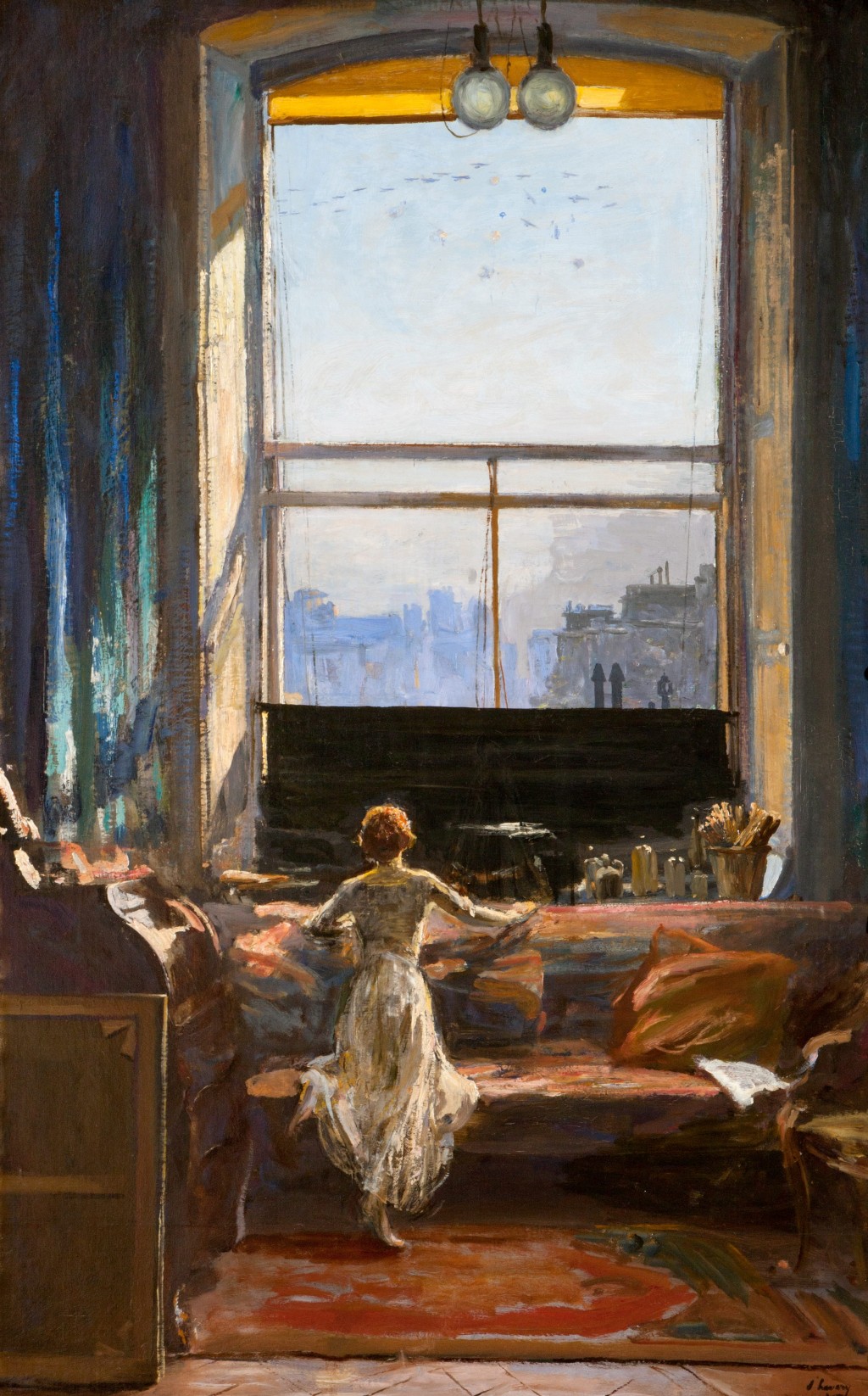
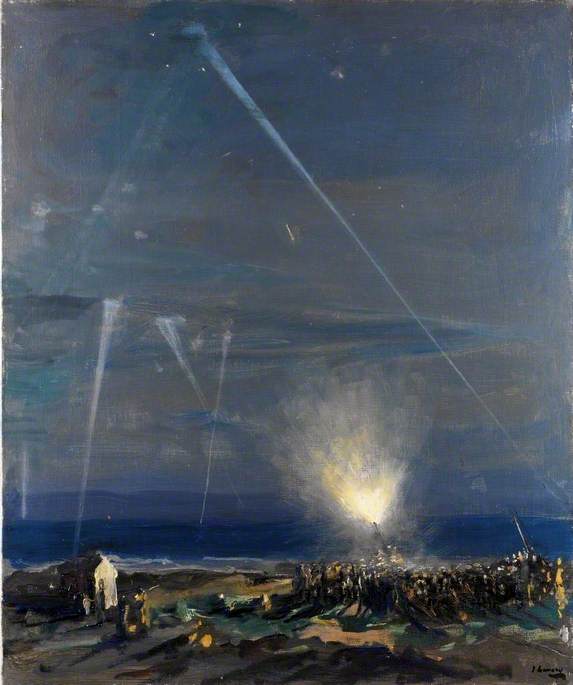
During the Great War Lavery was commissioned as a war artist. Several of his war paintings are on display at the Lavery on Location Exhibition at the Scottish National Gallery.

Mine-Laying Submarines Harwich 1917:-

Mine-Laying Submarines Harwich 1917

Hendon 1917. Hendon was a Royal Flying Corps training base. I really liked this as I’m a sucker for biplanes:-

Hendon 1917

More sombrely this is The Cemetery, Étaples:-

The Cemetery, Étaples

Daylight Raid from my Studio:-

A Coast Defence. An 18-Pounder Anti-Aircraft Gun, Tyneside:-

Lavery was almost alone in portraying those who became casualties. Wounded, London:-

Wounded, London

More of Lavery’s works can be seen on the Ulster Museum’s website, here.

John Lavery Exhibition, Scottish National Gallery (ii)

Lavery made his name when he was commissioned to paint the State Visit of Queen Victoria to the Glasgow International Exhibition 1888. For this he had individual sittings for the privileged invitees so that he could then incorporate accurate portarits of them into his final composition.

Glasgow International Exhibition

He painted many pictures of the International Exhibition including this one of the main building. Along with many other depictions of various International or National Exhibitions, plus the Festival of Britain, I have a copy of this hanging on my study wall:-

The Glasgow International Exhibition By John Lavery

Lavery also painted A View from the Canal, Kelvingrove, showing one of the gondolas which plied the waters of the River Kelvin as an amusement attraction:-

A View from the Canal, Kelvingrove by John Lavery

And this one of the exhibit The Blue Hungarians:-

The Blue Hungarians by John Lavery

One of the features of the international Exhibition was an array of restaurants and café including The Dutch Cocoa House (as depicted by Lavery below) which dispensed Van Houten products.

The Dutch Cocoa House by John Lavery

The above for some reason reminds me of both Edwin Hopper’s Nighthawks and Edgar Degas’s The Absinthe Drinker.

Lavery exhibited this painting in the Art Gallery at the International Exhibition. Dawn after the Battle of Langside. Mary, Queen of Scots in the aftermath of the battle:-

Dawn after the Battle of Langside

John Lavery Exhibition, Scottish National Gallery (i)

For some reason the title the Scottish National Gallery has given to its exhibition featuring the painter John Lavery is “An Irish Impressionist.”

I had always considered Lavery to be a Scottish painter, even if he was born in Ireland. He moved to Scotland as a child and started his career in Glasgow.

The Exhibition is on till 27th October.

Lavery’s early work resembles paintings by The Glasgow Boys. This is The Intruders, very reminiscent of a painting by James Guthrie:-

The Intruders by John Lavery

His style soon developed as he took to painting more impressionistic works such as these two of the Bridge at Grès (Grez-sur-Loing):-

The Bridge at Grès by John Lavery

The Bridge at Grez by John Lavery

Then we have Windy Day:-
Windy Day by John Lavery

and The Harbour of St Jean de Luz:-

The Harbour of St Jean de Luz by John Lavery

There are two versions of On The Loing in the exhibition. This one was a study for the larger painting exhibited beside it.

John Lavery: On the Loing

Adam Bruce Thomson

I’ve been to the City Art Centre, Edinburgh again. They have a retrospective exhibition of the works of Adam Bruce Thomson, of whom I admit that until the exhibition I had never heard.

The Exhibition’s title, The Quiet Path, perhaps explains that a bit. He seems to have been an unassuming man.

He was a very good painter but I was particularly taken by his drawings made during the First World War.

Zeppelin on the Ground:

Zeppelin on the Ground

Making Pontoon Bridge:

Making Pontoon Bridge by Adam Bruce Thomson

Royal Engineers Building a Bridge Near Mons:

Royal Engineers Building a Bridge Near Mons

Other drawings included Colinton:-

Colinton

And, Loch Carron: Passing Storm:-

Loch Carron: Passing Storm

Bringing in the Hay is more colourful:
Bringing in the Hay

As is New Galloway:

New Galloway

There were some paintings of Edinburgh scenes.

North Bridge and Salisbury Crags:

North Bridge and Salisbury Crags Edinburgh

The Old Dean Bridge:

The Old Dean Bridge

And  scenes from elsewhere.

Stooks, East Lothian:

Stooks, East Lothian

From my bedroom window:

From My Bedroom Window

Towards Mull:

Towards Mull

Tréboul Harbour, Brittany:

Tréboul Harbour, Brittany

The exhibition is on till the 6th of October.

More of Thomson’s art can be seen here.

Earth Abides by George R Stewart

Black Swan, 1985, 362 p.  Cover art by Eduardo Paolozzi.

During the late twentieth century this was considered as a classic Science Fiction novel of the post-apocalyptic variety.  I bought it many moons ago but somehow never got round to it till now.

Our protagonist Isherwood Williams is bitten by a rattlesnake when out on a hunting expedition. When he recovers he finds the human world has succumbed to a disease of some sort. Cities and roads are mostly deserted (the book was first published in 1950 when cars were much scarcer than they are now) but infrastructure – electricity, water, fuel – is still working. Overcoming his reluctance to use what wasn’t his property he takes a car and rides from his home in California across what was the US to the east coast and finds very few people have survived. Those who have, are disorientated and demoralised though three “negroes” have gone back to living off the land. Williams (in what is to modern eyes clearly a racist assumption) thinks they are more suited to this due to the way they lived before.

Back home in California he sets about life on his own but one day, when the electricity has finally failed and the street lights have faded away he notices a light at night. This leads him to a woman called Emma and the pair get together. Emma is of black ancestry so Williams’s racism is not too overt. (But then again in such a situation you could not afford to be overly choosy.) Emma is a resourceful and wise woman so it is just as well.

The pair set about surviving as best they can and even decide to have children. Along with a man called Ezra and the family he had collected around himself they form a community, which over the years grows and forms rituals of its own. Ish’s hand-held hammer becomes a totem, the long-lost Americans (of which to his community he is the last) and their accomplishments held in awe by the younger members. The difficulties of coming to terms with a new mode of life and of meeting other survivors or their communities  are explored briefly but mostly this is the story of Ish.

Some of the seeds of later post-apocalypse novels – especially the ‘cosy catastrophes’ of 1960s British SF – can be discerned in this book, so in that sense it can still be seen as a classic.

Pedant’s corner:- “extra ordinarily pleased” (extraordinarily,) “upon articles of dust” (particles of dust,) “but he heard only far off, the rasp and crackle of static” (needs a comma before ‘only’, “had take command” (had taken,) wistaria (x2, wisteria,) “whimpered her sleep” (whimpered in her sleep,) grape-fruit (grapefruit,) “what might, by generous interpretation, he called a social group” (be called a social group,) generaly (generally,) “electrical impluses” (impulses,) a missing comma before a piece of direct speech (x 2.) “Near by a smooth rock surface” (Nearby,) youngesters (youngsters,) geograhy (geography,) feminity (femininity,) Mohenjadaro (Mohenjo-daro.)

Rijksmuseum, Amsterdam (vi)

One of the oddest things we saw in the Rijksmuseum was this display of woollen hats:-

Woollen Hats, Rijksmuseum

A unique harpsichord he only surviving one of its type which plays one-fifth above normal pitch. Made by the Ruckers family from Flanders:-

Harpsichord, Rijksmuseum

The top floor of the museum is reserved for more modern exhibits. This biplane was designed during the Great War by Dutchman Frits Koolhoven for the British Aeronautical Transport Company:-

Biplane, Rijksmuseum

There was a chess set whose pieces looked like Great War crested china memorabilia but was designed by German Georg Fuhg “to glorify Nazi Germany’s urge to conquer.” It was shown in the Rijksmuseum in 1941 exhibition Kunst der Front organised by the occupier. The text in the border refers to countrie soccupied by Germany in 1939 and 1940:-

Chess Pieces, Rijksmuseum

Rijksmuseum, Chess Pieces

A cloth book for children which, as I recall, was made during the German occupation:-

Cloth Book, Rijksmuseum

Rijksmuseum, Cloth Book

Plaster model for the sculpture The Destroyed City by Ossip Zadkine, made to commemorate the bombing of Rotterdam in 1940. Zadkine said of it “I have sculpted tears.”:-

Destroyed City, Sculpture, Rijksmuseum


Do Ho Suh Exhibition, Modern One, Edinburgh

The current Exhibition at Modern One, Edinburgh, is Tracing Time by the Korean artist Do Ho Suh, of whom I hadn’t heard until the exhibition came on. It ws quite interesting, though some of the exhibits were a bit of a miss rather than a hit.

The outline of this reminded me of the shape of the Korean peninsula:-

Do Ho Suh 1

A fairly crude drawing of an odd subject:-

Do Ho Suh 2

Circles or swirls feature in a lot of the exhibits:-

Do Ho Suh 3

Do Ho Suh 4

Do Ho Suh 6

A somewhat scatological drawing:-

Do Ho Suh 5

This seems to be just a shape:-

Do Ho Suh 8


Houses, too, are a feature:-

Do Ho Suh 7

Do Ho Suh 9

Do Ho Suh 10

This walk-thorough installation recreates the entrances to several of the homes in which the artist has lived:-

Do Ho Suh 11

The Exhibition is on till Sep 1st.

Rijksmuseum, Amsterdam (iii) Paintings

One of the downstairs rooms in the Rijksmuseum held paintings that weren’t perhaps as famous as The Night Watch or Vermeer’s Milkmaid.

Two were by by Hendrick Avercamp, both reminiscent of the work of the Breughels.

Ice Entertainment Near a City :-

Hendrick Avercamp Painting, Rijksmuseum, Amsterdam

Winter Landscape with Skaters:-

Hendrick Avercamp Painting, Rijksmuseum, Amsterdam

Self portrait by Betsy Westendorp-Osieck:-

Betsy Westendorp Painting, Rijksmuseum

Self Portrait by Emile Bernard:-

Painting by Emile Bernard, Rijksmuseum

van Gogh Self Portrait:-

van Gogh Self Portrait, Rijksmuseum


Therese Schwartze Self Portrait:-

Therese Schwartze Self Portrait, Rijskmuseum

Portrait of Theresia Ansingh (Portret van Sorella) by Therese Schwartze. Also known as Woman Wearing a Hat. A better picture than mine is here:-

Portrait by Therese Schwartze

The Night School by Gerard Dou. An illustration of depiction of light. (Again better to see here):-

The Night School by Gerard Dou, in Rijksmuseum

An unusual Mondrian. Painting of a Windmill:-

Painting of a Windmill by Mondrian, Rijskmuseum


free hit counter script