Archives » Reading Reviewed

The Crest of the Broken Wave by James Barke

Collins, 1953, 318p, including 2p Note, 2p Contents and 2p list of characters.

This is the fourth in Barke’s Immortal Memory novel sequence on the life of Robert Burns. This instalment mainly concentrates on his taking the lease at Ellisland Farm, some miles north of Dumfries, a town which he does not care for, and his angling (the Scots word would be ettling) for a job with the Excise. There is though, a brief journey to Edinburgh where he finally settles accounts with his publisher William Creech and also with Jenny Clow, the mother of one of his many children, on whom he makes a settlement.

When we start, the house at Ellisland where he is to live with Jean Armour and his family, is in the course of being built and he has to live in a small, bare room nearby while Jean et al stay in Mauchline (still spelled Machlin by Barke.) Even when his new house is built, after many delays by the Dumfries builders, the walls are too damp with plaster drying out to be healthy.

The breaking in of Ellisland is an arduous task and Burns recognises it will not provide enough of a living hence his seeking of the Excise job. This is also arduous, involving many long miles on horseback in all weathers – and Burns was always prone to chills and fevers.

There is still time, though, for him to fall in with Anna Park, niece of the wife of a Dumfries innkeeper. She is portrayed as equally, if not more, willing than he is to consummate their passion and the inevitable occurs. (Reading these books it sometimes feels as if Burns only had to look at a woman to get her pregnant.) Her lying-in more or less coincides with that of Jean Armour’s latest and Jean selflessly agrees to treat Anna’s child as her own.

Within the text we are treated to a full rendering of Burns’s draft of Tam O’Shanter, a first reading of the poem given to his family assembled by the fire one night.

In an exchange with his strait-laced brother, Gilbert, Burns says, “the Scotland o’ saints and scholars and country squires is nothing but hypocrisy. Not one o’ them can square their beliefs with their practice,” adding that his reading of history and the Bible tells him “morality has ever been a snare and a delusion.”

Jean is well aware of Burns’s tendencies, earlier telling Rab’s sister Nancy that being jealous would do no good, and that she couldn’t deny him other women, so long as he loved them.

In an observation that reads a little too much like an authorial projection of future knowledge onto the past, Francis Grose, an author-antiquarian from London, tells Rab he admires the Scots peasantry, “the best educated in the world,” but not the gentry, with their aping of English foppery, yet considers the Scots nation as defeated, and “‘the English will beat and tame half the world before they’re done – especially the coloured races…… And dang me if they won’t get the Scotch to do all their dirty work for them and fight all their bloodiest battles.’”

Off-stage, the pre-Terror French Revolution rumbles away in the distance, with Burns privately expressing support, something an Exciseman could not do explicitly.

Apart from that performance of Tam O’Shanter none of the poetry makes it to the page this time, though Burns’s efforts in collecting and publishing Scots songs – without payment, a point which disquiets Jean – earn a few mentions.

The book’s title refers to the peak of Burns’s achievements, which Barke considers to have occurred around this time.

Pedant’s corner:- “‘You wrang to judge him’” (You’re wrang.) “It was the Burns’ fate she feared” (Burns’s,) “urgent breasts” (of Anna Park. Urgent?) “But it was a pity that necessity had compelled his to allow” (compelled him to allow.)

Frost Fair by Carol Ann Duffy

Picador, 2019, 41 p. lllustrated by David De Las Heras.

This, like The Christmas Truce, is one of Duffy’s Christmas poems. It is inspired by the frost fairs that took place on the River Thames in London during the Little Ice Age when people erected tents, stalls and even set fires on the frozen river during winter.

Duffy’s female narrator disguises herself as a man and wanders through the town describing the scenes she sees and eventually ventures onto the ice (not without initial mishap) to immerse herself in the goings-on, before spending the night sleeping on the river.

Usually the three lines at the end of the irregularly sized stanzas are rhymed.

David De Las Heras’s illustrations could be described as cartoonish, consisting as they do of blocks of colour, but they are effective in conveying the atmosphere and their crowd scenes in particular are reminiscent of Brueghel.

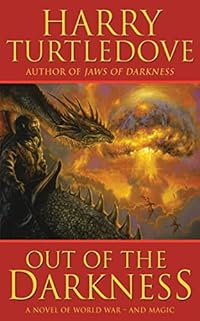
Out of the Darkness by Harry Turtledove 

Pocket Books, 2005, 661 p, plus vi p Dramatis Personae.

The usual fare from Turtledove as his mirroring of the Second World War in a world where magic/sorcery is a prevalent feature and fantasy creatures abound comes to an end. The episodic structure, returning to its viewpoint characters every so often, continues to frustrate with its repetitions of things the reader already knows about the people portrayed and their circumstances. So, too, does the misogyny of many of the characters. But this is an unenlightened world, and while it has good people in it there are not enough of them to make a material difference. They are only operating at the margins.

The equivalences with our world are not exact. For example there are no republics here, King Mezentio, the leader of the racist aggressors, does not die by his own hand but asks a soldier to do it and the magical counterpart to the Manhattan Project achieves its goal only unlike in our world is demonstrated to citizens of its proposed victims before its final deployment – on the capital city rather than provincial ones. It is interesting, though, that the developed magic/sorcery has been throughout the seven Darkness books subject to theoretical calculation. (Not quite magic then?) Though apart from drawing energy from the not always handy ley-lines it still needs life force to power it.

As Turtledove’s Derlavaian War winds down several of those we have come to know (very few of whom have experienced character development) meet their ends, others have happy endings – of sorts. The parallels with our world extend to an equivalent of the Nuremberg Trials. The book doesn’t end so much as stop, but as far as its survivors were concerned this was also true of our Second World War. Life goes on, if in different circumstances. Not all of them congenial.

Pedant’s corner:- “Tsavellas’ small kingdom” (Tsavellas’s,) “Iskakis’ wife” (Iskakis’s,) “not as if he’d take a step” (context suggests ‘not as if he’d taken a step’,) “floating fortress’ stick” (fortress’s,) “the marquis’ air” (marquis’s,) “but we liked to come into Priekule to listen to him” (not Priekule; Pavilosta,) “‘I should have won Algarve should have won’” (is missing a punctuation mark after that first ‘won’,) “Captain Frigyes’ bloodthirsty magic” (Frigyes’s,) “‘Assuming what you say about Mezentio is true, will will grant your soldiers their lives’” (… is true, we will grant …,) “Balazs’ smile” (Balazs’s. Balazs’ appeared again once,) “the ballocks” (I assume Turtledove, being USian, has only heard this word and doesn’t realise it’s spelled ‘bollocks’,) “Gyongos’ skirmishes” (Gyongyos’s,) Kunhegyes’ battered old palisade” (Kunhegyes’s.)

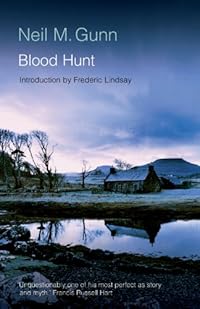
Blood Hunt by Neil M Gunn

Polygon, 2007, 265 p, plus 5 p Introduction by Frederic Lindsay.

Sandy Ross has retired from his life as a sailor to live out his time on a croft on his ancestral soil. An intrusion into his settled world comes when local policeman Nicol Menzies arrives to tell him a murder – of Menzies’s brother, Robert – has taken place and he needs to search the croft. The perpetrator is Allan Innes, one of a group of youths who used to frequent the croft.

A discomfited Sandy, all too aware Menzies is fired with an uncompromising zeal, pretends to unlock his barn and doesn’t mention the resistance he felt when pushing the door open. His more or less unconscious decision to try to help Innes lays out the novel’s path. When Menzies leaves, Sandy provides Innes with enough food to last a day or so.

Innes avoids the search for him by hiding on the Crannock (a crannog) in Loch Deoch, swimming across and back to keep in touch with Sandy, who plans to provide him with money and disguising clothing.

Fate intervenes when Sandy takes his cow to be served by the local bull. In her eagerness the cow pulls Sandy over and breaks his ribs, rendering him bed-bound. His everyday needs are looked after by the widow Macleay, a neighbour, who calls in the doctor and a redoubtable local nurse is also arranged. The widow Macleay is looked upon as a suitable husband for Sandy but he is wary of such a prospect.

A more surprising carer is Liz Murison, the woman over whom Innes and Robert Menzies had quarrelled, who turns up on Sandy’s doorstep saying she’d heard he needed help. In her pregnant state she has left the orbit of her father’s ire and his religious strictures.

The local minister drops in to try to persuade Sandy to return the girl to her family home. The minister – fond of a secret dram – says to him, “‘But if man does not take a stand on the great moral issues, woman never will. It’s not in her nature. There are times when a woman has no more moral sense than a fly on a windowpane.’”

Sandy isn’t swayed, Liz has no desire to go back and he sees no reason to ignore her wishes.

Things go on the way to their conclusion as the determined Nicol doggedly pursues his quarry to the bitter end.

Each of the characters (except perhaps for Nicol) is portrayed sympathetically. Sandy’s humanity in particular shines through.


Pedant’s corner:- In the Introduction; “Nicol Menzies’ brother” (Menzies’s,) “Allan Innes’ sweetheart” (Innes’s.) Otherwise: a missing comma at the end of a piece of direct speech, one missing before a piece of direct speech (x 2.) “It’s door was ajar” (Its door,) “finger prints” and, later, “finger-prints” (nowadays one word; ‘fingerprints’,) “fo’c’stle” (fo’c’sle – or fo’c’s’le.) “The pain, like the bruises, were on his left side” (The pain, …, was on his left side,) “tried to ease his shoulder out if its bandaging” (out of its bandaging,) a missing opening quotation mark before a piece of direct speech. “‘May be so’” (Maybe so.)


The Temple of Dawn by Yukio Mishima

In The Sea of Fertility, Penguin, 1987, 196 p. Translated from the Japanese 曉の寺 (Akatsuki no Tera) by E Dale Saunders and Cecilia Segawa Seigle.  First published 1970.

This instalment of Mishima’s tetralogy starts in 1940 and follows on from Runaway Horses by featuring now retired judge Shikeguni Honda, still convinced that Isao Iinuma was a reincarnation of Kiyaoki Matsugae, the doomed lover in Spring Snow; a belief mainly due to the presence of three moles on their left sides.

As part of his legal consultancy work protecting Japanese exporters’ interests Honda travels to India via Thailand. He meets a six-year-old Thai princess, Ying Chan, who is convinced she is Japanese but her assertions are, of course, treated by her family and attendants as mental aberrations. Honda believes her and tries unsuccessfully to see if she also has three moles.

On to Benares in India where Honda has an epiphany while Mishima takes the opportunity to impart to us a lengthy treatise on various ideas of reincarnation from around the world. At a waterfall in the Antaji caves Honda also recognises a scene which Matsugae had predicted he would encounter.

The Second World War comes and goes off-stage and the story undergoes a shift in tone when it restarts in occupied Japan where Ying Chan has come to study. Honda becomes obsessed by the idea of seeing her naked to confirm his reincarnation belief. He invites her to his house (but several times she does not turn up on time.) He tries to get the nephew of his neighbour to seduce Ying Chan, on whose intended room he can spy via a peephole, but this plan fails. (I note the recurrence of this peephole scenario in Mishima’s later novel The Sailor Who Fell From Grace with the Sea.)

Honda becomes even more of a voyeur before the novel’s climax during one of his houseparties and there is an odd, almost detached, final chapter set in 1967 where he discovers Ying Chan’s destiny.

Mishima’s unease at Japan’s loss of identity under Western influence is less to the fore here than in the previous two volumes. It is almost as if this instalment is from a different story sequence, despite the reincarnation connection.

Pedant’s corner:- “voices chanting a sutra rose rapidly to a crescendo” (No. The crescendo is the rise, not its culmination,) “plusses and minuses” (pluses and minuses?) “the aureoles around the nipples” (the areolae.)


Penny Plain by O Douglas

Thomas Nelson & Sons, 1923?, 378 p. First published 1920.

Set in the fictional Tweedside town of Priorsford (whose model it is not difficult to infer given the author’s background) this is the story of the kind-hearted – to excess? – Jean Jardine, aged 23 and guardian to her two younger brothers David and Jock, but also to Gervase (nicknamed Mhor,) the son of Mr Jardine’s second wife and also left alone when both his mother and Mr Jardine died. The Jardines are poor and live in a quaint cottage called The Rigs, owned by an absentee landlord. Jean worries over the cost when David is to go to University in Cambridge, and how he will fit in.

The well-to-do Pamela Reston, sister to Lord Bidborough, was brought up in Priorsford, and returns there to visit her childhood haunts. She takes a room in the house next door to The Rigs run by the no-nonsense Bella Bathgate but soon takes a shine to Jean and her family.

Travelling on the same train north as Pamela was successful businessman Peter Reid, the Jardines’ landlord, told to take things easy by his doctor. He comes to The Riggs incognito and is charmed by Jean’s unquestioning acceptance of him as a stranger.

The Great Expectations and will they won’t they get together plot are almost superfluous though. Douglas’s focus is on domesticity, with lavish descriptions of interiors and meals, and Jean’s feelings for her fellow humans. Her depiction of middle-class life in the immediate aftermath of the Great War is also a kind of historical record.

For modern readers, though, it may be jarring to read a sentence like, “He was no Jew, and took small pleasure in the outward cleansing of the cup and platter.” (Are/were Jews more notable than others for cleanliness?) Then an old colonial warns Jock the Indian Civil Service was “hardly fit now for a white man” and a child is quoted as saying of the thought of being a minister, “No, it’s not a white man’s job.”

Douglas is easy to read and does have insight – albeit in a narrow sense – into the human condition. There is no high adventure here, no strong conflict, just quiet lives lived out quietly. Virtue rewarded, though, may have been a novelistic staple of those times but it’s less obviously apparent in the twenty-first century.

Pedant’s corner:- “the Miss Watsons” (several times, ‘the Misses Watson’.)

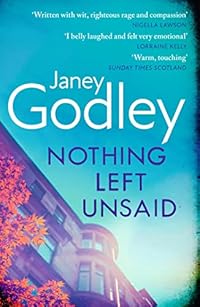
Nothing Left Unsaid by Janey Godley

Hodder, 2023, 249 p.

Godley, who died in 2024, was better known as a comedian and had a viral success with her voice-overs of Nicola Sturgeon’s press briefings during the Covid lockdowns. (“Frank, get the door!”)

This, though, is a reasonably standard novel which appears to draw on aspects of Godley’s early life for its inspiration.

When Sharon learns her mother Senga has been taken into hospital about to die she comes back from Bristol (where her marriage has broken down) to Glasgow. There she finds her mother is anxious for her to read a sort of memoir of her experiences in the 1970s. Senga’s marriage too was a mistake and her husband had left the family home. Sharon had been a practical, studious and dependable daughter, able to hold the ring as an additional support to her younger brother. The memoir is mostly concerned with Senga’s friends, most of whom have also made unsuitable marriages but Sandra’s husband is particularly controlling and prone to violence. As a result Senga becomes increasingly worried about her welfare, encouraging her to leave. But in the 1970s that was not so easy.

The book’s structure is rather unconvincing, alternating as it does between Sharon’s present and the extracts from her mother’s diary. Godley does provide a rationale for this in Sharon’s expressed reluctance to rush reading her mother’s story but surely this is psychologically unlikely. Wouldn’t most people faced with this situation read through the diary as quickly as possible?

The depiction of female friendship rings true, though, and the spirit of Glasgow shines through, while the nostalgic mentions of 1970s staples evoke the era admirably.

The story itself, however, while not inconsequential, is a little thin.

Pedant’s corner:- “The Farrow and Ball grey frontage …. were like every other café” “The Farrow and Ball grey frontage …. was like.) “Clyde was stood over the table” Clyde was standing over.) “Stuart was stood in the hall” (Stuart was standing in the hall.)  “‘Mr Blue Skies by ELO’” (Mr Blue Sky.)

The Angel’s Game by Carlos Ruiz Zafón 

Phoenix, 2010, 508 p. Translated from the Spanish El Juego del Angél (Editorial Planeta SA 2008) by Lucia Graves.

In this (sort of) prequel to The Shadow of the Wind, David Martín is a struggling writer just about scraping by, writing potboilers set in his home city of Barcelona in the 1920s. A hint of fantasy intrudes when he has a sexually charged encounter with a woman called Chloe – the name of his heroine – in a seedy establishment which he later finds has been abandoned for years. He comes under the influence of better-known writer Pedro Vidal to whose chauffeur’s daughter Cristina he is attracted and in the guise of editing Vidal’s manuscript rewrites his latest novel much for the better.

The proprietor of Sempere and Sons booksellers gives him a copy of Dickens’s Great Expectations, a book with which Martín is much taken, and introduces him to The Cemetery of Forgotten Books (familiar from The Shadow of the Wind, where Sempere’s son Daniel has a prominent part.) Great Expectations seems to be a kind of template here for Zafón but the parallels are by no means exact.

Out of the blue a French publisher Andreas Corelli asks Martín to write a book inventing a new religion. In return for one hundred thousand francs.

Corelli describes religion as “a moral code expressed through legends, myths, or any type of literary device, in order to establish a system of beliefs, values and rules with which to regulate a culture or society.”

He also has a jaundiced view of humanity, saying, “‘The incompetent always present themselves as experts, the cruel as pious, sinners as excessively devout, usurers as benefactors, the small-minded as patriots, the arrogant as humble, the vulgar as elegant and the feeble-minded as intellectual.’”

His thoughts on what motivates people to act badly have resonance. “‘When we feel like victims, all our actions and beliefs are legitimised, however questionable they may be. Our opponents, or simply our neighbours, stop sharing common ground with us and become our enemies. We stop being aggressors and become defenders. The envy, greed or resentment that motivates us becomes sanctified, because we tell ourselves we are acting in self-defence. Evil, menace, those are always the preserve of the other. The first step towards believing passionately is fear. Fear of losing our identity, our life, our status or our beliefs. Fear is the gunpowder and hatred is the fuse. Dogma, the final ingredient, is only a lighted match.’”

After his researches into religion Martín opines, “‘The main pillar of every organized religion, with few exceptions, is the subjugation, repression, even the annulment of women in the group.  Woman must accept the role of an ethereal, passive and maternal presence, never of authority or independence, or she will have to take the consequences. She might have a place of honour in the symbolism, but not in the hierarchy.’”

Martín moves into an old mansion which once belonged to Diego Marlasca – a man with a mysterious death whose ramifications will dog Martín’s future. (There are echoes here of a similar building in The Shadow of the Wind.)

In the meantime Martín has become plagued by Isabella, a fan of his writing, and come to the attention of Police Inspector Grandes as suspect in a mysterious fire at his former publisher not to mention the disappearance of Cristina.

He is saddened by Sempere’s decline in health and vigour. The bookseller complains that, “‘At my age, eroticism is reduced to enjoying caramel custard and looking at widows’ necks.’”

What could have been an insight into the importance of books in the lives of bibliophiles, however, degenerates in its latter stages into an overdose of unlikely happenings more akin to a thriller. Again, as in The Shadow of the Wind, Zafón flatters to deceive.


Pedant’s corner:-  “my father took me El Indio” (took me to El Indio,) shrunk (shrank.) “‘You don’t looked convinced’” (You don’t look convinced.)

Kings of Space by Captain W E Johns

A Story of Interplanetary Exploration

Hodder and Stoughton, 1954, 181 p, plus 6 p colour illustrations, 1 p Contents, 1 p List of Illustrations (by Stead) and 6 p Foreword.

The author was, of course, the creator of Biggles, Great War fighter pilot and thereafter general man of action. In the 1950s he took to writing science fiction for younger readers and it was in the children’s section housed in the basement of Dumbarton Library where, after I had consumed all their Biggles books, I started on those. It is due to Johns, then – along with the similarly aimed books written by Patrick Moore – that I developed an abiding interest in science fiction as a genre.

The foreword here sets out Johns’s purpose in writing such books, to inspire young people with the sense of adventure, while also pre-empting possible criticism of inaccuracies by emphasizing there was much not known about even the Solar System those 70 years ago. (He specifically mentions Jupiter’s eleven moons. At last count there are 115 of those.)

Now to the story.

Retired Group Captain Timothy Clinton and his son Rex have been stalking deer on a Highland mountain when the mist comes down towards the end of the day. Eventually they spot five red lights in the form of a cross and stumble across a house whose door contains an immobiliser. This is where a Professor Brane stays along with his butler (and factotum) Judkins.

The Professor is partial to coffee and caramels (which he took up since smoking represented too great a danger among the flammable materials he was surrounded by in his lab) and accepts flying saucers are real. He has also invented a spaceship he calls the Spacemaster, which is powered by cosmic rays. The red cross is a navigational aid to finding his way back home. Naturally he invites Clinton and Timothy to join him – and Judkins – on exploratory expeditions beyond Earth.

Various trips see them have a close encounter with a flying saucer, find life on the Moon, dinosaurs on Venus – a planet on which the Professor wants to take the opportunity to empty Spacemaster’s rubbish bins! – a Mars with no mountains but signs of humans; the last of whom are entombed on Phobos, before returning to Earth where they get the better of some foreign spies alerted to the possible existence of a spaceship by newspaper reports of strange apparitions in the Highland skies.

The whole thing is firmly of its time and ineluctably male but for what was back then called a juvenile (nowadays YA) spends very little time focusing on Rex.

Pedant’s corner:- “the stars would be overheard again long before they could reach their lodge” (overhead again,) “before a rough, overgrown track, guided them” (doesn’t need that second comma,) the word ‘professor’ appears within sentences both capitalised and uncapitalised seemingly randomly, “poor Judkins’ great anxiety” (Judkins’s,) “‘water, which is a mixture of hydrogen and oxygen’” (Er, no. A mixture of hydrogen and oxygen would simply be that, a mixture of two gases. Water is a compound of hydrogen and oxygen. Compounds have totally different properties from the elements needed to make them,) “the rudder, insert vertically in the exhaust thrust just below the nozzles” (inserted,) diaphram (diaphragm,) “level with he top of the gorge ” (with the top,) “everywhere there where little flecks” (everywhere there were little flecks.) “The affect of this on the human body” (The effect of this,)  “for the most part outlines were spoiled” (for the most part its outlines were spoiled,) the Professor says stray particles of hydrogen might have been caused to ignite by the ship’s velocity (for hydrogen to burn oxygen is also required,) gasses (gases – which appeared later,) the Professor says petroleum is a mixture of carbon and hydrogen (see above for water. Petroleum is a mixture, yes, but of differing compounds of carbon and hydrogen,) acclerated (accelerated,) “the same state of nuclear fission as the Sun” (nuclear fusion that would be,) a missing quotation mark at the end of a piece of direct speech.

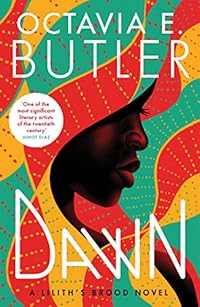
Dawn by Octavia E Butler 

Headline, 2022, 287 p. First published 1987.

When originally published the trilogy of which this is the first instalment was titled Xenogenesis. It now seems to be called Lilith’s Brood.

Lilith Iyapo wakes up in what appears to be a prison cell, provided with bland food. She has memories of this happening previously and also of her life on Earth when her husband and child had died in a traffic accident. This was shortly before a nuclear war left the planet uninhabitable (to humans at least.) She soon learns that a few humans were rescued from the apocalypse by an alien race, the Oankali; a species for which genetic engineering is essential.

The first appearance to her of an Oankali shocks her: they are covered in small tentacles acting as sensory organs, and which are attracted by movement. The Oankali have three sexes; male, female and ooloi. All have the ability to sense the biochemistry of genetics but the ooloi can manipulate it and build offspring from their mates’ genes.

Lilith is told a cancer has been removed from inside her and that the spaceship she is being held on is alive. The Oankali find cancer to be an attractive trait for their genetic manipulation purposes. They want to blend their own and human genetics, in part as their biological imperative but also to eradicate hierarchical tendencies from humans. They envisage Lilith’s part in this as to Awaken other humans and prepare them for this gene trade and a return to Earth. Lilith and the subsequent Awakened find the prospect repugnant.

When a sufficient number of people have been Awakened there are problems within the group. Specifically, some are wary of Lilith not only as a black woman but of her closeness to the Oankali and of the capabilities to manipulate the structure of the ship with which the they have endowed her, abilities naturally seen as suspicious by those not so treated.

In Dawn there are early similarities to other works of SF where people have been kept in captivity. The whole, though, depends on the credibility of the aliens and their motivations. I wasn’t entirely convinced.

Pedant’s corner:- “Where had all this been, Lilith wondered” (needs a question mark,) a missing end quotation mark after a piece of direct speech, “gasses” (gases,) “had come on to the bed with her and lay down” (and lain down,) “clean shaved” (clean shaven,) “Paul Titus’ wall” (Titus’s. Titus’ appeared again later,) “their own betrayal: No trip to Earth” (colons are not usually followed by a capital letter; ‘betrayal: no trip…’) A paragraph beginning with a piece of direct speech without having an opening quotation mark (I know this is a publishing convention but to me it feels wrong,) repellant (repellent.) “She froze where she stood and had all she could to keep from turning and running away” (is expressed awkwardly.) “It said nothing more, made no sound of its own pain” (ditto,) “she recognised Ahajas, Nikanj’s female mate as the owner” (she recognised Ahajas, Nikanj’s female mate, as the owner.) “She waited almost eager for the darkness” (needs a comma after waited,) Ahajas’ (Ahajas’s.)

free hit counter script