Archives » Golf

Preferred Lies by Andrew Greig

A Journey to the Heart of Scottish Golf. Weidenfeld and Nicolson, 2006, 289 p, including i p Acknowledgements and Thanks and ii p Contents.
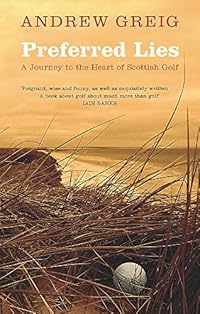
This project was undertaken after Greig’s surgery for a serious condition involving pressure on his brain, surgery from which recovery was by no means guaranteed. Thankfully his brain and other functions remained unscathed but it prompted a look back on his life and the golfing experiences of his youth. His father had introduced him and his two brothers to the game when they lived in Anstruther and he had become proficient enough to be asked to represent his county in youth tournaments but he drifted away from the game quite early.

The book is divided into eighteen sections (naturally) each reflecting an outing to a particular course or courses and each with its own addendum musing on the nature of life and golf, especially as related to Scotland and the Scots. All are tinged with Greig’s customary humaneness.

The courses range from South Ronaldsay, whose greenkeeping is entrusted to the local sheep – a feature which leads to its own all but unique hazards which the sheep leave behind them – to Anstruther, St Andrews, Bathgate, North Berwick, Gigha and even Iona, among others.

Greig says about his Dad and his golfing cronies, “They share a very Scottish sense that good fortune must come with a penalty.”

An attitude which has rubbed off. After being congratulated on a good shot by a woman called Joan (who came from the US) Greig replied, “‘It doesn’t happen often,’” only to be asked ‘Have you never heard of positive thinking?’

“‘Sure,’ I laughed. ‘In Scotland we call it kidding yourself!’

‘I call it unhelpful pessimism.’

‘We call it realism.’”

Of that quintessentially Scottish weather phenomenon he elaborates, “Dreich is our word for it. Our climate has made the word necessary, and its persistent, clinging gloom accounts for a lot of the Scottish mindset.”

Apropos his round at Bathgate – a much spruced up course from the one Greig remembered and a development he does not quite approve – he quotes playing partner Alastair McLeish, “‘Aye, Scottish Protestants,’ Al remarked after struggling himself in the opening holes. ‘We’re perfectly able to torture ourselves without any assistance.’”

The course on Gigha invoked in Greig thoughts which are an enduring theme of Scottish literature, a sense of important things lost. “The sorrow and loss are part of the beauty, but that doesn’t make them good. One of the reasons I’ve never lived in the West, despite it being part of what I must call my soul, is it’s too damn sad.”

In the end golf can be seen – like most sports – as some sort of metaphor for life. “Mostly golf is about self-inflicted suffering, self-knowledge and hard-won (precious because hard-won) joy. Who but the Scots could evolve a game that offers such opportunities for humiliation and failure, and no-one but oneself to blame for it? And such transcendent moments?”

Pedant’s corner:- “but there no witnesses” (but there were no witnesses,) “the unspoken immanence of death wasn’t terrifying” (immanence does make a kind of sense; but imminence seems more to the point,) “boys and girls getting up to good in the open privacy of the this coastal strip” (of this coastal strip.) “Princes Sreet Gardens” (Princes |Street Gardens,) “before dying in Iona” (on Iona,) “Forres’ first tee” (Forres’s.) “”I wiled away my last Dollar hours” (whiled away,) “more like one those summer evenings” (one of those summer evenings.)

Ben Bova and Chuck Yeager

I see from George R R Martin’s blog that SF writer and editor Ben Bova has died.

Martin is particularly indebted to Bova as it was he as editor of Analog who helped Martin’s career (and those of many others) by accepting his stories for publication.

As a writer Bova’s style was in that USian hard SF tradition, which isn’t entirely to my taste. Looking at my records it seems I only bought two of his novels, Millenium and Kinsman.

Benjamin William (Ben) Bova: November 8/11/1932 – 29/11/2020. So it goes.

I also saw (on CNN as it happens) that legendary test pilot Chuck Yeager, first to person to fly faster than the speed of sound (in air,) yesterday passed away. (The link is to his Guardian obituary.) I read Tom Wolfe’s book The Right Stuff (and also watched the film made from it) about Yeager’s era of piloting and the early US space programme.

Charles Elwood (Chuck) Yeager; 13/2/1923 – 7/12/2020. So it goes.

Also gone from us is former golfer and TV commentator Peter Alliss. His style had gone a bit past its sell-by date in recent times but it cannot be denied that his knowledge of golf and its history was immense.

Peter Alliss; 28/2/1931 – 5/12/2020. So it goes.

Gullane War Memorial

A cross above a square pillar on a larger square base.

The pillar has a wreath surmounting a downward pointing sword swathed by a garland inscribed “1914 – 1919”. The pillar’s square base is inscribed “1939 – 1945. Their name Liveth for Evermore.” The lower square panel reads, “In memory of the men of Gullane who gave their lives in the Great War.”

In the background is evidence of Golf’s Scottish Open which was played at Gullane the week before I took the photo:-

Gullane War Memorial

Looking east. Pillar’s square base has World War 2 names. Lower square panel bears Great War names:-

Gullane War Memorial

Looking north:-

Gullane War Memorial

Looking south:-

Gullane War Memorial

Seve

When I heard that Severiano Ballesteros had been taken poorly again I had forebodings and it was only a day later that the news of his death came. At the age of 54 this seems cruelly early.

He was one of those sporstmen whose fame transcended his sport. The evident joy with which he carried out his work stood out against the majority of professional sportsmen, and even more so in retrospect. His fist pump at the Road Hole in the final round when he won the Open at St Andrews epitomised this (though admittedly it is easy to be joyful when you’re winning.)

His greatest contribution to the game of golf was to boost the standing of the game in Europe. It is possible that without him the European Tour would not have garnered such success and also that the Ryder Cup might have fallen into abeyance as the US used to win it more or less all the time (certainly retained it) until the conversion of the contest into the US vs Europe rather than US vs the UK and Ireland.

When his game declined – possibly as a result of the onset of the illness which has now claimed him – it was a disappointment even to non-golfers.

His apparent recovery in 2009 from a brain tumour was good news. Sadly it wasn’t to last.

Severiano Ballesteros Sota, 9/4/11 – 7/5/11. So it goes.

Fife’€™s Art Deco Heritage 4: St Andrews (i)

When in the old town last week I took a few pictures of deco influenced buildings. This one, in South Street, was once John Menzies and is now a Smith’s.

Smith's, South Street

This close-up shows more detail of the Saltire below the roof line and the coat of arms.

Smith's close-up

Rollo, Davidson, McFarlane’s lawyers is in Bell Street.

Rollo etc

The street known as The Links runs right by the Old Course’s 18th fairway and green. You may have spotted this house in the TV coverage of the Open. It’s a strange mixture of deco and Scottish vernacular.

The Links long

This is from The Links itself. The roof steps are very deco.

The Links close

The Open, St Andrews

I’m not a golfer, but it’s impossible to live in Scotland and not be aware of the sport. Even more so in Fife where every wee town seems to have its own course. Lundin Links – barely a blink as you drive through it – has two; one which is usually used for Open qualifying and the other, Lundin Ladies’.

St Andrews, of course, is littered with them, demand for the Old Course being so great as to be unsatisfiable. So, in addition there are the New Course, the Eden Course, the Jubilee Course, the Castle Course, the Strathtyrum Course and the Balgove Course – and those are only the ones run by the St Andrews Links Trust.

The Open Championship – if you’re being parochial you’d call it the British Open – is underway at the moment and so the place is transformed. You can’t move in the town normally for golf shops etc. so goodness knows what it is like at the moment. So much of a distraction is the tournament that St Andrews’s other modern attraction – the University – shuts down for the duration.

Myself and the good lady caught the preparations last week. A small army of mowers was shaving the first fairway.

Mowers

On the sand just where the Swilken Burn finally flows into the North Sea there was a spectacular piece of driftwood. It almost looked like it had been sculpted.

Dinosaur?

Dinosaur "antlers"

From the links it looked like a sculpture of a cow but closer in more resembled a dinosaur.

You can see bits of the tented village in the second photo. It wasn’t quite in readiness but there were signs for banks and “Fish and Chips” and other stuff which I forget. It must be a huge money spinner – not all of it going to the town, sadly.

When the open is at Muirfield you can see the tented village from Kirkcaldy, gleaming whitely across miles of Forth estuary. The proprietors there call themselves “the Honourable Company of Edinburgh Golfers” but I believe they don’t allow women to be members – which may not be quite so honourable in this day and age.

Of course in central Scotland you are never far away from a course on the Open rota. Carnoustie is only across the Tay estuary from Fife and both Troon and Turnberry are on the Ayrshire coast, no more than a couple of hours drive away. (You just can’t avoid golfing puns in a piece like this.)

St Andrews is a favourite place for myself and the good lady but we’ll be giving it a miss this week. I’m sure you see more of the action on the TV anyway. I’ve caught some of yesterday’s and today’s play and I’ll be watching the climax on Sunday. At least I’ll be out of any wind and rain.

free hit counter script