Posted in Architecture, Bridges at 12:00 on 1 April 2026
Apart from Edinburgh, Alfred Buckham also photographed from the air other British cities and landmarks.
Durham:-

Lincoln:-

Oxford:-

Forth Bridge:-

Windsor Castle:-

His work is also a chronicle of early aviation (see R101 and R100 in the link above.)
This one’s a Fairey Napier in flight:-

Buckham’s Camera. It was specially constructed to be easier to use than ground based ones:-

No Comments »
Posted in Trips, War Memorials at 12:00 on 14 September 2021
Stanley is a town in County Durham.
I took a wrong turning there and ended up going down a street called Shield Row where I spotted this memorial in front of Shield Row Community House.
Given the uniforms the figures bear (Great War infantry and Royal Flying Corps) and its fresh look this would seem to be a Great War 100th anniversary construction.

No Comments »
Posted in Architecture, History, Trips at 12:00 on 21 January 2021
Auckland Castle (also known as Auckland Palace) in the town of Bishop Auckland, County Durham, is the former palace of the Prince Bishops of Durham.
It houses a collection of paintings known as the Zurbaráns, which are definitely worth seeing.
The exterior of the Castle/Palace wasn’t at its best when we visited as there was some refurbishment work going on at the side of the Castle nearer the town. That was swathed in plastic. (Our usual luck then.)
Gateway at side:-

Bishop’s quarters:-

Visitor’s entrance. This may have been temporary due to the works:-
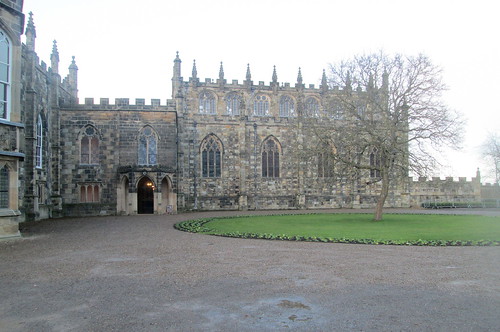
The Castle’s/Palace’s chapel, to the right of the entrance, is impressive.
Altar + stained glass windows:-

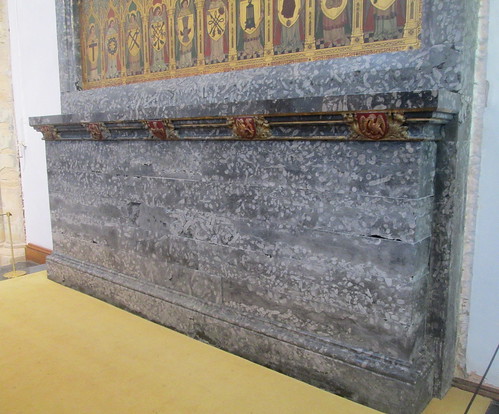
A marble altarpiece sits against the wall:-
The chapel organ is set on the wall above your head where you enter. The organist’s access is via wht looks like a precarious circular staircase whose upper part is seen to the right here:-

Ceiling. The ceiling isn’t curved. I stitched two photos to show it as a whole. It is elaborately painted:-

Clerestory detail:-

Marble pillar:-

2 Comments »
Posted in Modern Life Is Rubbish, Politics at 20:03 on 13 December 2019
We were in the Northeast of England last week. We visited Tynemouth, Durham, Bishop Auckland and Sunderland.
Tynemouth was reasonably prosperous looking, quite a few eateries and with a bustling Saturday market, Durham was busy, as you would expect from a Cathedral city. Sunderland was a typical city – in its centre anyway. (I did pass the Stadium of Light but it was in the dark.)
The attraction of Bishop Auckland was the recently refurbished Auckland Palace/Auckland Castle former home of the Prince Bishops of Durham. As part of the entry ticket we were able also to enter both Auckland Tower centrepiece of the Auckland Project (though the tower itself was closed due to high winds) and the excellent Mining Art Gallery just over the road from the tower.
The town itself though was deserted (well, it was a Sunday in England) and very run-down in appearance, empty shops prominent.
I can therefore see why the locals might want change but how on Earth they think voting Conservative will in any way improve their lot is beyond me.
The Tories’ track record in aiding the working person is poor to say the least. And for a former mining area to vote Conservative is an act either of outstanding forgetfulness – or remarkable forgiveness. This truly is a topsy-turvy age.
If I go back in five years’ time I very much doubt the town’s fortunes will have recovered.
By that time we may also have witnessed the NHS even more in hock to private provision (if not sold totally down the river,) judges neutered, Channel 4 and Ofcom eviscerated, the BBC dismantled, Parliamentary constituency boundaries redrawn to favour the Tories even more and voters without photo ID disenfranchised. Not to mention the rise of the cult of Alexander de Pfeffel.
Is all that really what the inhabitants of Bishop Auckland and its neighbouring towns desire?
There’s also a clash of mandates with respect to Scottish independence to resolve. Or not, as the case may be.
And a one-sided trade deal with the US to endure.
Plus I’ve not even touched on the EU negotiations which might still be going on.
What’s to like?
No Comments »
Posted in Architecture, Art Deco, Bridges, Trips at 14:00 on 15 August 2010
Apart from the suffix on my previous Durham post you knew this was coming anyway. I can’t seem to go anywhere without seeing Art Deco/Modernist buildings.
Somehow though and despite my experience in Chester last year, I thought pickings in Durham would be small.
Yet entering the main square in Durham the first building we came across was Boots.

There was construction work going on in the square which is why the photo is cropped tightly. Down a narrow street leading off the square there was this:-

I forget who the tenant of the building is now but the Burton’s shop in Durham at the moment is actually the other side of the street from this.
This is the view from the window of the car park we used.

I took this photo because of the roofline of the building just across the river which reminded me of the former Raith Cinema.

Just for contrast here’s one of the River Wear from below the Cathedal (and without any Deco.) There’s a weir stretching from the building on the left diagonally across the river and one of Durham’s bridges in the distance.

On the way out of town I pulled into a cul-de-sac to check the map. The street was full of thirties houses!

The third semi down still has its original Critall windows.

No Comments »
Posted in Architecture, Trips, War Memorials at 14:00 on 11 August 2010
After Newcastle we scooted down to Durham (passing Antony Gormley‘s Angel of the North on the way.) The main attraction there is, of course, the Cathedral. I’d seen it before from the train, dominating Durham’s skyline.
This is a side view I took from the south.

This one is from the north: a stitch of two photos as I couldn’t get back far enough to get the whole thing in.

Just to the right of the cathedral entrance in a grassy area there was a large stone cross.
We crossed the grass to investigate and it was another memorial to the South African War, if not quite as ornate as the one in Newcastle (see two posts ago.)

The cathedral itself is impressive while more intimate than York or Canterbury. It apparently costs over £60,000 a week to maintain it.
The stone columns supporting the structure are carved with different patterns. The chevrons were the most attractive. The shrine to St Cuthbert is a bit over the top though. Its canopy has iconography you would more expect to see in an Orthodox context rather than C of E. (But it would have been constructed in the RC era I suppose.)
On one wall there were lists of previous abbots, deans and bishops. I noticed one Thomas Wolsey, Cardinal, in the latter. He seems to have been the only Bishop of Durham who was also a Cardinal. The early names were all single. When did the practice of adopting surnames come into being?
The part of the cathedral I found most moving was the side chapel devoted to the Durham Light Infantry (DLI.) There were lists of battle honours dating back to beyond the Napoleonic wars. Books of remembrance of both World Wars were open at the relevant week’s dates showing the names of those DLI who died on the corresponding days in the war years, and where they fell. I saw no blank days for either war. So it goes. Several small crosses with poppies were laid in a niche. There was one for a former DLI soldier with the dates 1910-2010 and annotated “Veteran of Kohima.” Kohima was a particularly vicious battle on India’s border in World War 2. He did well to survive it, and to reach such an age.
There was also a memorial to miners who had died in pit disasters and such, not the sort of thing usually found in cathedrals I think. And a modern piece of stained glass showing the cathedral’s and Durham area’s history.
There’s a lot to see.
2 Comments »
