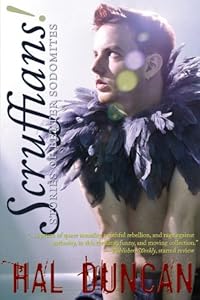
Scruffians! by Hal Duncan
Posted in Fantasy, Other fiction, Reading Reviewed, Science Fiction, Scottish Fiction, Scottish Literature at 12:00 on 6 August 2020
Stories of Better Sodomites. Lethe Press, 2014, 205 p.
Unlike normal folk (groanhuffs,) Scruffians are mis-shapes and misfits – Orphans, foundlings, latch-key kids; Urchins, changelings, live-by-wits; Rascals, scallywags, ruffians, scamps; Scoundrels, hellions, – in their chant that last word is followed by, Scruffians STAMP. The Stamp is how they came to be fixed as Scruffians, an excruciating procedure which stops any growth in age from that time on and embeds all their existing characteristics. Only nicks to the Stamp mark on their chests will allow alteration thereafter. Their lore is expressed by tales known as fabbles (an ideal coinage,) some of which appear here as if addressed to potential or newly-Stamped Scruffians. Not all of the stories here are of Scruffians but each section within one that is has a title (or number, depending on the story) and each paragraph a first line in bold type. All are excellent reading.
In How a Scruffian Gets Their Story a new recruit falls in with the Scruffians.
How a Scruffian Gets Their Name tells of how and why Slickspit Hamshankery got that title.
The Behold of the Eye is where humans store all the things they prize most highly. What catches their eye is stored by the eye – and each is a home to a faery. The story relates the experiences of newly born faery Flashjack as he seeks his Beholder (to be found by Toby Raymond Hunter’s Behold) and follows Toby’s life as he comes to terms with himself and his sexuality.
Scruffian’s Stamp is the story of Orphan, the first Scruffian, and how groanhuffs came to invent the Stamp without realising it would Fix Scruffians for good.
An Alfabetcha of Scruffian Names describes the characteristics of twenty-six Scruffians.
Jack Scallywag expands on the one paragraph about the Scruffian Knight in the Alphabetcha, how said Jack aspired to knighthood and came to it as others did, (by stealing it more or less,) how he set off on his mission to slay the dragon only to find out who the real dragons are.
The Disappearance of James H riffs extensively but explicitly on Peter Pan – a shadow, a crocodile tear, “‘I’m not a…’ ‘Fairy?,’ ‘Every time you say that, I whisper, a little part of you will die,’” – in its tale of the titular disappearance.
The Island of the Pirate Gods is another swashbuckling Pannish adventure (with added language) wherein the twin lovers Matelotage and Mutiny are the background to a story of The People’s Independent Republic of Arse, Cock and bloody Yo-ho-bloody-ho, ie PIRACY.
Very well constructed and set against the background of the playing of a hand in a Texas Hold ‘Em game The Angel of the Gamblers is a meeting with the devil type of story except it’s not the devil who demanded a soul, it was the eponymous angel.
The Shoulder of Pelops features figures from Ancient Greek myth and legend in a story about signs, meanings and the difference between words and the things they name.
Bizarre Cubiques is a history – and critique – of an alternative world art movement, the creation of artists Bricasso and Paque. The narrator has made his way from home in New Amsterdam in Amorica to Pharis via Caerlundein, Felixstoff and Diephe.
The worlds of superhero comics are the inspiration for The Origin of the Fiend, a metafiction where differing origin stories for different supercharacters impinge on the consciousness of a young lad ‘sending his mind back and forth along his own timestream,’ in a mundane world where no superhero can stop his brother dying whether that be in France or Korea or Vietnam or Iraq.
Sons of the Law is a Western story with a framing device positing it as a manuscript handed down through a family. It transcends all the Western clichés while at the same time deploying them – the saloon, the hunter, the killer, the slave (whose name, Abraham, and experience embed a Biblical reference,) the bargirl, the gambler, the wrangler, the drifter, in a tale of revenge and implied poetic justice.
Sic Him, Hellhound! Kill! Kill! ticks off two fantasy tropes in one swoop with a story of a boy and his lover (a werewolf) hunting vampires.
Oneirica melds many myths and legends into one tale as it describes a trip by various characters to find a stone chest containing mythological objects.
Inventive, delightful stuff.
Pedant’s corner:- Plasticene (Plasticine,) “fifth formers” (yet the narrator is Scottish, where the expression is ‘fifth years’. Perhaps not in private schools though where the scene was set.) “Joey sees him close his eyes, puts the barrel to his own chest and pull the trigger” (put the barrel,) rigourous (rigorous,) “that’s bound to sparks some stares” (to spark,) “and the hoi polloi” (hoi means ‘the’, so it should really be ‘and hoi polloi.) “None of them are aware” (None of them is aware.) “None of them know what’s in the briefcase” (None of them knows.)
Tags: Fantasy, Hal Duncan, Other fiction, Science Fiction, Scottish Fiction
