Archives » 2018 » May

The Tapestries by Kien Nguyen

Abacus, 2004, 347 p.

 The Tapestries cover

This is a tale of Vietnam in the early to mid- years of the twentieth century when the old ways were beginning to crumble under the influence of the French. Peasant woman Ven is sold to the Nguyen family of Cam Le village as a bride for their seven year-old son, Dan. She protects him when the family’s fortunes are ruined by the local magistrate Toan and the elders of the family are killed or flee. As their faces are both unknown to the outside world they can for a while take refuge in the Toan household where he and Toan’s granddaughter, Tai May, fall in love. During a visitation from an official of the Emperor’s court to betrothe Tai May to Bui, the official’s son, they reveal their identities. In the outcome Ven is accused of the murders of the official and Bui actually carried out by Toan.

Thinking Ven dead, Dan leaves for the Imperial city and due to his skill at embroidery eventually becomes chief embroiderer to the court. (It is this ability and Dan’s handiwork, of course, which lend the book its title.) Meanwhile, the disgraced Tai May has been sent away to join a dance troupe. Their paths cross at the court but they cannot meet due to their respective obligations to the Emperor. On the deathbed of the Lady Chin, still grieving wife of the murdered official, Dan gives her food to revive her and accompanies her to Cam Le to confront the source of both their woes and achieve resolution.

Perhaps because English is not Nguyen’s first language the writing isn’t quite as fluent or crisp as in the very best fiction. There is often a resort to cliché (“with all her might”) and dialogue too frequently tips over into the melodramatic. I also found the love story supposed to be at the novel’s heart so barely outlined as to be almost invisible. We are told of it but rarely experience any of the relevant emotion. Rather, it is the relationship between Dan and Ven which dominates the book. Therein lies its tragedy and pathos. Yet even there the withholding by Ven of a nugget of information from Dan till very late on, twists the arc of the narrative.

Pedant’s corner:- “she said to the him” (she said to him,) “the plastic loop in her hand” (was a metal loop on the previous page and, in any case, plastic? In 1916?) “in the middle of night” (the night,) twenty-four karat (is karat USian? It’s carat over here,) organdy (organdie,) sprung (sprang,) “even her face seemed to have shed its usual plainness and glow with the sparkling mystical world” (glowed,) “the Indochinese Communist Party led by the socialist Ho Chi Minh” (in 1932? Ho did found the Indochinese Communist Party in 1930 but he was in jail in Hong Kong from 1931-33 and then moved to the Soviet Union, not returning to Vietnam till 1941. Would most Vietnamese have even heard of him in 1932?)

Dumbarton 1-1 Arbroath

SPFL Tier 2 Play-off, Semi-Final, Second Leg, The Rock*, 5/5/18.

This was excruciating. We made it much harder than we ought to have done.

We came out of the blocks well and took the lead with Dougie Hill’s header from a Tom Walsh corner. We kept up the pressure and had several efforts, the best of which probably fell to Andy Stirling but he blazed it over the bar.

We weren’t in any danger till Liam Dick made a poor defensive header and put Andy Dowie in trouble. His short pass back went to their player who had the easiest finish imaginable.

After that we simply fell apart, every effort at the ball rushed, every clearance sclaffed, every second ball not gained.

Despite that we had some efforts on goal in the second half with Tom Walsh beating the keeper and having the ball cleared off the line, Danny Handling through on his own but lacking the pace to beat the defender and finally in injury time Liam Burt chipping the keeper on a one-on-one but missing the goal.

Scott Gallagher did have a few saves to make but was never really troubled.

Referee Craig Charletson was his usual arrogant self. Several times their players went through one of ours and not a free-kick to be had. The only one we got anywhere near their goal was given by the linesman. The man seems to hate us for some reason.

So. We have to go through all this again on Wednesday and Sunday against Alloa. I don’t think my nerves will stand it.

*Now The C&G Systems Stadium after our new, local, sponsors.

Another Big Game

The play-off Semi-Final second leg; this afternoon at the Rock.

I’m not any less nervous even though (perhaps because) we’ve got a one goal advantage.

Steven Gerrard

One response to his getting the job at Rangers is, “You’re having a laugh.”

Appointing a totally untried manager when you’re in a position of catch-up? That really went well for Celtic when they gave the post to John Barnes.

On the other hand he might just give them the gee-up they are obviously looking for.

Gary McAllister as assistant could be a decent move, though even if as a full boss he hasn’t quite set the heather on fire.

Friday on my Mind 165: Up Up and Away

Another Jimmy Webb song this was first recorded by the 5th Dimension in the US but it was The Johnny Mann Singers who had the UK hit.

The Johnny Mann Singers: Up Up and Away

Arbroath 1-2 Dumbarton

SPFL Tier 2 Play-off Semi-final, first leg, Gayfield Park, 2/5/18.

Now here’s a rarity.

I was composing this post in my head just before the final whistle and it began, “Well, I’ve still not seen us win at Gayfield,” when – lo and behold – we do just that, Craig Barr knocking the ball in at the second attempt.

Admittedly this followed an almost continuous run of Sons pressure where both Iain Russell and Liam Burt perhaps should have scored.

But it all ended up rather better than it might have.

Scott Gallacher had already had to make two (comfotable) saves before we threatened their goal but their keepers saves were of a higher order, first from Danny Handling’s header and then from Tom Walsh’s shot from the rebound. A defensive mix-up at the bakk almost let Arbroath score but their forward amazingly pulled it back too far and it escaped the post.

Second half we were more in the game and got the opener when fine work by Andy Stirling allowed him to cross. Tom Walsh’s header was perfect for Calum Gallagher to loop his header over the keeper.

Their equaliser came from a free-kick given at the edge of our box but play should never have got that far as a shove in the back tokk one of ours out of the play in the build-up. The goal encouraged Arbroath and they came at us with Scott Gallagher having to make two fine saves. Then after Iain Russell and Liam Burt came on for Calum Gallagher and Tom Walsh came that late push.

It’s not over yet, Arbroath showed they could theaten us, but we go into Saturday’s second leg in a better position than I had feared.

It will still be a nervy affair though.

Hame by Annalena McAfee

The Fascaray Archives, Harvill Secker, 2017, 585 p.
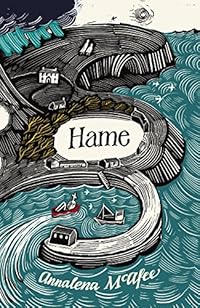
 Hame cover

This delightful book positively reeks of Scottishness. Told in Pairts Ane (Incomers), Twa (Cauld Handsel,) Thrie (Oor Ain Fowk), and Fower (Haste Ye Back,) and with a Glossary of Scots words, a Select Bibliography and two Appendices, it is not a straightforward novel – though I must say it pleased me from the first pages in having footnotes. It is on the one hand the journal of Mhairi McPhail, a Canadian of Scots extraction recently living in New York, returned to her ancestral home of the Hebridean island of Fascaray to investigate the life and papers of the late poet Grigor McWatt (self-styled Bard of Fascaray) and set up a museum in his memory, on the other a history of Fascaray (and through it the wider Scottish experience) as delivered through extracts from a supposedly forthcoming volume composed by McWatt entitled The Fascaray Compendium (as edited by McPhail and to be published by Crumlin Press) plus extracts from McPhail’s own book on McWatt’s life, A Granite Ballad – The Reimagining of Grigor McWatt (Thackeray College Press, 2016,) all interspersed with examples of the poet’s work (mostly owersettings – translations – or reimaginings of poems familiar from other sources.)

Blessed – and blighted – by the success of his song Hame tae Fascaray in the early 1960s (the list given of artists who have recorded it includes among the great, the good – and the unlikely [The Three Tenors? Dolly Parton?] – the wonderfully named Shooglenifty) and whose lyric bears some (undoubtedly intentional) similarities to The Mingulay Boat Song, McWatt is stand-offish – except perhaps in his cups – curmudgeonly, opinionated, a staunch supporter of both the Scots language and the islanders’ interests, fiercely anti-landlord and even more virulently anti-English – almost a caricature, although solidly fleshed out, of the dour Scot. His relationship with Lilias Hogg (the Flooer o Rose Street) – represented here as something of a poet’s groupie but evidently devoted to McWatt – is predictably distant, not helped by Hogg’s discovery of letters to McWatt from a mysterious woman named Jean.

Our partial narrator McPhail also has a troubled history, a straying husband and her disastrous retaliatory affair in part precipitating her decision to take the job on Fascaray, necessitating bringing along her nine-year old daughter Agnes, who in turn suffers a more or less benign neglect. But who finds the island interesting. At one point in her journal Mhairi describes the contrast in Glasgow’s atmosphere from the night of the Independence referendum to the day after. “Yesterday Glasgow was a carnival. Today it’s a funeral,” and tells us, “Scots have little time for overt sentimentality, though the covert sort has its place.”

Such meditations on Scottishness are never far away. In his Compendium McWatt quotes a Spaniard as writing, “‘Scots go to war, and when they run out of wars, they fight each other,’ and goes on to add, “While our native hostility and suspicion of each other may be ingrained, it is as nothing – a mere shadow dance – to the contempt we hold for our arrogant southern neighbours.” Mhairi’s journal contains a narrator’s aside about the smoothing out of an interviewee’s Scots for tourist consumption. “For ‘very’ read ‘gey’, for ‘aren’t’ read ‘arenae’. It’s not so hard is it?” But her transcriber avers, “‘There’s no Scots leid1…. There are about four Scots dialects and ten sub-dialects, and they’re all variants of English with a bit of Norse thrown in.’” (To which it’s a pity that Mhairi doesn’t reply, ‘But Scots was once one of the great languages of mediæval Europe. On equal footing.’) Later, though, Mhairi does come across McWatt writing that Scots is “no more a dialect than Catalan is a local variant of Castilian Spanish.”

Among McWatt’s many lists of Fascaray’s plant life, animals, sea creatures and the like is one of Scots words denoting fine weather – most of which necessarily describe short interludes – and one, deow, which is defined as “gentle rain”. We are also treated to his view of what makes a Scot – “a modest stoicism, a sense of social justice, a distrust of rank and the trappings of fame and an unbragging appreciation of the beauty and majesty around us.”

The titles and nominal publishers of McWatt’s writings add further grace notes:-
his Memoirs:- Forby (as by Virr Press, 1962) and Ootwith (Smeddum Beuks, 1994,)
his Collected Journalism – mostly reprints from the local (mainland) newspaper The Auchwinnie Pibroch:- Frae Mambeag Brae: Selected Columns and Essays of Grigor McWatt (Stravaigin Press, 1980) and Wittins: Mair Selected Columns and Essays of Grigor McWatt (Stravaigin Press, 2011,)
the books of poetry:- Kenspeckelt (Virr Press, 1959,)
Kowk in the Kaleyard (Virr Press, 1975,)
Wappenshaw (Virr Press, 1986,)
Warld in a Gless: The Collected Varse of Grigor McWatt (Smeddum Beuks, 1992,)
Teuchter’s Chapbook (Smeddum Beuks, 1998,)
Thoog a Poog (Smeddum Beuks, 2010,)
That’s me Awa (Smeddum Beuks, 2013,)
The Whigmaleerie’s Ower – The Complete Collected Verse of Grigor McWatt, ed. Ailish Mooney (Smeddum Beuks, 2015.)

The book’s endpapers display an illustrated sketch map of Fascaray and its environs. The first appendix contains recipes for Fascaray delicacies – the method for a fish piece2 takes up one line, as does that for the soorocks salad – the second is the sheet music for Hame tae Fascaray (as published by Stramash Music.)

Though it is twice (subtly) foreshadowed I’m still undecided as to whether the twist in the final sections revealing the nature of Jean’s relationship to McWatt enhances or detracts from McAfee’s overall tale; either response is legitimate.

No matter: notwithstanding the embedded tales with which McAfee has provided us here, what is impressive is the journey, the relish in the use of Scots, the demonstration of its vitality, its refusal to lie down and go away. Hame is a book which revels in the ongoing Scottish tradition in literature.

1leid = language
2piece is of course a Scots word for sandwich.

Pedant’s corner:- benificent (beneficent,) Menzies’ (Menzies’s,) “the English national anthem on the Home Service” (would actually be the UK one I would think,) Mhari-Ann (elsewhere Mhairi-Ann,) there is an opened parenthesis on page 176 which remains resolutely unclosed, Fascaray is described as being in the Hebrides but Mhairi at one point puts it in the North Sea, “met at a dance in Green’s Playhouse, Glasgow” [where the Sensational Alex Harvey band was playing.] (I doubt it was a dance then; a concert maybe.) Millais’ (Millais’s,) the Fringe Festival (back in the day it was called the Festival Fringe,) a nude revue in Edinburgh in the 1950s? (I don’t think so,) a missing comma before a piece of direct speech, span (spun,) “as a ‘a quisling’” (remove one of those “a”s,) “It is to the inhabitants of my tiny isle that I turn to” (one of those “to”s is superfluous,) “ the new dance the twist had come to Auchwinnnie” [the nearest town on the mainland] “in 1968” (a trifle late even for the back of beyond. Early 1960s, more like,) midgies (midges,) The festival (Festival,) “was said to be have been launched” (was said to have been launched,) “on the the fact” (only one “the”,) Miss Geddes’ (Geddes’s,) “a Harry Potter star” (in 2000? The first film came out in 2001,) “none the the wiser” (only one “the”,) sea-sclaters (sea-slaters?) “domestic woodlouse or sclater” (I have only ever heard or seen this as “slater”,) catapaults (catapults,) “and where if fell” (it fell,) in the Glossary “wheen” is defined as a small amount (I have only ever heard or read “wheen” as describing a relatively large amount.)
Big Game

At Arbroath tonight.

Cup final aside, probably the biggest game for the Sons in six years.

Though with the (slight) potential for three more to come in short order.

I confess I’m bricking it.

War Memorial, Kilmadock Parish, Doune

Kilmadock Parish is in Stirlingshire and I believe Doune is its biggest settlement.

The obelisk style memorial on a square plinth with broader base base is prominently situated by the A 84 road between Stirling and Callander at its junction with George Street, Doune. The World War 2 Memorial pillar is to the extreme right here before the set of external stairs.

Kilmadock Parish, Doune, War Memorial 1

Closer view. The inscription reads, “To the glory of god and in memory of the men of the Parish of Kilmadock who gave their lives for King and Country in The Great War 1914-1919. See ye to it that these shall not have died in vain.”:-

Close up of Kilmadock Parish War Memorial, Doune

World War 2 Memorial pillar (to right of the earlier Memorial.) The inscription reads, “1939-1945. During those years when our native land was in mortal danger these young men gave their lives for us. Ne Obliviscaris” (Ne Obliviscaris = Forget Not):-

Kilmadock Parish, Doune, World War 2 Memorial

World War 1 names, first plaque:-

Kilmadock Parish, Doune, War Memorial 4

World War 1 names, second plaque:-

Kilmadock Parish, Doune, War Memorial 5

Cautionary Sign, Princes Street Gardens Christmas Fairground Ride

Princes Street Gardens Christmas Fairground Ride

free hit counter script