Archives » The Crow Road

If the Stars are Lit by Sara K Ellis

Luna Press, 2025, 198 p. Reviewed for ParSec 14.
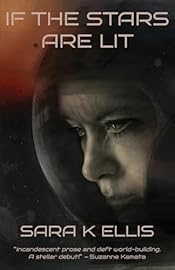
Well. They do say you should start with a bang – and this novel does begin with a sentence reminiscent of the first in Iain Banks’s The Crow Road, though what unfolds is neither a bildungsroman nor (quite) a murder mystery but a decent enough piece of Science Fiction.

Viewpoint character Jocelyn Carsten (Joss,) is a hostage negotiator on the way home from managing a crisis on the planet Haitch when her passenger ship Tiktaalik suffers an explosion. She is still alive, just, but is injured, and is the sole survivor. All contact with the ship’s Central Hub – and the outside world – is lost. Only Harbour, the controlling intelligence of passenger mod Petal 4, is available to aid her.

After a trip to the med bay and an EVA to survey the damage to the ship, Harbour advises her to rest. When she wakes up there is another presence in the mod, a gemel; a holographic copy of Joss’s personality, but this has the physical appearance of her ex-wife, Alice Dray.

“A gemel” (the plural is also gemel) “is a sentient being generated from an individual’s psyche,” usually, but not always, taking on the appearance of their sires, “fuzzy copies of their progenitors, interpolated from memories and neurocircuitry, and can resemble their users to a disturbing degree,” but can be “warped by narcissists with fat wallets and the desire for more intimate personal assistants,” as had been the case with Gabrielle Vecher, on-site CEO for Haxen Mining Corps, and his gemel Malachi. Narcissus and Echo in the same package, thinks Joss. Gemel were not allowed physical bodies but, with safeguards, could patch into systems and control them from the inside. They “drew force from external sources, running off the excess electricity in the machines around them.”

This Not-Alice becomes a psychological prop for Joss and a device for the author to run Joss’s backstory past the reader, in instalments. Indeed, at times our access to Joss’s thoughts shifts between the present and her past memories with little or no signalling.

Joss’s rescue from isolation – when it comes (rather abruptly it must be said) – is by a military force co-commanded by none other than Alice Dray: the real one. Its mission is to investigate both why Tiktaalik and the tunnels on Haitch were blown up and to try to obtain the release of the humans still there held by gemel, an endeavour where Joss’s negotiating skills come to the fore. But Alice Dray’s co-commander – something of a loose cannon of the gung-ho military type – threatens to undermine Joss’s steps towards a solution of the situation.

It turns out Vecher had constructed a highly dangerous device deriving from mysterious markings on the tunnels on Haitch. And time is running out. “‘That thing Vecher made tore a hole in the fabric of the universe or whatever the hell you want to call it, and it’s growing, becoming less stable by the hour,’” says Joss during the negotiations.

Given her initial circumstances, Joss is unsurprisingly prone to periods of introspection and questioning both of herself and others.

Despite some problems with structure and pacing this is an engaging read and will push enough familiar buttons for SF readers to emerge satisfied.

The following did not appear in the published review.

Pedant’s corner:- Written in USian but with some British spellings. The planet Ross128 H’s nickname of Haitch is an egregious mispronunciation of that letter of the alphabet, “on a round-a-bout route” (roundabout – which was used elsewhere in the text for a meander -) once there was a single quotation mark where double ones are employed elsewhere, shlock (schlock,) back-peddling (back-pedalling,) hostage takers “174 million miles away” morphs to “140 million mile silences” during the communications gap, “sliding the stack of credits Joss had won back from her back across the table” (Joss was playing her opponent for the first time, so just ‘had won from her’.) “This is ….. based on …..?” (wasn’t a question so full stop, not question mark,) C02 (It’s not C zero two as was printed in the text, and the 2 ought to be a subscript,) “wracking your brain” (racking,) “sending some part of her ex’s upper-class snobbery would revolt” (sensing some part.) “‘Tell and I send you outside to repaint the serial number.’” (No clue. Who is Tell?) “what she can offer them are options” (I read ‘what she can offer them’ as a singular subject to the following verb; so ‘what she can offer them is options’,) “is different thing” (is a different thing.) “‘Ph damage right here’” (‘pH damage’ was meant and pH always has an upper case H and a lower case p – even at the start of a sentence,) “drowns out nothing but Callen’s voice” (everything but Callen’s voice,) “‘I pretty sure’” (I was pretty sure,) “for having sunken so low” (for having sunk so low.) “She doubts its convincing” (doubts it’s convincing,) “amid glow of the launch” (amid the glow of the launch,) a missing extraneous end quotation mark, a missing comma before the quotation mark at the end of a piece of dialogue. “‘How is that that they’ve got people down there?’”  (How is it that they’ve got…,) “‘if we so much get within the distance’” (if we so much as get within…,) “it takes her moment” (it takes her a moment.) “Alice takes her seat again and switching back to their private comm.” (and switches back to,) “the metal partition the separated them” (partition that separated them.) “A name that inferred family, and what she’d always been taught to mean trust, love and guidance” (and that she’d always been taught…,) “but do they do afford” (but they do afford,) “of the Florenz’ cargo bay” (the Florenz’s,) “breathing apparatuses” (the plural of apparatus is apparatus,) “nothing but the judder of the engine and the clatter of equipment as rattles against the bulkheads” (could be rewritten more clearly,) “‘I can’t let you can’t do this’” (either, ‘I can’t let you do this’ or, ‘You can’t do this.)
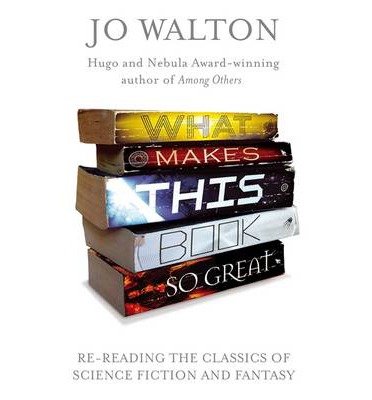
What Makes This Book So Great by Jo Walton

Re-reading the classics of Science Fiction and Fantasy, Corsair, 2015, 477 p.

 What Makes This Book So Great cover

This is a collection of Walton’s contributions to a blog on Tor.com, appearing between 15/6/2008 and 25/2/2011, in which she discussed the works of SF and fantasy she had been re-reading during that time. Her claim to be able to read up to six books in a day astonished me. If she’s doing that how does she fit in everyday life – food shopping, cooking, eating, family life, putting out the bins? Where on Earth can she find time to write fiction, or a blog post? Yes she says she sometimes spends all day in bed (I assume through illness or some debilitation) but even so. Admittedly that six was a maximum and she says she starts another book as soon as finishing the previous one. There was also the odd, to me, observation that she feels she hasn’t read a book if she hasn’t re-read it at least once; that first impressions of a book are suspect. I differ here, certainly from a later in life perspective. If a book does it for me the first time that’s fine; with perhaps a very few exceptions, if it doesn’t, a re-read is unlikely to help. My tbr pile is too high for much re-reading anyway. I also cannot read at Walton’s pace. Perhaps I pay too close an attention to the minutiae of a text; vide Pedant’s corner.

Many of Walton’s enthusiasms I doubt I would share. She spends 14 posts and over 60 pages here on Lois McMaster Bujold’s Vorkosigan series which has far too many volumes for me to embark upon now, and in any case I have a disrecommendation from another source. Similarly 17 posts and 53 pages on Steven Brust’s Dragaera series. Not going to happen.

Walton always writes interestingly about the subject at hand; even of books I have no desire to read (whatever her eloquence.) And “IWantToReadItosity” is a great coinage. “It’s hard to explain, is utterly subjective and is entirely separate from whether a book is actually good.” We all have such guilty pleasures.

She occasionally digresses from the SF/Fantasy remit, for example enthusing about Iain Banks’s The Crow Road and of Middlemarch opines that George Eliot would have been a great writer of Science Fiction if only she’d had the idea to invent the form.

A puff on the back cover quotes Publishers Weekly, ‘For readers unschooled in the history of SF/F, this book is a treasure trove.’ I wouldn’t disagree.

Pedant’s corner:- Various instances of “there are a number” or “there are a lot” – too many to note individually. “I admire it to no end” (if anything this means “there is no purpose to my admiration of it”. I assume Walton meant “I admire it no end.”) a missing comma before a quote (x 2,) Achilles’ (Achilles’s,) visit with (visit,) “Every culture has their own naming custom” (its own naming custom,) “and right go on into” (and go right on into,) for goodness’ sake (goodness’s.) “The Mazianni are a company fleet” (is a fleet,) “the rest of the worlsd … look on jealously” (looks on,) “The weight of significance of things … sometimes need” (needs,) “when it gets us information” (gives us,) Marilac – but two lines later Marilican Embassy (which is it; Marilac or Marilic, Marilacan or Marilican?) “global warming has deteriorated” (“the climate has deteriorated because of global warming,”) “and is decided” (either “has decided” or “is tasked with” the context isn’t entirely clear,) Katan (Katin on next page,) “‘going I know not whence’” (in a quote from Dunsany; whence means “from where” – you can’t go “from where”,) “‘to be a part of the forest. (from ‘The Fortress Unvanquishable, Save for the Sacnoth’)” (no full stop after forest; or else a capital F at “from” and a full stop after Sacnoth.) “There are the sort of situations,” (the sorts of situations,) “who’s presented a great poet” (as a great poet,) elegaic (it’s spelled elegiac.) “There were a host (there was a host,) “that the British population shrink” (shrinks,) “Shute’s Britain …., indeed their ability” (its ability,) “to get away with Nicholas’s guesses to be more often right than wrong” (being more often,) to whit (to wit,) the PTA are considering (the PTA is considering,) vaccuum (vacuum,) “These are the kind of” (kinds of,) Marcus Aurelius’ (Marcus Aurelius’s,) “so that she has learned to thank people, and realise how nice” (realised,) Jesus’ (Jesus’s,) “Small Beer are definitely my favourite small press” (is definitely,) vapourised (vaporised, this is a curious error in a book full of USianisms,) ascendency (ascendancy,) philo-sophical (no hyphen) even moreso (more so.)

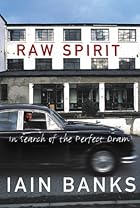
Raw Spirit by Iain Banks

In search of the perfect dram

Century, 2003, 368 p.

I bought this mainly for completeness. I’ve read all of Banks’s fiction and so his only non-fiction book kind of rounds things off. It also qualifies for the Read Scotland Challenge.

Raw Spirit cover

It is strange to be writing about this in the wake of the referendum. While the book is ostensibly about whisky it is in reality a hymn to Scotland, in particular its landscape, its “Great Wee Roads” and its inhabitants, not forgetting the West Highlands’ voracious midges and prodigious rainfall. Banks’s liking for fast cars can’t be missed and the numerous inns and hotels he frequented as well as the distilleries and their visitor centres (there is, it seems a whisky “experience” look) will be grateful for the exposure. Had the book been solely about whisky I would not have been the best person to appreciate it as I have never taken to the stuff.

That said, the history and processes of whisky production are described in extremely accessible terms. While Banks attempts descriptions of the single malts he samples in the course of his travels (for which he had no shortage of willing companions) this is perhaps an impossible task – in the way that descriptions of music are often lacking – but the word “peaty” does appear quite often.

Parts of Raw Spirit read like Banks’s non-SF fiction. The verbal interplay between the author and his friends is just like the conversations encountered in say Espedair Street, The Crow Road or Complicity, the asides and digressions – his journeys were undertaken and the book written around the time of the (second, the illegal) Iraq War, occasioning familiar Banksian rants – typical of his mainstream work.

As a book Raw Spirit is barely ten years old yet so much has changed since it was published. Banks himself is sadly no more, as are the Inverleven Distillery at Dumbarton and (not so sadly) the Forth Road and Skye Bridge tolls. The landscape, the Great Wee Roads, the whisky, though, remain – at least those bottles as yet unconsumed.

A delightful addition to the Banksian œuvre.

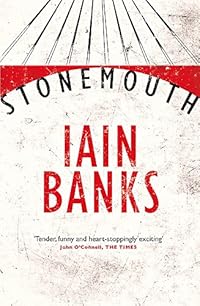
Stonemouth by Iain Banks

Little, Brown, 2012, 357 p.

Stonemouth cover

Stewart Gilmour returns to his hometown, Stonemouth, somewhere in North East Scotland, to attend a funeral after a five year absence occasioned by two-timing his fiancé, Ellie, the daughter of a prominent local crime boss. The tone is set from the first as he awaits a hard man on the parapet of the suspension bridge that looms large over the town to check his reappearance will not be too unwelcome. The subsequent resumption of old friendships and acquaintances reads true – especially with Gilmour’s once best friend Ferg – as does the evocation of the claustrophobia of life in small to medium sized towns but perhaps less convincing are the threads where Gilmour seeks to unravel the circumstances surrounding the revelation of his dalliance with the “delightful Anjelica” which caused him to flee to London five years before and the fall from the bridge of Ellie’s brother which took place in the interim.

The ongoing narrative is structured over the weekend leading up to the funeral but is interspersed with Gilmour’s memories of earlier times. At one point he reflects on the delights or otherwise of the Scottish wedding reception, with its exhausting and interminable Scottish Country Dances (though the narrative renders the exuberant vocalisation that never fails to accompany these as “yee-hoooch” when it’s actually more like “hee-yeugh.”) There is also a musing on the process by which the world came to be dominated by the values of money and big business and a critique on the sort of selfishness advocated by Ayn Rand.

Though there are moments of light-heartedness and a couple of good jokes the sense of menace is never far away and the story unrolls steadily towards the violent dénouement demanded by the set up and treatment. And it is, after all, a Banks novel: a fact of which the reader is always conscious. Echoes of The Crow Road, Complicity, Whit and The Steep Approach to Garbadale are never far away. And Banks did allow one of his characters to say, “Amn’t I?” (Hurray.)

Stonemouth is accomplished and very readable. Most of the characters (hard men and gangsters apart) are engaging, if sometimes annoying, and pleasingly complex.

free hit counter script