Archives » Suez

Sunderland Memorial Wall

Between Sunderland War Memorial and Mowbray Park a memorial wall has been erected to commemorate those who have served in conflicts since the Second World War and to honour Sunderland’s post-World War 2 fallen.

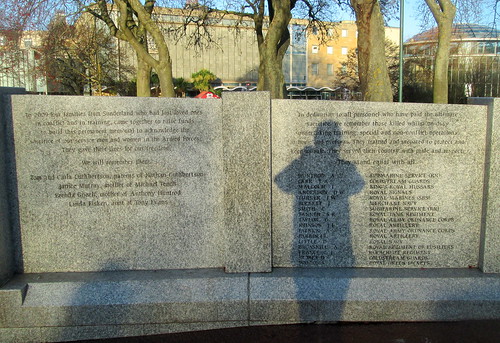
The first section commemorates non-combat deaths in war:-

War Memorial Wall, Sunderland

The rest of the wall is a sobering reminder of the many conflicts in which British soldiers have lost their lives since 1945.

Palestine and India:-

Palestine and India Memorial Wall, Sunderland

Malaya and the Cold War:-

Malaya and Cold War Memorial Wall, Sunderland

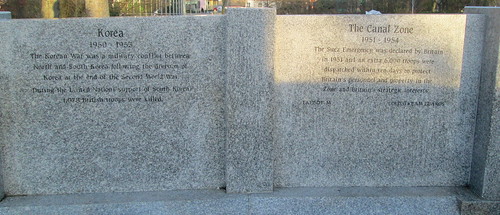
Korea and the Canal Zone:-

Korea and Canal Zone Memorial Wall, Sunderland

Kenya and Cyprus:-

Kenya and Cyprus Memorial Wall, Sunderland

Aden, Radfan and Suez:-

Aden, Radfan and Suez Memorial Wall, Sunderland

Borneo, Northern Ireland and Oman Dhofar:-

Bornoe, Northern Ireland, Oman Dhofar Memorial Wall, Sunderland

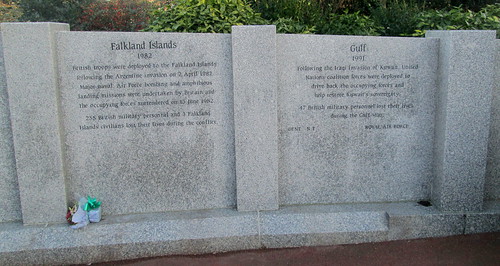
Falkland Islands and Gulf War:-

Falkland Islands, Gulf War, Memorial Wall, Sunderland

Bosnia, Kosovo, Sierra Leone:-

Bosnia, Kosovo, Sierra Leone Memorial Wall, Sunderland

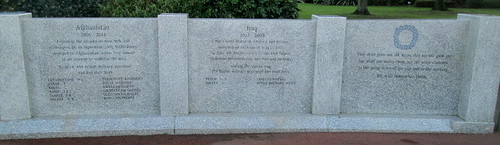
Afghanistan and Iraq, plus Ode of Remembrance:-

Afghanistan and Iraq Memorial Wall, Sunderland

Ack-Ack Macaque by Gareth L Powell

Solaris, 2013, 341 p, including 16 p of the short story from which the novel originated.

 Ack-Ack Macaque cover

Ack-Ack Macaque is the lead character in a highly successful MMORPG (Massive Multi-player Online Role-Playing Game) where he is a Spitfire pilot in an unending Second World War. He also turns out to be “real”, hooked up to the game, embodied in a brain-enhanced monkey which an AI liberation front group manages to free from its confinement in the labs of the game’s constructor, Céleste Industries, with the help of Prince Merovech, heir to the throne of the United Kingdoms of Britain and France (which countries merged after the invasion of Suez in 1957, later also incorporating Norway – with other Scandinavian countries in a wider association) and incidentally also the son of Her Grace Alyssa Célestine, Duchess of Brittany, head of said Céleste Group. Quite a lot to be going on with then, but the execution is initially marred by some intrusive information dumping (which, to be fair, did settle down.)

I had quite a few reservations about the scenario. This is an altered history, of course, but is it one so far removed from our own that the British monarchy could have regained executive power? A further problem though is that Ack-Ack Macaque is almost a peripheral presence, the main bulk of the narrative focusing on Prince Merovech and journalist Victoria Valois, both of whom have also been subjected to treatment in Céleste’s labs, the former’s being the motor of the plot.

Nevertheless, the whole thing rattles along at a good pace and is filled with incident and intrigue.

But I couldn’t believe a single word of it.

Addendum:- Not so for the short story where Ack-Ack Macaque first appeared (in Interzone’s 212th issue, September 2007) and appended here, which relates what goes wrong when the original anime version of the monkey is made over and exploited for commercial reasons. There is an irony in there somewhere.

Pedant’s corner:- A “time interval later” count of 7. “it was up to her accept and mourn” (to her to accept and mourn,) “‘Could you give me a minute please detective?’” (unless “please detective” is a title – and it isn’t – there should be a comma after please,) akevitt (Norwegian spelling of aquavit/akvavit,) Julie and Frank’s (I know this is common usage but it ought to be Julie’s and Frank’s,) it’s (its,) “and winced and the pain” (at the pain,) “‘For saying you’ll go the funeral’” (go to the funeral,) “he saw Julie’s silhouette stood” (can a silhouette stand? – that “stood” ought to be “standing” anyway – we also had “sat” where seated or sitting is better usage,) could use (the British term is could do with,) irresistable (irresistible,) zipper (zip,) gotten (got,) legally obligated (obliged,) commandoes (commandos?) “I’m the back-up, same as Paul” (the person saying this wouldn’t have known Paul’s back-up had been activated,) skull and crossed-bones (it’s usually skull and crossbones.)

Syria and Parliament

It seems that an outbreak of sanity has occurred in the UK Parliament with its vote against military action in Syria.

Now, chemical weapons are horrible things (even if you are just as dead being killed by high explosive or shell fragments or blast or a bullet; it is difficult to see a moral difference) but I fail to see how attacking Syrian government forces can make life better for the average Syrian even if responsibilty for the use of such weapons were to be established beyond doubt.

Not to mention the wider implications. Pour oil on to a fire, why don’t you? Bombing yet another mainly Muslim country will only encourage those Muslims who have a grievance against the UK already.

[And don’t forget there are many reasons for that grievance. I noted only yesterday that British forces were involved in killing locals in Iraq in the 1920s. This followed the Balfour Declaration of 1917 which laid the path for the eventual Jewish takeover of most of Palestine. Then there was the overthrow of Mossadeq in the early 1950s. The collusion with Israel over Suez in 1956, the Suez invasion itself. The illegal invasion, on totally spurious pretexts, of Iraq in 2003. This is just those instances of UK intervention which impact on the Middle East. (A term which is itself anglocentric.)]

Quite how adding in another external faction to what is a civil war in Syria would help in resolving the situation there is also beyond me.

Just because people say something must be one doesn’t mean you can do anything you like.

Mr Irresponsible (aka David Cameron) has once more shown himself up to be a blustering bully. I suspect his enthusiasm for miltary intervention in Syria is that he believes sending in the armed forces helped both Margaret Thatcher and Tony Blair to be re-elected. (A belief in which he is probably mistaken.) What he hasn’t learned is that the Iraq invasion – or, more accurately, its aftermath – poisoned the opinion of most British people against the assertions of Government spokespeople and Prime Ministers over the reasons for using troops and weaponry.

Military action against Syria could be like stirring up a hornet’s nest with a stick. There is no telling what the consequences would be.

A better response to use of chemical weapons, or any atrocity, would be to make sure that anyone responsible for what are considered war crimes is held to account by the international community. This would mean instant arrest should they stray outside whatever jurisdiction is keeping them safe from it and then arraignment before an international court. This stricture ought of course to apply to anyone, from whatever country, not just those our politicians say they don’t like.

And as to the effects of chemical weapons it might be best to deluge Syria with kits containing antidotes to the chemicals likely to be used – which would render their deployment pointless.

It wouldn’t stop the killing though.

I’m afraid this has been a somewhat unfocused rant. I can’t see a quick way out of the present Syrian imbroglio, the two sides seem too far apart for that.

Civil wars tend to be intractable. Intervention in them needs to have a purpose beyond, “Something must be done.” I didn’t think any of our politicians – least of all Mr Irresponsible – had enough wisdom to see beyond such simplicities. Parliament has at least resolved not to do more harm.

For the moment anyway.

The Taxis Of The Marne by Jean Dutourd

Secker and Warburg, 1957. 192p. Translated from the French Les Taxis De La Marne by Harold King.

I bought this book, sans dust cover and consequently of any indication of content, in a second hand book shop, expecting it to be a history book about the ferrying of part of the French Army in a commandeered fleet of Paris taxis to the River Marne in September 1914 in order to exploit the gap in the German advance (revealed by aerial reconnaissance) caused by a failure to hold tightly to the Schlieffen plan.

On starting it, however, I discovered it was a polemic, written by Dutourd in an effort, it would seem, to expiate his (and by extension France’s) guilt at not putting up more of a fight to prevent the later German victory in 1940.

He places the blame for this lack on complacency but also on stupidity, of both the politicians and the generals of the inter war years. He contrasts their pusillanimity and collective failure to inspire with Churchill’s “fight them on the beaches” speech and with the glories of the French army in WW1 and of Napoleon’s times. Only De Gaulle – who, of course, stood out against acquiescence in the defeat – meets with his approval.

Dutourd is not too enamoured of the post war equivalents of those generals and politicians either, referring to the defeat at Dien Bien Phu and obliquely to the Suez debacle. At the time of writing De Gaulle was out of government “in a house not even paid for by the state” and Dutourd hankers for his return. (Was he as in favour of his great man, I wonder, when De Gaulle returned and immediately proceeded to give Algeria away?)

Dutourd’s attitudes are firmly those of someone of his life and times – as he admits himself when he states he wants no part of a future that does not have French civilisation as its foundation. He fears France will never be glorious again and will become what he terms a “female” nation. He is also, in passing, disparaging to Egyptians.

One of his main theses is that private morality and that of the state cannot be equated. To my mind this comes far too close to suggesting that nations are perfectly within their rights to bully others. If that is so, then why is he complaining about France not fighting more energetically in 1940?

Dutourd highlights the enervating effect of the heroes of 1914-18 returning to homes dominated by the women they had left behind and allowing that circumstance to remain unchecked as a main contributor to loss of national backbone. The suffocating nature of those heroes’ tales of war on their children is said to be another source of debilitation.

That France had simply been exhausted by WW1 – bled white, as was Falkenhayn‘s intention in initiating the strategy of attrition – and in no fit state to resist a determined war of revenge by the vanquished of that war, that disaster was maybe inevitable, does not seem to occur to Dutourd as a reason for the ennui.

Dutourd was, apparently, mainly a novelist. A Prix Stendhal winner, no less, and a member of the Académie Française. I idly wonder what his fiction is like. I shan’t be seeking it out though.
free hit counter script