Rob Roy Statue, Stirling
Posted in Trips at 12:00 on 15 February 2025
Across Corn Exchange Road from Stirling’s War Memorial is a statue to the historical figure Rob Roy McGregor:-

Information plaque:-

Posted in Trips at 12:00 on 15 February 2025
Across Corn Exchange Road from Stirling’s War Memorial is a statue to the historical figure Rob Roy McGregor:-
Information plaque:-
Posted in History, Trips at 12:00 on 12 February 2025
Bannockburn is the site of the Scottish nation’s birth. Had it not been for the victory Robert the Bruce won over the forces of the English King Edward II in 1314 Scotland would almost certainly have been absorbed into England, as Wales was under the previous King Edward – Edward I, known as Longshanks and also as the Hammer of the Scots. (Not that the intervening 700+ years have eroded Welsh identity entirely away nor the three hundred since the Union of the Parliaments diluted the sense of Scottishness.) But Scotland as we know it would not exist, its separate legal and educational system not even a fleeting thought.
While the fact of the battle is undeniable there is no archæological evidence of the actual battle site, most of the soldiers’ accoutrements being perishable, its exact location is now a matter of conjecture informed by historical sources and topography.
We visited the Visitor Centre in April. This is the major information board:-

There was also this tableau of the battle site constructed from historical references:-

The tour guide (a genial Englishman) was very informative and there were some cartoonish films no doubt intended to appeal to children filling in some of the background to the battle.
On the small hill outside the Visitor Centre there is a huge flagpole flying the Saltire of Scotland. It is situated within a rotunda:-


Inside the rotunda is a cairn which bears the inscription “For God and St Andrew Robert the Bruce King of Scots planted his flag near this spot when the Scottish patriots under his command vanquished the armies of Edward of England at the Battle of Bannockburn, 24th June 1314.” Below that is a quote from the Declaration of Arbroath, the assertion of Scottish nationhood sent to the Pope in 1320. “We fight not for glory nor for wealth nor honour but only and alone we fight for freedom which no good man surrenders but with his life.”

In the background above can be seen the statue of King Robert seated on a horse which dominates the area beyond the rotunda:-


Rotunda and flagpole seen from the path to the statue:-

View down to suggested battlefield site:-

Posted in History at 20:20 on 20 August 2024
I meant to put this in one of my recent Linlithgow Palace posts but forgot. The statue is in the grounds of the Palace on the Linlithgow side.

Posted in History at 12:00 on 10 August 2024
For historical reasons this black bitch is a symbol of Linlithgow in West Lothian. So much so that citizens born there, no matter their colour or sex, are proud to be called a black bitch. However, there was a stushie when this statue was commissioned and erected as people thought the description was offensive.
But the dog was female and black and the epithet is therefore descriptive.

The information board tells the story:-

Posted in Cinemas, Trips at 20:00 on 5 August 2023
In the centre of Ayr there is a statue of Scotland’s bard Robert Burns. I referred to it in my post showing the Odeon Cinema there. Naturally enough the statue is in Burns Statue Square:-

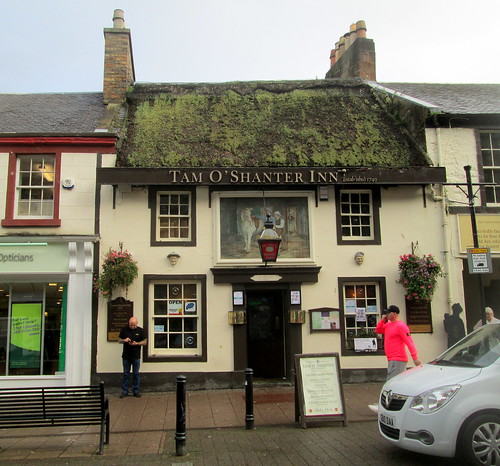
Another Burns related place of interest in Ayr is the Tam O’Shanter Inn, the oldest pub/restaurant in the town I believe. Tam O’Shanter is perhaps Burns’ best known poem. The inn is from where Douglas Graham, the inspiration for Tam, set off on the journey which the poem chronicles:-
Posted in Norway Cruise, Sculpture, Trips at 12:00 on 7 July 2021
This monument with a series of sculptures round its base I thiought represented all the trades associated with Bergen but it seems to be called the Sailor’s Monument or Maritime Memorial:-


This statue of the poet Nordahl Greig is to the side of the National Theatre:-

King Hakon VII, 1872 – 1957:-

This one seems to list former Norwegian monarchs:-

Posted in Trips at 12:00 on 2 February 2021
Just behind the Memorial Wall in Sunderland’s Mowbray Park lies a Veterans’ Walk.


Veteran’s Walk Plaque:-

Veteran’s Walk information notice:-

An additional curiosity in the park is this statue of a walrus beside the pond:-

Posted in Trips at 20:30 on 12 September 2020
The grounds of Gladstone’s Library, Hawarden, are dominated by a huge statue of the man.
Statue of William Ewart Gladstone with Gladstone’s Library building behind:-

Showing figures:-


Reverse of Gladstone Statue. Inscribed 1809-1898:-

Posted in Aberdeen, Sculpture at 20:30 on 27 August 2020
Statue of William Wallace in Aberdeen. This stands near Union Terrace Gardens. It is inscribed, “Willam Wallace, Guardian of Scotland” and in addition, I tell you a truth, liberty is the best of all things, my son, never live under any slavish bond, and was paid for with funds left for the purpose by John Steill of 38 Grange Road in Edinburgh, the son of James Steill sometime of Easter Baldowrie in Angus:-

Aberdeen’s Old Market Cross dates from 1686:-

Posted in Sculpture, War Memorials at 12:00 on 30 June 2020
Seaham is a town on the North Sea coast in County Durham.
The statue of Tommy is on the seafront in an area known as Terrace Green by Seaham’s War Memorial. It was erected in 2014 to mark the 100th anniversary of the Great War.

Detail:-

Side view:-

Reverse:-

Its sculptor was Roy Lonsdale:-

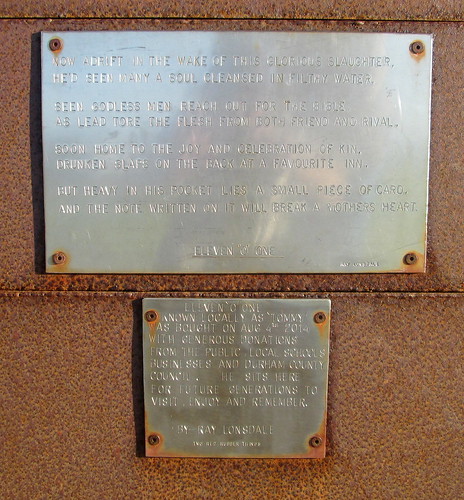
Dedication plaques. The sculpture’s proper name is 1101, to reflect the minute of peace at the Armistice which ended the war:-
Other side view:-

There are more pictures of Tommy here.
