Archives » Second World War

Aboyne War Memorial

Aboyne‘s War Memorial is a Community Hall. The memorial itself is in the alcove with stained glass windows to the left in the photograph below:-

Aboyne War Memorial

Stained glass alcove – names to sides:-

Aboyne War Memorial

Great War dedication (to the dead of Aboyne and Glen Tanar) plus names of Great War dead:-

Great War Names Aboyne and Glentanar War Memorial

World War 2 dedication: also to the dead of Aboyne and Glen Tanar. In addition, one name from the Korean War

Aboyne War Memorial, Second World War

Wreaths and Crosses:-

Wreaths and Crosses, War Memorial 5

Aboyne War Memorial, Wreaths and Crosses

Alford War Memorial

Alford‘s War Memorial is a Celtic Cross on a tapered square base. It lies off Parkhill Road:-

Alford War Memorial

Great War dedication and names Adam-Harper:-

Alford War Memorial, Great War Dedication and Names Adam-Harper

Great War names, Harper-O’Brien:-

Alford War Memorial, Great War Names, Harper-O'Brien

Great War names Ogston-Webster:-

Alford War Memorial, Great War Names Ogston-Webster

Second World War names:-

Second World War Names, Alford War Memorial

Luncarty War Memorial

Luncarty is a village just north of Perth, in Perth and Kinross. Its War Memorial, a cross surmounting a stepped hexagonal plinth, lies beside the B 9099 road on the northern side of the village:-

Luncarty War Memorial

Dedications. “In remembrance of those who gave life itself for us, 1914-1918. Their name liveth for evermore,” with, below, “1939-1945” and World War 2 names:-

Luncarty War Memorial Dedications Plus Names

Great War Names:-

Luncarty War Memorial, Great War Names

Great War Names, Luncarty War Memorial

Thrumster Estate War Memorial

This War Memorial, an obelisk on a stepped square base, lies beside the A 99 road a bit south of Wick. I’d noticed it on the way up to Gill’s Bay and Orkney and stopped to photograph it on the way back down.

Erected by public subscription it is dedicated to “the immortal memory of the brave men belonging to Thrumster estate who fell in the Great War 1914 – 1919” “and also of those whose names are below who fell in the Second World War 1939 -1945.”

Thrumster Estate War Memorial

Northern aspect. Great War names:-

Thrumster Estate War Memorial From North

Sothern aspect. Again Great War Names:-

War Memorial, Thrumster Estate, Wick

War Memorial for Ackergill and Hempriggs Estate, Wick

I spotted this War Memorial on the eastern side of Wick when we were returning from Orkney, so of course stopped to photograph it. It’s unusual in being topped by an urn.

Ackergill and Hempriggs War Memorial, Wick

Dedication – to the men of the Ackergill and Hempriggs Estate:-

Dedication Ackergill and Hempriggs War Memorial, Wick

Eastern aspect:-

Eastern Aspect, Ackergill and Hempriggs War Memorial, Wick

Western aspect:-

Ackergill and Hempriggs War Memorial, Wick, Western Aspect

Leaving Orkney

On the trip back from St Margaret’s Hope to Scotland (which Orcadians, rather than ‘the mainland,’ call the nearest part of Britain – to them ‘the mainland’ is Orkney’s largest island) we passed the gun batteries on South Ronaldsay.

These are I think called the Hoxa Battery.

There were gun emplacements here in both World Wars to protect Scapa Flow. These remains have the look of World War two constructions.

Hoxa Battery, South Ronaldsay, Orkney

South Ronaldsay, Orkney, Hoxa Battery

In 2017 I photographed them from a bit further away.

War Memorial, St Margaret’s Hope, Orkney

St Margaret’s Hope was our last stop on Orkney as it was where we picked up the ferry for Gill’s Bay in Caithness. I mentioned it in 2017. Its War Memorial is in the form of a kilted soldier atop a tapering square plinth.

War Memorial, St Margaret's Hope, Orkney

The front of the memorial is dedicated to the men of South Ronaldsay who fell in the Great War:-

Close up War Memorial, St Margaret's Hope, Orkney

War Memorial from rear:-

War Memorial, St Margaret's Hope, Orkney, From Rear

Word War 2 Dedication, on side of memorial:-

Word War 2 Dedicationm War Memorial, St Margaret's Hope, Orkney

Finstown, Orkney, War Memorial and Graves

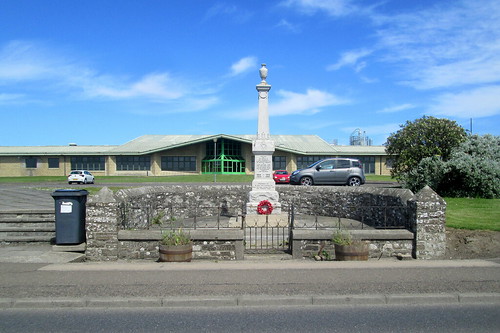
Finstown is a small settlement about halfway between Kirkwall and Stromness. Its War Memorial is a simple obelisk lying beside the A 965 road through the village:-

War Memorial, Finstown, Orkney

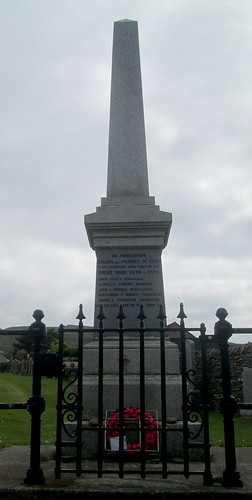
Closer view:-

Finstown War Memorial, Orkney

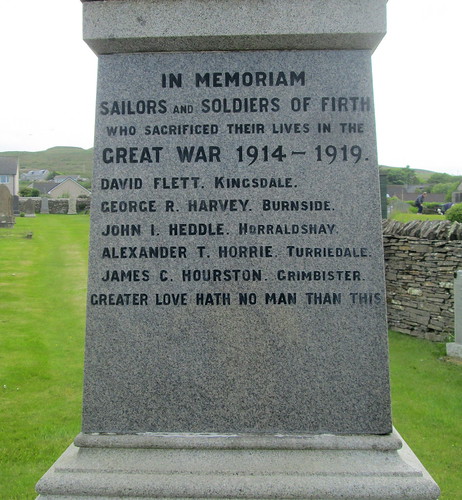
Dedication “to the soldiers and sailors of Firth.” (Finstown lies on the Bay of Firth,) and names Flett-Hourston:-

Dedication, Finstown War Memorial, Orkney

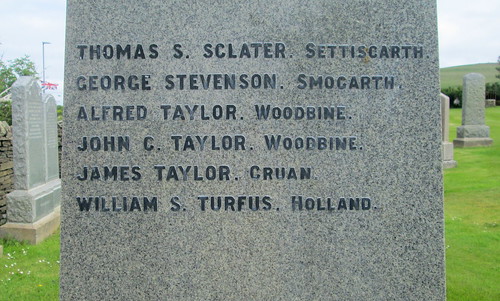
Names Sclater-Turfus:-

War Memorial, Finstown, Orkney

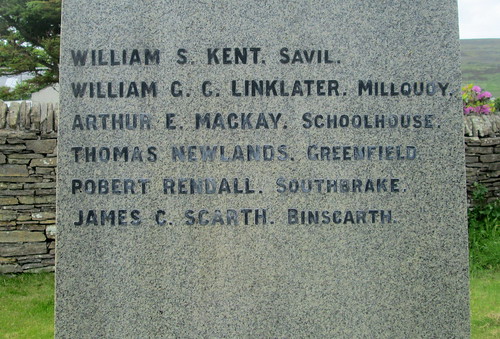
Names Kent – Scarth:-

Names Finstown War Memorial, Orkney

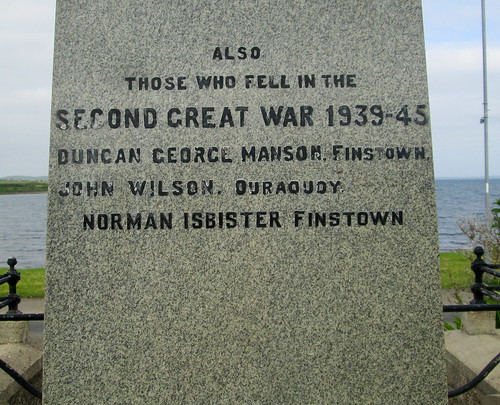
World War 2 Dedication and Names:-

World War 2 Dedicationand Names, War Memorial, Finstown, Orknet

In the graveyard behind the memorial lie two Commonwealth War Graves, both from World War 2.

Marine N Isbister, RML, HMS Proserpine, 8/7/1944, aged 24, a local whose name is on the War Memorial:-

War Grave, Finstown, Orkney 1

Lance Bombardier J M Bews, Royal Artillery, 26/3/1941, aged 20:-

Finstown, Orkney, War Grave

OVERLORD: D-Day and the Battle for Normandy 1944 by Max Hastings

BCA, 1984, 366 p.

This is an overview of the Normandy campaign from its planning through D-Day itself and on to the breakout from the beachheads to the closing of the Falaise pocket. The author’s stance on the campaign is that the Germans had the better resolve, equipment and better trained soldiers, but the Allies an overwhelming superiority in matériel and supplies. Not that that necessarily meant victory was a foregone conclusion. Much hard fighting was required. Casualty rates – on both sides – were prodigious, in some units 100%.

After the landings there was a belief among the Allies that firepower alone would suffice to beat the Germans but events proved this to be misplaced and progress did not depend on leadership. Hastings says that “few American infantry units arrived in Normandy with a grasp of basic tactics,” though their airborne troops did. There were some less than effective commanders but replacing them tended to have little effect. Even the better generals (Patton included) could not improve the performance of poor quality divisions. Problems – in both Allied armies – often lay at regimental and battalion level. German soldiers, however, adapted at once to the need for infiltration in the bocage, “their junior leadership was much superior to that of the Americans, perhaps also to that of the British.” Hastings does note that Bradley’s response to the Mortain counter-attack was, being calm and unflustered, a better command achievement than Patton’s haring around north-western France.

One thing I hadn’t realised till reading this was that even in the run-up to D-Day both Allied Air Forces were still reluctant to carry out the softening up bombing required in Northern France as they were of the opinion that they could win the war by themselves by attacking German industry and so no ground invasion would be required. Quite how this belief held on is odd since it ought to have been obvious that the German bombing Blitz on British cities had not greatly damaged the morale of the British people. Certainly not so far as to make the Government sue for peace with Germany. However, the bombing campaign over Germany in early 1944, while not really limiting aircraft production, had led to the defeat of the Luftwaffe due to the Mustang P-51 fighter’s effectiveness in inflicting losses on the Germans, whose aeroplanes and more crucially pilots consequently were not available to contest control of the skies over the invasion force. Another contributor was the Allies’ denial to the Germans of weather recording stations in the North Atlantic so hampering their forecasting. And of course there was FORTITUDE, the deception plan which had many Germans believing the Normandy invasion was a feint and another attack would take place on the Pas de Calais. As a result the Germans were unprepared for the attack when it came. Rommel of course was famously at home for his wife’s birthday and Hastings seems so tickled by the tit-bit that the German general Feuchtinger was apparently closeted away with a female friend on the night of June 5th – 6th that he tells us this twice.

Since the area round Caen was the hinge of the Allied force (and closest to Germany if a breakout were to take place) the Germans of course sent their best forces there. This meant the British and Canadians always faced the cream of the German troops in Normandy. The pressure was nevertheless such that Rommel was forced to use his tanks to shore up his defensive line and consequently could not concentrate them for a counter-attack. Montgomery was always conscious that British manpower was limited and the need to minimise losses resulted in overuse of what the Allies had a lot of – armour – as against a mix of armour and infantry. However, he did his reputation no good by continually misrepresenting the situation and his intentions both at the time and afterwards. In the end it was massed fire-power, particularly artillery, which wore down the Germans. In this context it is noteworthy that the historian Basil Liddell Hart later said that OVERLORD was “An operation that went according to plan but not according to timetable.”

Pedant’s corner:- focussed (many times: focused,) ditto “focussing” (focusing.) “One of the greatest throngs of commanders ever assembled … were gathered” (One … was gathered,) “Canaris’ loyalties” (Canaris’s,) “Brigadier Williams’ worst fears” (Williams’s,) “reached a crescendo” (reached a climax,) “the infantry were deployed” (was deployed,) “less weapons” (fewer weapons,) “Sepp Dietrich’s I SS Panzer Corps were quite unable” (was quite unable,) “the sheer enormity of the forces” (not enormity, they were not monstrous except in so far as any army is; ‘extent’.) “The SS were increasingly obsessed” (this is the SS as a whole, therefore ‘The SS was’,) Hodges’ (Hodges’s.)

Lybster War Memorial

Lybster is a village on the A 99 in Caithness about 13 miles south of Wick.

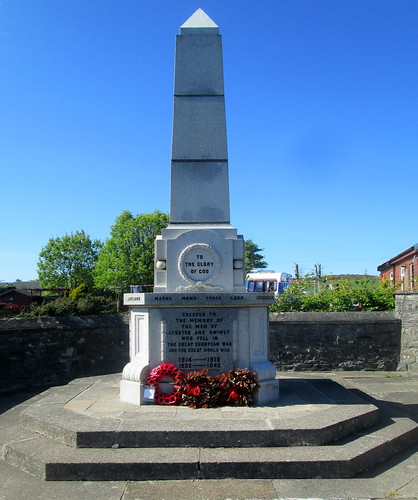
Its War Memorial is a granite obelisk situated on the east side of the road. Dedicated to “the men of Lybster and Swiney who fell in the Great European War and the Great World War”:-

War Memorial, Lybster

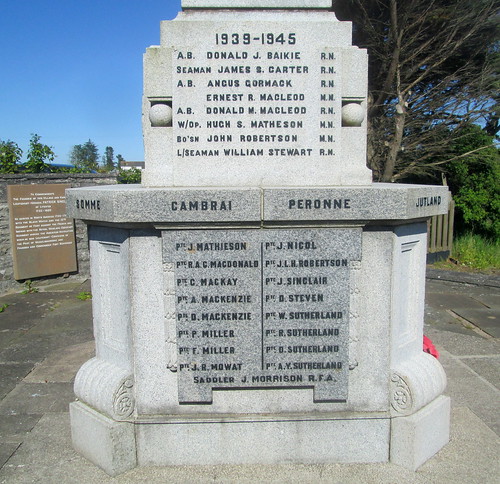
Reverse of Lybster War Memorial. World War 2 dedication. Upper list is of World War 2 names, the lower is for the Great War:-

Reverse of Lybster War Memorial

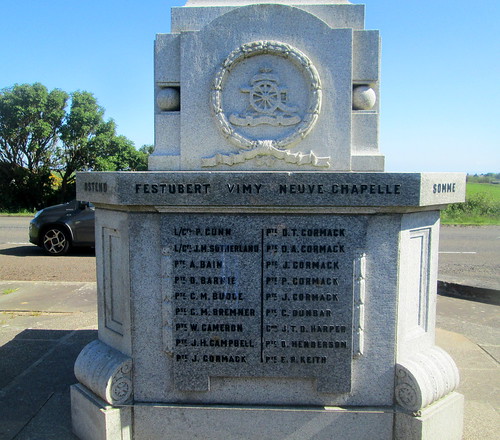
Close-up on names. The obelisk is aslo inscribed with the names of Great War battle scenes, Paschendaele, Beaumont Hamel, Ostend, Festubert, Vimy, Neuve Chapelle, Somme, Zeebrugge, Cambrai, Peronne, Jutland, Marne, Mons, Ypres, Loos.

War Memorial, Lybster Great War Names

Lybster War Memorial, Names

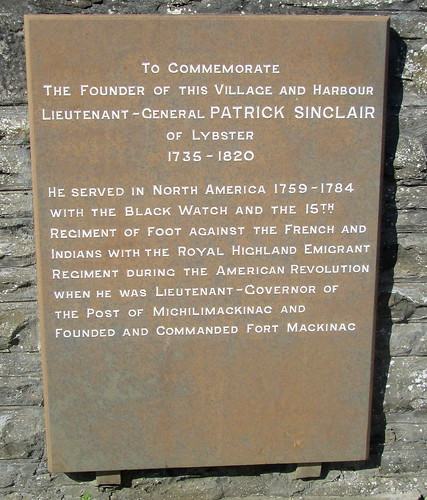
On the wall behind the memorial is a plaque commemorating the village’s founder:-

Plaque for Village Founder, Lybster

free hit counter script