Now She Is Witch by Kirsty Logan
Posted in Fantasy, Reading Reviewed, Scottish Fiction at 12:00 on 28 July 2025
Vintage, 2023, 343 p
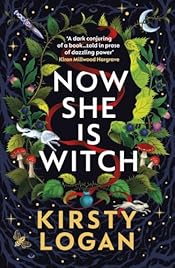 Lux was brought up by her mother in a house by the forest. Her mother was a healer and maker of poppets and possets, subject to suspicion because her baby had arrived suddenly with no man on the scene. Her mother gone, and Lux returned to the house after a sojourn in a sanctuary subject to strict religious rules, she is living alone when a woman, Else, arrives seeking her help to poison the local lord “‘who calls women witches so that he has an excuse to kill them.’” That same night Lux’s house is attacked by some of the local boys. They are driven off by a wolf, which may be Else in transfigured form, but not before the house is set on fire. Lux and Else set off together into the forest. The rest of the tale follows both – but mainly Lux – until she eventually finds employment in the lord’s castle, with Else tending to the herb/poison garden, and their misadventures there. I note here that Logan attributes to the lady of the manor more agency than a woman in her situation is likely to have had.
After a “Before” prologue which is unpunctuated (apart from dashes) and printed in italics and with no capital letters, the story is told in five parts. Parts One and Three have section titles all beginning with “Now She Is” followed by one word (in order these were Outcast, Prey, Maiden, Servant, Sacrifice, Whore, Poisoner.)
Part Two is “Lux’s Story” and is given to us also unpunctuated and printed in italics with no capital letters (apart from the words He and Him when describing the lover she had in the sanctuary.) Part Four, “Else’s story,” was similarly unpunctuated but had capital letters where appropriate.
Part Five’s sections have no titles and are in numbered order.
We are here, though, firmly in default faux-mediæval fantasy territory though there is some additional colour, a land bridge between the south and the north, the sea rising, there has been fire in the sky, poison vapours, ash, a sickness spreading supposedly from the north, whose sign is black roses on the skin.
Logan’s almost relentless theme is man’s inhumanity to woman. “Women are, as Father Fleck used to tell them at the sanctuary, less intelligent, more suggestible, and have more entry points into their bodies. All those orifices ready for a devil to creep into.” In Else’s story she tells Lux “it turns out all that really matters in this world is what a man wants because you either give it to him or he takes it and gives nothing in return” but “Beauty is dangerous. Beauty has power. Beauty has violence.” She outlines “the only available options, Maiden, Wife, Nun, Widow,” adding, “And I could not be any of these even if I wanted to. But there is one other option for a woman and it is the worst of all. Witch. Witch. Witch.”
The plot unfolds slowly to the point where we find the reason for Else’s attachment to Lux.
I suppose it is difficult to write in a contemporary setting a story about the best option for a woman being a witch but I’m really tired of tales such as this adopting a historical template.
On a sentence level Logan is good and her characterization is more than adequate. The whole thing seemed a little bit by the numbers though.
Pedant’s corner:- “Jesus’ birth” (Jesus’s,) “her tongue would not lay still” (would not lie still,) “aren’t I?” (Logan is Scottish; the correct usage is “amn’t I?”)
Tags: Fantasy, Kirsty Logan, Now She Is Witch, Scottish Fiction
