Archives » Scottish Fiction

Cloud Cuckoo Land by Naomi Mitchison

The Traveller’s Library, 1928, 348 p.

Cloud Cuckoo Land cover

This contains a dedication which I would have thought to be quite daring for the 1920s, “To my lover.”

The book is set during the Pelopponesian War, starting off on the island of Poieëssa in the Aegean Sea. Here young Alxenor is caught between the wishes of his brother, Euripaides, to support Sparta against the island’s overlord Athens, and those of Chromon, the brother of the girl he likes, Moiro, in favour of the democrats. When the revolt aganist Athens comes, Alxenor is only able to save Moiro with the help of a Spartan, Leon, and find she has made an enemy of Chromon. He and Moiro flee to Athens where he is taken in by Theramenes, a trader, and marries Moiro. He is only able to make money by enlisting as a rower on one of Theramenes’s triremes but it is never enough and he and Moiro live more or less hand-to-mouth, even when they have a son, Timas. Moiro is pregnant again when Alxenor has to make another sailing trip and he advises her to keep the new child if it’s a boy or else expose it (in the Greek way) if it is a girl. It’s a girl and his wishes are followed by the household. Thereafter things between Moiro and Alxenor are broken and he takes care not to make her pregnant again.

On one of Alxenor’s trips he receives news that Sparta’s navy has defeated that of Athens at Aegospotami and the fall of the city becomes a foregone conclusion. Thus it is that Alxenor and his family end up in Sparta at the household of Leon’s cousin where Moiro has an affair with Leon and the inevitable happens. Her loyal slave attempts to get rid of the child but it goes wrong and Moiro dies. Here the Spartans offer to bring up Timas as one of their own. Alxenor is willing at first but another non-Spartan who is undergoing the same training as intended for Timas secretly warns him not to allow it. He and Timas make their escape and head for Poieëssa.

This is another illustration of Mitchison’s clear love for ancient times as in The Corn King and the Spring Queen and Travel Light (and also Blood of the Martyrs.) Her knowledge of the times and customs shines through but I would perhaps have enjoyed this more if I’d had a wider knowledge of the Pelopponesian war than merely that it was a contest between Athens and Sparta.

As a novel, though, this has a peculiar ending in that it doesn’t seem to have a conclusion. It just stops. And I still can’t quite see in what context the title Cloud Cuckoo Land is apposite.

Pedant’s corner:- Theramenes’ (Theramenes’s. All names ending in ‘s’ in this book are treated similarly, though,) shrunk (x 2, shrank,) “he dare not” (past tense, dared not,) “none of the Spartans were back” (none … was back,) slipt (archaic spelling of slipped – or is it Scots?) “two fellow-servants of Isadas’ went” (doesn’t need that apostrophe after Isadas,) “wouldn’t leave go” (wouldn’t let go.) “None of them were …” (None of them was… .) mistress’ (mistress’s,) sunk (sank.) T S Elliot (in a chapter epigraph. T S Eliot.) “‘Aren’t I ever going back’” (Please. ‘Amn’t I ever going back?’)

Death in Bordeaux by Allan Massie

Quartet, 2010, 284 p.

 Death in Bordeaux cover

Part One; Bordeaux, Spring 1940. A body is discovered and Superintendent Jean Lannes is called to investigate. He is acquainted with the deceased, Gaston Chambolley, whose penis has been cut off and placed in his mouth as if this were a crime committed because of Chambolley’s homosexuality. The body has been moved, though, and Lannes soon supects the motive was political rather than due to prejudice, disgust, or a sexual encounter gone wrong. Chambolley had been looking into the death of his brother Henri’s wife Pilar, a Spaniard active in the Republican movement.

The times hang over proceedings like a pall. Bordeaux’s mayor is a fascist and the city rife with prejudice against Spanish refugees, Reds and Jews. For the first half of the novel the Phoney War pervades the background, a threat merely delayed. Lannes’s son Dominique is in the army manning the Maginot line and his wife, Marguerite, sick with worry. Lannes’s brother-in-law, high up in local government, spouts the ruling party line. The supervising magistrate is keen to shut the inquiry down but Lannes and his colleagues do not like unsolved cases.

When Lannes is sent to the Comte de Grimaud who requests him to track down the source of poison pen letters about the Comte’s (fourth) wife, Miriam, he has been receiving, the murder case takes on a twist. Chambolley was an associate of the Comte’s grandson, Maurice, who seeks out Lannes to tell him he witnessed the possible murderers entering the ground floor of Chambolley’s apartment block the night he was killed. Further complications ensue when one of Chambolley’s contacts with the Spanish, Javier Cortazar, is also found murdered, again mutilated. This seems to lead only to another dead end, though.

The Comte’s heir, Edmond, another with fascist leanings – but national government contacts – continually warns Lannes off “disturbing” the family even after the Comte is found dead after a fall down the stairs. The de Grimaud housekeeper (in the long ago another of the Comte’s many sexual conquests, one of whom may even have been his own daughter, and the Comte the father of her illegitimate child) suspects that child, known variously as Marcel or Sigi, to be the perpetrator. On leaving a restaurant where he had been meeting Edmond, Lannes gets shot and it is possible that Edmond may have engineered this.

In Part Two the chapters do not have the date headings that Part One’s did, but we are several months down the line, Lannes is back on duty, his wounded son is in a POW camp and Bordeaux under German occupation. The justiciaire, however, will be left to its own sphere except in so far as crime is political and impinges on Germans or the occupation. Lannes’s other children, Clothilde and Alain, do not quite know how to interact with the German soldier billeted in the flat above theirs, but Marguerite now has to worry whether Alain will be drawn into something foolish.

Under the occasional disapproval of his new boss, an Alsatian called Schnyder (who privately laments to Lannes that many of his young countrymen will now be drafted into the Wehrmacht,) and of the supervising magistrate, Lannes still plugs away at the Chambolley/Cortazar case. A trip to Vichy, that deluded spa town, to interview Edmond confirms his powerlessness in the face of the new order.

Massie is a Scot but when out of the blue one character uses the Scots word blethers, it seemed a little odd in the mouth of a Frenchwoman. Then again, why not? The novel wasn’t written in French. Considering Massie’s previous work it seems something of a diversion for Massie to take on the crime novel as a form, though he has previously interrogated the French experience during the Second World War.

If it is the duty of the detective story to set the world to rights this one fails in that regard, at least in this volume. By its end things are worse than at the start, with the Germans in charge and little place for honest policemen, unless they can keep their heads well down, and the lives of the general populace circumscribed and compromised.

It is only the first in a quartet though. The other three are on my shelves.

Pedant’s corner:- Lannes’ (innumerable instances, Lannes’s – of which there were some examples,) a missing full stop (x 2,) “hadn’t know Pilar well” (known,) “they were praised her in her day” (no first ‘her’, or, no ‘in her’ needed,) Republiqué (République,) “of is being” (of his being,) “an dark blue handkerchief” (a dark blue,) inasmuchas (in as much as,) Clotilde (several times, usually Clothilde but, once, Cothilde,) a line indentation in the middle of a paragraph, “grande-me’re’s health” (grand-mère’s,) “‘That’s what I trying to get across’” (what I was trying to get across,) “‘in the matter of subject to investigation’” (in the matter subject to investigation,) “‘all I was thinking off’” (thinking of,) innumerable misplaced quotation marks some even reversed or missing, missing commas before or after direct speech, “the length of tis body” (its body,) “had spoken for a document” (of a document,) Cours del’Intendance? (Cours de l’Intendance,) “no doubt either than in a strange way” (that in a strange way,) “they had not see the count” (seen,) “Blind Man’s Bluff” (as I recall it was always Blind Man’s Buff,) “ad sit with him” (and sit,) “‘we should only to see good order maintained’” (we should only [seek?] to see good order maintained,) “without new masters” (with our new masters.) “‘Poor Jules,’ He said” (‘Poor Jules,’ he said,) “and is actress friend” (and his.) “Or an instant she responded” (For an instant,) “a hornet’s next” (nest,) “if not immediately than in time” (then in time,) “‘nobody in their right minds ever going to buy’” (nobody in their right mind’s ever.) “‘I sure of it’” (I’m sure of it,) “‘how would we fell afterwards’” (how would we feel afterwards,) “‘wsn’t she?’” (wasn’t she,) “the blossomed with a rush” (then blossomed,) Lanne (Lannes.)

Bookshelf Travelling For Insane Times

The good lady is taking part in a meme, which originated with Reader in the Wilderness in the USA.

It’s not quite in the spirit of the meme but I thought I would give you a glimpse of some of my bookshelves over the next few weekends. (Monday counts for this.)

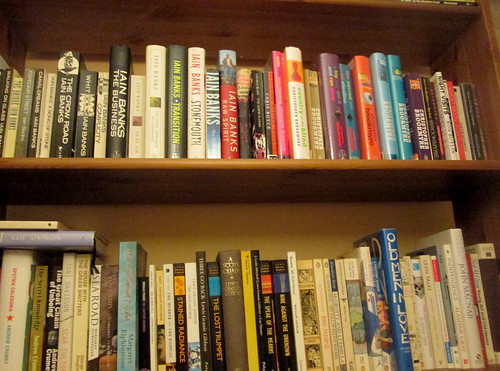
So these are the top four shelves of the bookcase where I keep those works of Scottish Fiction I have already read. (Unread books are kept elsewhere.) The bookcase was bought from IKEA and fitted well in our old house which had high ceilings. When we moved to Son of the Rock Acres we wondered where it could go. Not downstairs, not enough clearance. Upstairs though, the ceilings are three inches higher! The removal men were great at manœuvring it into place with so little margin for error. It now sits on the top corridor just outside my study. (You can’t always see the books so clearly, there’s usually more stuff placed in front of them. A few history books are still perched above some in the bottom row.)

Scottish Books 1

Scottish Books 2

Edited to add:- The meme was set up to include recommendations for reading. Well, on that note Lewis Grassic Gibbon is always worth it, most especially Sunset Song in the A Scots Quair trilogy. So too are Alasdair Gray, Iain Banks, Anne Donovan, Margaret Elphinstone, Andrew Crumey, Andrew Greig, James Robertson.

Persian Dawns, Egyptian Nights by Lewis Grassic Gibbon

Polygon, 1998, 274 p, plus vi p Introduction (The Other Grassic Gibbon) by Ian Campbell and 3p Foreword (Good Wine) by J D Beresford.

 Persian Dawns, Egyptian Nights  cover

This edition was published as by Lewis Grassic Gibbon but originally saw the light in 1932 under the author’s real name J Leslie Mitchell. It is divided into two sections.

Persian Dawns is a series of tales supposedly mediated (and commented on) by our author from archive manuscripts in the Monastery of Mevr, written by Neesan Nerses, a Nestorian bishop of the 1200s, stories he called the Polychronicon.
I The Lost Constituent is the tale of Islam’s greatest General, Mirza Malik Berkhu, who comes back to Baghdad after his latest triumph to be told by the Caliph to sequester himself. He spends the next ten years in pursuit of the secret of eternal youth but is rudely interrupted by the Mongols.
II The Lovers are two men, one a Christian mercenary, Hormizd, son of Bishop Nerses, saved from slaughter at the hands of the Mongols by the other, a chief of the Outer Horde, who is later imprisoned for his pains, but set free by Hormizd as the Mongols return home. Theirs is a complicated relationship but it endures.
III The Floods of Spring is again set after the sack of Baghdad. A deputation from a Christian village on the Euphrates comes to the bishop at Alarlu to ask for a priest as theirs had been killed. The bishop returns with them to rouse the villagers both from their torpor and from the influence of Zeia and Romi, two wanderers who had turned up in the Mongols’ aftermath, to rebuild the dams that the Mongols destroyed.
IV The Last Ogre lives in a cleft in the rocks in the mountains of the Kablurz Beg where the bishop’s daughter, Amima, effective manager of Alarlu while her father pores over his manuscripts, had gone hunting despite his refusal of permission. The Beg is said to be the haunt not only of wild animals but also strange mythical demons. Having lost her weapons and horse in an encounter with a lion Amima finds shelter with the creature, a last vestige of prehistoric times.
V Cartaphilus is a cyclic tale; of Baisan Evid, imprisoned in a lightless dungeon for consorting with the Caliph’s favourite, Miriam. He has a companion in the darkness, eventually revealed as Cartaphilus, the denier of Christ, Wandering Jew of Christian legend. On his release, fired with a desire to persuade Cartaphilus of Christ’s godhood and so precipitate the Second Coming, Evid roams the Middle-Eastern world in search of Cartaphilus, via the tomb of Doubting Thomas among other places, before returning to Baghdad and a different realisation.
VI Dawn in Alarlu might have been crafted to counterpoint the biblical phrase What shall it profit a man though he gain the whole world and lose his own soul? as the bishop’s daughter takes the side of a monk escaped from the monastery where he was taken as a child and subjected to its harsh discipline. By escaping he stood to lose his soul; but he had gained the world.

The stories in Egyptian Nights are listed alternately under the titles of two poems by John Keats, L’Allegro and Il Penseroso. All the L’Allegro stories are prefaced by the same paragraph of introduction and are as-told-by tales which Sergie Lubow, a former White Russian, relates to our unnamed narrator. The Il Pensero stories are more straightforwardly written.

L’Allegro
I Amber in Cold Sea tells of Gavril Dan’s escape from the Crimea as the Bolsheviks took over and how that relates to the couple Lubow and our narrator see coming out of a taxi one Cairo night.
Il Penseroso
II Revolt. The same night as his sick son Hassan’s life hangs in the balance, Rejeb ibn Saud is to give the final exhortation to a crowd before a projected uprising. He resolves to encourage or condemn the revolt according to the message he will receive as to his son’s survival.
L’Allegro
III Camelia Comes to Cairo. Camelia is a woman who had left London under the cloud of a common complaint five years earlier, then studied medicine in Dresden, before coming to Cairo as it needed a female doctor. She has to prove her worth to Lubow’s friend Adrian – and his catty sister.
Il Penseroso
IV Dienekes’ Dream tells of how a street in Cairo came to have ϴΕΜΟΠΥLΑΙ inscribed on its wall, the site of a last stand against eviction by Greek immigrants who had settled on a midden and turned the site into a thriving weaving concern.
L’Allegro
V Siwa Plays the Game. Lubow tells of his commissioning by an English author of novels set in Egypt (a place said author had never visited) to show him the real Egypt. When this reality fails to live up to the author’s imaginings – too mundane, too squalid – Lubow and his Egyptian guide determine to furnish him with what he desires.
Il Penseroso
VI The Children of Ceres is a kind of Good Samaritan story, with everyone passing a poor old woman in the street until one woman recognises her.

All the stories are accomplished enough in themselves but could perhaps have done without the ‘throat-clearing’ introductions. Very little hint of Gibbon’s Scottishness shows through. But that is as it should be, given their settings. But Gibbon is never less than readable.

Sensitive souls should note that the text contains the word “nigger”.

Pedant’s corner:- In the Introduction; Wells’ (Wells’s,) Nerses’ (Nerses’s.) Otherwise; Nerses’ (Nerses’s,) noice (noise,) Tigris’ (Tigris’s,) Dienekes’ (Dienekes’s)stratagem (stratagem,) staunching (stanching,)

Crossriggs by Jane & Mary Findlater

(The title page has Mary & Jane Findlater) Virago, 1986, 382 p, plus viii p Introduction. First published 1908.

Crossriggs cover

In Crossriggs, a town an easy train ride from Edinburgh, the locals have always looked up to the inhabitants of the Manse, for many years the preserve of the Maitland family. The present incumbent is not a Maitland but the people still look to Robert Maitland, who has come back to live in the town, for advice. The book, though, mainly focuses on Alexandra Hope (known as Alex) whose father Alexander is an idealistic fruitarian and a bit of a no-hoper, and seems to the reader to have no visible means of support. Through Alex the Findlaters make much of the fact of the family’s poverty (illustrated mostly as a matter of not enough food and money. But these things are relative; they have a kitchen-and-house helper in Katherine, and a drawing room.) Important to the overall story arc is the inhabitant of the local big house, Admiral Casillis, now blind. We are told that nothing much happened in Crossriggs till Alex’s sister Matilda had to return from Canada to her childhood home – with her five children – when her husband died, and the Admiral’s grandson Vanbrugh (Van) came to live with him. But even after this nothing much happens in the text for a long while.

To help support the six extra mouths Alex is of course forced to take a job, a process she finds embarrassing. She undertakes to read to Admiral Casillis every day bar Sundays, for two hours each day, mostly the newspaper. The youthful Van is struck by her and takes to visiting the Hope household on almost a daily basis. He is too young for Alex who strives to avoid confronting his regard for her. A public reading at another big house leads to Alex taking on more readings in town (Edinburgh.) In the meantime she turns down John Reid’s marriage proposal with the excuse to herself that she is too busy and has to provide for her nephews and nieces. It is Maitland, though, who bails out her father from an unwise guarantee and pays for the children’s education. She is of course in love with Robert Maitland who it seems has an equal affection for her but both cannot express it as he is already married. Her affection shows itself in an inability to control her verbal meanderings in his presence.

There are instances where the character’s language reflects the writers’ times. Van expresses dissatisfaction with his grandfather’s treatment of him. Alex replies, “‘If you had to work hard for your living, like me, you’d find you had more to think.’” His riposte is one decidedly not for those sensitive to modern properieties. “‘If I’d been allowed …. to work at anything that interests me, I’d slave like a nigger.’”

We also, twice, have another expression of prejudice. The first is when Alex says to her niece someone is, “‘-a little Jewish. She stopped.’ Sally flushed. ‘Why are Jews so nasty, Aunt Alex?’”

This is not really excused by Alex’s reply. “‘They’re not dear; far from it. An ancient race, the cleverest and noblest in the world in many ways,’” with some added excuse about Jews being an Eastern people and “fond of colour.”
Later we also had, “‘And he’s really not so -’ Matilda paused. Alex …. remarked gently – ‘Semitic, dear, is the word you want.’”

The book suffers a little from us being introduced to too many characters too early, giving the reader little chance to get to know them and hence care about their fates. However, the later appearance of the fateful Miss Orranmore gives us no doubt as to the kind of woman she is. Its main theme is of pride and conformity but like much serious literature Crossriggs treats with love – albeit obliquely and mostly unspoken – and death. Here any sex is resolutely off-stage, or at least only revealed by its usual consequence. Paul Binding’s Introduction says that the Findlaters – who wrote separately as well as together – had early success (Virginia Woolf was among their admirers) but their popularity dropped off in the 1920s. It seems a very Victorian era novel. The thought, “‘You don’t suppose, do you, at your age, that the things one doesn’t speak about are the things one forgets?’” has, however, not lost any of its pertinence.

Pedant’s corner:- On the back cover; Mathilda (in the text it’s Matilda,) Locheanhead (Lochearnhead.) Otherwise; some nineteenth century spellings, repellant (repellent) etc, “from whence” (whence means ‘from where’,) “you mentioned seventeen shillings” (actually two shillings a day = twelve shillings for six days, but Alex had enquired about two and six a day = fifteen shillings,) some missing commas before pieces of direct speech, ramshakle (ramshackle.) Chapter XVIII’s heading is omitted and starts at the top of the page where the other chapters started lower down. These next, with missing letters within words, must have been in the original publication from which this edition looks to have been reproduced, [“every bead twin king” (twinkling,) “rath r” (rather,) Matida (Matilda,) “one f” (one of,) “bo anical” (botanical,) “‘W hear’” (We hear,) “momen ” (moment,) ] “sound asleep more once” (once more,) “Aunt E. V. regarded he with her penetrating glance” (regarded her,) “so that is was not difficult” (so that it was,) Cassilis’ (Cassilis’s,) an opened quote that is never closed.

Where the Apple Ripens by Jessie Kesson

B&W, 2000, 192 p, including xii p Introduction by Isobel Murray.

 Where the Apple Ripens  cover

Kesson drew on her early life for inspiration in much of her fiction, which in the Introduction we are told was always composed in the form of a play for radio first. Several of the stories here reflect rural life, some are set in institutions, all are unmistakably Scottish. Most are adorned with page centred quotations from poems or hymns or songs. The characters within them are vibrant and individual; depicted economically, vividly and with compassion. This is good stuff.

The longest tale here is the first, Where the Apple Ripens, a novella describing two days in the life of Isabel Emslie, set to take up a place in service the next week in the big town. Her last schoolday is marred by its coincidence with the funeral of Helen Mavor, who had let herself waste away after the birth of her illegitimate baby. The novella is perfused with the contrast between Calvinist rectitude and human impulse, her mother’s admonishments, the prurient comments Isabel overhears as she passes the local bus stop, the thinly veiled innuendos and warnings, her poetic sensibility – illustrated by copious quotations from poems and hymns – her youthful exuberance and desire to dance (a heavy signal, this,) the bravado she expresses when she says she’s ‘not feared’ of Alex Ewan, the local man with a reputation, a bravado which is later revealed to have face value.
In Stormy Weather such inclemency is the only reason Matron can muster not to allow the older orphanage girls out to go to the Band of Hope meetings on Friday nights. The story, however, is more about the compromises, the quids pro quo, the petty revenges the inmates have with and over one another.
Set in 1923, ‘Once in Royal…’ relates the excitement around the scramble for tickets for the Chief Constable’s Christmas dinner for poor children as felt by Sarah, who does not consider herself the ‘poor, wee soul’ of others’ opinion.
The Gowk, Jockie Riddrie, is the local simpleton, forever hanging around the school fence, drooling, or exposing himself. After allowing herself to be enticed up into the woods young Liz Aitken becomes pregnant but steadfastly refuses to reveal to her family who the father is. For the village folk and especially the gowk’s stepmother, Kate, Jockie becomes the obvious candidate to blame. But his father Hugh knows better.
Having caught the biggest tiddler in a jam jar The Bridge is where the local boys span, hand over hand on its girders, across the river below.
Until Such Times is the interval during which narrator ‘you’ are staying with your Grandmother and the Invalid Aunt away from your Aunt Ailsa (who, we infer, is not your aunt) whom the Invalid Aunt says is man-mad and that ‘you’ would clip her wings. Invalid Aunt never has a good word to say about anyone but ‘you’ are devoted to ‘Aunt’ Ailsa, who is actually trying to do her best for ‘you’.
Another story narrated by an unnamed ‘you’, Good Friday is not the religious festival but the tale of a sufferer from acute neurasthenia longing for the day she’ll be released from mental hospital.
As its title suggests Life Model is about a sitter for Art Students, one who could hold a pose better than most, and of her secret for being able to do so.
In an intimation of mortality Road of no Return sees a woman come back to her childhood village overlooking Loch Ness and finds it deserted. But her memories remain.
Set in an old people’s home and with a kind of time-slipping narrative Dear Edith … describes the letters Mrs Cresswell composes to her dead friend Edith, interspersing these with the conversations of the staff.
This Wasted Day is the last of a tinker, arraigned at the Pearly Gates by those who looked down on her during her life with all their misconceptions and prejudices. The Big Man turns out to have different ideas from them but there is still a twist to come.

Pedant’s corner:- In the Introduction; Alex Ewen (the book’s text has Ewan,) “Never had Isabel ran so fast” (the passage was in standard English not vernacular Scots, so, ‘run’,) paeon, (paean,) an opening quotation mark that was unclosed, sang (again, the passage was in standard English, so, sung,) ommission (omission,) court yard (courtyard,) a missing comma before a piece of direct speech, another missing after one, momentoes (the correct ‘mementoes’ appeared two lines later,) descendents (descendants,) vocal chords (cords.)

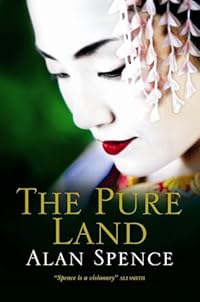
The Pure Land by Alan Spence

Canongate, 2006, 428 p.

 The Pure Land cover

Ipponmatsu is a house still left standing, albeit with every window shattered, after the A-bomb was dropped on Nagasaki. Two GIs break in to find its Japanese occupant, Samurai sword in hand, about to commit seppuku. They are surprised to find he speaks English. He tells them his father was Scottish.

The Pure Land is the fictionalised life story of that Scot, Aberdonian Tom Glover, taken on by Jardine Matheson to work for them in a Japan newly opened up to trade after Commodore Perry’s Black Ships had forced the Shogun to end Japan’s isolation.

Spence paints a compelling picture; first of the life, and love, Glover left behind, of his arrival in Japan as Guraba-San and a first encounter with the Samurai Takashi, the strangeness he found there, the mistrust, the Samurai striding about, casually disembowelling and beheading any who displeased them (and not just foreigners,) the tensions and strains within Japanese society, the disagreements of the Choshu and Satsuma clans, those wishing Japan to modernise, others fiercely resistant to foreign influence corrupting their unsullied country, the consolations he found after crossing the hesitation- and mind-made-up bridges to the flower quarter, his acumen in business and the risks he took when striking out on his own, his taking a Japanese wife, Sono, the loss of their child and relationship, his introduction of a railway to the country (a development not built on for decades.)

An instance of arrogance and carelessness on the part of an Englishman leads to his death. In the retaliation by British gun-boat diplomacy at Kagoshima, Sono was killed. Undaunted, Glover indulges in gun-running to both sides in Japan’s internal conflict, amassing a paper fortune but incurring debt, and is instrumental in sending representatives, first of the Satsuma, then later of the hitherto reluctant to modernise Choshu clan, to Britain, where they see the future. Through his contacts with a shipyard in Aberdeen he provides for the foundation of Japan’s shipbuilding industry via dry dock construction, and acts as middle-man for the purchase of ships for Japan’s first modern navy.

This is all wondeful stuff. I would have rated this book very highly on its execution up to its midsections and, in retrospect, there is a subtly handled recurring motif of bridges being both safe pathways yet also dangerous. However, when the Japanese crisis comes Glover is not involved personally and the text has to resort to telling, giving us a short history lesson in which the Tokugawa Shogunate is finally overthrown and the Meiji Emperor restored to ultimate power. In the ensuing uncertain times the currency collapses as do Glover’s finances and he has to sell his coal mine, the first in Japan, but remains to manage it. His friendship with the rising politician Ito Hirubumi lets him in on the ground floor of a company whose symbol will be three diamonds, Mitsu-bishi, and he also finds time to found Kirin beer. At one point he regales a drinking companion with the words, “‘The Scotch, however, is from home. There are some things even the Japanese shouldn’t be trusted to copy!’”

All this is background though. The book is at its finest when dealing with Glover’s relationships with women (first love Annie, where the Brig o’ Balgownie over the River Don features prominently, first wife Sono, the courtesan Maki Kaga – an affair said to have been the inspiration for the opera Madame Butterfly – his housekeeper Tsuru, who falls for him, and whom he marries) and on personal thoughts and feelings, the perennial novelistic concerns of love, sex and death, here with the fate of a nation thrown in, the astonishing transformation of Japan from a mediæval feudocracy to a Twentieth Century world power in less than forty years. Unknown to Glover Maki bears him a son while he is temporarily back in Aberdeen, a son whom he later adopts, the book’s central human source of unease.

At times Spence can’t resist the opportunity for his story to comment on itself. One of Glover’s accomplices keeps asking him, “And then?” when he outlines developments in Japan’s future. The latter part of Glover’s life is somewhat skimmed over, though. The reflection on his life represented by his interview by an American reporter in 1911, questioning Japan’s expansion into Manchuria and Korea, is probably justified but the underlining of the irony of Mitsubishi’s Nagasaki shipyards being a target of the second atomic bomb attack in the 2005 chapter really isn’t. In that same section one of the characters wants to know what happened to the woman in the story. We find out in the last.

Pedant’s corner:- a missing comma before a piece of direct speech, “a leather football” (in 1862? Not impossible.) Queensberry rules (these weren’t drawn up till 1865,) rowboat (rowing boat,) sprung (sprang,) a missing opening quotation mark (x2,) Shinsasburo (previously Shinsaburo,) sunk (sank,) payed (paid,) “‘I said For God’s sake why?’” is missing quote marks around ‘For God’s sake why?’; ditto with the ‘I said Why not?’ in “I said Why not?” “blew her nose hard” (this was a Japanese woman in Nagasaki in 2005. I remember reading once that to a Japanese, to blow your nose in public is extremely rude,) Ryonen (later, always rendered as Ryonan.)

Scottish Short Stories Edited by Theodora and J F Hendry

Penguin, 1945, 123 p.

Scottish Short Stories cover

The back cover says this book was mostly edited by Theodora Hendry but she was killed in the London Blitz. The criteria for selection in the volume was Scottish stories with a Scottish setting or else it “would almost certainly have assumed an international aspect.”
The first, The Coasts of Normandy by George Blake, is the story of a tragedy which befell the narrator’s childhood friend and its effect on the child’s mother as reflected through the prism of a chance encounter with a stranger many years later on the coast of Normandy. It takes a slightly circuitous route to its revelation (which the reader intuits well before the narrative gets there) but this allows for such thoughts as, “The simple feel as warmly as the clever and the learned.” Another of its observations is a reminder that, for some soldiers at least, the Great War was not only a horrific trial and ordeal but also an opportunity to remake their lives in its aftermath.
In A Sunday Visit by Colm Brogan two boys are dragged along by their mother to the Mortons’ house, where the family has just suffered a bereavement. Amid all the whispering, the boys are left to their own devices.
A Hike to Balerno by Ronald McDonald Douglas sees two boys on the titular hike, the escapades they get up to, the banter between them, “daft, just plain daft.”
Clay by Lewis Grassic Gibbon is the story of Robert Galt, a man from a chancy background who takes a farm and devotes all his time to it, to the neglect of his wife and his daughter’s prospects.
Beattock for Moffat by R B Cunninghame Graham tells of the last journey of a dying Scot on the train up from London with his cockney wife and his brother come to take him home to die. The author observes of the accomodations married couples make with each other that “usually … good points, seen through prejudice of race, religion, and surroundings, appear … defects,” and refers to the Cockney wife’s reticence being explained by, “the English theory, that unpleasant things should not be mentioned, and that, by this means, they can be kept at bay.” The prose evidences that Scottish authors’ eye for landscape.
In The Sea by Neil M Gunn a twelve-year-old overcomes his fears, staggering through the night down to the harbour to witness the perilous return of his father’s and brother’s boats during a great storm. Here it is seascape (or land-meets-sea-scape) which the descriptive powers bring to life.
J F Hendry’s Chrysalis is a fragment of the childhood of a boy who wants to be good but fears he is bad because he sometimes is too enthusiastic in his activities.
Clock-a-Doodle-Doo by Willa Muir is set in a room full of clocks (all wag-at-the-wa’) which can speak to each other, having theological discussions over whether the Son or Moon is the primum mobile and aspiring to Pure Horological Thought.
Neil Munro’s The Lost Pibroch could be characterised as a Scottish version of the Pied Piper of Hamelin. Two pipers come to Half-Town. After a night of musical vying with the blind piper there he finally plays them the titular pibroch he “got from a man in Moideart.” It has “something of the heart’s longing and the curious chances of life” and sets up a wanderlust in those who hear it.
In The Matinee by Fred Urquhart a fifteen-year-old newly graduated into long trousers reverts to shorts to get into the cinema more cheaply, dragging his younger brother along for corroboration. Engrossed in a film where a factory owner exploiting the workers is presented as virtuous he fails to acknowledge his brother’s increasing personal discomfiture.
Eric Linklater’s Kind Kitty is an old woman who likes a drink, then dies through lack of it a few days after throwing a party for Hogmanay. She inveigles her way into heaven but finds the company there uncongenial, and the beer far too poor.

Pedant’s corner:- a missing full stop, “brigh” (is missing a final ‘t’,) missing commas before pieces of direct speech.

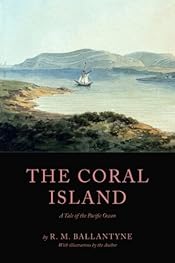
The Coral Island by R M Ballantyne

A Tale of the Pacific Ocean.

EriK Publishing, 2017, 239 p. First published 1858. One of the 100 best Scottish Books.

 The Coral Island cover

When I first saw this on the list of 100 best Scottish books I wondered if I had read it in my youth. Reading it now (which I would not have done were it not on the list) its contents struck absolutely no bells in my memory.

This is a tale narrated by Ralph Rover of three cheery lads; himself, the older Jack Martin and the younger Peterkin Gay, and their life after shipwreck on the coral island of the title, a place with bountiful food, not only cocoa-nuts, bread-fruit, yams, taro, plums and potatoes, but also pigs and ducks and of course fish. Their ingenuity and resourcefulness (not, what with all that bounty, do they really need them much) allow them to lead a happy life until it is disrupted first by the descent on their shores by South Sea natives at war with each other (one side whom our heroes naturally get the better of, the other side then becoming free to return to their home) then by pirates. Ralph falls into the latter’s hands and is transported across and around the Pacific islands before eventually finding his way back to rescue Mark and Peterkin.

The book is of course riddled with the cultural assumptions of the time in which it was written. A flavour of this is given when Peterkin asserts of potential black inhabitants, very early on when the three don’t know what exactly they will find, “‘Of course we’ll rise, naturally, to the top of affairs: white men always do in savage countries.’” (Those sensitively disposed should note the text contains one instance of the word “niggers” and that is put into the mouth of a pirate.)

Much play is made of this “savagery” and of the cannibalism of the region’s as yet unconverted natives as contrasted with Ralph’s intermittent piety (after he lost his Bible in the shipwreck.) To a man – and woman – the natives are redeemed, civilised and instantly ennobled by the adoption of Christianity. The more, though, that the text insisted that those tales of cannibalism and savagery are true the more I came to resist the thought. In any case, the savagery displayed was no more than the pirates are shown to be capable of.

Reunited, the three set off to aid one of the native women of the freed warring party whose chief Ralph had become aware was refusing to allow her to marry whom she pleased and now threatened to kill her. That chief is much displeased when they turn up and soon imprisons them. The book ends with an almost literal deus ex machina as the three are saved by the conversion of their captor by a missionary.

The Coral Island is not the shipwreck on a deserted island ur-text – that would be Robinson Crusoe – but with its depiction of pirates it clearly had an influence on Treasure Island and Peter Pan and its suffocating certainties apparently festered in William Golding’s head and led to its antithesis in Lord of the Flies. That it holds such a position is the only possible reason to include it in a list of 100 best books. In terms of literary merit or insight into the human condition it belongs nowhere near one.

Pedant’s corner:- Both the cover and the title page bear the words “with illustrations by the author.” None were to be found inside. Otherwise; contains mid-nineteenth century spellings – cocoa-nuts, sewed, etc. Otherwise; occasional omissions of commas before pieces of direct speech, ricochetting, (ricocheting,) maw (it’s not a mouth,) “signed to several of attendants” (of his attendants,) “seized Jack and Peterkin and violently by the collars” (doesn’t need that second ‘and’.)

The Girl on the Stairs by Louise Welsh

Hodder and Stoughton, 2013, 298 p.

 The Girl on the Stairs cover

The viewpoint character here is Jane, heavily pregnant and newly arrived in Berlin to stay with her Lebenspartner, Petra, in an apartment block. The room being prepared for the baby is dark and overlooked by a derelict set of flats. Their neighbours are a single man and his daughter, Alban and Anna Mann. Anna is the titular girl on the stairs. Jane overhears Anna’s father shouting at her and sees bruises on her face and so becomes increasingly convinced Anna is being abused, despite Anna’s denials.

She observes Anna in various situations, at a U-Bahn station interacting with older boys, crossing the space towards the derelict flats – a haunt for all sorts of undesirable behaviour – coming out of the downstairs flat, where the Beckers live, going into the nearby church which has a relatively new young priest. On talking with Frau Becker, a woman still mentally scarred by the Russian occupation of Berlin, she is told Mann killed his wife, Greta, and buried her under the floorboards in the flats opposite.

All the while Petra is less than attentive to Jane, out at work all day or off to a conference in Vienna, and Jane’s imagination whirls around, causing her to delve into Anna’s life and unwittingly to set in train a chain of events which will lead to tragedy and a vindication, of sorts.

Via the medium of Mann’s former professional life as a gynaecologist Welsh offers the possibility that Jane’s fears about Anna are a consequence of pregnancy affecting her emotional balance or if they are indeed valid.

Welsh’s writing is smooth and fluid, the novel exquisitely plotted, the psychological motivations and subtleties of the characters utterly believable and the whole is never less than readable and engaging but there was something about it that felt as if it was an exercise verging on by the numbers. Perhaps it was the foreign setting – and in that respect Berlin was an absence here, there was nothing to illustrate the character of the city – but there was something distanced about it, not in the Muriel Spark class of distanced but certainly more surface than depth. Crime aficionados would probably find it fine though.

Pedant’s corner:- “she wanted nothing more but to lie down” (usually ‘than to lie down’,) occasional missing commas before pieces of direct speech, politeness’ (politeness’s,) “aren’t I?” (Jane is Scottish, supposed to be from Glasgow, she would say ‘amn’t I?’) staunch (stanch,) “out of synch” (usually ‘out of sync’.) “The congregation were beginning to” (was beginning to,) focussed (focused.)

free hit counter script