Archives » Scottish Fiction

Ghost Moon by Ron Butlin

Salt, 2014, 246 p.

 Ghost Moon  cover

Curiously that’s two books in quick succession where the main character has been named Maggie. Here it is one Maggie Davies, though in the care home where she endures her declining months she is known as Maggie Stewart.

The story is told in interleaved sections. Those which recount from his point of view the visits of Maggie’s son Tom to his uncomprehending, dementia suffering mother, are always headed Sunday (though, one, on Maggie’s birthday actually occurs on a Monday,) and other, longer, numbered chapters tell the story of the life which led her there; a life not exactly flashing before her eyes but recollected in non-tranquillity. The final chapter, titled Sunday Afternoon, interweaves paragraphs from the two time-lines as the end nears.

Maggie spent the post-Second World War years seeing her twenties fade into thirty without attracting an admirer and fell prey to the dubious charms of the first man who gave her some attention only to be promptly dumped. When the inevitable happened, her parents threw her out. She travelled to Lewis to the home of family acquaintances but, forewarned, they also treat her with disdain and contempt. Only in a guest-house does she encounter any warmth, when she and the landlady’s war-blinded son, Michael, fall for each other. Lewis is a small place, though, and her secret causes her to be thrown out from there too. Returning to Edinburgh, it is only her sister-in-law, Jean, who shows her any compassion or sympathy. She struggles to find a job in her unmarried condition and she is little better treated at Woodstock House where she contracts to be confined and for her child to be looked after until she can get on her feet. Butlin really brings out the utter callousness of “polite” society at this time towards those who had made a mistake or been too innocent – or both. Only her correspondence with Michael, carried out via his best friend, and her visits to Woodstock House to see Tom give her any comfort. When Michael contrives to travel to Edinburgh it seems a happy ending might be in store – but we know from the ‘Sunday’ sections this will not be forthcoming.

This is a wonderfully written slice of an aspect of social history and a blazing indictment of those blinded to compassion and consideration by self-righteousness.

Pedant’s corner:- Jenners doorway – later Jenners’ doorway (Jenners’s,) Queens Crescent (Queen’s Crescent – used later,) Mrs Saunders’ (Saunders’s,) “that the woman’s heart being turned over” (that the woman’s heart was being turned over,) Miss Davies’ (Davies’s.) “The Forth Road Bridge was a cat’s cradle of red” (the Road Bridge has never been red and wasn’t built till the early 1960s: this part of the novel was set in 1950. The Forth Bridge – the rail bridge, which requires no such distinguishing adjective and was completed in 189o – was meant,) “to start to paying Jean back” (to start paying Jean back,) “would would stop her” (only one ‘would’ needed,) an opening quote mark which wasn’t necessary as it was a descriptive passage, not dialogue, “in her wellingtons boots” either, ‘in her Wellingtons’, or, ‘in her wellington boots’.)
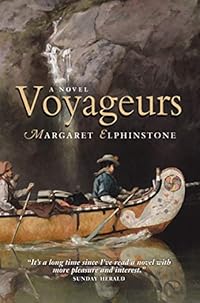
Voyageurs by Margaret Elphinstone

Canongate, 2004, 474 p.

 Voyageurs  cover

This formidably researched novel is set mainly in North America before and during the War of 1812 which was fought between the US and Britain (plus its Native American allies) but it is not concerned with that conflict except peripherally. The book is an example of a found manuscript, as supposedly written by Mark Greenhow, a Quaker from Cumbria – topped and tailed by an Editor’s Preface and Afterword, signed MNE, January 2003.

Greenhow was a Quaker from Cumbria. Most of his life was spent on a farm called Highside where the manuscript was ‘found’ hidden away when the ‘editor’ moved in. It reveals Mark’s life was turned upside down when his family received a letter from Canada telling them that his sister Rachel, previousy disowned from the Quaker Society of Friends for marrying her husband, Alan Mackenzie, before a priest, had disappeared somewhere in what was known as Upper Canada and therefore presumed dead. For Mark the ties of family outweighed the strictures of the Society and he resolved to go to Canada and try to find her. All his voyages (barring his final return home) as well as some incidents of his home life in the time before Rachel left for Canada are described in detail. Like most Scottish writers Elphinstone has a gift for landscape description, here deployed to convey the vastness of the North American continent and the local conditions. The customs of the time and the politics of fur-trading by the SouthWest Company are all necessary ingredients to the tale while the background to the war, whose prosecution, barring one small incident, remains off-stage, forms part of the novel’s plot as does Greenhow’s Quaker pacifism – or, I should say, his refusal to be involved in killing people.

The narrative is unavoidably tinged with Greenhow’s Quaker beliefs, with much talk of Monthly Meetings, the vanity of clothing, his soul-searching about relationships with the opposite sex and his failures fully to live up to the Society’s ideals.

A serious injury to Alan, who had additional reasons for undertaking once more the arduous journey to the island where Rachel disappeared, forces the three-man expedition to over-winter in the climate of north Lake Michigan, which even the indigenous peoples find inhospitable, and whose exigencies end up with Mark accommodating to what he considers pagan beliefs. They also bring home the unlikelihood of Rachel having survived. The sojourn also allows the three trapped men the opportunity to tell each other their life stories and so expand Elphinstone’s portrayal of their times. And far from being a hindrance Mark’s refusal to kill people ends up as an asset.

The ‘manuscript’’s text is peppered with Scots words – feart, clarty, grat – which I suppose could easily have been in the Cumbrian vocabulary in the early 19th century but will have to take on trust. And we have footnotes! Always a delight.

It is the characters, though, that shine through. Even the least is given careful consideration and expression. The puzzlement and, on being informed of its significance, the subsequent acquiescence of a local Ojibwa Chief when Mark extends his hand for shaking to seal a deal is a lovely vignette. Elphinstone makes you believe that this is really how people of this time were, and how they lived.

Pedant’s corner:- In the Acknowledgements; a capital letter after a semi-colon. Otherwise; “our line of the family have lived” (our line … has lived,) “if I ever I did” (only one ‘I’ needed,) “cost me Jaques favour” (Jaques’s,) “Kerners’ agent” (Kerners’s, though I concede it would probably not be pronounced with two ‘s’es,) Roberts’ (Roberts’s, ditto,) wigwam (from the limited descriptions in the text of the structures concerned it isn’t entirely clear whether these were in fact tepees,) a missing comma before a piece of direct speech, “that we’re used to here” (that we were used to,) span (spun, as used later,) James’ (James’s,)

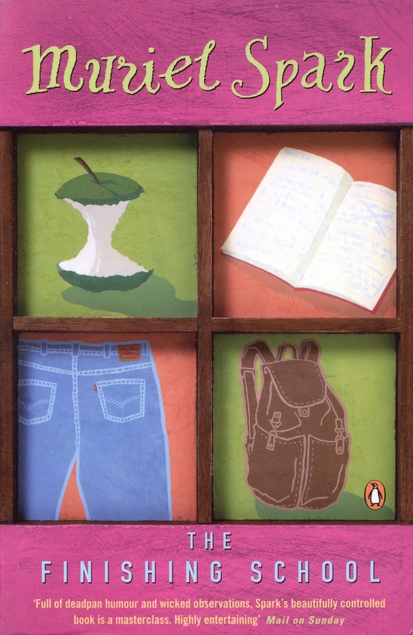
The Finishing School by Muriel Spark

Penguin, 2005, 158 p.

The Finishing School cover

On reading this I found my dissatisfaction with Spark’s writing beginning to crystallise. Clearly people find it engaging and worthwhile but to me there is something cold and detached about it, observational yes, but uninvolving. Her de haut en bas style renders her characters flat and merely going through whatever motions Spark intends for them. They don’t come alive. They certainly don’t leap off the page and into my mind.

This one all starts promisingly enough with a lecture on scene-setting in writing delivered by the joint owner of College Sunrise, the Finishing School of the title. He is Rowland Mahler who runs the place along with his wife Nina (who actually does most of the work.) One of the attendees, Chris, a seventeen year-old, is writing a novel where he speculates the death of Lord Darnley, second husband of Mary Queen of Scots, was instigated by a desire for revenge on the part of Jacopo, brother of David Rizzio in whose murder Darnley was deeply implicated. Rowland has aspirations to be a novelist himself but having read Chris’s first two chapters finds himself blocked and increasingly obsessed with Chris.

That first page is deceptive though and we are soon pitched into a narrative where too much is told, not shown; where information is dispensed to the reader in a way that is like reading author’s notes for characters rather than experiencing them behaving as themselves. They may have passions but we are not given the opportunity to feel them though Spark does find space to include a few sideswipes at the publishing industry.

There are some interesting ideas here but they are not fleshed out. In the end this is not so much a novel, more like a series of preliminary sketches for one. Or an extended outline.

Pedant’s corner:- wirey (the word is spelled ‘wiry’,) automatons (automata,) a missing comma before a quote (x2,) to-day (why the hyphen? It’s spelled ‘today’,) “on the grounds of imputed, activities unbefitting her one-time royal connections” (doesn’t need that comma after ‘imputed’,) “‘Is that it’s natural colour?’” (its.)

Scar Culture by Toni Davidson

Rebel Inc, 1999, 253 p Including 9 p Appendices. One of the 100 best Scottish Books.

Scar Culture cover

Had it not been for that 100 best Scottish books list I would never have sought this out. As it was I couldn’t say I enjoyed it exactly but it was interesting and well written. It has an odd structure though, broken up into five sections titled respectively Click, Fright, Sad, Preparation, The Experiment; and the viewpoint shifts between Click and Fright and Fright and Sad are a bit jarring – but probably intentionally so.

The first two are memoirs of two inmates in The Breathhouse, a psychiatric institution, where the inmates have all been given nicknames by the staff to illustrate their quirks (not only Click and Fright, but also Blade, Dogger, Treats and Synth.)

Click took photographs both in actuality (once he was given a camera by his parents) and in his head. He calls his parents Exit (because she did) and Panic (because he was prone to.) Fright’s section is a transcript of tapes made of him relating his memories as part of his therapy. He and his brother witnessed his mother’s death at the hands of his father and were later subjected to dark experiences in a caravan. The last three sections are written from the viewpoint of Dr Curtis Sad who is indulging in psychosexual research in the area of inter-family sexuality. Sad calls his other professionals psychohacks, and receives communications from Peterson, a like-minded psychosexual researcher in the US (but whose letters, rendered in the text in italics, use British English spellings.)

Sad is obsessed with his Sister Josie, about whom he has memories/fantasies of a distinctly unbrotherly hue. These demonstrate he is as loopy as any of the inmates. He refers to “memory recovery as a form of lethal weapon,” is setting up an exercise in milieu therapy in which he will reconstruct the environments in which Click and Fright suffered their traumas. He enlists Blade, Dogger, Treats and Synth to help construct these. Does this sound as if all will go well?

Three appendices provide us respectively with the Rules of Psychiatry which Curtis refers to in sequence at intervals in the main narrative, notes from his sister Julie’s (much needed in my opinion given Sad’s account of her childhood and adolescence) psychotherapy sessions, and an index of Click’s photos.

In Scar Culture Davidson has opened up the world of the psychologically disturbed (and perhaps that of the practitioners of psychiatric well-being.) It is certainly important to consider in fiction the plight of the mentally unwell – and of those whose upbringing has rendered them unstable – but it is by no means a comfortable experience to read of them.

Curiously, my edition has rough-cut page edges (though the tops and bottoms were smooth) as if it had been published in the nineteenth century.

Pedant’s corner:- “‘Its safe here’” (It’s,) “‘but I couldn’t been to look at him’” (couldn’t bear,) a missing end quotation mark (x2,) “was back here in that mountainside lagoon” (back there makes more sense,) out-with (it’s one word, outwith,) “tickled out feet” (our feet,) “he would researched” (he would be researched,) “an sheepish look” (a sheepish look,) “liked to fight too much, like to use her hands to scratch” (liked to use her hands,) “my parents lies’ left off” (my parents’ lies left off,) “that’s just kind of moronic psychobite” (just the kind of,) winge (whinge,) “in small coffin shaped cardboard box” (in a small,) “on the dolls back” (doll’s,) Breatthouse (elsewhere always Breathhouse,) a missing end quotation mark (x4, one in Appendix II,) snuck (sneaked,) “for the the first hour” (only one ‘the’ required,) “in regard, to why you are here” (no comma needed,) airplane (aeroplane.) “Every tree … had been stripped of their bark” (of its bark,) “nasal wines” (whines.)

Alasdair Gray

Sad, sad news.

Alasdair Gray has died.

If he had never done anything else in his life his first novel Lanark (arguably four novels) would have made him the most important Scottish writer of the twentieth century’s latter half, if not the whole century. (Perhaps only Lewis Grassic Gibbon rivals him in that respect.)

But of course he published 8 more novels, the last of which I read in 2009, 4 books of short stories – see this review of one of them – 3 of poetry (I reviewed a couple here and here,) many pieces for theatre, radio and television plus books of criticism (as here) and commentary (eg see here).

Yet that was not the least of it. There is also his work as an artist and illustrator to take into account. His drawing/painting style was unique and uniquely recognisable; much admired and sought after.

A polymath and curmudgeon, learned and contrary, Gray was one of a kind.

Even as his work lives on we will miss his acerbic presence.

And I still have his The Book of Prefaces to peruse.

Alasdair Gray: 28/12/1934 – 29/12/2019. So it goes.

Best of 2019

These are the books that stood out from my reading this year – in order of when I read them. 7 by men, 6 by women. 3 were SF or Fantasy.

The Map of Love by Ahdaf Soueif
Lord Byron’s Novel: The Evening Land by John Crowley
Hy Brasil by Margaret Elphinstone
Shiloh by Shelby Foote
A Strangeness in my Mind by Orhan Pamuk
The Lantern Bearers by Ronald Frame
Gone Are the Leaves by Anne Donovan
The Garden of Evening Mists by Tan Twan Eng
A Pass in the Grampians by Nan Shepherd
Half of a Yellow Sun by Chimamanda Ngozi Adichie
The Violent Century by Lavie Tidhar
Eleanor Oliphant is Completely Fine by Gail Honeyman
Exhalation by Ted Chiang

Reading Scotland 2019

This was my Scottish reading (including a Scottish setting) in 2019.

Those in bold were in that list of 100 best Scottish Books.

15 by women, 15 by men, one non-fiction,* two with fantastical elements.

The Driver’s Seat by Muriel Spark
A Concussed History of Scotland by Frank Kuppner
Romanno Bridge by Andrew Greig
Winter by Ali Smith
Lord Byron’s Novel: The Evening Land by John Crowley
The Shell Seekers by Rosamunde Pilcher
Tunes of Glory by James Kennaway
Hy Brasil by Margaret Elphinstone
Sartor Resartus by Thomas Carlyle
The Land the Ravens Found by Naomi Mitchison
The Ballad of Peckham Rye by Muriel Spark
Independence by Alasdair Gray*
The Lantern Bearers by Ronald Frame
Gone Are the Leaves by Anne Donovan
Children of the Dead End by Patrick MacGill
A Pass in the Grampians by Nan Shepherd
Brond by Frederic Lindsay
The Bullet Trick by Louise Welsh
The Siege of Trencher’s Farm by Gordon Williams
Its Colours They Are Fine by Alan Spence
Reality, Reality by Jackie Kay
Salem Chapel by Mrs Oliphant
Transcription by Kate Atkinson
Spring by Ali Smith
Eleanor Oliphant is Completely Fine by Gail Honeyman
The Stars in the Bright Sky by Alan Warner
Jelly Roll by Luke Sutherland
The Citadel by A J Cronin

Memoirs of a Spacewoman by Naomi Mitchison
Where the Bodies Are Buried by Christopher Brookmyre

Where the Bodies Are Buried by Chris Brookmyre

Abacus, 2012, 411 p.

 Where the Bodies Are Buried cover

Aspiring actress Jasmine Sharp is another of Brookmyre’s innocents brought into contact with violent criminals. Her failure to get any parts has led her Uncle Jim to hire her to help out in his Private Investigator practice. Not that she’s very good at that either, yet The trouble is he’s disappeared and she needs to find him and to earn money. Her attempts to interest the police in looking for him fall flat.

We start, though, with the murder of a smalltime Glasgow gangster, Jai McDiarmid but the connection between this and what turns out to be the main plot is somewhat tenuous. Detective Superintendent Catherine McLeod is put on his case, allowing Brookmyre to highlight the denizens of the Glasgow outwith-the-law fraternity. McLeod has the obligatory plagued personal life of the detective novel protagonist though her troubles are of a low-key variety.
A file on Uncle Jim’s desk reveals he was looking into a decades old disappearance of parents and a child on behalf of the left behind daughter. Jasmine’s efforts to follow this up lead her to hardman Tron Ingrams, once known as Glen Fallan, who has been thought dead for twenty years.

The lead characters are not as interesting as those in Brookmyre’s Jack Parlabane and Angelique de Xavia novels. Or, are they just more perfunctorily drawn? Moreover the prose rarely if ever rises above the functional. Where the Bodies Are Buried feels like crime writing by the numbers.

“He who controls the spice controls the universe” which Brookmyre characterises as an eighties movie reference does however show his affinity with Science Fiction.

Pedant’s corner:- “there are a select few semiologists” (strictly, there is a select few,) “… person to be sat in front of me” (seated, or, sitting,) Collins’ (Collins’s,) growed-up (surely even hard-boiled Glaswegians say ‘grown-up’,) Cairns’ (Cairns’s,) a missing comma before a piece of direct speech, Ingrams’ (Ingrams’s,) “coming off of” (I know it’s Glaswegian dialect but this was in ‘normal’ prose; coming off, no ‘of’,) middle-age spread (it’s usually middle-aged spread,) “oblivious of the tension” (it’s ‘oblivious to’.) Central station (it’s a proper noun, Central Station,) Motley Crue (I believe that band spells its name with erroneous umlauts, Mötley Crüe.)

Memoirs of a Spacewoman by Naomi Mitchison

Women’s Press, 1985, 149 p. © 1962, First published in the UK, 1976.

Memoirs of a Spacewoman cover

I read this when I first bought it many moons ago but couldn’t actually remember much about it other than it was a bit dry. Re-reading partially reinforces that impression. Much of it is told not shown and the overall effect tends towards the intellectual. That said, it is never less than interesting.

Our narrator Mary is a communications expert who has gained employment on the intergalactic expeditions sent from Earth to contact and understand the aliens on the target planets. Non-interference with the alien life-forms is the guiding principle of the expeditions. On her travels Mary encounters radiates, a bit like starfish, who therefore have no binary view of the universe, and creatures who form grafts on others’ surfaces as a means of reproduction. Mary accepts such a graft and finds herself mentally dissociating somewhat and mysteriously attracted to water. All creatures who agree to such a graft (dogs for example) tend to be unwilling to repeat the experience.

Reference is made to Mary’s relationships with the various fathers of her children but there is more or less no exploration of these and not much more of the hermaphrodite Martian, Vly who somehow manages to engender her haploid child, Viola. (Martians communicate via sex organs.) Keeping contact – or even contemporaneity – with partners is admittedly made difficult by the time blackout caused by space voyaging.

The bulk of the text, though, is devoted to the life-forms on a planet which bears pattern-making “caterpillars” whose patterns are painfully disrupted by “butterflies” they refer to as “masters”. Teasing out the relationships between these creatures takes Mary and her companions a while. Some tension is caused by this as one of the expedition members becomes too close to the “caterpillars”.

In its depiction of a society in which women are on an equal footing with men as scientists and explorers – and in more general senses – as well as in its exploration of the details of alien reproduction Memoirs of a Spacewoman was something of a trail-blazer. That makes it an important (I hesitate to say seminal) pioneering work of SF.

Pedant’s corner:- Extra points for hyaena (now defunct, as hyena has become the accepted spelling.) Otherwise; “I liked in that he had tried” (‘I liked it that he had tried’ makes more sense,) “assemblement of data” (assemblement? Assembly, or assemblage, of data, surely?) “Peder was much interested” (‘very interested’ is the more natural expression,) a missing comma before a piece of direct speech, aureolus (that means golden. I suspect aureola was intended,) in, “We might unwittingly destroy some life which was not induced to move out by any of these stimuli, and of course we destroyed vegetation,” life is contrasted with vegetation (but vegetation is, of course, alive,) Silis’ (Silis’s,) furtheir (further,) Miss Hayes’ (Hayes’s.) Miss Hayes sent off on long expeditions” (Miss Hayes set off on…,) the text describes alien creatures in Earthly terms as eg ‘reptiles,’ ‘caterpillars,’ ‘butterflies’ (I know this usage is for purposes of familiarity for the reader but animals on other worlds would/will not come under the same biological classifications as on Earth,) “as regard” (usually as regards,) follicules (follicles.)

Jelly Roll by Luke Sutherland

Anchor, 1998, 411 p. One of the 100 best Scottish Books.

 Jelly Roll cover

When a book’s epigraph is the passage from Marlowe’s Doctor Faustus which ends in, “Why this is hell, nor am I out of it,” as uttered by Mephistopheles, you know its contents will not be an unalloyed bundle of laughs. Jelly Roll has its lighter moments but the subject matter is indeed serious.

The novel starts when Glasgow jazz band The Sunny Sunday Sextet’s saxophonist, Malc, who is a bit of a psychopath, decides, for domestic reasons, to stop playing with them. The ensuing discussions among the band’s members – in uncompromising Glasgow dialect – relate to whether to give up altogether or find a replacement, and even if doing the latter would be a wise move given Malc’s likely reaction. The prospect of a tour of the Highlands and Islands has the potential to sway things. The group’s drummer Paddy introduces narrator Roddy Burns (whose tipple is the unlikely Bailey’s) to his sister’s boyfriend Liam; who plays like a dream. He seems the perfect answer, young, gifted and ……. black. Embarrassments ensue when he comes along to the next band practice as Roddy has somehow neglected to mention that last fact to the other members. He thinks they are being racist and they think he is, precisely because he didn’t mention it. Liam’s response is to ignore any tension. It turns out this is his strategy to cope with the harassments he habitually has to endure because of his skin colour.

The novel then jumps forward in time to describe incidents occurring during the tour, taking in a roll-call of Scottish towns – Blairgowrie, Dunkeld, Crieff, Fort William, Inverness, Portree, Ullapool – which are usually described by an italicised gazetteer entry. (Ullapool’s is a touch harsh. It merely says herring 1788.) It is obvious we have missed something in the interim. A later return to events which occurred after Malc rejoined the band, with Liam as a supposed backing saxophonist, fills in the gaps. Malc is an unreconstructed racist, as his dubbing of Liam as ‘Banana’ emphasises. His tendency to violence and to pick fights is displayed in several scenes, including the plot’s fulcrum. Not that Malc is alone in his racism or indeed his violence. The band’s reception at one of the venues develops into a rammy due to elements of the audience taking exception to Liam’s appearance.

I assume the book gains its title from Roddy’s penchant for “jellies” (diazepam.) When I first read the blurb on the back I declined to buy it thinking it would not be for me but given my wish to complete that “100 Best Scottish Books” list (at least all the fiction on it) I subsequently could not ignore a charity shop copy at a very reasonable price. I was pleasantly surprised – depictions of violence notwithstanding: there is a lot more going on in Jelly Roll than I have commented on. Its appearance on the list may be due to its highlighting of racism (in his youth Sutherland was the only Scots-African in Orkney) but it is certainly better written than some others which are on it.

Pedant’s corner:- the speaker grill (grille,) sunk (x3, sank,) sprung (sprang,) peninsular (peninsula,) “another thing comin” (another think,) whinging (to me ‘whingeing’ is the better spelling,) duffelcoat (duffel coat,) “to fall back onto” (fall back on to,) span (spun,) the watersedge (the water’s edge,) lungeing (conversely, lunging,) “seemlessly into the cultural fabric” (seamlessly,) twinging (twingeing,) Hawkins’ (Hawkins’s,) doppleganger (doppelganger,) “‘Ah’m ah fuck?’” (‘Am ah fuck.’) “fob us of” (off,) windowledge (window ledge,) Dunkin Doughnuts (I believe the company spells it Donuts,) “a hand held short” (hand held shot,) snuck (sneaked.)

free hit counter script