Archives » Scotland

Scotland 2-1 Denmark

Hampden Park 10/8/11

I know this is a bit late but I only saw the highlights of this game. It looked like we were hammered 1-2. Denmark made much the more and better chances but Scotland scored two and they didn’t.

The first came from a free kick where the Scot, were he a Dane, might have been described as going down too easily.

Allan McGregor flapped at the equaliser. It was like watching Stephen Grindlay.

Scotland’s second was a finely worked effort, though.

A win’s a win. I’d have taken it in any Dumbarton game.

Whether there will be a similar result against the Czech Rep in the upcoming qualifying game is another matter.

Inverting The Pyramid by Jonathan Wilson

The History of Football Tactics, Orion, 2008, 356p.
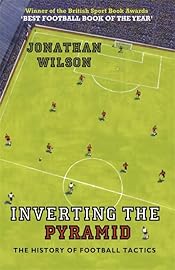
This book does exactly what it sets out to, describing the evolution of football tactics from their formless beginnings when everybody on the pitch, apart from the goalkeeper, dribbled towards the opponents’€™ goal with team mates ‘€œbacking up’€ in case the ball was lost, through the invention of passing (or, as it was delightfully phrased, combination play; I like that, let’€™s bring it back) in Scotland, the first real formation of 2-3-5 – one of whose pioneers was my beloved Dumbarton – mentioned on page 23 but not, alas, in the index – in winning their sole Scottish Cup in 1800 and long time ago, 1883 to be precise: its gradual stalemating till the offside law was changed in the 1920s to allow only two defenders between ball and goal line which in turn led to the withdrawal of the centre half into the back line of a 3-2-5 and the ‘€œclassic’€ three defender, two half back, two inside forward, plus centre forward line-up of the W-M or W-W. The later adaptations of this formation (in some cases, as in Great Britain, very much later) via the diagonal, through the deep lying centre forward, 4-2-4, 4-4-2, 4-3-3 and 3-5-2, by which time the pyramid of the book’€™s title had been inverted, leading on to 4-5-1, even 4-6-0, plus the variations of all of these and the pressing game, are given their place and their innovators due recognition.

In particular the histories of football in various countries, Brazil, Argentina, Italy, Austria, Hungary, the USSR, the Netherlands, England, even a foray into the Scandinavian experience, and the life histories of the various coaches concerned, are admirably laid out as is the tension between attack and defence, creativity and negativity, craft and effort. Through it all the importance of system is a given. A well-organised and drilled side will always beat a disorganised one, or one following too rigid a previous template, provided the system is understood and adhered to.

The tendency for any innovations to be imitated at first mainly in a defensive sense is noted and in passing the notions of Charles Reep and Charles Hughes of direct football being particularly effective is knocked on the head, even on statistical grounds. In some cases it can be, as can any system, but against good players who can keep possession directness will fall down.

Whether football’s evolution has ended is a moot point but in the modern world with global TV coverage and worldwide scouting it is unlikely any team will be able to spring a truly revolutionary tactical surprise. But then again before that offside law alteration there had been little or no tactical change for around thirty years. In Britain, the W-M then held sway for another forty or so.

But the centre half disappeared as a half back, wingers disappeared, full backs became wing backs, wing halves and inside forwards turned into central defenders or midfielders, who evolved into holding players or playmakers; and the playmaker has all but disappeared. The centre forward may go the same way. (I would say that, arguably, with Barcelona, he already has. Messi is not a centre forward, Villa and Pedro tend not to play up the middle.)

In modern football flexibility within a system is a key ingredient, and fluidity. Modern players at the top level are no longer specialists in the way they were. Everyone is an attacker and defender at the same time. (However some will always remain more gifted and more general than others. At the level I watch football the demarcation of roles is still pronounced. I doubt that will change soon.) Football is actually a game played with space – or denying it – and not really with the ball. But, as Barcelona demonstrate, possession, keeping it and regaining it, certainly helps.

The book has occasional infelicities of the sprung for sprang type and a few typos but for all those interested in football and how it came to be the way it is this is a wonderful, informative and illuminating read. I thank my younger son for lending it to me.

Michael Gove, Law Breaker

I thought the Tories were supposed to be the party of law and order.

Yet I well remember Tim Yeo once speaking up for those who, due to the use of speed cameras, had been caught breaking the law. Yeo talked as if the law were something to be neglected or set aside, as if people who broke the speed limit were not law breakers, which quite clearly they are.

At least at the time Yeo was merely a Member of Parliament (if a spokesman for the opposition.)

But Michael Gove…..

Michael Gove is the UK Secretary of State for Education.

Yet on Sunday he incited parents to take part in a mass act of law breaking by volunteering to keep schools open during the proposed strike tomorrow by teachers. (This does not affect Scotland – and Northern Ireland I expect. I’m not sure about Wales but I think education is a devolved power there too.)

Quite apart from the fact that Gove thereby declares that teaching is easy and anyone can do it without training and so demeans those who are effectively his employees (he should perhaps try it sometime) teachers are not only trained but thoroughly vetted before being allowed near children. The procedure is known, in Scotland at least, as disclosure and is specifically designed to protect children from potential danger or harm. (As some recent cases have shown it does not always work, but it is a sensible precaution.)

Gove has in effect incited parents, and any Head Teachers who permit this to take place, to break the law, since, if an undisclosed person is placed or places her- or himself in front of the children an offence has been committed.

As Secretary of State Gove ought to be aware of this law. If he was, then he has deliberately encouraged an act of law breaking – become an accessory before the fact. If he was not so aware then the law does not hold ignorance as an excuse and he is still guilty.

But then what else can you expect of a man who has conned thousands of pounds of various monies out of the taxpayer via MPs’ expenses but has got away with it – like many of his cabinet colleagues, including Mr Irresponsible himself – because, being a millionaire, he could afford to repay it? (Or some of it.)

Rep. Ireland 1-0 Scotland

Carling Nations Cup, Aviva Stadium, Dublin, 29/5/11

It was almost inevitable the Republic would win this. They were at home after all.

Again I’ve missed the goal, but I’ve heard this game was dire – not even a patch on the English League 1 play-off between Peterborough and Huddersfield. People just lumping the ball forward; no passing, no Barcelona style passing anyway.

In that case neither of these two sides will trouble the 2012 European Championships.

Wales 1-3 Scotland

Carling Nations Cup, Aviva Stadium, Dublin, 25/5/11.

You could be forgiven for not knowing this match had taken place. I didn’t even see the goals on the news – mainly because I missed the news last evening. The good lady and I went out for a meal last night; at the Annapurna, a very nice Nepalese restaurant. But I digress.

By all accounts the crowd was woeful; not surprisng for a game between Wales and Scotland held in Dublin when the Irish Republic is in the middle of a hellish economic time the night after the Republic themselves had had a game.

It sets up Sunday’s (it is Sunday, isn’t it?) game nicely but the Wales – Northern Ireland game tonight won’t be much of an attraction I’d have thought.

Interesting Times

I’ve been puzzling over the quite stunning result of the Scottish Parliamentary Election yesterday. How to explain the sudden deluge of votes for the SNP? An overall majority which the structure of the parliament was expressly designed to forestall?

Partly of course it’s the uninspiring nature of Labour’s Scotish leader, Iain Gray, a man with little charisma or presence. Also the lack of big Labour names on the ballot papers – though this did not prevent them taking the usual swathe of seats at the last such election four years ago. There may too this time have been a feeling that Labour took its vote for granted. The minority SNP administration also made a reasonable fist of its past four years in power, with not too many cock-ups.

The major difference, though, might, for the first Election since the Scottish Parliament was set up, be the fact of a Conservative led government at Westminster (which Scots by and large voted against – as did most of the rest of the UK, to be fair.) The Labour vote in Scotland at the UK General Election last year, as in all General Elections since the 1970s, was about attempting to protect Scotland from the effect of Tory depredations. In this it signally failed – as did the “safe” option of voting Lib-Dem – whose MSPs (and English local councillors) paid the first price for the deal with the devil their UK Parliamentary Party made on going into coalition with those loathed Tories.

At least until the next UK General Election (due in 2015) Labour will be unable to fulfill that protecting role as their UK Parliamentary presence is an irrelevance; and so too could their Scottish hegemony be ignored.

An SNP majority in the Scottish Parliament, an unfettered SNP administration, is a statement of another kind. The calculation may have been that the SNP will fight for Scotland more, or better, than Labour – or that it will be able to secure more concessions from the Westminster coalition than Labour could ever hope to achieve.

Whatever else the vote was, it wasn’t a vote for independence. Most Scots do not wish to be separated from their neighbours and friends – in many cases families – and are happy to remain part of the UK so long as said friends and neighbours don’t shaft us too much.

There is a warning there for the Westminster coalition – but also for the new Scottish Government.

Rocket Science?

There are two interesting posts over at Ian Sales’s blog.

The first is an attempt to (re)define “hard” SF. As far as he sees it – and I largely agree – this is SF that is bound, more or less, by known physical laws, by the restraints inherent in, for example, Physics and Chemistry.

In this regard any use of the trope of, for example, faster than light travel is – despite decades of convention and use in what might otherwise be considered hard SF stories – not hard SF in the strictest sense, as, to our best knowledge, the speed of light is an insurmountable barrier.

This is not to decry other types of SF (which are perfectly legitimate) merely to say that they go beyond the bounds of the known and, in the case of Space Opera in particular, which cleaves the paper light years with carefree abandon, actually tend towards wish-fulfillment. Though of course there is the necessity of getting characters from here to there in a reasonably efficient, non-boring manner.

It is amusing to recall here what is perhaps the most famous phrase in Science Fiction – certainly in its dramatic form, “Ye cannae change the laws of Physics, Captain.” This from a TV programme which made a habit, nay a virtue, of portraying just that.

Ian makes a distinction between hard sciences (Cosmology, Physics, Chemistry) and softer ones such as Psychology, Archaeology and Anthropology. While agreeing that the term is most often interpreted this way I wouldn’t myself say that stories featuring these could not be hard SF.

The second of his posts is an announcment that he will be editing an anthology of… hard SF; to be called Rocket Science.

No need to rush. Submissions will not be accepted till 1st August.

Rocket Science is itself a term that has often irritated me as it is most often heard in the phrase, “It’s not rocket science, is it?” as if rocket science was at the cutting edge, inherently incomprehensible. As Ian points out in his post, the science of rocketry – as opposed perhaps to some of its technological aspects – has, due to its basis in chemical reactions whose energetic outcomes are limited and, moreover, fixed – not evolved much in a century.

I know it’s use is as much metaphorical as anything else but I’ve always felt tempted to respond to anyone who trots out the, “It’s not rocket science,” line, that rocket science isn’t rocket science.

Rocket Science, however, may be.

Brazil 2-0 Scotland

Emirates Stadium, 27/3/11

This was 2-0 going on a doing. Brazil were, as expected, superior in every department.

What was especially noticeable was that every time they lost the ball they swarmed round the Scotland players and as a result got it back very quickly. Their speed of thought and movement were a cut above. Plus their virtuosity was sublime. Only the odd misplaced pass and then working like beavers to get the ball back.

Scotland’s players looked pedestrian.

We’re kidding ourselves if we think we can ever get near them.

Scotland 3-0 Northern Ireland

Carling Nations Cup, Aviva Stadium, Dublin, 9/2/11.

A comprehensive win it seems, most unlike recent Scotland performances.

There were no extended highlights on television, however, just the goals* on the news, so I’ve no idea whether we were any good or not.

*Fluky second goal perchance.

The Norn Irish were missing a few players.

Mustn’t sniff at a 3-0 win though.

Scotland’s Art Deco Heritage 19 (i). St Andrew’s House: 1.

This ought really to have been one of the first of these posts but I didn’t get round to photographing the building till last Sunday. It belongs in Scotland’s Art Deco Heritage rather than merely Edinburgh’s because it is such a significant building (both architecturally and governmentally) housing as it does a fairly large proportion of the Scottish Civil Service.

Below is a view of the rear looking from North Bridge.

I took the photo from just beside the War Memorial which I featured yesterday. You can just see part of the roofs of Waverley railway station in the foreground. The tower at the top of the picture is actually on Calton Hill, the round structure to the left is in the cemetery adjacent to St Andrew’s House.

Here is the building in all its monolithic Stalinist glory.

From right:-

From left:-

The central frontage is a bit overbearing:-

</

Each of the pillars is surmounted by a statue:-

If you click on the above to enlarge it you can probably see the words carved into the stone just above the pillars. They depict six of the functions of the Scottish Office; architecture, statecraft, health, agriculture, fisheries, education.

free hit counter script