Archives » RAF

External Exhibits, Montrose Air Station

Before you get to the museum entrance at Montrose Air Station Heritage Centre you pass these hangars which date from before the Great War:-

WW1 Air Hangars

Then there’s the obligatory Spitfire. This one’s named Red Lichtie. There is an Arbroath connection, though this one is probably a replica of the original:-

Spitfire Red Lichtie

More up to date (well, 1950s) is this Gloster Meteor:-

Gloster Meteor

This artillery piece, an anti-aircraft gun, is also exposed to the elements:-

WW2 Artillery Piece, Montrose Air Station

Prominent too is this memorial to all those RFC and RAF personnel who served at Montrose Air Station:-

RFC and RAF Memorial

Geddington War Memorial

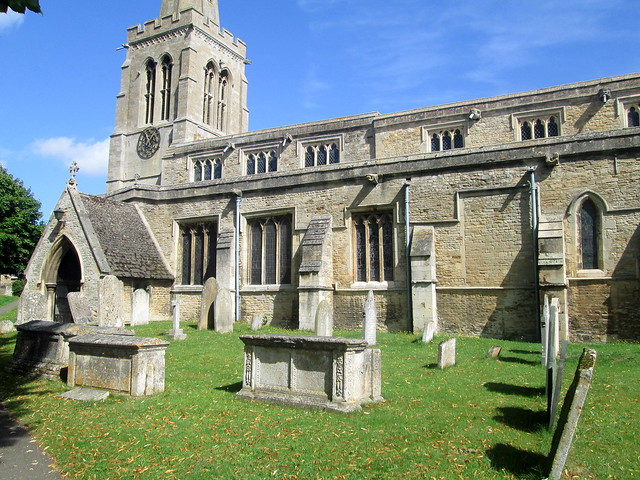
The War Memorial of Geddington, Norhamptonshire, lies in the grounds of the Church of St Mary Magdalene which stands near to the Eleanor Cross.

Church in Geddington

The Memorial is a simple cross on a tapered stone pedestal standing on a plinth.

Geddington War Memorial

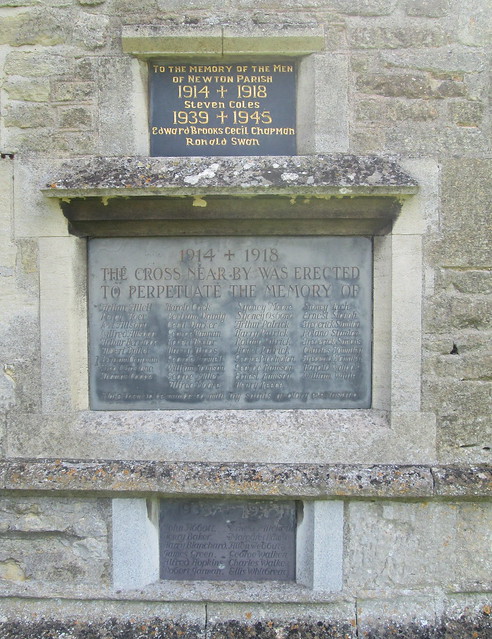
Unusually the names of the war dead are not engraved on the Memorial but rather are set into the wall of the church. 1914-1918 names in middle plaque, 1939-1945 on lower. The upper panel contains names for both wars of men from Newton Parish.

Geddington War Memorial Plaque

There are also two Commonwealth War Graves in the churchyard.

Driver Charles Townley, Royal Field Artillery, 9/11/1918. Aged 24.

First World War Grave, Geddington

Aircraftman J W Green, RAF, 15/9/1940. Age 32.

Second World War Grave, Geddington

Sweet Caress by William Boyd

The Many Lives of Amory Clay. Bloomsbury, 2015, 451 p. Borrowed from a threatened library.

 Sweet Caress cover

While the subtitle might suggest a novel along the lines of The First Fifteen Lives of Harry August or Life After Life this is a much more conventional tale of a life recollected from old age, if not quite tranquillity. Pioneer woman photographer Amory Clay’s first person narrative more or less follows a chronological order but there are the occasional interpolated scenes telling of her present day existence on the island of Barrandale (with its “bridge over the Atlantic” to the mainland) at the supposed time of writing in 1977. What renders the book unusual is the inclusion of reproductions of photographs illustrating Amory’s life (most of which are attributed to Amory.)

Sweet Caress is another of those books describing the life of someone through the Twentieth Century and in which they keep encountering significant events. It is of the essence then that war impacts on Amory. Her father was disturbed so much by his experiences in WW1 that he tries to commit suicide by driving himself – and Amory – into a lake, the man she marries has a dreadful memory of a post-Rhine crossing incident in WW2 with which he cannot come to terms, a later lover disappears presumed killed while she and he are in Vietnam. However, Amory’s contact with the great and the good is minimal – one glimpse each of the Prince of Wales (as Edward VIII was at the time) and Marlene Dietrich – more reflective of a normal life.

I note that the choice of name for his protagonist does allow Boyd to essay the pun “roman à Clay” about a book one of her lovers subsequently writes about their relationship. Similar games are played with subsidiary characters in the novel whose names nod to women who were relatively successful in their fields in the times he is writing about.

All her experiences lead Amory to feel, “not to be born is the best for man – only that way can you avoid all of life’s complications.” Later, “Any life of any reasonable length throws up all manner of complications ….. but it’s the complications that have engaged me and made me feel alive.” Through Amory, Boyd makes much of the ability of a photograph to stop time for a moment. She is also of the opinion that black and white photographs are art and colour photography somehow less true.

It’s all beautifully done – and the final chapter does supply a reason why Amory is writing her story – but Sweet Caress nevertheless kept bringing to mind the same author’s The New Confessions and (though less so) Any Human Heart, though in this regard the woman protagonist did make a difference.

Pedant’s corner:- Amory uses the word robot in 1924. Boyd just scrapes by here; but only by a couple of years at most. The location of Barrandale is unambiguously close to Oban – part of the estate of her now deceased husband. The house where they spent their married life is, though, supposed to be near enough Mallaig that school there might have been an option for their twin daughters had he not been an aristocrat yet their groceries were delivered from Oban. Fort William makes much more sense for proximity to Mallaig than Oban, which is hours away by road even now.
Otherwise we had:- vol-au-vents (surely the plural is vols-aux-vents?) Achilles’ (Achilles’s, not that it makes any difference to the pronunciation,) gin and tonics (gins and tonic – which does appear later!) take it on board (in the 1930s?) the Royal Air Force (during the war in conversation people said the RAF – they still do,) a missing “?” at the end of a question, the Palais’ (the Palais’s, again this appears later,) the church of St Modans a few pages later becomes St Monad’s and may have been an unlikely location for a divorcé to be remarried in those times,) the girls had “just done their A levels” (in 1965 Scotland? Highers, I think – unless private schools put their pupils in for English exams,) dark matter and dark energy are mentioned in 1977 (the first had been by that time, but dark energy was not named as such till 1998.)

A God in Ruins by Kate Atkinson

Doubleday, 2015, 398 p. Borrowed from a threatened library.
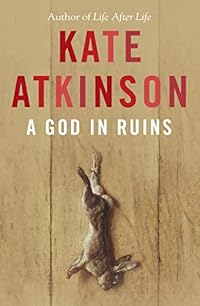
 A God in Ruins cover

It’s almost impossible for me to discuss this book without the possibility of spoilers. For nigh on 400 pages Atkinson relates the life and times of Teddy Todd, RAF bomber pilot and brother of the Ursula whose many lives were told in Atkinson’s previous novel Life After Life, yet within a few pages of the end the author pulls the rug from under her preceding story in spectacular fashion. Yes, familiarity with the previous book bolsters the logic of what she does but that conceit was firmly established before the novel was fully under way. Here there is foreshadowing in Teddy’s nightmares about the war (“in nightmares we wake ourselves before the awful end, before the fall,”) the epitaph from Keats that Teddy reflects on, “Here lies one whose name was writ in water,” and his thoughts in the care home where he is living out his days, “That’s what he’d always done, of course, what everyone did, if you were lucky,” but really this skirts close to the sort of thing that teachers warn against very early in anybody’s attempts at story-telling as being essentially unfair on the reader. Of course, alternative endings such as Atkinson gives us are not new to fiction (and Life After Life in a sense was a whole book of them) but they usually carry on from the events leading to them and do not vitiate what has gone before quite as completely as the one here.

That her tale survives this is, then, something of a wonder, the engagement she engenders not wholly undermined. I know all fiction is a combination of smoke and mirrors, but it isn’t usually so explicitly acknowledged within a text. It helps that A God in Ruins (in retrospect a very apt title) appears formidably researched. The wartime scenes are stunningly effective. The book stands as a eulogy to the 55,573 dead of Bomber Command, a lament for their never to be born children and grandchildren, a threnody to all of its aircrews – including the survivors “part of him never adjusted to having a future”.

I had early reservations, too, about some of the techniques employed in the narrative. The timeline jumps about – not only from chapter to chapter but within a section, sometimes within a paragraph. Some events are referred to or described more than once (and not always from a different viewpoint) and I thought I’ve been told this already. In the context of the novel’s last few pages though these became more explicable.

Despite the chapters on Teddy’s later life and those focusing on his children it is the war that increasingly comes to dominate the narrative. “‘Sacrifice,’ Sylvie said, ‘is a word that makes people feel noble about slaughter.’” Teddy comes to the conclusion, “By the end of the war there was nothing about men and women that surprised him. Nothing about anything really. The whole edifice of civilisation turned out to be constructed from an unstable mix of quicksand and imagination.” Elsewhere, “Britain in the gloomy aftermath of war felt more like a defeated country than a victorious one.”

A hint to the mindset of an author of fiction is perhaps pointed to in the passages, “A whole life could be contained in a dinner service pattern. (A good phrase. She tucked it away,)” and, “People always took war novels seriously.”

In what I believe I recall as an exchange which also occurred in Life After Life (deliberately ironical given that book’s premise) we have, “Nancy sighed. ‘Sometimes I wonder,’ she said, ‘about reincarnation.’ ‘No,’ Ursula said, ‘I believe we have just one life, and I believe that Teddy lived his perfectly.’”

A God in Ruins may not be lived perfectly but is, overall, an impressive achievement; better than Life After Life. One that, principally due to the war scenes (see: I did take them seriously – though of course WW2 is a period in which I have long had an interest,) will live with me for a long while.

Pedant’s corner:- medieval (is mediæval – or even mediaeval – now a lost cause?)

Drone Killings

The Prime Minister, David Cameron – known to this blog as Mr Irresponsible – has stated that the recent killing by RAF drone strike of two UK citizens in Syria is lawful as it was an act of self-defence and there was no alternative.

So. Let me get this clear. It is illegal for agents of the UK government to execute people convicted in the UK courts for murder, treason (or even arson in Her Majesty’s Dockyards) since the death penalty for such crimes has been abolished; but it is legal to do so to someone outside the UK’s legal jurisdiction, someone who has not been so convicted, or even put on trial?

How is that exactly?

(And what is to stop the government declaring anyone so guilty and despatching a drone to get rid of them?)

I thought we (the so-called civilised law-abiding nations) were supposed to be better than them (the likes of ISIS, ISIL or, the description I believe they themselves abhor, Daesh.)

We have been here before, of course. The major difference is that Gibraltar is British sovereign territory and Syria is not.

Mind you. Abolition of the death penalty in the UK has been a dead duck since the Iranian Embassy siege.

Can Someone Not Rid Us Of This Clown?

I see our PM, the inestimable Mr Irresponsible wants to use our already overstretched military forces to become embroiled in the situation in Libya. (There is by the way a fantastic typo in the headline of that link.)

Has he learned nothing from our involvement in Iraq and Afghanistan? And he’s just downscaled the RAF’s training programme, the very service whose input will be most required in the most likely operations in Libya.

Any use of UK military force in Libya is liable to backfire as it did in those other countries. Can DC guarantee no innocent casualties from such a development? Even deaths or injuries to those loyal to Gaddafi, those in the firing line in other words, could be a provocation too far.

If Gadaffi subsequently goes their families will resent the fact they were killed/injured by foreigners. If he stays his regime is not going to be enamoured of us. Either way our national interest is weakened.

While I personally would like to see him gone Gadaffi’s destiny ought to lie in the hands of Libyans.

DC’s survival is unfortunately not in the hands of us Britons. We won’t get the chance to chuck him out for another four years (think about it) by which time the damage he and his smirking side-kick George Osborne – have you ever seen such a smug, irritating so-and-so, he outranks even Kenneth Baker in that regard – will have done to the fabric of British life will be unrepairable.

Where are the Lib Dems when you need them?

Forgotten they’re supposed to be jointly in charge, it would seem.

free hit counter script