Archives » Other fiction

The Longings of Women by Marge Piercy

Penguin, 1995, 541 p.

I bought this because Piercy normally writes SF (or what can be interpreted as SF) but this is a contemporary mainstream novel – for 1998 values of contemporary.

This is the intertwined tale of three women living in Boston, Massachusetts; Leila Landsman, Mary Burke and Becky Burgess. Leila is a professional woman, a college teacher whose theatre director husband has an ongoing philandering streak, serially having affairs with his – always younger – leading ladies.  Mary is Leila’s cleaner but had lived a reasonably comfortable existence until her marriage broke down: she is now homeless but conceals this from her cleaning agency employers and the clients whose houses she cleans. Becky is a working-class woman who has pulled herself up from her origins by getting an education, for which her family made sacrifices, a desk job at a media company and a marriage to Terry, a man of rather better off means but who is lazy as a result and suffers from an unjustified sense of entitlement.

Leila’s and Becky’s lives intersect when Leila is asked to write a book about the court case in which Becky is accused of murdering her husband with the assistance of her teenage lover, Sam Solomon. Becky’s treatment by the press has been unrelentingly critical.

Leila’s and Mary’s stories are unfolded in the present of the novel (with flashbacks memories of their origin stories,) Becky’s is given to us in chronological order as it occurred. This has the effect of presenting us with different pictures of Becky from the two time streams. At first Mary’s story also seems to be divorced from that of Leila but does give us an alternative perspective on her life.

Mary’s is a salutary tale, about how easy it is to fall from security, how necessary it is not to appear homeless – especially when you are. She sleeps where she can – airport lounges, empty buildings – but preferably in her client’s houses when they are away from home and is eternally grateful to the (black) woman who showed her the ropes of homelessness, the ways to avoid danger, when she first arrived on the streets.

There is a degree of character development to Leila as her marriage disintegrates slowly then precipitously. Mary, perhaps hardened by the streets, undergoes less change. Becky’s descent into murderousness is not quite so convincing, though.

This is a decent enough novel which doesn’t reach the heights of Piercy’s earlier books Body of Glass and Woman on the Edge of Time.

Pedant’s corner:- thier (their,) “less alternatives (fewer alternatives,) “Mrs Coreogio” (elsewhere always ‘Coreggio’,) “they dozed of to” (dozed off to,) blond (blonde.) “‘I’m wondering if Sam will remind me of him in person is much as he does when’” (in person as much as he does when,) “cole slaw” (coleslaw,) rendez-vous (this was in the middle of a line, no need for a hyphen; rendezvous,) “Sorts Illustrated” (Sports Illustrated?) “had interviewed murderers and battered woman” (battered women.) “‘I’ll never seen you again’” (never see you again,) “happy to be notied” (noticed.) “They’d hadn’t an ambition among them” (either ‘They’d hadn’t had an ambition’ or ‘They’d hadn’t an ambition’,) “none of the three families were communicating” (none of the three families was communicating,) “in her own behalf” (on her own behalf,) ambiance (ambience.)

The Bastard of Istanbul by Elif Shafak 

Penguin Essentials, 2019, 365 p. First published 2007.
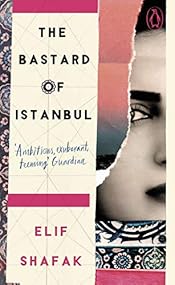
Addressing as it does the Armenian genocide of 1916 (though only in a historical sense,) this was the book that saw the author put on trial for “denigrating Turkishness,” but the charges were eventually dropped.

The novel’s main focus is on the Kazancı family, one with an unfortunate history of its male members dying at a young age. There is a hint of magical realism here, the more sweeping kind of narrative more or less alien to the Anglophone tradition, in any case a nod to the supernatural elements which often appear in fiction from other literary backgrounds. The Kazancıs have a cat named Sultan. (They’re now on Sultan the Fifth. This naming system though, did remind me of Mad Jack’s burro in The Life and Times of Grizzly Adams.)

The chapter titles all relate to foodstuffs – or at least substances which can be ingested; cinnamon, pine nuts, orange peels, etc, though one is water and the last potassium cyanide. For the Kazancıs are a family for which food occupies a central nurturing role. Many Turkish dishes are named or described during the course of the novel.

In the first chapter the then nineteen-year-old Zeliha Kazancı strides the streets of Istanbul wearing her trademark short skirt – which she will not relinquish even in later years. Under harassment she recites to herself “The Golden Rule of Prudence for an Istanbulite woman: When harassed on the street never respond” as that only fires up the enthusiasm of the harasser. (There are also Silver and Copper Rules of Prudence.)

Zeliha is on her way to a clinic to seek an abortion but, perhaps due to hallucinations brought on by anæsthetic or else a subliminal wish to carry the child – though the latter seems unlikely – becomes over-agitated and makes it impossible for the procedure to continue. The bastard of the title (though there is one other metaphorical candidate) could thus be Zeliha’s daughter, Asya, who is brought up among her aunts Banu, Feride and Cevriye, their mother, Grandmother Gülsüm, and the matriarch Petite-Ma. Acknowledging the unusual circumstances of Asya’s origins (in her late teens of the novel’s main timeline her father’s identity has still not been disclosed,) Zeliha is also known as aunty. The only son of the family, Mustafa, long ago left Istanbul for the US and has never returned. The aunts’ father had of course when still young succumbed to the curse on the family males. Even so, by the age of sixteen Asya had discovered that “other families weren’t like hers and some families could be normal,” a twist to that quote from Tolstoy. [https://www.goodreads.com/quotes/7142-all-happy-families-are-alike-each-unhappy-family-is-unhappy]

Asya is fixated on Johnny Cash and spends time in Café Kundera, associating with characters identified only by their attributes, the Non-Nationalist Scenarist of Ultranational Movies, the Closeted-Gay Communist, the Exceptionally Untalented Poet and the Dipsomaniac Cartoonist, who says the real civilization gap is not between East and West but between Turks and the Turks. “‘We are a bunch of cultured urbanites surrounded by hillbillies and bumpkins on all sides. They have conquered the whole city.’” The Exceptionally Untalented Poet says, “‘We are stuck between East and West …. the past and the future … the secular modernists … and the conventional traditionalists.’” In its own way this is a signal that the book could be read as a ‘condition of Turkey’ novel.* When one of them brings along a new girlfriend we are told of Asya that “When she met a new female she could do one of two things: either wait to see when she would start hating her or take the shortcut and hate her right away.”

Mustafa, in the US, has taken up with Rose, who was divorced from Barsam Tchakhmakhchian, a first generation Armenian American. Barsam and Rose’s daughter Armanoush (Amy,) is the second pivot of the plot, brought up as she was with her father’s family’s constant reinforcement of Armenian memories and attitudes vis-à-vis the Turks. Shafak has some fun depicting Amy’s date with a man she soon finds unsuitable, where they both contemplate plates of food whose arrangements are based on expressionist paintings. To resolve the conflict she feels between her US and Armenian heritages Amy decides to travel to Istanbul to visit her stepfather’s family, where her revelations about the treatment of her ancestors creates at first bewilderment.

“She, as an Armenian, embodied the spirits of her people generations and generations earlier, whereas the average Turk had no such continuity with his or her ancestors. The Armenians and the Turks lived in different time frames.” For Armenians “time was a cycle, the past incarnated in the present and the present birthed the future. For the Turks, time was a multihyphenated line, where the past ended at some definite point and the present started anew from scratch, and there was nothing but rupture in between.” Even Aunt Cerviye, as a history teacher, was unaware of the details or extent of the Armenians’ tribulations. For the aunts, the history of Turkey only began in 1923, with Atatürk’s reforms. (Such historical forgettings, or forgettings of history, are by no means confined to Turkey, though.)

In another expression of literary apartness, that rebuff to Western fiction’s conventional realism, Aunty Banu has – or claims to have – control of two invisible djinn, one on each shoulder; the good one, whom she calls Mrs Sweet, on the right, the bad one, Mr Bitter, on the left. It is from Mr Bitter she learns the truth about the Armenians’ sufferings. And about Asya’s father, news which she keeps to herself, though his identity is revealed later.

Shafak has her characters make more general observations too. Asya tells Amy, “When women survive an awful marriage or love affair … they generally avoid another relationship for quite some time. With men, however … the moment they finish a catastrophe they start looking for another one. Men are incapable of being alone.”

Curiously, Shafak at least twice used the word wee in the Scottish sense of small, as in “a wee bit.”

Some reviews I have seen online of The Bastard of Istanbul have been a bit sniffy, one even going so far as to say that on this evidence Shafak isn’t a good novelist. I suspect this means that reader had not had a wide experience of fiction from outwith the Anglosphere. Shafak’s writing has a brio, an exuberance, too often missing from that more staid inheritance.

Pedant’s corner:- *Turkey is now officially known as Türkiye; “wrack your nerves” (rack your nerves,) “and her cheeks sunk in” (sank in. There were other examples of ‘sunk’ for ‘sank’,) “as she laid still on a table” (as she lay still,) “phyllo pastry” (filo pastry,) “always on demand” (always in demand,) no introductory quotation mark when one chapter began with a piece of dialogue but there was with other chapters.

Life Class by Pat Barker 

Hamish Hamilton, 2007, 253 p

This is the first book of Barker’s trilogy about alumni of the Slade Art School in the run-up to the Great War. I read the second one, Toby’s Room, before I realised it had this predecessor.
This book is more concerned with Paul Tarrant than Barker’s other two main protagonists, Elinor Brooke and Kit Neville. Paul used a small inheritance from his aunt to enrol at the Slade but the tutor, Henry Tonks, finds his work insipid and Paul begins to doubt his own talent. The slightly older Kit Neville has already had some success as an artist though. Elinor meanwhile has enough trouble dealing with being a woman in a traditionally male enterprise without both the men being attracted to her. She is initially not interested and Paul temporarily takes up with Teresa Halliday, one of the life models, who is escaping from a violent husband.

It is not until the Great War breaks out though, and its scope widens, that the book gets fully into its stride. Barker is clearly comfortable with that war as her subject (as witness her Regeneration trilogy.) Kit and Paul, turned down for war service, sign up to be ambulance drivers with the Belgian Army but are initially used as medical orderlies in field hospitals. Barker’s immersion in the minutiae of the war stands her in good stead here.

In this latter part of the novel a lot of the communication between Paul and Elinor consists of reproductions of their letters to each other. In one of these Elinor notes that the women in her circle keep quiet when men talk about the war (although they’ve not been in it) and compares that to the Iliad, where the girls whom Agamemnon and Achilles quarrel over “say nothing, not a word,” adding, “I don’t suppose men ever hear that silence.” This is a thought Barker would develop in her later Women of Troy books.

Barker’s writing is smooth, almost imperceptible. Accomplished as always.

Pedant’s corner:- Elinor’s hair style is inconsistently described as cropped, bell shaped, or tied back with a ribbon. The knee wound Paul sustains in a bombardment is also seemingly forgotten at times in later passages.

Best of 2024

19 this year; 12 by men 7 by women, 4 with an SF/fantasy tinge (5 if you count Beloved,) 1 non-fiction, 1 fictionalised memoir. Not in any order; apart from of reading.

News of the Dead by James Robertson

The Gift of Rain by Tan Twan Eng

Tomorrow by Chris Beckett

Purple Hibiscus by Chimamanda Ngozi Adichie

Things Fall Apart by Chinua Achebe

Landmarks by Robert McFarlane

Toby’s Room by Pat Barker

Independent People by Halldór Laxness

Confessions by Jaume Cabré

Sparks of Bright Matter by Leeanne O’Donnell

Navola by Paolo Bacigalupi

The Forty Rules of Love by Elif Shafak

Star of the Sea by Joseph O’Connor

Human Croquet by Kate Atkinson

Lizard Tails by Juan Marsé

Creatures of Passage by Morowa Yejidé

Xstabeth by David Keenan

Borges and Me by Jay Parini

Beloved by Toni Morrison (review to appear here soon.)

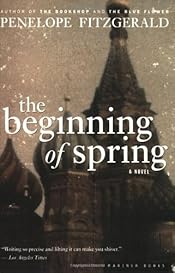
The Beginning of Spring by Penelope Fitzgerald

Mariner Books, 1998, 187 p

Here, we are in Moscow in 1913. Though educated in England, printer Frank Reid has spent most of his life in Russia, inheriting the business from his father, but that life is thrown into disarray when his wife Nellie ups and leaves leaving him with three children to cope with, Dolly, Ben and Annushka, and so he engages a young woman, Lisa Ivanovna, as a sort of nanny.

The details of life in pre-revolutionary Russia seem convincing, the sealing up of houses windows’ for the winter, the casual bribery (connected with a mention of the venality of Grigory Rasputin,) the petty regulations, the restrictions placed on the movement and employment of Russian citizens, the necessity to assuage the police and other relevant authorities. Some incidents are at times reminiscent of Doctor Zhivago, particularly the association between Lisa Ivanovna and Volodya Vasilich, the man who breaks into the printing shop one night and fires a gun at Frank, though the dynamic is reversed.

Reid’s interactions with others, his deputy Selwyn Osipych, whose main interest is in having his volume of poems published but who may have been involved with Nellie’s decision to flee, the print shop supervisor, Tvyordov, are both friendly and distanced. His daughter Dolly seems remarkably composed in the face of the situation – but adolescent girls often are.

However, Reid’s burgeoning attraction to Lisa Ivanovna is told to us rather than shown and so does not contain as much force as it might have.

Pedant’s corner:- “Jeyes’ fluid” (Jeyes’s?) “‘I don’t think so. She certainly didn’t say so?’” (isn’t a question,) “there was still barrel organs playing in the streets” (there were still,) benzine (a word used in other languages certainly but the British one is ‘petrol’. Petrol was used later in the phrase “This Russian petrol is very low on benzine.” Make of that what you will.) “Their breaths rose together as steam into the bitterly cold lamplit air” (I know people refer to it this way but steam is actually invisible, the misty you can see emanating from people’s outbreaths is actually water droplets, condensed steam/water vapour.)

Between the Acts by Virginia Woolf 

Wordsworth Classics. (In The Years & Between the Acts.) 2012, 256 p, including x p Notes and a xix p Introduction to both books by Linden Peach. Between the Acts was first published in 1941.

This was Woolf’s last novel, published posthumously. A prefatory note by her husband said it was completed but not corrected nor revised, though he believes she would not have made any large alterations. I beg to differ.
Like The Years (with which it is combined in this edition) this is more straightforward than Woolf’s earlier novels To the Lighthouse and Mrs Dalloway. That doesn’t do much to recommend it though as what we are given here is a portrait of tiresome upper-middle class people doing and saying upper-middle class things but that could perhaps be borne were it not for the fact that the main part of the book is a struggle to get through as it contains a blow-by-blow account of a local pageant in all its lengthy tediousness.

In Linden Peach’s Introduction to Between the Acts he asserts that the novel is interrogating Englishness. If it does, it is only Englishness of a very narrow sort.

The text mentions an incidental character by describing him as “a Jew”, as if that said all there was to say about him.

Sensitivity note: as well as the gratuitous remark about “a Jew” we also encounter the phrases “worked like a nigger” and “white man’s burden.”

Pedant’s corner:- again the Notes explain references of which a British reader would be aware; Somerset House etc. Otherwise; “said Mrs Manresa ogling Candlish, as if he were a real man” (would be better punctuated as ‘said Mrs Manresa, ogling Candlish as if he were a ….’,) “it was a mellay” (usually spelled melé or mêlé,) “Mrs Rogers’ chin” (Mrs Rogers’s.) In the Notes: Sohrab and Rustum is said to be by Matthew Arnold. While he did write such a poem (and Woolf’s characters would undoubtedly have been familiar with it) the original story was in fact from Shanameh, (https://en.wikipedia.org/wiki/Shahnameh) an epic poem by the Persian  Ferdowsi (Abul-Qâsem Ferdowsi Tusi,) (https://en.wikipedia.org/wiki/Ferdowsi) Daladier is said to have been Prime Minister of France from 1838-1840 (it was 1938-40.) “Il Rissorgimento” (Risorgimento.)

Best of 2023

These are in order of reading; 18 in total, 9 by women, 10 by men, 8 by Scots (italicised,) 4 translations, 1 SF/Fantasy. The links are to the reviews on here:-

Paradise Reclaimed by Halldór Laxness 

The Women of Troy by Pat Barker 

For the Good Times by David Keenan

The Infinities by John Banville

Wild Geese by Nan Shepherd  

Paper Cup by Karen Campbell

A Would-Be Saint by Robin Jenkins 

Master of the Crossroads by Madison Smartt Bell 

Beethoven’s Assassins by Andrew Crumey  (my review was published in ParSec 8 and will appear here in due course.)     

The Marriage Portrait by Maggie O’Farrell 

The Liar’s Dictionary by Eley Williams

Fishnet by Kirstin Innes 

The Gaze by Elif Shafak

Dancing Lessons for the Advanced in Age by Bohumil Hrabal

Utopia Avenue by David Mitchell 

O Caledonia by Elspeth Barker 

Cybele, with Bluebonnets by Charles L Harness

Of Love and Other Demons by Gabriel García Márquez

My present read (Luka and the Fire of Life by Salman Rushdie) may be an addition to this list (but then again it may not.)

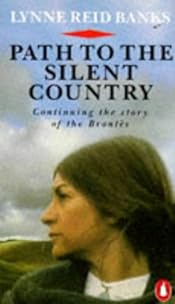
Path to the Silent Country by Lynne Reid Banks

Charlotte Brontë’s Years of Fame, Penguin, 1988, 238 p, plus i p Foreword and vi p Preface.

In this continuation of Charlotte Brontë’s story from Dark Quartet, she is in deep mourning for her late sisters and brother but left in effect to see to her father’s welfare on her own (except for the two servants.)
Her true identity has finally been unmasked though and on a visit to London she finds herself a celebrity but the unkinder reviews of Jane Eyre received distress her. In particular being brought up as the daughter of a cleric and steeped in that religion she is upset by the criticism that her book was unchristian. In Reid Banks’s account it was fellow writer and social theorist Harriet Martineau who explained to her people’s objections. Other literary luminaries of the time who pop up here include William Makepeace Thackeray, Harriet Martineau and Mrs Gaskell, the latter of whom she formed such a friendship with that she was entrusted to write Charlotte’s biography.

The main tension in the book, though, is her relationship with her father Patrick who acted very autocratically towards her and resented any time she spent away from him. (His main fear was that she would marry and thus fall prey to a then common fate, the rigours and dangers of child-bearing. How much of this is Reid Banks’s imagination or whether he was just being extremely selfish is moot.)

As told here a few men took Charlotte’s attention but none cast the same sort of spell on her as had her employer in Brussels, Constantin Héger. When Mr Nicholls, Patrick’s curate, expressed a romantic interest in her Patrick reacted violently and more or less banished him.

A commission to construct a book from her sister’s the papers brings her grief to the fore again but leads her to destroy the best of their remaining literary pieces, as being poems too personal to publish.

After the publication of Villette her writing ground to a halt, she had too much else on her mind and too much to do looking after her father.

It was her eventual marriage to Nicholls, after a promise never to leave her father reconciled him to the match, that would indeed prove disastrous as, despite perhaps thinking herself too old, she became pregnant and her body could not cope with the concomitant demands on it.

Attempting to fictionalise the lives of real people, especially ones about whom such a lot is known, can not be an easy endeavour. Reid Banks does it as well as can be expected.

Pedant’s corner:- has USian spellings throughout (color, honor, modelling, somber etc.) Otherwise; villain (villain – used later,) unperceivingness (unperceptiveness?)

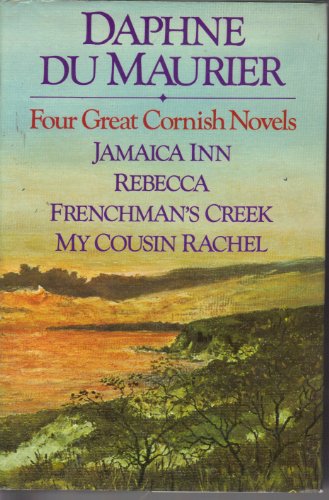
Rebecca by Daphne du Maurier

275 p. In Four Great Cornish Novels, Gollancz, 1984. First published in 1938.

How does the modern reader review an eighty-five year-old book with a large cultural imprint and a story perhaps familiar from TV or film adaptations? And one on which anyone reading the review may already have formed their own opinions? This is the problem with Rebecca, a book I have come to very late. Is there anything new to say about it?

Its first line “Last night I dreamt I went to Manderley again” is of course iconic and astute (or would be to a reader coming to it with no foreknowledge.) The narrator clearly has an attraction to the place but no longer a connection to it. Yet it sets up a mystery. Why is that so? What happened that Manderley is no longer in her life? Why would it be so significant to her? Hence, we read on. I would argue, though, that the rest of that chapter, where we receive the second Mrs de Winter’s memories of its grounds, is a touch too overwritten.

The second chapter begins, “We can never go back again, that much is certain,” once more a promise of revelations to come and perhaps with a more widespread application. Yet such going back, recollections of lives lived from older – maybe wiser – perspectives, is a staple of literature. And so we have the second Mrs de Winter’s account of the early days of her relationship with her now husband, Maxim. Though Maxim de Winter tells her – and us – she has “a lovely and unusual name” we never learn it, which is a bit of a tease and also something of a copout by the author. But it does serve to underline the central thrust of the book. Rebecca, despite its title, is not really her story at all, nor even that of the second Mrs de Winter (except in the fragments we are shown,) but rather of that first wife’s effects on the other characters and of the influence, in an entirely unparanormal way, dead people can exert on the living from beyond the grave.

The mousy, diffident girl Maxim de Winter meets in Monte Carlo due to her paid companionship of Mrs van Hopper (a well-judged portrayal of such a snobby woman and her entitled, selfish behaviour – the blustering Jack Favell, Rebecca’s cousin, who towards the end threatens the promised happy ending, which is itself undone by Manderley’s destruction, is another well-drawn individual) cannot quite believe Maxim’s interest in her – especially since Rebecca’s glamour and allure are all that she hears about. This is perhaps a little disingenuous of du Maurier. Would even the most self-effacing young woman really believe that a man as wealthy as Maxim would marry her solely out of sympathy? And so soon after the death of a woman to whom he was supposedly devoted? That there wasn’t something about her that he found congenial and desirable? That she cannot realise that her difference from Rebecca is the point is much easier to understand. His witholding from her of that information is a mark against him but then without it there would have been no plot. But that leaves our narrator continually holding herself to a standard to which she cannot live up, prey to the machinations of the contemptuous and manipulative housekeeper Mrs Danvers whose devotion to Rebecca survives her mistress’s death. Then again the second Mrs de Winter is largely naïve and too taken up with her own insecurities to see any deeper picture before it is thrust on her.

People have been struck by similarities between Rebecca and Jane Eyre. Both bear characteristics of the Gothic novel, both are the memoirs of a young woman who falls under the spell of an older man with a big house. Yet the comparison is not exact. In Rebecca there is no barrier to marriage, the first Mrs de Winter is dead, in Jane Eyre, Mrs Rochester, the mad woman in the attic, is not – at least until the fire kills her and leaves Mr Rochester blind. However, in Rebecca it is arguable that the mad woman is actually in plain sight in the form of Mrs Danvers. And Jane would not have stood by Mr Rochester if she thought he had got rid of his wife.

No doubt it is due to the book being published in the 1930s but there is a curious lack of passion to the relationship between Maxim and his second wife. Maxim drops into his old habits as soon as he returns to Manderley, leaving his new wife to fend for herself through her long days. There is even a reference to Maxim’s bed being unslept in, their twin beds, then, a clear signal the couple does not sleep together. Love and sex being absent, of the three big novelistic concerns that leaves only death for Rebecca to dwell on.


Pedant’s corner:- Some 1930s usages (to-day, to-night, suit-case.) Otherwise; “reading Bradshaws” (Bradshaw’s,) some commas missing before pieces of direct speech, “lunch I suppose” “the passage was in the past tense” (lunch I supposed,) “Mrs Danvers’ dislike” (Danvers’s,) “the hood” (of a car. That would be the bonnet, then,) the line “pockets. He was staring straight in front of him. He is thinking about Rebecca,” is repeated two lines later and the line it replaces never appears. “‘He was not in a fit to state to undertake anything of the sort” (that first ‘to’ is superfluous.) “It means we had to go” (Again the passage was in past tense; ‘It meant we had to go’,) “Doctor Phillips’ car” (Phillips’s.) “Tired women with crying babies in pram and stared into windows” (is missing something between ‘pram’ and ‘and.’ Or the ‘and’ is superfluous.)

The Marriage Portrait by Maggie O’Farrell

Tinder Press, 2022, 446 p.

In the novel’s first paragraph Lucrezia de’ Medici – married to Alfonso d’Este, Duke of Ferrara, for less than a year – realises that her husband intends to kill her. Forthcoming chapters relating her time at the retreat called Fortezza, near Bondeno, to which Alfonso has taken her, presumably for this sinister purpose, are in the same present tense as this one is. These are interspersed with past tense chapters unfolding the tale of her life up to that point as the third daughter of Cosimo I de’ Medici, Duke of Tuscany.

The second chapter begins, “In the years to come, Eleonora would come to bitterly regret the manner in which her fifth child was conceived.” This, of course, brings immediate echoes of Gabriel García Márquez.  Here, though, such a proleptic pronouncement is perhaps more justified since it is not about this story’s future but describing its past. Eleonora’s misgivings are of course borne out since Lucrezia grows up an unusual child, aloof from her siblings. She was drawn to a tigress brought to her father’s menagerie and touched its fur without consequence, she has a great skill in drawing and painting, most of which has to be hidden from those around her – especially her ultra-conventional husband. Her best paintings are only for her own satisfaction, later used as palimpsests for images more acceptable to the wider world.

Alfonso d’Este had originally been betrothed to Lucrezia’s elder sister, Maria, but she unfortunately died. The alliance between the houses of Tuscany and Ferrara then fell on Lucrezia’s shoulders – at the age of thirteen. In the novel Lucrezia is against this even at her marriage’s eve. At its first mooting, her nurse, Sofia, conspires to pretend that she is not yet child-bearing by concealing any evidence of menstruation. Such prevarications had to end of course and Lucrezia is finally wed – to a man she had seen only once before and who turns out to be cruel and vindictive, and since his dynasty rests on shaky foundations, interested only in the provision of an heir.

As a young ingénue, Lucrezia’s ignorance of the politics of the Ferrarese court is exacerbated by Alfonso’s secretiveness about them. His mother had turned Protestant and thus a source of considerable embarrassment, before she fled abroad. His sisters Elisabetta and Nunciata make some efforts to befriend Lucrezia but are in thrall to Alfonso as well as in his power. The example Alfonso makes of Elisabetta’s presumed lover and besmircher of her honour, Ercole Contrari, is gruesome but illuminative of character. And brings home to  Lucrezia her powerlessness in her new role.

The marriage portrait of the title (apart from the depiction the novel gives us of the marriage of Lucrezia and Alfonso) has been commissioned by Alfonso from the famed Il Bastianino, who sends his pupils Jacopo and Maurizzio to make preliminary sketches. Lucrezia saves Jacopo’s life by administering milk and honey when she comes upon him comatose in a corridor in the aftermath of a fit of some kind. An immediate connection forms between them. This fateful association provides the lever for the novel’s resolution (in which O’Farrell permits herself to embellish the historical record.)

To modern Western eyes the sacrifice of a young girl on the altar of political or family alliances for dynastic purposes is objectionable. However the practice was unquestioned in historical times and is even yet widespread in other parts of the world. Humans still have a lot of progress to make in the matter of recognising the worth of one half of the species. Then again power corrupts. To be a male underling during the Italian renaissance was also to be (relatively) powerless, as an incident between Alfonso’s right hand man, Baldassare, and a servant illustrates.

While not quite reaching the heights of O’Farrell’s previous novel Hamnet, this is good, readable stuff. She conjures up the society of renaissance Italy well and puts us into the mind of an idiosyncratic young girl not yet fully wise to the ways of her world and shows how it changes her.

Pedant’s corner:- “into narrow streets of the city” (into the narrow streets.) “All is not lost” (Not all is lost,) mink (Lucrezia thinks of this as a comparison to a stone marten in a painting. The European mink’s range did not include Italy but that does not necessarily exclude it from her knowledge,) Hercules’ (Hercules’s,) Zeus’ (Zeus’s.) “‘Did you mother not teach you…’” (your mother,) burglarising (I growled at this. The verb is burgle, not burglarise, the participle required here is burgling.)

free hit counter script