Archives » Nina Allan

BSFA Awards 2015 Booklet

BSFA Awards 2015 cover

First, congratulations to the BSFA for getting this out in time in time for it to be read before the presentation of the awards at Eastercon. Easter is remarkably early this year. About as early as it can possibly be. (See previous post.)
And not only does the booklet contain the listed short stories but also the non-fiction nominees (or extracts therefrom) and as usual the nominated artworks.

As to the short fiction:-

Three Cups of Grief, by Starlight by Aliette de Bodard.1
An interstellar Empire has crop-growing space stations and long-lived mindships. Parents’ memories are usually downloaded to their children but those of crop researcher Professor Duy Uyen are allocated to her research group’s next leader. Her daughter, who became a mindship, will nevertheless remember her forever.

Witches of Lychford by Paul Cornell.2
A supermarket chain wants to build an outlet in a town where the borders with the other worlds are weak. This would result in the borders being breached. The witches of the title (not all of whom are witches) are three women who band together to preserve the status quo (in all its aspects.)

No Rez by Jeff Noon.3
Unlike in its original publication (in Interzone 260) the text here is not laid out transversely (perhaps robbing the story of some of its visual impact.) The tale is nevertheless rendered in a variety of typefaces. In its world, pixels are the be-all and end-all. Our narrator stumbles across a dead body with a box that renders everything in high rez. Heavies then come after him to get the box back.

Binti by Nnedi Okorafor.4
Binti is the first of her Himba kind to be invited to Oomza Uni, the first to leave Earth. Her tribal habit was to cover themselves in otjize, a mixture of plant extract and red clay. On the trip the space ship is invaded by Meduse with whom the otherwise dominant humans, the Khoush, are at war. Only Binti’s edna – a general name for a piece of old tech whose use no-one remembers – protects her. Otijze turns out to be useful to the Meduse, as does Binti herself.

Ride the Blue Horse by Gareth L Powell.5
In a post-apocalypse US two men scavenging amongst a huge collection of shipping containers for sellable goodies from the old days uncover a 1960s Ford Mustang. The freedom of the road beckons.

In the non-fiction6 Nina Allan called for the possibility of a woman Doctor (Who) not to be dismissed and for that programme to be less self-referential, the book of Letters to Tiptree acknowledges the legacy of Alice Sheldon (aka James Tiptree Jr,) James McCalmont worries about the future of impartial reviewing, Adam Roberts surveys the SF and Fantasy of 2014 (and skewers Puppygate for its baleful effect on the Hugo Awards,) while Jeff VanderMeer tells of his trials while writing his three novels that were published in one year.

Pedant’s corner:-
1 “had fallen out before, on more trivial things” (over more trivial things,) “treason to much as think this” (to as much as think this,) “the only thing in existence were the laboratory and the living quarters” (“and” – therefore the only things in existence were,) designed to accept an unbalance (imbalance,) it’s mother’s hands that lie her down into the cradle” (lay her down [in?] the cradle,) ‘“When I hear you were back into service”’ (in service.)
2 This is set in Gloucestershire so the need to use the USianism “gotten” totally escapes me. Also “I could have used” for “I could have done with”. I know it was originally published on a US website but that’s no excuse. After all Cornell does have one character say “summat” as in summat terrible. Sprung (sprang,) focussed (focused,) “instead that she setting up the shop” (was setting up the shop,) “someone she vaguely new” (knew.)
3 “She always get the best streams” (gets,) “too many people, to many viewpoints, all on me” (context suggests “too many viewpoints”.)
4 “too old for anyone to know it functions” (its functions,) CO2 (CO2,) sunk (sank, x 3,) conducter (conductor,) ‘“The only thing I have killed are small animals”’ (things, then,) “all I could see were a tangle of undulating tentacles and undulating domes” (all I could see was…,) “Or the cool gasses” (gases) “Okwu promised would not harm my flesh even though I could not breathe it” (breathe them,) miniscule (minuscule,) museum specimen of such prestige are highly prized” (specimens,) ojtize (otjize,) clear is used to mean colourless rather than transparent.
5 Written in USian. “I caught a whiff of carbon monoxide.” (Carbon monoxide is odourless I’m afraid. A whiff of partially burnt petrol, maybe.) Plus: if the narrator and his companion don’t know how to drive a car (and nor has anybody for decades) how does he know which is first (gear) and what a clutch is?
6 There were typos etc (noun/verb disagreements in particular) in most of the non-fiction but I haven’t bothered enumerating them.

BSFA Awards (for 2014)

This year’s nominees for the BSFA Awards have been announced.

As far as the fiction is concerned we have the unusually high total of eight novels on the ballot form, of which I have read three*. (Edited to add: so far.)

The Race* by Nina Allan (NewCon Press)
Cuckoo Song by Frances Hardinge (Macmillan)
Europe in Autumn by Dave Hutchinson (Solaris)
Wolves by Simon Ings (Gollancz)
Ancillary Sword by Ann Leckie (Orbit)
The First Fifteen Lives of Harry August* by Claire North (Orbit)
Lagoon by Nnedi Okorafor (Hodder)
The Moon King* by Neil Williamson (NewCon Press)

The short fiction has only three contenders – all of whom are women it seems; for the second year in a row. I have read none of them as yet (but hope the BSFA will produce the usual booklet.) Though it’s totally irrelevant I was on a panel at last year’s Eastercon with Ruth Booth.

The Honey Trap by Ruth EJ Booth (La Femme, Newcon Press)
The Mussel Eater by Octavia Cade (The Book Smugglers)
Scale Bright by Benjanun Sriduangkaew (Immersion Press)

Interzone 254, Sep-Oct 2014

Interzone 254 cover

Marielena by Nina Allan1
Noah Wahid, an asylum seeker, while waiting for his permission to remain, spends the days in an endless round of impoverished futility and seeing the face of Marielena, the girl he left behind, in nearly everyone he meets. The story hinges on Noah’s encounter with a refugee from the future.

A Minute and a Half by Jay O’Connell2
The tale of how Evan came to be in sole charge of a two year old daughter he hadn’t known about. He’s taken programmers, which, in a very intrusive info dump, we are told are able to sculpt human wetware in accordance to user input parameters. Or are they just hallucinogens?

Bone Deep by S L Nickerson
A woman with a medical condition where her flesh is turning to bone can only access the treatment she needs by having sponsors’ logos tattooed onto her. (Don’t give the buggers ideas is what I say.)

Dark on a Darkling Earth by T R Napper
In a world of perpetual war where memory has to be stored on electronic cards or it is lost, an old man falls into the orbit of a group of soldiers.

The Faces Between Us by Julie C Day
Is set in an Oregon where ghosts live on in ashes and Larry and Amber try to find the way “through” by snorting them.

Songs Like Freight Trains by Sam J Miller
Christine no longer listens to music. Ariel, her friend from her teenage years taught her the trick of time travel via song. But Christine’s daughter yearns to dance.

1 Imposter. Narrator Noah tells us his vocal command of English is not good but uses words like annunciates. Pita bread is usually spelled pitta.
2 Cannoboloid (????) I suspect this should be cannabinoid.

Interzones 254, 255 and 256

The Seventh Miss Hatfield cover
 Irregularity cover

Interzone 254 has been out for a while and includes of course my review of The Seventh Miss Hatfield by Anna Caltabiano. Jim Steel’s blog has a BIG picture of the cover. It’s a special Nina Allan issue. See here and here for my thoughts on her longer works.

My latest review book is Irregularity, a collection of short stories based around the Age of Reason. Since that has arrived I suppose it won’t be long until Interzone 255 hits the doormat.

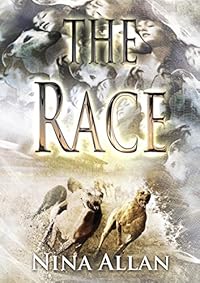
The Race by Nina Allan

NewCon Press, 2014, 251 p

The Race cover

This seems to be marketed as a novel but is in fact a set of four tenuously connected novellas the succeeding ones of which cast doubt – or light depending on your viewpoint – on the events of at least one of the previous ones. Three are first person narrations, the third (appropriately) is in third person.

The book starts with Jenna, whose title character narrates a tale of smartdogs – greyhounds upgraded (initially illegally) with some human DNA – and the handlers who can communicate with them telepathically via a chip inserted in the brain. The setting is the town of Sapphire, hard by an ecologically damaged area off Romney Marsh. The plot kicks off when Jenna’s brother Del’s daughter Luz Maree is kidnapped, ostensibly for money which Del hopes to procure by running his smartdog Limlasker in the season’s big dog race the Delawarr Triple, but in reality because she can interact with the dogs without an implant. In this segment Allan employs the phrase “going to the dogs” perfectly straight, but on its first appearance I initially read it as “in decline.”

Christy is set in a recognisable “real-life” Hastings but we are invited to believe the town of Sapphire which we met in Jenna is an invention of the eponymous narrator, who retreats into the stories of her imagined world – subsequently achieving publication with them – when her overbearing brother Derrick, a nasty piece of work, damages her life too many times. One of his girlfriends disappears, another called Linda enlists Christy’s help to leave Derrick for her former boyfriend Alex. Derrick reacts violently. The parallels between Christy’s life and Jenna’s are plain. Too much so. Having even a fictional writer write about stuff so obviously inspired by her own life stretches credulity too far. Fair enough in the general case (and then only if a writer’s sources are invisible to the ordinary reader) but here the artifice undermines the effect of Jenna as a story. One of the overlaps between these first two stories is a focus on gloves but this does not carry over into the final pair.

In the third person narration, Alex, again set in our universe, it seems Christy’s fears about what may have happened to Linda are unfounded as, years later, Alex tells her he saw Linda some time after the violent incident. (But the reader may think he was mistaken. The writing is sufficiently ambiguous to allow for either possibility.)

By contrast with the first and last in the book, both these middle two novellas are apparently set resolutely in the real world. Unfortunately the outcome of this is to dilute the effect of the other two stories. I know it is Allan’s intention to make us question the narration and the reality of the everyday – each novella has a scene where other worlds intrude on the milieu, parallel worlds are explicitly mentioned at times – but what it means is we cannot trust any of them. The connections we make slip away.

The last story, Maree, also has smartdogs, but they are off-stage (except for Maree remembering one called Limlasker.) This world has some familiar town names – Inverness, Faslane, Madrid – but also invented ones, Asterwych, Charlemagne, Lilyat and the countries of Crimond, Thalia, Farris and Espinol. Our narrator, one of those who can communicate with smartdogs without implants, is about to make the dangerous sea voyage from Crimond to Thalia to become part of a research project to help decipher the language of a strange set of signals from space. We discover Maree was taken from her parents when young. Her Dad was named Derek and he has a sister called … Christy. The set piece here is an encounter with Atlantic whales – not our familiar species, but strange creatures, aloof from and disdainful of humans. Like the dog race in Jenna, though, this apparent centrality is only background to the story. It is as if the SF in The Race isn’t SF. That’s fine, in fact I’m all for it – but don’t rub our noses in it.

Throughout all four sections of the “novel” information dumping, although necessary, is a bit intrusive and the foreshadowing verges on heavy-handed.

Despite all of the book, bar Maree’s sea voyage, being set in Britain (or, in the case of Crimond, an altered Britain) various USianisms spatter the text – veterinarian, semester, jerking off, sneakers, airplane (though aeroplane is employed more often,) outside of, wedding band, a raise – which I’m afraid detract from the verisimilitude. At times there was some awkward syntax, “a vegetable I’ve never tasted before called aubergine.” “The house was on Emmanuel Road, a solid Victorian terrace with a weathered front door.” The terrace has a front door? And it may be Allan has a problem with endings. Except for Maree, they seemed rushed. I noticed a similar tendency in the same author’s Spin.

As a whole The Race is a hall of mirrors, of distorting mirrors. Nothing is reliable; even its unreliability. It might even be said to be less than the sum of its parts. Which is a pity as Allan can write well and empathically.

Pedant’s corner:-
A “span,” brooch spelled as broach, double English (in a primary school?) “I think that was he was counting on,” “We lived of frozen fish fingers…” “pretending they was invisible,” “that 1 now knew,” “Tim had has name down for Oxford,” “I decided I to Laton Road,” “Recounted the final days an old piano teacher dying in Aberystwyth,” “accustomed Maclane’s presence,” “Faslane shrinks and dwindles, … first a … smudge on the horizon, then disappearing altogether. We are still in the mouth of the loch, not in the open sea at all yet.” Faslane has “disappeared” but we’re still in the mouth of the loch, not the open sea? (Aside: the Faslane I know is near the mouth of the loch it stands on – it’s a small loch – and disappears very quickly; when the necessary turn on leaving the loch is performed.) “The pattern templates were …. carefully folded and each once sealed within a white paper packet.”

Best of the Year

It’s traditional at this season of the year to list what has most impressed over the past twelve or so months. Except I’ve only done it once before. Twelve months ago.

Once again I find ten books stood out over the year.

In order of reading they were:-

Snow by Orhan Pamuk
Gentlemen of the Road by Michael Chabon
Empty Space by M John Harrison
New Finnish Grammar by Diego Marani
Dark Eden by Chris Beckett
Spin by Nina Allan
The Feast of the Goat by Mario Vargas Llosa
Girl Reading by Katie Ward
Planesrunner by Ian McDonald
Fire in the Blood by Irène Némirovsky

4 are translations, 4 are SF*, 3 are by women. Make of that what you will.

*If you count the last section of Girl Reading, that would be 4 and a bit.

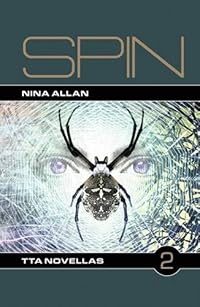
Spin by Nina Allan

TTA Press, 2013, 92 p.

Novella no. 2 from TTA Press, publishers of Interzone and Black Static.

This is a strange atmospheric piece, very well written.* It is set in a Greece where iPads and emails are in everyday use and holographic people are difficult to discern from real ones but triremes roam the seas and Carthage has fought a war with Corinth within the past 100 years.

When narrator Layla Vargas was young her mother was executed in a bizarre way for having unnatural powers. Layla has now grown and set out for a new life in Atoll City. On the bus on the way she meets an old woman who will influence her future. Layla’s uncommon ability to sew tapestries attracts the attention of a woman whose son has a strange disease and who wishes Layla to cure him. Layla is reluctant to be thought unusual.

Despite the SF trappings there is throughout the feel of fantasy and the dénouement is firmly fantastical. It was refreshing to read a piece in that vein not firmly rooted in mediævality.

The writing is measured and beautifully modulated, the characters rounded and believable. The story concluded a bit like a popped balloon though, all the intrigue that had been carefully built up thereafter more or less dribbling away. It was as if Allan had come up against her word limit and had to find a way to stop. That’s a pity as there was scope here for more exploration of the scenario and greater length. Allan knows what she is doing though and does it well.

*It is a pity, however, that in a novella entitled Spin there is a “span” count of 1.

Interzone 246 and the James White Award

TTA Press, May-Jun, 2013.

Interzone 246

This accompanied Nina Allan’s Spin, a TTA novella which I have promised to review here. My review of Ian McDonald’s Planesrunner appears in this issue, which I assume I received as a contributor’s copy.

The Machinehouse Worker’s Song by Steven J Dines
Men work stoically at their shifts in a machinehouse which they cannot leave until they succumb to an apparently psychological sickness, or death. The story is set at a time when only two of them remain.

Triolet by Jess Hyslop
Mrs Entwistle grows poems (which seem to be exactly like flowering plants but speak their verses when touched.) One day she gives James and Lisa a triolet. Its repetition presages alteration.

Sentry Duty by Nigel Brown
An alien stands guard for her Sisterhood and interacts with the human whose skycart has landed in their territory. This story would not have been out of place in a 60s SF magazine.

The Angel at the Heart of the Rain by Aliette de Bodard
An immigrant from a war torn country comes to terms with her new existence.

Thesea and Astaurius by Priya Sharma
A reworking of the Minotaur story featuring the woman Thesea. Minos is a blood-crazed madman and Deadalus wields modern technology.

The Core by Lavie Tidhar
Achimwene follows his lover Carmel through Central Station. She is a strigoi, a data vampire to whom the Station’s children are attracted. A strange piece, undermined for me
by the use of the word “faint” once each in the first two lines, describing respectively the light and a glow.

Cat World by Georgina Bruce
Narrated by an eight year old girl, an orphan who lives on the streets with her sister. Flavoured chewing gum takes their minds into Cat World. Her sister disappears and she has to fend for herself.

The James White Award is a short story competition open to non-professional writers and judged by a panel of professional authors and editors. The winner receives a cash prize, a trophy and publication in Interzone. This year’s winner, selected by Aliette de Bodard and Ian McDonald, was:-

You First Meet the Devil at a Church Fete by Shannon Fay
A well written tale narrated by one Stuart Sutcliffe, who is tempted by the devil with promises of the band he’s in with John and Paul – and George – becoming big. Stuart turns him down. The rest is history.

BSFA Awards Short Stories

Over the past few weeks I have read the short stories nominated for this year’€™s BSFA Awards. I am assuming that, as in the past couple of years, the BSFA will be producing a booklet containing them but since each has been posted on the internet (there is a link from the BSFA’s Awards page to the online versions which is how I managed to read them – though I found off a screen is not the most comfortable of ways to do so) perhaps that might not happen.

The Silver Wind by Nina Allan, from Interzone issue 233, is a kind of time-travel story mixed with parallel worlds. It tells of the encounter of a man from a fascistic future Britain with a genius who makes clocks (which he refers to as time machines.) To begin with there is too much info dumping and throughout a lot is told rather than shown. Perhaps the story needed more space to breathe but I felt the sureness of touch of an accomplished story teller was missing. There is a use of words that is not quite precise -€“ eg ‘hoping one soldier would not see me’ rather than ‘€œhoping none of the soldiers would see me’€ – and twice we are treated to the peculiar phrase, ‘€œIt was growing dusk,’€ but at least Allan knows the use of ‘€œnor’ as in, ‘€œnot for love nor money nor any of these new-fangled gadgets.’

The Copenhagen Interpretation by Paul Cornell, from Asimov’s, July2011, is set in an altered future where European monarchies strive to keep the balance of power throughout the Solar System, souls have weight that is aligned to dark matter and Newton came up with a kind of relativity theory which allows space to be folded – all amenable to a tale of espionage and derring-do admixed with betrayals of various sorts. This stretches suspension of disbelief at times but overflows with ideas and is excellently written.

Afterbirth by Kameron Hurley, from Kameron Hurley’€™s website, is about a woman in a backward-leaning religious society which is engaged in a never-ending war, whose rulers have deliberately cut it off from the stars – originally as an escape from whatever’€™s out there but now to prosecute the war better. In her forbidden astronomical observations she finds God in a torn filter laid across the night sky. Again there is a fair bit of info dumping -€“ perhaps inevitable in stories of short length.

Covehithe by China Miéville, from The Guardian, 20/4/11, features sunken oil-rigs returning to land to drill into the earth and lay – eggs? seeds? – from which smaller rigs later emerge. Atmospheric, but again info-dumpy. The human involvement in Covehithe – a father and his daughter observing one such landing -€“ doesn’€™t really overlap with the SF background. Another scenario where society has suffered extreme breakdown and the military has a strong presence.

Of Dawn by Al Robertson, from Interzone 235, has a woman whose soldier brother has been killed being inspired by his poetry, the music of a long neglected composer, an all but forgotten TV documentary and a figure from Greek myth to produce a synthesis of poetry and music by bringing all those strands together. The final part of the jigsaw is provided by a shadowy figure in a village commandeered by the army long ago, but which had inspired both poet and musician. The story contains echoes of the Green Man myth and illustrates that English fascination with the pastoral. The info dumping here is well embedded.

The futures shown by the five stories are all bleak, having in common repressive regimes of either military or religious stamp. SF is never about the future, though. These stories tell us a lot about where we are now.

As stories though, rounded works of fiction, I found most of them unsatisfying. The only truly successful one was Paul Cornell’s. If these represent the best of last year the SF short story is in a bad way.

BSFA Awards Shortlist

It’s that time of year again. The BSFA Award nominations are out.

The full lists can be found here.

The fiction nominees are:-

Best Novel:-

Cyber Circus by Kim Lakin-Smith (Newcon Press)

Embassytown by China Miéville (Macmillan)

The Islanders by Christopher Priest (Gollancz)

By Light Alone by Adam Roberts (Gollancz)

Osama by Lavie Tidhar (PS Publishing)

Of which I have (so far) read one.

Best Short Fiction:-

The Silver Wind by Nina Allan (Interzone 233, TTA Press)

The Copenhagen Interpretation by Paul Cornell (Asimov’s, July)

Afterbirth by Kameron Hurley (Kameron Hurley’s own website)

Covehithe by China Miéville (The Guardian)

Of Dawn by Al Robertson (Interzone 235, TTA Press)

I have read none of these as yet but only The Copenhagen Interpretation is not available online via the BSFA page linked to above. Presumably the booklet of nominated stories that the BSFA has produced for the past two years will be repeated this time around, too.

free hit counter script