Archives » Michael Chabon

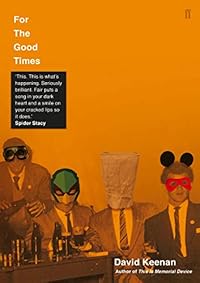
For the Good Times by David Keenan

Faber and Faber, 2019, 358 p.

How do you follow up a novelistic debut such as This is Memorial Device, a book about an imaginary rock band told from a kaleidoscope of multiple viewpoints? Keenan’s answer is to write about something totally divorced from that. 1970s Northern Ireland. “The best decade what ever lived.” (Except for the lack of oral sex.)

For the Good Times is another odd concoction, though. Larded with “Irish” jokes, it is essentially the story of three laddies, Tommy, Barney and narrator Samuel, held together by a linked love for the songs of Perry Como whom they have been told is absolutely clean-living, and who slip into nationalist activism almost by accident.

Their first project is to carry out a shooting and they narrowly avoid capture, running a roadblock with Tommy on the car roof spraying gunfire while singing For the Good Times. Their second is to recover an old arms stash, their third to kidnap the wife of a comic book store owner who they are told owes The Boys money. Her name is Kathy and she disappears leaving only her high heels behind. Sammy later sees her dancing in a bar, pursues her to the toilets where, unbidden, she fellates him. He can’t decide whether or not the relationship they then enter is because she wants to protect her husband from retribution but goes along with it, meeting her after her work in the Europa Hotel. The three lads take over the book shop in lieu of the supposed debt. Cue various riffs on comic books and superpowers.

This is Belfast as a surreal place. One of the characters is nicknamed Miracle Baby. He is “a retard” but one who knows the truth of everything. Kathy’s husband turns out to look exactly like Tommy. The three each imagine themselves as a different superhero. The most potent power? Invisibility; “being invisible is the greatest power you could ever have in Ireland,” a cloak which IRA membership conforms on them.

There is some stark realism. Local IRA boss Big Mack when the lads are joking about a bomb he’s demonstrating, tells them not to act like clowns, adding, “‘see if the IRA could dispense with Irishmen altogether, we’d be one fuck of a formidable fighting unit.’” Joining The Boys was motivated by “protection, resentment, ambition, revenge, honour, sex, money, style, class,” plus a history of violence “that ran through our veins and (let’s face it) was one of the only things holding the generations together,” and moments of recognition. “In Ireland history isn’t written. It’s remembered.” As it is in all sad countries.

Eventually escape becomes necessary. “Fucking Glasgow, my friend, it’s just like Belfast, the same rivalries, the same segregated pubs, the same flags, the same halls, the same murals, the same fucking teams; a friendly city once you get to know it. Plus you’re just as likely to get stabbed for your colours as back home, so as you know where you stand as soon as you’re off the boat. …. It was just like being back in the Ardoyne only with blow jobs aplenty.” But even life in Glasgow becomes too hot.

However nothing in this world is as it seems. Even Kathy. “It’s a web of lies we were all caught in. It’s the default position of the Irish. If in doubt, lie; if asked, make it up; if questioned deny it … tell them fucking nothing.”

In a passage that might be true to the book’s milieu but could equally well be there because Keenan thinks he ought to say it, Sammy tells us, “that was the one thing we never did: we never asked ourselves any questions, in fact we lied. We lied to ourselves more than we did to anyone else. You had to. How else do you do this stuff, day in day out? If you had a working brain you would be finished.” He says he “realised that Belfast is full of ghosts, that Belfast is haunted in the daytime and that nobody pays attention to any of them.” It’s the perfect place to indulge in mayhem. “If you were a daemon where would you go to do your work? Belfast.”

The novel partly comes across as a kind of cross between Michael Chabon’s The Amazing Adventures of Kavalier and Klay and, in its observation of casual violence, Graeme Armstrong’s The Young Team. It is, though, made problematic by its illustrations of violence (admittedly difficult to avoid in any novel dealing with this subject) and flawed by some overblown passages rendered in italics illustrating the adventures of the superheroes the three have imagined for themselves. It also contains an aside on the erotic connotations of the ladies’ silk handkerchief.

Pedant’s corner:- The epigraph attributes the song It’s Impossible to Perry Como. (He did sing it but the English lyric was written, as noted in the Acknowledgements, by Sid Wayne, Spanish words and music by Armando Manzanero.) Otherwise; “a beautiful delicate labia” (labia is the plural, no ‘a’ then,) “a flappy disk” (floppy disc, but this may have been trying to convey the speaker’s argot.) “‘Does that not gives you a shiver?’” (give,) “a dice” (x 3, dice is plural; one of them is a die,) fit (fitted,) “lay low” (several times; lie low,) “so as” (frequently; used where ‘so’ would be sufficient,) “faraway lochs” (I know Keenan is Scots but the narrator is Irish, shouldn’t that be ‘faraway loughs’.)

Best of 2017

Fifteen novels make it onto this year’s list of the best I’ve read in the calendar year. In order of reading they were:-

The Amazing Adventures of Kavalier and Clay by Michael Chabon
His Bloody Project by Graeme Macrae Burnet
A Man Lies Dreaming by Lavie Tidhar
The Panopticon by Jenni Fagan
The Stornoway Way by Kevin MacNeil
The Sea Road by Margaret Elphinstone
The Untouchable by John Banville
Swastika Night by Katherine Burdekin writing as Murray Constantine
Spaceman of Bohemia by Jaroslav Kalfař
The Power by Naomi Alderman
Imagined Corners by Willa Muir
This is Memorial Device by David Keenan
The Underground Railroad by Colson Whitehead
Kalpa Imperial by Angélica Gorodischer
Psychoraag by Suhayl Saadi

That’s six by women and nine by men. Six were SF or Fantasy, counting in The Underground Railroad, (seven if the Michael Chabon is included,) seven were by Scottish authors.

Tigerman by Nick Harkaway

Windmill, 2015, 378 p.

 Tigerman cover

When I started this it read like some sort of odd fusion between Michael Chabon and Gabriel García Márquez. Why? Well, there’s the boy whose great interest is in comic books (The Amazing Adventures of Kavalier and Klay). Then the viewpoint character is referred to all but exclusively as “the Sergeant” (The General in his Labyrinth) and the setting is exotic – to me at least. The island of Mancreu in the north part of the Indian Ocean. The Sergeant has seen (messy) service in Afghanistan, Iraq and Bosnia and been farmed out to the island as a British Brevet-Consul with strict instructions to do, or interfere with, nothing. Yet in his new home he has a quasi-police role. Think Death in Paradise with all the twee bits ruthlessly excised except in a different ocean and a menacing air to the whole island.

For Mancreu has been the subject of an environmental disaster in its subterranean magma well (all sorts of undesirable biological emanations now proceed from there at irregular intervals) and is under sentence of death, “so wretchedly polluted that it must be sterilised by fire,” by the international community. People have already left – Leaving parties de rigueur – and the rest of the population is only biding its time. On land an international force known as NatProMan has a sort of rules-enforcement function. Offshore a Black Fleet is up to no good and tales circulate of a criminal/pirate/underworld type dubbed Bad Jack who lurks in the island’s shadows.

The Sergeant has developed a fatherly interest in the boy – who seems to have no parents but is liberally supplied with comic books and speaks fluent comic. In a meta-fictional moment the boy says of the stories in the comics, “There must be development-over-time or it is just noise.”

Things are shaken up when a bunch of gunmen come into Shola’s bar (where the Sergeant and the boy go to take tea) and shooting starts. Shola is killed but the Sergeant protects the boy with a nifty piece of action using for a weapon a tin containing custard powder which he employs as a sort of grenade. It explodes when the gunmen fire at it in defence. This gives the Sergeant the opportunity to overwhelm the remaining gunmen.

After the Sergeant discovers the boy – who may be called Robin but then again that could be a Batman joke – has been severely beaten and some of his comics systematically ripped apart as a punishment they cook up a plan between them. Inspired by the Sergeant’s somewhat magic realist encounter with a tiger (which he has related to the boy) the Sergeant, with the aid of a mask and some painted body armour, will become “Tigerman” to deal with the island’s bad guys. After all, “Myths and monsters were a human weakness, even on places not about to be evacuated and sterilised by fire.”

The plot sharpens when a missile is fired from the Black Fleet onto the building where the arrested gunmen are being held but it kind of jumped the shark later when the exact relationship between the boy and Bad Jack is revealed.

Along the way the NatProMan chief ruminates, “You had to listen to what a Brit was saying – which was invariably that he thought X Y Z was a terrific idea and he hoped it went well for you – while at the same time paying heed to the greasy, nauseous suspicion you had that, although every word and phrase indicated approval, somehow the sum of the whole was that you’d have to be a mental pygmy to come up with this plan and a complete fucking idiot to pursue it…. they didn’t do it on purpose. Brits actually thought that subtext was plain text.”

The last few pages strive for an emotional reaction from the reader but Harkaway hasn’t done quite enough in the preceding ones to earn it which is a shame as I really liked his previous novel Angelmaker.

Pedant’s corner:- Bad Jack is at one point rendered in French as Mauvais Jacques. I had always thought Jacques was French for James, as in Jacobite, not Jack. Otherwise; the Sergeant is told to “rest up” by the previous Consul (rest up is a USianism, a Brit would more likely say rest,) “which he could use about now” (use is an USianism; ‘which he could do with about now’,)”the bigness of this idea”(x2; what an ugly expression,) mortician (undertaker,) sit-uations (not at a line break so situations,) with with (only one with required,) Freddy Mercury (Freddie Mercury,) “‘She wants a friendly face, is all’” (is all is USian, a Brit would say, ‘that’s all’,) a missing comma before the end quote mark of a piece of dialogue and another missing before a new piece, phosphorous flares (phosphorus,) there were a lot of positions (there were lots of positions.)

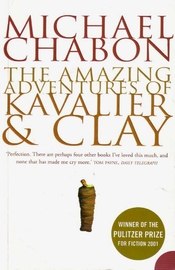
The Amazing Adventures of Kavalier and Clay by Michael Chabon

Fourth Estate, 2001, 646 p, plus iii p Author’s Note.

The Amazing Adventures of Kavalier and Clay cover

I was immediately struck by this book’s opening sentence, “In later years, holding forth to an interviewer or to an audience of fans at a comic book convention …. Sam Clay liked to declare … that back when he was a boy … that he had been haunted by dreams of Harry Houdini.” In its essential form this has similarities to the first sentence of Gabriel García Márquez’s One Hundred Years of Solitude, “Many years later, as he faced the firing squad, Colonel Aureliano Buendía was to remember that distant afternoon when his father took him to discover ice.” Not a bad model to aspire to. Chabon’s opening sentence is, however, less stark, more elaborate than Marquez’s, being replete with subclauses and apparent asides. In this it is at one with many of the ones that follow, exquisite, information packed, beautifully constructed sentences unfolding over several lines yet seeming almost effortless, not a word out of place nor too much. Yet other sentences are admirably short. This is a book that has some very good writing indeed. At the same time it is also a compelling story. And it has occasional footnotes. What’s not to like?

The Kavalier and Clay of the title are respectively Joe and Sammy, cousins, both artists, who invent a comic book hero known as The Escapist, inspired by Kavalier’s training as an escapologist in Prague in the 1930s. They meet when Joe Kavalier turns up at the Klayman household in New York after his fraught journey from Czechoslovakia (via Lithuania and Japan) the setting up of which required almost all the money his family could scrape together to save at least one of their number. There are echoes of Márquez’s magical realism in Joe’s escape from Nazi occupation; inside a coffin which also contains the (disguised) Golem of Prague. The Escapist character is a great success – punching Hitler on the nose and otherwise bashing Nazis speaking to a latent emotion – as are other creations of theirs such as Luna Moth, riding the boom in comic books of the time. Despite exploitation by their publisher (the standard contract handed over the rights to their characters) they still manage to make a fair bit of money. Joe is continually worried about his family in Prague and his cash mostly goes to finding out their well-being or otherwise and to bringing his younger brother Thomas and other Jewish children to the US. In amongst details of their personal lives – Joe’s affair with Rosa Luxemburg Sax and Sammy’s incipient homosexuality laying the ground for later developments – Chabon also delivers to us a history of the comic book.

Given my interest in Art Deco and Moderne architecture I was particularly delighted by the scene set in the abandoned remains of “that outburst of gaudy hopefulness”, the New York World’s Fair 1939-40.

In a sentence that has striking echoes for the world in which I was reading the book Chabon says, “One of the sturdiest precepts of the human delusion is that every golden age is either in the past or the offing.” Arguably the real delusion is that there ever was, or will be, a golden age.

The shadow of the wider world never lifts from Joe, even if on joining up on the final entry of the US into World War 2 the navy sends him to the Antarctic rather than to kill Germans. A novel of folk caught up in “interesting times” may be a shortcut to wider significance but, “The true magic of this broken world lay in the ability of the things it contained to vanish, to become so thoroughly lost, that they might never have existed at all,” is as true of more settled eras. And the events in Europe and elsewhere are backdrop to the human stories here. For all that, as well as a story of love and loss, tragedy and redemption (or a kind of catharsis,) at its heart The Amazing Adventures of Kavalier and Clay is a pæan to the comic book. And Chabon has made art out of its history.

Pedant’s corner:- the local Gestapo bureau (this was on the border between Poland and Lithuania, hence before the German invasion of Poland; so no Gestapo. Even if after the German invasion the border would have been between the Soviet controlled area of Poland and Lithuania so still no Gestapo,) beltoids (deltoids?) from which dangle … an array (an array dangles,) Longchamps’ (Longchamps’s,) “a Brooklyn Dodgers football game” (the Brooklyn Dodgers were a baseball team; still are, though they moved to LA,) lists of dramatis personae (dramatis personae plural would be dramatum personae,) “there were a fair number of moths” (x 2, there was a fair number,) aetataureate (an invention by Chabon meaning “of the golden age”,) missing start quote on a piece of dialogue at a chapter start (probably the publisher’s house-style, but annoying just the same,) a number of orders were issued (a number was issued,) maw (for an entrance. A maw is a stomach,) “‘Oh much more than see him’” (seen him makes more sense,) chile con carne (not spelled chile.)

Best of the Year

It’s traditional at this season of the year to list what has most impressed over the past twelve or so months. Except I’ve only done it once before. Twelve months ago.

Once again I find ten books stood out over the year.

In order of reading they were:-

Snow by Orhan Pamuk
Gentlemen of the Road by Michael Chabon
Empty Space by M John Harrison
New Finnish Grammar by Diego Marani
Dark Eden by Chris Beckett
Spin by Nina Allan
The Feast of the Goat by Mario Vargas Llosa
Girl Reading by Katie Ward
Planesrunner by Ian McDonald
Fire in the Blood by Irène Némirovsky

4 are translations, 4 are SF*, 3 are by women. Make of that what you will.

*If you count the last section of Girl Reading, that would be 4 and a bit.

Gentlemen of the Road by Michael Chabon

A Tale of Adventure. Sceptre, 2007, 204p

Gentlemen of the Road cover

This was a delight. The story of two Jews With Swords (as Chabon’s working title had it) in the region of Khazaria on the Silk Road about 1,000 years ago it is a modern Boy’s Adventure Story. It is a long time since I read one of those but as far as my memory serves Chabon writes this much better than the Victorians did.

The two Jews are both a long way from home. Zelikman is from Regensburg in the Frankish Kingdom, and Amram is an African descendant of Solomon via the Queen of Sheba. Their scamming of other travellers by faking fights in order to profit from the betting thereon is interrupted by their encounter with Filaq, heir to a bekdom which has been usurped. Gentlemen of the Road is an admirably short novel but manages nevertheless to incorporate a lot of action.

The sentence structure can be convoluted, incorporating digressions and sub-clauses, but everything is in its place and contributes to the ongoing story. The inclusion (one per chapter) of full page illustrations of lines from the text gives the book the correct retro feel. How it relates to the work of such as R M Ballantyne and G A Henty I cannot say as my memory of those is hazy, but I doubt they had any sexual content as this does, briefly. What was unlikely in those is a woman having the agency one of the characters in this book exerts, indeed any sort of agency at all.

Chabon’s depiction of the times of the book accords with what I know of that era and place and extends it. I did wonder if the bek and kagan dual ruler set up in Khazaria might have been an inspiration to Robert Silverberg for the Coronal and Pontifex of his Majipoor novels and stories.

The end-papers contain a lovely map of Khazaria and the surrounding lands.

Gentlemen of the Road is a beautiful artefact, outside and in.

free hit counter script