Archives » Laura Hird

My 2015 in Books

This has been a good year for books with me though I didn’t read much of what I had intended to as first I was distracted by the list of 100 best Scottish Books and then by the threat to local libraries – a threat which has now become a firm decision. As a result the tbr pile has got higher and higher as I continued to buy books and didn’t get round to reading many of them.

My books of the year were (in order of reading):-
Bring Up the Bodies by Hilary Mantel
Electric Brae by Andrew Greig
The Thousand Autumns of Jacob de Zoet by David Mitchell
Station Eleven by Emily St John Mandel
Europe in Autumn by Dave Hutchinson
Traveller of the Century by Andrés Neuman
The Affair in Arcady by James Wellard
Flemington and Tales from Angus by Violet Jacob
The Book of Strange New Things by Michel Faber
Ash: A Secret History by Mary Gentle
Young Adam by Alexander Trocchi
Song of Time by Ian R MacLeod
The Gowk Storm by Nancy Brysson Morrison
The Bridge Over the Drina by Ivo Andrić
To Kill a Mockingbird by Harper Lee
Fair Helen by Andrew Greig
The Dear, Green Place by Archie Hind
Greenvoe by George Mackay Brown
The Tin Drum by Günter Grass
Europe at Midnight by Dave Hutchinson
The Cone-Gatherers by Robin Jenkins
A God in Ruins by Kate Atkinson
Go Set a Watchman by Harper Lee
Born Free by Laura Hird
We Are All Completely Beside Ourselves by Karen Joy Fowler

If you were counting that’s 25 in all, of which 15 were by male authors and 10 by women, 8 had SF/fantasy elements and 11 were Scottish (in the broadest sense of inclusion.)
Reading Scotland 2015

A lot of my Scottish reading this year was prompted by the list of 100 best Scottish Books I discovered in February. Those marked below with an asterisk are in that 100 best list. (In the case of Andrew Greig’s Electric Brae I read it before I was aware of the list and for Robert Louis Stevenson his novella was in the book of his shorter fiction that I read.)

Electric Brae by Andrew Greig*
A Sparrow’s Flight by Margaret Elphinstone
The Guinea Stamp by Annie S Swan
The Girls of Slender Means by Muriel Spark
The White Bird Passes by Jessie Kesson*
Attack of the Unsinkable Rubber Ducks by Christopher Brookmyre
Buddha Da by Anne Donovan*
Flemington by Violet Jacob*
Tales From Angus by Violet Jacob
Annals of the Parish by John Galt
The Book of Strange New Things by Michel Faber
Change and Decay in All Around I See by Allan Massie
The Hangman’s Song by James Oswald
Wish I Was Here by Jackie Kay
The Hope That Kills Us Edited by Adrian Searle
Other stories and other stories by Ali Smith
Young Adam by Alexander Trocchi*
The Gowk Storm by Nancy Brysson Morrison*
No Mean City by H McArthur and H Kingsley Long*
Shorter Scottish Fiction by Robert Louis Stevenson*
The Expedition of Humphry Clinker by Tobias Smollett*
Girl Meets Boy by Ali Smith
Fair Helen by Andrew Greig
The Dear, Green Place by Archie Hind*
Fur Sadie by Archie Hind
Greenvoe by George Mackay Brown*
Stepping Out by Cynthia Rogerson
Open the Door! by Catherine Carswell*
The Silver Darlings by Neil M Gunn*
Scotia Nova edited by Alistair Findlay and Tessa Ransford
After the Dance: selected short stories of Iain Crichton Smith
John Macnab by John Buchan
Another Time, Another Place by Jessie Kesson
Consider the Lilies by Iain Crichton Smith*
The Thirty-Nine Steps by John Buchan*
Poems Iain Banks Ken MacLeod
Mistaken by Annie S Swan
Me and Ma Gal by Des Dillon*
Tea with the Taliban: poems by Owen Gallagher
A Choosing by Liz Lochhead
The Cone Gatherers by Robin Jenkins*
Born Free by Laura Hird*
the first person and other stories by Ali Smith

That makes 42 books in all (plus 2 if the Violet Jacob and Archie Hind count double.) None were non-fiction, 3 were poetry, 2 SF/Fantasy, 19 + (4x½ + 3 doublers) by men, 13 + (3 doublers and 1 triple) by women, 2 had various authors/contributors.

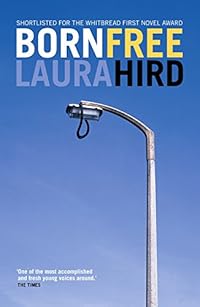
Born Free by Laura Hird

Canongate, 2001, 285 p. Borrowed from a threatened library. One of the 100 best Scottish Books.

 Born Free cover

If any proof were needed that the Scottish novel has escaped the confines and restrictions of Calvinism this book would provide it. Not that talk of religion is entirely absent but it is – more or less – restricted to its “proper” (as one of the narrators has it) sphere: football. The book is told from the four viewpoints of the Scott family, nearly sixteen year-old Joni, her fourteen year-old brother Jake, father Vic and mother Angie. Their hedonistic carryings-on range from Joni’s shoplifting and stealing of the bill money from beneath her mother’s mattress, Jake’s incessant playing of console and PC games and Angie’s alcoholism. Only Vic is free of what might be termed vice – but he is on Prozac.

There’s no sign here of the Scottish writer’s love of landscape description (most of the action takes place in Edinburgh) and not much of two of the three great novelistic concerns but the same cannot be said of the third. The novel is riddled (or should that be raddled?) with sex; from Joni’s determined efforts to lose her virginity before she’s legal, Jake’s adolescent thumbings-through of increasingly sticky-paged magazines, Vic’s Prozac-numbed lack of interest, Angie’s drunken couplings with Raymond, her boss at the bookie’s, and Last Bus Lil’s desperate cravings for bus drivers. In passing there is also, “Sean says the priest in there’s an old paedophile and shags all the bairns from Sunday School.” Born Free was published in 1999; well before the recent scandals broke. Wayward priests were it seems something of an open secret.

The narrative promises to be about the family dynamic – especially its breakdown – and in this respect Raymond’s disappearance in suspicious circumstances threatens to take the book in a different direction but it is the fulcrum that provides the precipitating crisis.

Joni’s thought that, “Virginity’s far too good to lose just once,” is a striking phrase. So too is Vic’s when he thinks about the “coronary problems on both sides of the family” and reflects, “Our hearts get us every time.” This is a novelistic formulation but in a novel where the main characters treat each other with the contempt born of too much familiarity stands out as overworked.

Earthy, unsentimental and above all true to its characters, who live and breathe (not to mention function bodily) in front of our eyes, Born Free is a brilliant observation on Scottish city life in the late twentieth century.

Pedant’s corner:- a crowd gather round (gathers,) Head Office really frown upon such losses (frowns,) chippolata (chipolata,) “How could Dad have ever have … (“have ever”, or “ever have”; not “have ever have”,) “I’m determined not to let her phase me” (faze me,) “for a another drink” (no “a”,) he wants me to got through (go through,) “he promises to will phone round” (no “will”; or “he promises he will”,) “I try not the think” (not to think.)

free hit counter script