Archives » Kim Stanley Robinson

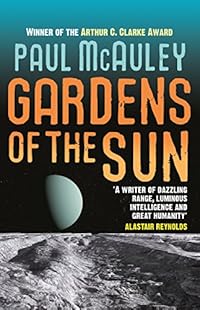
Gardens of the Sun by Paul McAuley

Gollancz, 2009, 440p.

In the aftermath of The Quiet War, the Outers -€“ humans altered to cope better with living in the further reaches of the Solar System – have been driven beyond the moons of Jupiter and Saturn. Parts of Gardens of the Sun are set in bubble habitats round Uranus, Neptune and Pluto or on wandering asteroids but the action, such as it is, also ranges back to Earth. This division of humanity – which also includes so-called Ghosts who follow a mystic claiming to have messages from the future – is the source of conflict in the novel. There are several sub-plots including the ongoing search for the gene wizard Avernus, one of the many characters from The Quiet War to reappear here, along with others such as Sri Hong-Owen, Macy Minnot, Loc Ifrahim, Felice Gottschalk and Cash Baker. The gardens of the title turn out to be habitats gengineered by Sri Hong-Owen to allow life to be easier amid the harshness of space.

Despite there being enough in this book to fill a whole series of novels, reading this one was hard going. The different characters’ stories are too remote from each other, even if some do overlap by the end, and are not in any case the main focus of the narrative which often reads like a history of the future (except with use of the pluperfect – usually a sign more is being crammed in than the story can bear.) It is in effect one long info dump and the scenes where the characters interact seem like addenda.

McAuley’€™s future environment is impressively detailed, though, as indeed was Kim Stanley Robinson’€™s in his 2312 which tended to neglect plot. It’€™s a pity we’re told most of it instead of being allowed to experience it.

Clarke Award Shortlist

Last year it was Chris Priest who incited controversy over the Clarke Award, this year it seems to be the judges themselves – for not including a book by a woman on their shortlist.

The contending books are:-

Nod by Adrian Barnes (Bluemoose)
Dark Eden by Chris Beckett (Corvus)*
Angelmaker by Nick Harkaway (William Heinemann)
The Dog Stars by Peter Heller (Headline)
Intrusion by Ken MacLeod (Orbit)*
2312 by Kim Stanley Robinson (Orbit)*

I’ve read the last two of these and Dark Eden is on the TBR pile.

The overlap with this year’s BSFA Awards novel short list is strong (asterisked titles) but only 2312 is also up for the Hugo.

I’m a bit surprised that M John Harrison’s Empty Space didn’t make the list, it’s the sort of book that Clarke Award juries tend to like.

Hugo Awards Short Lists

The Hugo is effectively the world’s Science Fiction award but it’s usually a North American fiefdom. The awards are presented at the World Science Fiction Convention, which, this year, is Lone Star Con 3 on whose website all the nominations can be found.

Unlike the BSFA Awards the Hugo splits non-novel SF into three categories as below.

Best Novel
2312 by Kim Stanley Robinson (Orbit)
Blackout by Mira Grant (Orbit)
Captain Vorpatril’s Alliance by Lois McMaster Bujold (Baen)
Redshirts: A Novel with Three Codas by John Scalzi (Tor)
Throne of the Crescent Moon by Saladin Ahmed (DAW)

Best Novella

After the Fall, Before the Fall, During the Fall by Nancy Kress (Tachyon Publications)
The Emperor’s Soul by Brandon Sanderson (Tachyon Publications)
On a Red Station, Drifting by Aliette de Bodard (Immersion Press)
San Diego 2014: The Last Stand of the California Browncoats by Mira Grant (Orbit)
“The Stars Do Not Lie” by Jay Lake (Asimov’s, Oct-Nov 2012)

Best Novelette

“The Boy Who Cast No Shadow” by Thomas Olde Heuvelt (Postscripts: Unfit For Eden, PS Publications)
“Fade To White” by Catherynne M. Valente (Clarkesworld, August 2012)
“The Girl-Thing Who Went Out for Sushi” by Pat Cadigan (Edge of Infinity, Solaris)
“In Sea-Salt Tears” by Seanan McGuire (Self-published)
“Rat-Catcher” by Seanan McGuire (A Fantasy Medley 2, Subterranean)

Best Short Story

“Immersion” by Aliette de Bodard (Clarkesworld, June 2012)
“Mantis Wives” by Kij Johnson (Clarkesworld, August 2012)
“Mono no Aware” by Ken Liu (The Future is Japanese, VIZ Media LLC)

Remarkably I have read two of the novels, but that is thanks to Interzone and its reviews editor, Jim Steel.

It is notable that only one novel (2312) and one short story (Immersion) appear both on the BSFA short list and the Hugo.

BSFA Awards 2012

The BSFA Award shortlist for stories published in 2012 has been announced.

For best novel we have:-

Dark Eden by Chris Beckett (Corvus)

Empty Space: a Haunting by M. John Harrison (Gollancz)

Intrusion by Ken MacLeod (Orbit)

Jack Glass by Adam Roberts (Gollancz)

2312 by Kim Stanley Robinson (Orbit.)

Unusually I have read three out of the five already, two of those courtesy of Interzone and its kind reviews editor. Thank you, Jim.

My views on 2312 I posted on this blog only two days ago. Those on Empty Space will be forthcoming.

Intrusion I reviewed here.

As for the short stories I have read only one of them so far, the last on this list; and very good it was too.

Three others, though, are available to read on the net. Doubtless the BSFA will be producing its usual booklet.

Immersion by Aliette de Bodard (Clarkesworld no. 69)

The Flight of the Ravens by Chris Butler (Immersion Press)

Song of the body Cartographer by Rochita Loenen-Ruiz (Phillipines Genre Stories)

Limited Edition by Tim Maughan (1.3, Arc Magazine)

Three Moments of an Explosion by China Miéville (Rejectamentalist Manifesto)

Adrift on the Sea of Rains by Ian Sales (Whippleshield Books)

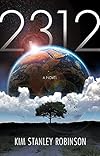
2312 by Kim Stanley Robinson

Orbit, 2012, 561p. Reviewed for Interzone 242, Sep-Oct 2012.

Note: this is not how the review appeared in Interzone. The post below is 650 words or so long. Due to a mix-up over Interzone’s move to a new page size their reviews editor had to cut 150 of these.
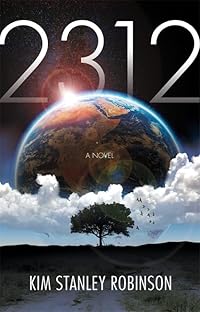
 The Intrusion cover

The Solar System has long been colonised; from asteroids inside the orbit of Mercury out to the mining of the Oort cloud. Earth is garlanded with space elevators and its billions of mainly impoverished inhabitants are resentful of the easier life they imagine spacers enjoy. The planet has succumbed to global warming – there is a nice vignette of an inundated New York as a kind of stalagmitic Venice (though I would have thought storms would have ravaged the skyscrapers quite quickly.) Terraformed asteroids – either hollowed out and spun up “innies” or tented over “outies” – provide habitats for the growth of food (much of which helps to supply Earth,) the preservation of animals now extinct on the home planet, or as spaceships for fast inter-system travel. Politically the structure is Balkanised with habitats jealously guarding their own interests and playing each against other. Humanity too is splintering as a proto-speciation of humans with different statures has developed as a result of the different living environments that abound. Medical advances mean limbs can be regrown, life span has increased, gender become more plastic. Quantum computer AIs known as qubes control many processes, some are utilised as wrist aids or even via head implants. 2312 has no lack, then, of Science-fictional ideas with which to tickle the sense of wonder. The characters’ longevity is almost incidental, though, as apart from not seeming to worry about their children they do not behave very differently from at present. Despite being well over one hundred they act as if they’re in their twenties or younger. This may be how long life spans affect us, of course.

The narrative follows four viewpoint characters; Swan Er Hong, a gynandromorph who lives on Mercury and whose grandmother’s death leads off the story; police Inspector Jean Genette, a so-called small; Fitz Wahram, an androgyn, and Kiran, a young earthman who rescues Swan from possible kidnapping on one of her visits to Earth. The – plot such as it is – hinges on whether or not the qubes are developing consciousness and designs of their own; even manifesting themselves as androids, possibly as terrorists. It is a feature of the narrative that we see the characters caught up in events, variously imperilled, but never quite at the centre of things; which is like life. This is not the usual mode in SF but none the less welcome for it.

Since his Mars trilogy Robinson has rarely borne his research lightly. Here the “story” chapters are variously separated by descriptions of eight (sub)planetary bodies/habitats, fifteen lists, eighteen extracts from an apparent history written well after the events of the novel and three “quantum walks.” It is a style which largely circumvents the crudities of information dumping by parading them as a strength. It is not an entirely new approach to the problem. Robinson credits John Dos Passos in his acknowledgements and, within SF, John Brunner employed a similar technique in Stand on Zanzibar.

In pursuit of this the novel ranges all over the solar system from Terminator, a city constantly on the move over the surface of Mercury, out to Io, back and forth to Earth, taking in Venus, Saturn’s cloud tops, Titan, Pluto and various interplanetary terraria, surfing the gravity wave on Saturn’s F ring along the way. The main fault with all this is that it can seem the narrative has been designed to show off the research. At one point Swan says, “All right. I will. But I’m going to take the long way there.” But she is, in our terms, old, and she has time.

Without these interpolations between the chapters, though, the book would have been much less impressive.

In 2312 plot and characterisation are not Robinson’s primary concern. It is the solar system – to which, as one of the interludes reminds us, humanity is bound by the vastness of interstellar space – that is his hero.
Goodbye 2012

I don’t usually do end of year round-ups – mostly because most folk write theirs before Christmas and that offends my sensibilities. The year ends on 31st Dec, not before.
Whatever, I looked through all the fiction books I read this year and found twelve that stood out. In order of reading they were:-

PfITZ by Andrew Crumey
Zoo City by Lauren Beukes
The Master and Margarita by Mikhail Bulgakov
The Song of Achilles by Madeline Miller
The Kings of Eternity by Eric Brown
the Tiger’s Wife by Téa Obreht
And The Land Lay Still by James Robertson
The Museum of Innocence by Orhan Pamuk
Redemption in Indigo by Karen Lord
New Model Army by Adam Roberts
Galileo’s Dream by Kim Stanley Robinson
D’Alembert’s Principle by Andrew Crumey

That’s four by women and eight by men, which is a pretty high strike rate for the distaff side compared to my fiction reading as a whole, 12:45 – is that shockingly low or a reflection of publishing? Four were SF, eight not; though that ratio alters if you count the fantastical – the Lord, the Obreht, the Bulgakov, and the Crumeys which feature stories from a city made up within one of the two. Only the Robertson and the Pamuk lie wholly within the realm of the naturalistic.

I don’t propose to rank the twelve in any way.

Interzone 242

2312 cover

After a few difficulties with the printing of the issue I believe Interzone 242 has now been published. This is the edition which contains my review of Kim Stanley Robinson’s 2312.

Details of the printing problems have been posted on Interzone’s web page. Who’d be a small publisher?

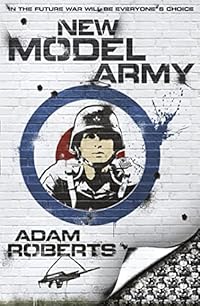
New Model Army by Adam Roberts

Gollancz, 2010, 282p.

 New Model Army cover

You know that you’re reading something a bit out of the ordinary when the first sentence of a novel is “I am not the hero of this story.” Whether or not this statement is reliable is a question that can only be answered by reading the whole but, coupled with the narrator’s knowingness about how a novel ought to be structured, shows a strong authorial awareness of his craft. It is a consciously literary sentence and the novel as a whole bears out its promise. I didn’t much take to Roberts’s 2011 novel By Light Alone but was more impressed by his much earlier Stone. A back cover quote on New Model Army from Kim Stanley Robinson says, “Roberts should have won the 2009 Booker Prize.” (That would have been for Roberts’s prior book Yellow Blue Tibia which I have yet to read. New Model Army has literary claims to have won it in 2010. I can see why it was not considered, though.)

The New Model Army of the title, whose members have named it Pantegral, is – like other NMAs of its sort – a truly democratic one. Enabled by the internet – its communications and information web is referred to as a “Wiki” throughout – to communicate and discuss in real time, they vote on proposals on tactical and strategic matters and act on the majority decision. This contrasts with the hierarchical, feudal structures of the traditional state army against which it fights – and repeatedly defeats.

The battle sequences are believably described though the background to the war that is taking place in a disintegrating UK is a trifle – if amusingly – far-fetched. In addition the ease with which the NMA’s members access advanced ordinance wasn’t fully obvious, the rest of life in England, which is where the first segment is set, seems little different from the present where such access is limited to say the least. (Or I hope it is.)

An echo of Stone is in the narration. Here the narrative is a kind of memoir addressed as if to a US colonel by whom Block is being interrogated and who wishes to use him as a weapon against NMAs. Unless we are to infer that later Block returns to the US this doesn’t quite work in the second long section when Block falls into the hands of an Alsatian NMA known as Schäferhund, nor in the very much shorter third segment.

New Model Army has important things to say about why wars occur and the nature of humanity – what we do in general and why we do it. Treating not only with the evolution of humanity beyond feudalism into the “giants” of the NMAs but also with the literary perennials of love and death, it packs a lot into its 282 pages.

(Unfortunately there was a span count of 3, though; plus 1 “lay.”)

Reviews, Reviews

Fever cover
2312 cover

My review of Lauren DeStefano’s Fever can now be read in Interzone 241 (Jul-Aug 2012.)

I will publish it here after a decent interval.

I have also submitted my review of Kim Stanley Robinson’s 2312, due to appear in Interzone 242 (Sep-Oct 2012.)

2312

2312 cover

My latest book for review in Interzone has thumped on the doormat – and when I say thumped I mean thumped.

It weighs in at 561 pages and I’ve to review it in 650 words by July 31st for inclusion in Interzone 242.

It’s by Kim Stanley Robinson and is entitled 2312.

I fancy (and I may be taking a wild stab in the dark here) it’s probably set in, em, 2312.

free hit counter script