Archives » John Christopher

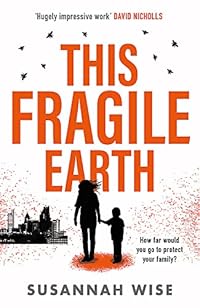
This Fragile Earth by Susannah Wise

Gollancz, 2021, 356 p. Reviewed for ParSec 1.
In the 1950s and up to the mid-1960s British SF consisted mainly of stories of worldwide disaster – a subgenre which Brian Aldiss somewhat unkindly dubbed cosy catastrophes – whose most prolific contributors were the Johns, Wyndham and Christopher, but also to which, at a stretch, J G Ballard’s early novels could be assigned. While the disaster story never disappeared completely the vogue did ebb and British SF began to cleave the paper light years with the best of them.

In recent times SF writers more generally perhaps sensed the coming contagion. Emily St John Mandel’s Station Eleven helped to revive the concept of a fictional worldwide disaster and Caroline Hardaker’s Composite Creatures (also reviewed for ParSec 1) has elements of the form. In this book Susannah Wise inhabits that global catastrophe tradition full on – and in a British context.

It is an altered Britain though, which has a heavy Chinese influence. Six year-old Jed’s schoolteacher is a Miss Yue, a supermarket chain is called Lianhua, noodles and rambutan are common foods and a mysterious company called Shīluò zhì lurks in the background.

The common elements of the catastrophe novel are present: communication breakdown, food queues, barricaded roads, troops on the streets. Less usual ingredients here are that bees have gone extinct (though attempts have been made to restore them synthetically) with their pollination tasks in the meantime replaced by tiny drones; following on from beetle blight a rampant disease called Bovine Staph is apparently transmitted through rainwater and can affect humans; venturing outdoors requires UV goggles to be worn to protect against eye damage from sunlight; the currency is exclusively digital – Litecoin spent via Lite-cards.

Pre-disaster just about every service is accessed wirelessly or via AI robots such as BinX, DoctreX, MediX and WaitreX. GScopes, mediated by a system named GQOS, have replaced mobile phones. Roads are constructed from fibre-glass panelling and road signs are exclusively electronic. Agrico-bots roam the countryside.

Then one day the drones start to malfunction, the electricity goes off and everything shuts down. Viewpoint character Signy comes home to a fridge in meltdown, its food rotting. Despite the resultant lack of amenities her partner Matthew keeps saying things will be all right “tomorrow” but one night, while Signy and Jed hide in the loft, Matthew confronts burglars at their house and is killed. Signy sets off from London with Jed to try to reach her mother’s home in Northamptonshire – by bicycle. Along the way they meet the usual assortment of people who either help or steal from them but also uncover the importance of TrincXcode and its links to musical form.

Wise’s writing is fine but in what is presumably a striving for immediacy she exhibits an over-fondness for verbless sentences. Like this one. Her characterisation is generally convincing enough but her portrayal of Jed is inconsistent. As indications of his youth he sometimes has to have words defined to him and he refers to “Mr Mack Wrecker” from the Peter Rabbit books but he also comes out with absurdly adult phrases supposedly remembered from Miss Yue. Things like, “Quantum field which allows the system to work out infinite possibilities,” and, “The system can work out in milliseconds every possible outcome that can happen from any action it takes in multiple universe models and make the best choice.” OK, the reader is getting the info dump but these sentences read as unlikely to come from the mouth of a six year-old, however tech savvy. There is also his memory from three years earlier of his grandfather telling him something “terrible and important,” to wit, “TrincX is the birth of true Artificial Intelligence – God’s daughter come to walk on Earth,” a warning now come true.

This central role of AIs in the background of the narrative has the effect of making the book’s resolution a literal deus ex machina, or, rather, dei ex machinae. Whether that makes it cosy or not is a fine judgement but it certainly leans towards it.

Pedant’s corner:- GQOS’ (GQOS’s,) “the Orkneys” (the locals prefer the designation Orkney, or, the Orkney Islands,) “more combustible that the old carbon boiler” (than,) gotten (in dialogue? In Britain?) Signy rushes out the front door with no mention of its mechanism previously not working due to the shutdown of communications, hummous (hummus.) “‘Danny!’.” (doesn’t need that full stop, the exclamation mark provides that function.) “It lay uncertain rays across” (It laid uncertain rays,) “‘I bought it from home.’” (brought it.) “‘It’s wasn’t Lau Chen was it?’” (‘It wasn’t’.)
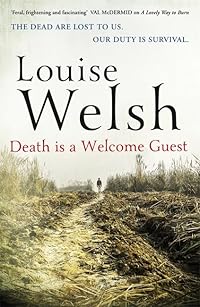
Death is a Welcome Guest by Louise Welsh

John Murray, 2015, 380 p.

This is the second in Welsh’s Plague Times trilogy (see here for my review of the first) written pre-Covid. To read it in the midst of a pandemic is odd but the similarities are outweighed by the differences. “The sweats” is at once both more virulent but more forgiving than Covid. Those who die succumb quickly, those who survive do not experience lingering symptoms.

Avoiding the usual hazard of middle books of three Welsh cleverly has a different viewpoint character from A Lovely Way to Burn. This is Magnus McFall, sometime comedian, who witnesses the first manifestations of “the sweats” while playing down the bill to a much more successful comic. His reflection that “London had not closed for the Blitz, the IRA, or al-Qaeda. It would take more than a few germs to shut down the city” is of course not borne out by our own pandemic experience.

On his way home after a gig he prevents the rape of a girl but is himself mistaken for the rapist and so finds himself in jail awaiting trial. Not a good place to be at the outset of a pandemic. When his cellmate dies he is placed in with Jeb who is in the sex offenders wing and garb. It later transpires Jeb is in solitary because he was a policeman found guilty of murdering the woman whom he had a relationship with on an undercover assignment.

Their breakout of jail is brutal – not least to other inmates – and they make their way into the country on motor bikes using back roads, with Magnus aiming to return to his home in Orkney. Several close encounters ensue before the pair end up at Tanqueray Hall, a big house containing a small religious group led by the elderly Father Wingate. We have here almost the perfect closed community, the setting for many a crime story. And the murders have already started.

The breakdown of civil life is a staple of apocalyptic tales, as is attempts to restore order by harsh actions. To a certain kind of mind catastrophes are soon latched on to as a manifestation of God’s punishment for wickedness. The ideas that a Supreme Being could be benevolent and that disasters can occur to the innocent, are beyond that mind set. The fact of survival is no guarantee of innate goodness, and it can of itself unhinge the survivor.

Character is a tricky aspect of the post-apocalypse tale. Norms of behaviour may change as a result of the event, but some human constants will remain so. Welsh’s scenario is the classic one of the SF so-called ‘cosy’ catastrophe, albeit with a modern twist and an added dash of crime (which itself is a concept liable to undergo change in the aftermath.) There are inevitable echoes of John Christopher in Death is a Welcome Guest even if Welsh has never read him (though I suspect she has.) She certainly knows how to keep the reader turning the pages. It remains to be seen whether in the third of the trilogy the expectations of that sub-genre are fulfilled.

Pedant’s corner:- “(how many hours ago?).” (that full stop after the bracket is unnecessary. The question mark acts as a marker for the end of the sentence.) “A series of tabloid headlines were riffling through Magnus’s mind” (A series was riffling. Extra points for ‘Magnus’s’ though.) “Wylie Coyote” (that cartoon character is Wile E Coyote,) “vodka and tonics” (tonic is an adjective here so cannot be made plural; ‘vodkas and tonic’, or ‘vodkas with tonic,) snuck (sneaked. Please,) “hooching with them” (usually spelled ‘hoaching’ or sometimes ‘hoatching’,) staunch (stanch.)

A Wrinkle in the Skin by John Christopher

Hodder and Stoughton, 1965, 218 p.

A Wrinkle in the Skin cover

John Christopher is perhaps best remembered for his Tripods series of books for young adults but also contributed to the British sub-genre of “cosy catatstrophe” most mined by the other John (Wyndham.) A Wrinkle in the Skin falls firmly into the catastrophe category as a series of giant earthquakes befalls the world. (From a modern perspective Christopher’s description of the cause of earthquakes was obviously written before the theory of plate tectonics was fully established.)

Matthew Cotter is a widower living in Guernsey when the earthquakes hit. After living through the ’quakes, his aim is to try to find his daughter who was living somewhere in England before the catastrophe. He first joins a small group of survivors one of whom acts as a kind of petty king intent on keeping the best female to himself to ensure any sons that ensue are recognized as his and regards Cotter (whose relative lack of interest in the opposite sex was established in the short pre-disaster chapter) as his right hand man. It is here perhaps that the sexual attitudes of the time A Wrinkle in the Skin was written (of time immemorial?) are most obvious as a woman who is a willing sexual partner for most of the others is referred to in the text in crudely dismissive terms.

Soon Cotter escapes to strike out on his own but is followed by a pre-pubescent boy whom he had earlier managed to rescue from a damaged building and for whom he now has to take responsibility. The English Channel has disappeared in the vast upheaval and they can walk across the old sea bed. During this sojourn they come upon a more or less intact oil tanker deposited on the new land, inhabited by a captain who has gone slightly mad.

Making it to England they hit upon a group who recognize them as non-threatening and take them in. The group seeks to hide both themselves and their stash from bands of marauders but of course can not always be successful. One such raid takes place when Cotter and many of the others are away from the camp on a food search. They arrive back in time to prevent the attackers from unearthing the food and Cotter uses a shotgun to drive them off, wounded or not. However, he later learns from one of the women of the new accommodation she has had to make to those gangs of men who chance upon her and the contempt in which she holds all men for their appetites. In a lawless, almost hopeless environment I suppose this is the way it would be.

As I recall the author’s The Death of Grass was somewhat similar in its treatment of the post-apocalyptic scenario.

Pedant’s corner:- “‘You know how to get here?’” (context suggests there rather than here,) Skiopos’ (Skiopos’s,) dark-aureoled (they weren’t aureoles, but areolas,) “he cut if off” (he cut it off.)

free hit counter script