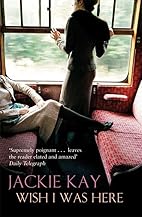
Picador, 2007, 202 p.
I was impressed by Kay’s novel Trumpet last year. This is her second book of short stories. I have yet to read her first. Wish I Was Here has very wide margins so you’re actually getting fewer words than you might think but all the stories are insightful and magnificently readable. There are only occasional intrusions of Scottishness into the narratives.
You Go When You Can No Longer Stay relates the breakdown of the twenty-five year relationship between Hilary and Ruth; a breakdown premonitored by Hilary quoting from Martin Amis – one example of which provides this story’s title. Another such bon mot (which actually is nonsense) is, “All marriage turns into a sibling relationship.”
In What is Left Behind1 a (heterosexually) married woman who has monthly trips away for assignations with a female lover remembers all the rooms they have (not) slept in. This one is written in USian from a USian’s viewpoint.
Wish I Was Here2 has a woman whose best friend has recently found a New Lover (also a woman) wait for the couple to arrive at their holiday hotel. In this story what is not said, what the narrator does not think – what she dismisses – is what is most important.
In How to Get Away with Suicide3 Malkie spends his day trying to think of a way to commit suicide while making it look accidental. This is because his wife has left him for another man, and taken the kids. Among his observations are, “Glasgow’s changed; it used to be a dark city and now it’s light,” and, “it’s only love that matters in the end.”
Blinds features a woman who has recently split up with her partner having a conversation with the man who comes to measure up for the blinds in the terraced cottage she’s just moved into. She feels exposed. Of the woman who waves and smiles into her kitchen she thinks, “We all want friendly neighbours, of course. But too friendly neighbours fill us with alarm and dread.”
In The Silence a man asked by his wife to, “give me a minute’s peace at my breakfast,” tells her, “I’ll shut up, then.” And does. For ever.
My Daughter the Fox3 is a metaphor about motherhood and the disruption it brings. It tells the story of a woman who gives birth to a fox. She names her offspring Anya.
What Ever5 gives us four snapshots from the life of Ina McEwan, each one featuring an encounter with bird life, respectively quails, a little tern, a robin and a gull.
In Not the Queen6 Margaret Dorothy Lockhart is a Glaswegian woman who is the spitting image of the Queen. She has been since birth. It isn’t a happy thing to be.
Pruning.7 A woman whose female partner of fifteen years is having an affair with another woman finally loses it. The last line here is deliciously ironic.
The longest and most affecting of these tales is Sonata8 in which a woman on an all-night train journey through an unnamed Eastern European country hears the story of another. Contains perceptions such as, “The ugly have no rights. They don’t even feel the right to be loved. They feel grateful for the simplest of kindnesses,” and, “And what does it all matter, those petty jealousies compared to a life, a love, what does it matter.”
In The Mirrored Twins9 two male mountain climbers who have become an item set out one day to see the mirrored twins of Ben More and Stob Binnein. One of them observes, “If people just came out and walked up here every now and again, there would be less wars.”
Pedant’s corner:- 1 The song lyric, “Sonny, once so true, I love you-ooo,” is quoted. I always understood that to be ”Sunny one so true.”
2 Unless the narrator is again USian the use of “New Years” ought to be New Year.
3 Despite Malkie being Glaswegian the word bairns is used for his children. Also Kenny Dalgleish should be Dalglish.
4 medieval
5 When first encountered the family is referred to as the McEwan’s but later on the same page – correctly – as the McEwans. “It was the site she returned to, what ever.” I can’t see the purpose in rendering whatever as two words.
6 I hate the formulation “Queen of England.” In its first appearance here it may be forgivable as it’s that woman herself looking in the mirror – but she surely knows well enough she is Monarch of many other countries besides. But for Maggie’s fellow Glaswegian husband to say, “not a bloody person in the whole of England wid be able to tell the difference!” strikes me as unlikely as he’d be more than aware that he didn’t live in England but still had the same Queen. On a train journey south Maggie knew Scotland changed into England “but she couldn’t see the difference properly.” Really? No difference in the patterns of fields, in the appearance and dimensions of houses?
7 ass (arse.)
8 “you have those kind of looks” (that kind – or those kinds.)
9 “there would be less wars” (fewer.)