Archives » George Mackay Brown

Beside the Ocean of Time by George Mackay Brown

Flamingo, 1995, 219 p.

This is a chronicle of life in the Orcadian island of Norday in the years between the World Wars till just after the Second. But it is also a collection of short stories.

Thorfinn Ragnarson is a dreamer. His teacher, Mr Simon, says he can’t seem to teach the boy anything and his father says he’s not good at farm work either. At one point he seems to be channelling Dad’s Army’s Captain Mainwaring when he refers to Thorfinn as, “You stupid boy.”

Not much gets past the islanders. Many of their conversations take place in the island’s shop and post office.

Thorfin has an imagination, though, letting it run wild through history, which is where the short story aspect of the novel comes in. We read his reminiscences of Vikings on the road to Byzantium, a dilapidated knight and his squire travelling to the battle of Bannockburn, the experience of the inhabitants of one of the then new-fangled brochs, an ancestor taking Mara, a selkie woman, as a wife.

Meanwhile, Mr Drummond, the new Minister, surprises the community by being unmarried and letting the Manse fall into grubbiness, scandalises some by, once, treating the men in the pub to a round before inviting them to church and having a young female arrive to stay with him at the Manse. She is taken to by the local ‘person of quality,’ Mr Harcourt-Smithers, riding his horse all over the island. It is not until she is leaving that her relationship to Drummond is revealed. She has nevertheless fired Thorfinn’s imagination again.

The outside world (and impending war) intrudes when government men arrive to survey the land for an aerodrome, whose impact will change the island forever.

The last chapter, Fisherman and Croftwoman, sees the return of Thorfin to the island after being in a POW camp for most of the war (where he began writing, using his earlier daydreams as source material) and of Sophie, a childhood acquaintance, to take the inheritance of a nearby croft.

Like most Scottish literature Beside the Ocean of Time is about loss and change; but it is also about what endures, what makes a community, and acceptance.

Pedant’s corner:- “less worries” (‘fewer worries’ but it was in reported speech so probably true to the speaker,) “Johnny Walker” (the whisky: it’s ‘Johnnie Walker’.)

Borges and Me: an encounter by Jay Parini

Canongate, 2021, 309 p.
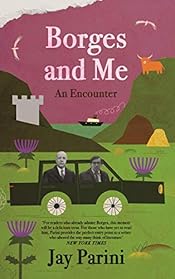
In his youth, as a post-graduate student at St Andrews escaping being drafted to Vietnam and contemplating a thesis on George MacKay Brown (a prospect his tutor deprecated on the grounds that Brown was still alive,) the author, a nervous individual from Scranton, Pennsylvania, with an overbearing mother also to escape, met Argentine writer Jorge Luis Borges, who was on a visit to the town to meet a local academic, Alastair Reid, with whom Parini had formed a friendship. Despite Borges’s fame, Parini had never read a word of his.

The book is constructed, and reads, like a novel, starting with a recounting of the author’s learning of Borges’s death one morning fifteen years, plus a wife and three sons, later, triggering memories of the impact Borges had made on him. Borges and Me goes on to relate the circumstances of that meeting, the car journey through the Highlands with Parini acting as the blind Borges’s eyes it led to, and how it changed him. Thirty-six years on from that, Parini was encouraged to write it all up as a complete narrative. Such a tardy account cannot be in all respects absolutely accurate, some elisions and compressions must occur. Parini’s afterword uses the phrase ‘novelistic memoir’ to characterise it. As a result the book is therefore probably more effective than a pure memoir.

In many ways the title is apposite. Borges and Me is really more about Parini than Borges. His mother on learning of his proposed transatlantic destination said, “‘Are you crazy? Nobody goes to Scotland!’” but relented, saying, in recognition of his avoiding the Army, “‘At least you’ll be safe in Scotland, though Scotch girls have a bad reputation,’” (really?) “‘and the men apparently wear skirts.’”

We hear of Parini’s preoccupations of the time; the unread letters from the draft board he stuffed in a drawer, his learning to use the word ‘rucksack’ for ‘backpack’ and what he describes as the pretentious ‘garden’ for ‘yard’, his struggles connecting with women.

The descriptions of St Andrews are of course very familiar to me. But Alastair Reid’s warning to Parini, contrasted with his experiences in the Pacific War (World War 2 was still a huge presence in so many lives in the 1960s and 70s,) “‘Remember, this isn’t a university, it’s a film set. Don’t be fooled. The lecturers, even the students, are actors. They’re here to attract tourists,’” is only partly true. St Andrews has the golf as well to do that.

An anecdote Reid told him prompted the thought, “Was this the essence of storytelling? Did one simply have to relate a tale in a believable fashion, with the authority of the imagination?” Which is of course a comment on the present enterprise – and of fiction writing in general.

And there are reflections on the Scotland of that age. Reid says, ‘What I don’t like about Scotland is that virtue is taken for achievement. And narrowly defined. We’re always judged in this fucking country…. They don’t even take off their clothes to fuck here.’ This last prompted Reid to suggest special Scottish pyjamas, with flaps in the appropriate place so that the deed could be done as secretively as possible.

(Aside. Actually I read once that the Inuit peoples of the Arctic have clothes that are indeed equipped in such a way; but that would be for purely practical purposes, to avoid the cold, not as a moral imperative.)

As portrayed here Borges was a formidable personality with an intimidating breadth of knowledge – among other things he corrected Parini’s pronunciation of Scone (Palace.) “‘It rhymes with spoon. It’s a Pictish word’” – and also aware of his own mortality. The failings of the body did at one point lead to a comic episode in a B&B in Killiecrankie. The only toilet was off the bedroom of the widowed lady proprietor and Borges had consumed a few pints.

Parini does not pity Borges his blindness as it in some ways freed him. “No wonder he lived so fully in the great room of his mind.”

At one point Borges apparently stated, “‘Israel as a state inspires me. An intractable situation, very sad, unsolvable with Palestine: competing and equally valid claims.’” Intractable indeed.

He also had an old man’s wistfulness for the loves of his youth (and present) Doña Leonor and Maria Kodama, a contrast with the young Parini’s stated lack of experience

The final stop on the car journey, for a pilgrimage across Drumossie Moor, the battlefield of Culloden, has poignant resonances, though I must say the tourist facilities there have changed a lot since that time. Parini describes them as basic indeed. When I revisited a few years ago the visitor centre was as bright and commercial as you would find anywhere.

But Borges’s influence was profound.  “One felt somehow more intelligent, more learned and witty, in his presence. The universe itself felt more pliable and yielding, and so available.”

Borges and Me is a delightful book. An elegant tribute to the great man, a tribute to the uncertainties of youth and the potentially beneficial upshots of unexpected encounters.

Pedant’s corner:- mostly written in USian. “Orkney, a remote island off the north coast of Scotland” (Orkney is an archipelago, not a single island,)  bandanna (x 2, bandana,) “a tony girls’ school in Kent” (??? Tiny? Tory?) “in pigeon Spanish” (pidgin Spanish that would be,) “following the M 90 through the town of Kinross” (the M 90 bypasses Kinross, you have to make a small detour to go through the town,) crenulations (as a castle feature it’s spelt crenellations,) “a lunch of mulligatawny and cheese rolls” (I hope it was mulligatawny soup and cheese rolls; a filling of mulligatawny and cheese does not sound appetising,) “he invariably shined warmth on his characters” (shone warmth,) “chomping at the bit” (it’s champing.) Robbie Makgill (more likely McGill,) “‘We played hooky’” (supposedly said by a Scot. It’s not a phrase we use for truanting, ‘dogging it’, ‘bunking off’, or ‘plunking’, as it was called in my youth.)
Vinland by George Mackay Brown

John Murray, 1992, 238 p.

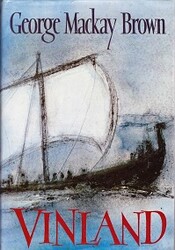
The book’s title is a misnomer as only the first section, in which young Ranald Sigmundson stows away on Leif Erikson’s ship, is actually set in any way at all in that fertile countryside. Even that sojourn is fleeting since one of the Norsemen, Wolf, reacts violently in an encounter with the indigenous skraelings as a result of which good relations are never restored. Brown takes this chance to put into Leif Erikson’s mouth a speech about how the arrival of Europeans will spell doom for the natives.
The novel is the tale of Ranald’s life, taking in his prowess as a horseman winning a race in Greenland, the brief stop in Vinland, a trip to Norway where he meets King Olaf (proud of his self-appointed status as the bringer of Christianity to Orkney,) returning to Orkney before a trip to Ireland as part of Earl Sigurd’s campaign against Brian Boru at the Battle of Clontarf (a disaster for the Orcadians but also for Boru personally,) settling in his farm at Breckness. The final, valedictory, section is titled Tir-nan-og.

Much of the intrigue of the book is taken up with the internal duels of the sons of Earl Sigurd to rule in Orkney. A matter complicated by the fact that the supreme ruler is the King of Norway and he too wants his slice. Three of Sigurd’s sons hold the islands more or less equally, but one, Thorfinn, also has lands in Caithness and Sutherland for which he pays homage to the King of Scots. Feudal land inheritance was a nasty business.

If in the end he is neglectful of his wife Ragna, since he becomes ever more reclusive as the cares of the world wear on him, Ranald lives out his life as a good man. Brown has given us here a picture of life in the Viking world just this side of the cusp of Christianity. In human relations not much has changed since.

Pedant’s corner:- “the dice was loaded against him” (‘dice’ is the plural [of die], ‘the dice were’,) “laying less eggs” (fewer eggs.)


Hawkfall by George Mackay Brown

Triad Granada, 1983, 253 p.

This a collection of stories all set in the author’s homelands of Orkney. Each is a beautifully rendered snapshot of life in those Northern islands

The title story, Hawkfall, is told in five parts, illustrating the history of Orkney in stages, showing aspects of life – and death – there from ancient times through those of the Vikings, the brutal, rapacious Earl of Birsay, the Napoleonic Wars and the early twentieth century.

The Fires of Christmas relates two historical violent confrontations in the Great Hall of Ophrir, which occurred eighty nine years apart.

The subtitle of Tithonus, Fragments from the diary of a Laird, outlines its structure. The Laird in question had inherited the Hall (a big house) on Torsay from his great uncle, along with two hundred pounds a year. By the end of the story, among many other changes, that sum is exiguous and the Hall is falling apart. It is his interactions with the locals that have most attention, particularly those with the schoolmaster, the Minister, the local gossip and Thora Garth, the only child of Armingert and Maurice, arriving after twenty-one years of marriage, who later causes a scandal by jilting her fiancé and shacking up with a ferryman. The tale has a neat twist at the end.

The Fight at Greenay occurred after the men of Harray, on their way to the sea to harvest seaweed to use as manure, had been insulted by the men of Birsay, reluctant to let strangers across their lands, in the halfway inn where the Harraymen had stopped for refreshment.

The Cinquefoil is told in five parts (Unpopular Fisherman, The Minister and the Girl, A Friday of Rain, Seed, Dust, Star and Writings,) in which are laid out the various relationships over time of the narrators of each and their acquaintances/friends/lovers. As a result it encapsulates the closeness and complexity of island life as a microcosm of life in general.

The Burning Harp is described as a story for the eightieth birthday of Neil Gunn. In 1135 a cottage is set on fire by intruders, who decide to let out, in turn, children and servants, a priest and finally a poet whose singing they heard and recognise as that of Niall of Dunbeath. (His songs mirror those of Gunn’s stories.)

To anyone familiar with Scottish folklore Sealskin’s title tells the reader more or less all. It is impeccably told though. A man finds a sealskin on the beach and stores it in his barn. A day or so later he encounters a naked woman swimming by the shore. She has no knowledge of the language and he takes her in; to the great ire of his mother. Marriage and children ensue. Years later he discovers the skin again and the inevitable happens. An afterword mentions the tale was inspired by a famed Orkney musician, Magnus Olafson.

The Girl spends an afternoon lazing on the sea-bank almost in earshot of a group of men gossiping while repairing fishing nets and such, till she hears the approaching sound of a motor-bike.

In The Drowned Rose, William Reynolds, the new schoolmaster on Quoylay, is visited on his first night on the island by a young woman in a red dress, looking for a man named John. Reynolds befriends the local minister, Donald Barr, who refuses to elaborate on the woman’s history. She had been the previous schoolmistress, Sarah McKillop, well remembered by her pupils, and it is only a spiteful neighbour called Henrickson who reveals her tragic end, taking great relish in describing what he regards as the scandalous goings on which preceded it and why the islanders had resolved on a male as her successor.

The Tarn and the Rosary shows episodes in the life of Colm, a writer, from his grandfather’s death, through his first trip to the small Loch Tumishun in the centre of the island of Norday, the burgeoning of his confidence and aspirations when his first composition is praised by his teacher, his overhearing a group of men bemoaning the superstitions of Catholics, to his sojourn in Edinburgh trying to write but also attending mass. It’s an almost haunting evocation of Northern Island life.

The Interrogator has set out from Leith to Norday to question the locals about the death of Vera Paulson, found in the sea a month after she disappeared. None of them is very forthcoming. When the girl herself appears – as a ghost – her story does not quite match with any of theirs.

Pedant’s corner:- “and the shore of Firth” (of the Firth,) “a gonner” (goner,) bissom (usually spelled besom,) “it muirburn (its muirburn.) Suppper (supper.)

The Lament: A Scottish Tradition

I mentioned recently in my review of Christopher Rush’s A Twelvemonth and a Day that it fell into that long list of laments with which the Scottish novel is liberally bestowed – going back at least as far as the poem on the state of the nation written on King Alexander III’s death after falling from a cliff in Fife in 1286, but which may well be an oral tradition older still.

This sense of things lost seems to be an itch which Scottish letters is unable not to scratch.

Many of the books on the 100 best Scottish Books list fall into this tradition; of the ones I have read not only the Rush but also Iain Crichton Smith’s Consider the Lilies, Archie Hind’s The Dear Green Place, William McIlvanney’s Docherty, George Mackay Brown’s Greenvoe, Neil M Gunn’s The Silver Darlings, Lewis Grassic Gibbon’s Sunset Song certainly qualify. Arguably Jessie Kesson’s The White Bird Passes also fits the bill; its title certainly does.

Whether this dwelling on things gone by is due to a sense of lost nationhood or not is a matter for debate but the itch is played out not just in Scottish literature, the lament is a major strand in bagpiping and has a long history in song (eg The Flowers o’ the Forest.) The Proclaimers’ Letter From America – “Bathgate no more” etc – is merely a modern take on the form.

Another important strand in the Scottish novel is that of the döppelganger/the supernatural. Here James Hogg’s Private Memoirs and Confessions of a Justified Sinner, which can certainly be seen as a reflection on the duality of the Scots psyche after the Treaty of Union as well as an illustration of Scottish literature’s fascination with the Devil, is the prototypical – and arguably the finest – example though Robert Louis Stevenson’s Strange Case of Dr Jekyll and Mr Hyde is perhaps better known furth of Scotland.

On thinking about all this I realised that, despite being Science Fiction, my own novel A Son of the Rock was also such a lament (though it eschews any truck with the supernatural.) The book was certainly conceived in part as an allegory of the decline of shipbuilding on the Clyde which had occurred in my early lifetime but I had not consciously been aware of any wider resonances while I was writing it. I did though somewhat impertinently consider it as a “condition of Scotland” novel.

Perhaps Scotland’s condition has always been in decline, its writers always noticing what has been, is being, lost. I note here that Andrew Grieg’s Fair Helen is a retrospective lament for the loss of “wit and laughter, music and dance and kindliness” in the Reformation.

My 2015 in Books

This has been a good year for books with me though I didn’t read much of what I had intended to as first I was distracted by the list of 100 best Scottish Books and then by the threat to local libraries – a threat which has now become a firm decision. As a result the tbr pile has got higher and higher as I continued to buy books and didn’t get round to reading many of them.

My books of the year were (in order of reading):-
Bring Up the Bodies by Hilary Mantel
Electric Brae by Andrew Greig
The Thousand Autumns of Jacob de Zoet by David Mitchell
Station Eleven by Emily St John Mandel
Europe in Autumn by Dave Hutchinson
Traveller of the Century by Andrés Neuman
The Affair in Arcady by James Wellard
Flemington and Tales from Angus by Violet Jacob
The Book of Strange New Things by Michel Faber
Ash: A Secret History by Mary Gentle
Young Adam by Alexander Trocchi
Song of Time by Ian R MacLeod
The Gowk Storm by Nancy Brysson Morrison
The Bridge Over the Drina by Ivo Andrić
To Kill a Mockingbird by Harper Lee
Fair Helen by Andrew Greig
The Dear, Green Place by Archie Hind
Greenvoe by George Mackay Brown
The Tin Drum by Günter Grass
Europe at Midnight by Dave Hutchinson
The Cone-Gatherers by Robin Jenkins
A God in Ruins by Kate Atkinson
Go Set a Watchman by Harper Lee
Born Free by Laura Hird
We Are All Completely Beside Ourselves by Karen Joy Fowler

If you were counting that’s 25 in all, of which 15 were by male authors and 10 by women, 8 had SF/fantasy elements and 11 were Scottish (in the broadest sense of inclusion.)

Reading Scotland 2015

A lot of my Scottish reading this year was prompted by the list of 100 best Scottish Books I discovered in February. Those marked below with an asterisk are in that 100 best list. (In the case of Andrew Greig’s Electric Brae I read it before I was aware of the list and for Robert Louis Stevenson his novella was in the book of his shorter fiction that I read.)

Electric Brae by Andrew Greig*
A Sparrow’s Flight by Margaret Elphinstone
The Guinea Stamp by Annie S Swan
The Girls of Slender Means by Muriel Spark
The White Bird Passes by Jessie Kesson*
Attack of the Unsinkable Rubber Ducks by Christopher Brookmyre
Buddha Da by Anne Donovan*
Flemington by Violet Jacob*
Tales From Angus by Violet Jacob
Annals of the Parish by John Galt
The Book of Strange New Things by Michel Faber
Change and Decay in All Around I See by Allan Massie
The Hangman’s Song by James Oswald
Wish I Was Here by Jackie Kay
The Hope That Kills Us Edited by Adrian Searle
Other stories and other stories by Ali Smith
Young Adam by Alexander Trocchi*
The Gowk Storm by Nancy Brysson Morrison*
No Mean City by H McArthur and H Kingsley Long*
Shorter Scottish Fiction by Robert Louis Stevenson*
The Expedition of Humphry Clinker by Tobias Smollett*
Girl Meets Boy by Ali Smith
Fair Helen by Andrew Greig
The Dear, Green Place by Archie Hind*
Fur Sadie by Archie Hind
Greenvoe by George Mackay Brown*
Stepping Out by Cynthia Rogerson
Open the Door! by Catherine Carswell*
The Silver Darlings by Neil M Gunn*
Scotia Nova edited by Alistair Findlay and Tessa Ransford
After the Dance: selected short stories of Iain Crichton Smith
John Macnab by John Buchan
Another Time, Another Place by Jessie Kesson
Consider the Lilies by Iain Crichton Smith*
The Thirty-Nine Steps by John Buchan*
Poems Iain Banks Ken MacLeod
Mistaken by Annie S Swan
Me and Ma Gal by Des Dillon*
Tea with the Taliban: poems by Owen Gallagher
A Choosing by Liz Lochhead
The Cone Gatherers by Robin Jenkins*
Born Free by Laura Hird*
the first person and other stories by Ali Smith

That makes 42 books in all (plus 2 if the Violet Jacob and Archie Hind count double.) None were non-fiction, 3 were poetry, 2 SF/Fantasy, 19 + (4x½ + 3 doublers) by men, 13 + (3 doublers and 1 triple) by women, 2 had various authors/contributors.

Greenvoe by George Mackay Brown

Polygon, 2004, 249 p, plus vi p introduction by Ali Smith.

(Not borrowed from but) returned to a threatened library.

 Greenvoe cover

Of George Mackay Brown, a native of Stromness in Orkney, Wikipedia says “he is considered one of the great Scottish poets of the 20th century.” He nevertheless also wrote plays and prose. This novel, Greenvoe, is in the list of 100 best Scottish Books. While showing many of the characteristics of Scottish writing – the descriptions of landscape and, here, seascapes, a sense of things lost, the pervasiveness of Calvinism – Greenvoe is also distinctly Orcadian.

The novel is set mainly in the titular village on the fictional island of Hellya and follows the lives of its inhabitants over the course of six days, focusing on each in turn. Over time this builds up into a convincing portrait of the village and island life but one of the drawbacks of Brown’s approach is that before we have had the opportunity to get to know them well we are thrown over twenty named characters in the first few pages thus making keeping track difficult to begin with.

The population includes three fishermen, the wastrel Bert Kerston whose wife Ellen feels much put-upon; Samuel Whaness, married to Rachel who bemoans her childlessness and The Skarf (always capitalised) who tells stories of the island’s history in the hotel bar every night. There is a concupiscent ferryman, Ivan Westray; hotel-keeper Bill Scorradale, who substitutes the whisky; an alcoholic minister, Simon McKee, whose mother, racked with guilt, daily imagines her trial on various charges; the local posh girl, Inga Fortin-Bell, home for the holidays; shopkeeper Joseph Evie and his wife Olive; the frustrated schoolmistress Miss Inverary; Alice Voar, “Every man in Hellya has lain with her,” the mother of seven children (each with a different father); elderly Ben and Bella Budge; meths drinker Timmy Folster; and a mysterious hotel guest who sits typing away all day in his room. On the third day the travelling salesman Johnny Singh arrives to make the annual rounds. This section, entirely narrated from his point of view in the form of a letter to his uncle Pannadas – the usual salesman – gives an additional perspective. In it he says, “The island is full of ghosts.” This is a foreshadowing. For like many classic Scottish novels Greenvoe is an elegy. The island life shown here is on its way out – and not merely due to the Government project, Dark Star, which arrives to hollow out the land and cover it with wire fencing. Each chapter of the book (bar the last) covers a single day and ends with a description of the (all different) initiation rites of the Ancient Mystery of The Horsemen.

In her introduction Ali Smith suggests that the core of the book is in the one character who never sets foot in Greenvoe, Mrs McKee’s niece Winifred Melville, who has an illegitimate child, refuses to marry the father, becomes a Catholic and makes a living writing novels. This would be to neglect how much island life itself is a pervasive aspect of the narrative, the almost impossibility of true privacy, the inability to avoid gossip, the depredations of the modern world.

To my mind it is Mrs McKee herself who is the fulcrum. In one of his perorations her imaginary prosecutor (in fact Mrs McKee’s conscience) tells us, “’Become a Catholic,’ said Aunt Flora. ‘What’s good about that? If you ask me it’s worse than the illegitimate child.’ Hers is, thank God, the authentic, affirming voice of religious Scotland.” Describing an incident in which Mrs McKee allowed Winnie to shelter from the rain in a Catholic Church he adds, “Mrs McKee – whose hand plucked an innocent girl out of a Highland rainstorm into – Lord have mercy on this poor Scotland of ours – the abode of The Scarlet Woman.” She it was too who introduced her son to drink by way of a medicinal toddy. Such are the scars Calvinism inflicts on the true believer.

Yet Brown also tells us, “The essence of love is pain; deep in the heart of love is a terrible wound.” Perhaps it is this pain, this wound, that Calvinism seeks, on our behalves, to avoid. Literature (thankfully?) does not.

Pedant’s corner:- (Some of these look as if they are mistakes in transcribing a handwritten manuscript.) Greenove (once, for Greenvoe,) ona (on a,) meth (methylated spirits is more usually shortened to meths but Mackay Brown uses it consistently,) “like a toby jug came to life” (come to life,) knit (knitted,) under a wide are (arc,) becareful (be careful,) “whoal” (“whoa!”?) fetor (foetor*,) “ says be to me” (“says he to me”,) blashphemous (blasphemous*,) “This lie glimmers at.” ??? Ceileidh (Ceilidh,) stange (strange?) flat heer (beer,) a lap wing (lapwing,) scorpian (scorpion,) telesceope (telescope,) mantlepiece, (mantelpiece*,) “The Window” (the context suggests a rock, The Widow, twice mentioned higher up the same page,) “Now them, Sidney,” (Now then,) Belia (Bella,) elegaic (elegiac,) “his date of birth ‘ll be in” (birth’ll,) a missing end quotation mark, Aunt Alora (Flora,) Fergus’ (Fergus’s,) “by the rose bush, Her basket was always …” (full stop for comma?) Gaderene (Gadarene?) spur (spar makes more sense,) back and fore (maybe it’s northern thing, then,) a thin keep (since this is of a wind, a thin keen?) “…an hour ago said Bill Scorradale’ He must have…” (“…an hour ago said Bill Scorradale. ‘He must have…”) “corn-beef” usually “corned beef”,) what a fine, big housel (house! ?) Wedgewood cups and saucers (Wedgwood?) Prince Street (Princes Street,) and and (one “and” would suffice,) gableends (gable ends,) but this time (by this time?)
*correctly spelled elsewhere.

free hit counter script