Archives » George MacDonald

The Green Isle of the Great Deep by Neil M Gunn

Polygon, 2006, 276 p, plus 5p Foreword by Diarmid Gunn. First published 1944.

In this book we return to the pairing of Young Art and Old Hector from a novel which I read in 2016.

After a night where the adults of Clachdrum talk about ongoing events in Hitler’s Germany and the terrifying thought that your mind could be broken, the pair go on a fishing expedition.

While attempting to catch a salmon they fall into the pool and apparently drown, waking up in another world, the Green Isle of the Great Deep of the title. This is a place which is recognisably Scottish rural, but with variations. A watcher tells them to travel to the Seat of the Rock and warned only to stay at the Inns along the way.

The land is fertile and fruit abundant but they are warned not to eat it, only to eat at the inns. However, Art is fractious, does not want to stay at the inns and eats the fruit, with no ill effects.

There are, of course, biblical connotations to this, but also questions of free will. On the Green Isle, life is regimented – an allegory of Nazi Germany, true, (there is talk of expansion into other lands,) but equally applicable to the feudally circumscribed life of the Highlands.

While Art makes the most of his ability to roam, escaping the clutches of the authorities Hector falls into their sway. He finds that fruit was forbidden “so that man would be restored to his original innocence,” be without blemish, the perfect worker, do all things he was told to do, all to ensure perpetual order. Hector is told “obedience is the highest of virtues.”

Art is sought out by the Hunt but continues to evade his pursuers, which leads to doubts spreading at the Seat.

There are echoes in the novel of George MacDonald’s Phantastes (though Gunn is much the better writer) and similarities to Gunn’s later novel The Well at the World’s End.

Many of Scottish fiction’s dealings with the fantastic feature meetings with the Devil. The Green Isle of the Great Deep is different in that here Hector demands from the Seat a meeting with God – and gets it. This gives Gunn the opportunity to philosophise about totalitarianism and freedom, knowledge and wisdom, thinking and feeling and the necessity for governance to be tempered by wise counsel, armed with which Hector and Art can return to life in Clachdrum.

Pedant’s corner:- a missing comma before a piece of direct speech, focused (focused,) “spoke to her husband an pointed to” (and pointed to,) “their bodies quivered and shrunk” (and shrank,) ogam (now spelled ogham.)

Wild Harbour by Ian Macpherson

British Library, 2019, 220 p, including a v p Introduction by Timothy C Baker, and Wild September a vi p article by MacPherson. First published in 1936. Reviewed for Interzone 290-291, Summer 2021.
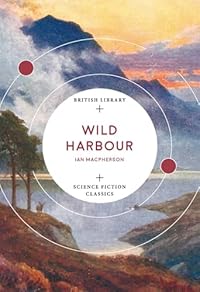
 Wild Harbour cover

In the mid- to late twentieth century Science Fiction by Scottish authors was all but invisible. Only four names spring to mind as being much in evidence at the time; J T McIntosh (who did though manage to publish over 20 SF novels,) Angus McVicar – whose output was aimed at YA readers (such books were called juvenile at the time) – and a reprint in the early 1960s of David Lindsay’s 1920 novel A Voyage to Arcturus, which despite its impeccably Science-Fictional title was arguably more of a fantasy than SF as such. Alasdair Gray produced his monumental Lanark in 1981 but that was such a unique novel (or four novels) that it hardly represented a trend or a model practicable to aspire to. And again it leaned towards fantasy, though some of his short stories were more recognisably SF. A tendency towards fantasy and horror in Scottish fiction had always been present – taking in George MacDonald’s Lilith etc and some of Robert Louis Stevenson’s stories (notably of course The Strange Case of Dr Jekyll and Mr Hyde) – as was the tale of the supernatural or, at least, encounters with the devil, whose origins go back even further than Victorian times. Forty to fifty years ago though, of evidence of SF either in that present or from earlier decades, there was barely a trace, neither as reprints nor on library shelves. Not until Polygon’s republishing of the novels of Lewis Grassic Gibbon – some of them published originally under his real name of J Leslie Mitchell – did I become aware that there had indeed been a Scottish tradition of writing SF before the appearance of Iain (M) Banks. Ken Macleod swiftly followed him. That dam having been broken by their success in the field, there are as of now a fair few Scots active in the genre.

With Ian Macpherson’s Wild Harbour, the British Library, whose new editions of British Crime Classics from the 1930s have brightened up bookshop shelves with vibrant Art Deco style covers redolent of the railway posters of that decade, has pulled another long languishing work of Scottish Science Fiction out of obscurity.

The book was written in the shadow of the looming Second World War. In it, something has happened in Europe and war has been declared, exactly what and between whom is unspecified. The novel starts sometime after with protagonist Hugh and his wife Terry being woken up in the middle of the night by the sound (and sight) of gunfire in the distance, towards Inverness. It soon becomes obvious they are taking refuge in a cave – the text goes on to lay out how well they had customised it to the requirements of living in the wild – as an escape and hiding place from the outside world. Hugh had had no inclination to fight in a war, had refused to follow the instructions of his call-up papers and the pair made off into the country to fend for themselves. Despite his aversion to war Hugh nevertheless has to kill animals to survive, hunting deer, fishing, snaring the odd rabbit.

The text takes the form of diary entries by Hugh with chapter titles which usually consist only of dates (from 15 May 1944 – 11 October) except for the final one, Night. Oddly, despite numerous mentions of salting of deer for the winter, when October comes we are told they have run out of meat.

In an observation on modern humans’ capacity to get by unaided that has even more relevance these days Hugh remembers an acquaintance from before the war telling him, “Our senses are blunted. We depend on a multitude of people to make our clothes and food and tools for us. We have noses that can’t smell, ears that are deaf -”

The pair’s struggle to survive and maintain their seclusion is threatened by human intruders into their surroundings, intruders whose shadowy nature and motivations only heighten the sense of threat. In this context Wild Harbour prefigures British SF’s “cosy” catastrophes of the 1950s.

The Introduction tells us, “Place is formative in all Macpherson’s novels, but the human relationship with place is never an easy one.” That is a statement that could be made about the Scottish novel in general. Another Scottish novelistic trait displayed here is a close attention to depiction of the land.

The writing is of its time, though, and the feel very reminiscent of Gibbon’s slightly earlier SF novels Three Go Back and Gay Hunter, both of which involve sojourns in almost deserted countryside, but also of John Buchan’s John Macnab, (plus there is the merest whiff of Geoffrey Household’s Rogue Male.) Macpherson, however, has an absurd overfondness for the phrase “commenced to” and from the perspective of over 80 years after publication it is noticeable that Terry’s contribution to the pair’s survival is confined almost entirely to the domestic sphere, within the cave.

In valediction, Macpherson offers us the thought that, “We are victors over fate when we choose well, though it destroy us.”

A subsequent article by Macpherson, entitled Wild September, which was published in September 1940, rounds off this edition, and in it he reflects on the actual war which started in 1939.

As Science Fiction, though, Wild Harbour on balance falls down. Its background is too sketchy and there is no real necessity for such a story to be placed in a putative future (except for the international situation at the time it was written.) It could as easily have been a present-day narrative with a more mundane reason than dodging conscription for escaping to the hills. However, that might be argued to be an unwarranted criticism as it projects twenty-first century ideas onto an older text and a work of SF is always about the time it was written, never the future. As a historical curiosity and a reminder that SF by Scottish writers has an extended history Wild Harbour is welcome. Modern SF readers, though, might prefer more meat on its bones.

Pedant’s corner:- in the Introduction; “depictions of violence in books bears little relation to” (depictions …. bear little relationship to.) Elsewhere; a lower case letter at the start of a sentence after a question mark at the end of the previous one, ditto after an exclamation mark, digged (dug,) “‘there didn’t use to be’” (used to be,) a switch of tense from past to present then back, “where I sunk his rifle” (where I had sunk his rifle,)

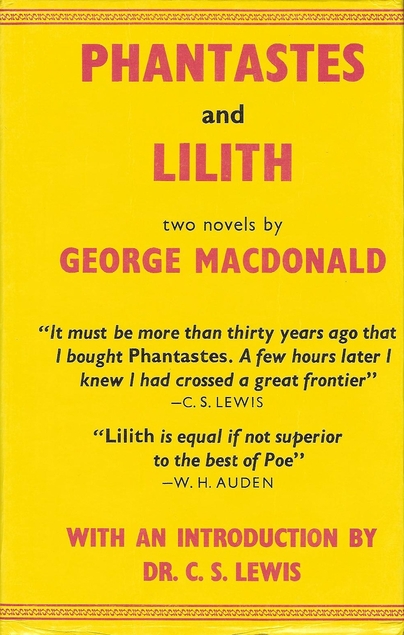
Lilith by George MacDonald

In Phantastes and Lilith, Gollancz, 1962, 237 p. First published 1895. One of the 100 best Scottish Books.

 Phantastes and Lilith cover

A Mr Vane (no first name is ever provided) inherits a country pile and very soon finds it is visited by a strange apparition. This is the house’s long ago librarian, a coated gentleman who from the front appears to be a raven and has the ability to move through mirrors – taking Mr Vane with him.

This mirror world at first appears strange merely in an Alice’s Adventures in Wonderland kind of way. The librarian/raven is prone to whimsical verbal contortions as in, “‘No one can say he is himself, until first he knows that he is and then what himself is. In fact nobody is himself and himself is nobody,’” but the milieu soon develops a darker aspect in the creatures Mr Vane encounters. Seemingly dead bodies, animated skeletons (one of whom expresses a deeply misanthropic view of wedlock in a conversation, where its expostulation, “‘This can’t be hell!’ is rejoined by another’s, ‘It must: there’s marriage in it!’”) Then there are Little Ones, who if they are not careful how they eat turn into giants. These giants capture Vane and might persecute the Little Ones but somehow manage to forget their origins and remain blind to them. Visiting a city called Bulika, whose princess wishes to kill all babies to forestall a prophecy of her demise, becomes a goal of Vane’s sojourn. Her existence is bound up with two leopardesses, one spotted, one white, which feature prominently from then on.

After Vane meets the librarian/raven’s wife the couple’s identities are revealed to be Adam and Eve. Adam bestows on Vane some cryptic warnings. Vane’s rescue and revival of a comatose – to all intents dead – woman leads to complications as this turns out to be Lilith, Adam’s former wife and the same princess who blights the existence of all who live under her sway. I say live, but there is some doubt as to whether these creatures are in fact alive or dead or indeed in some other state. After that it all got a bit mired in philosophical ramblings. Not my cup of tea at all.

The book’s 19th century origins are indicated by archaisms like wafture (of wings,) dropt (dropped,) wrapt (wrapped,) glode (glided,) clave (cleaved,) and staid (stayed.)

I would say this is firmly of its time. As an insight into the religious preoccupations of a late Victorian it is no doubt illustrative. It doesn’t much illuminate the human condition, though, and would not reach my 100 Best Scottish Books.

Pedant’s corner:- Shakspere (the 1895 spelling of Shakespeare I assume,) narow (narrow,) “against walls of its cage” (against the walls,) ne’re (1895 spelling of ne’er?) “fast as could” (as fast as I could?)

The Princess and the Goblin by George MacDonald

In the omnibus At the Back of the North Wind/The Princess and the Goblin/The Princess and Curdie, published by Octopus, 1979, 166 p (for The Princess and the Goblin.)

George MacDonald Omnibus cover

As a fairy tale (its first three words are “There was once”) this is not my usual fare. I only read it as it was in the Herald’s “100” best Scottish Fiction Books. The title seems a little askew as there was not one goblin in the story but many, who live under a mountain near to the castle where the Princess (who has the very unprincessly name of Irene) lives. She is to be kept away from the forest and hill at night in case she encounters the goblins but her nurse, Lootie, mistakes the time one day and the pair would have been at their mercy but for the intervention of a miner’s son, Curdie. A lot of the tale is in fact Curdie’s as he later ventures into the mines and discovers what the goblins are up to, but several sequences involve the princess’s meetings with a strange old woman claiming to be her great-great grandmother (though on the second meeting she has become young) spinning away in the upper floors of the castle, invisible threads which, Theseus-like, aid the princess and Curdie in the plot’s working-out.

To twenty-first century eyes the demonisation of the goblins stands out. I suppose they are some sort of sexual metaphor – the princess has to be protected from nastiness – and the King is presented as far too noble. Still; it is a fairy tale. A certain degree of simplicity is to be expected.

The king spends most of the time absent, on kingly duties, and I note there is no mother, no queen, to be seen. A perennial trope of the children’s tale is such a separation from parents.

Pedant’s corner:- a missing end quote, rhymster (rhymester,) horid (horrid,) “The cobs dropped persecuting me and look dazed” (looked,) “they came to the conclusion it had been slain in the mines, and had crept out there to die” (slain implies death; so how could it then have crept out to die?) balnkets (blankets.)

10 Forgotten Fantastical Novels You Should Read Immediately

At least according to this website.

The list is:-

Phantastes by George MacDonald
Masters of Atlantis by Charles Portis
Looking for the General by Warren Miller
Doom by William Gerhardie
That Hideous Strength by C.S. Lewis
Lud in the Mist by Hope Mirlees
The Boats of the Glen Carrig by William Hope Hodgson
All Hallows’ Eve by Charles Williams
The Great Dark by Mark Twain
The Fabulous Baron Munchausen and The Fabulous World of Jules Verne, two films by Czech director, animator, and special effects genius Karel Zeman

Well, one of these entries isn’t a novel at all but two films – so that breaks the criterion straight away – the Lewis is surely not forgotten (I have an as yet unread copy on the tbr pile,) the Mirlees and the Hope Hodgson are regularly cited as fantasy classics. Make of that what you will.

Since Fantasy isn’t really my thing I’ve not actually read any of these titles though. Could any of these potentially change my reading habits?

free hit counter script