Archives » Fantasy

The Magic Toyshop by Angela Carter

Virago, 1998, 202 p.

The Magic Toyshop cover

Fifteen year-old Melanie feels on the cusp of womanhood and wonders to herself how having sex or being married will feel. Her cosy middle-class existence is disrupted the night after she tries on her mother’s wedding dress – damaging it in the process – as in what she interprets as a piece of (un)sympathetic magic she receives news her parents have both died on the trip they had been on. Along with brother Jonathon and much younger sister Victoria she is packed off to live with Uncle Philip, their mother’s brother, who is married to Margaret Jowle, in turn rendered dumb ever since her wedding, communicating by means of chalk and blackboard. This new home is a constrained environment, ruled by Philip with a frugal rod of iron, Margaret and her brothers Finn and Francis (whom she brought with her to the marital home) living in fear. Philip is a toy/puppetmaker and they live over the toyshop which gives the novel its title.

The book has an odd sensibility, tonally and atmospherically redolent of Dickens, with some relationship dynamics reminiscent of Joan Aiken’s The Wolves of Willoughby Chase but also containing faint echoes of The L-Shaped Room. The occasional references to such things as radios and other manifestations of (relative) modernity feel quite strange in comparison with the Victorian atmosphere which pervades the book even in the earlier chapters where Melanie is untroubled by straitened circumstances. This disjunction verges on magic realism as there is an aura of weirdness hanging over things throughout yet which never declares itself openly.

As the novel progresses Melanie’s revulsion to Finn’s lack of cleanliness and his interest in her is countered by her burgeoning awareness of sexuality. The twist near the end is one which I suspect neither Dickens nor Aiken would have dared essay though it might not have troubled Lynne Reid Banks.

Pedant’s corner:- “Scarborough-is-so-bracing” (in the posters it was Skegness that was so bracing,) focussed (focused.) “There were a number of shops” “There were a number of cake tins” (there was a number,) “some armless, some legless, same naked, some clothed,” (some naked,) “in two hundreds beds” (hundred,) “greasy Orientals” Vyella dress (Viyella,) tremulo (tremolo.) “The first of Jonathan’s wooden ships were up for sale” (the first was up for sale,) “in the butchers” (the butcher’s,) “open eyes of pure of colour” (has an “of” too many.) “She spread out her skirts and put shells into it” (skirts is plural; so, ‘put shells into them’,) pigmy (pygmy,) “who had laid in bed” (lain,) Aunt Margaret must have fried up everything friable in the larder” (fryable; “friable” means crumbly,) hiccoughing (hiccupping, the supposed resemblance to a cough is a misattribution,) “and she not sure” (and she was not sure,) a missing end quotation mark.

The Yellow Wallpaper by Charlotte Perkins Gilman

Penguin, 1995, 91 p.

The Yellow Wallpaper cover

This is a small collection containing five of Gilman’s short stories, published as part of Penguin’s 60s Classics series. All could be considered to some degree feminist tales even if the term was not in widespread use at the time they were written. Three have some supernatural/speculative bent.
The Yellow Wallpaper is Gilman’s famous tale of a woman in her sick bed haunted by the yellow wallpaper of her bedroom room in the house her physician husband has rented for three months. Possibly being gaslighted (gaslit?) by her husband and his assurances that she needs to rest and take medicine to become well again, over the weeks she comes to see strange patterns in the wallpaper and an old woman behind its bars, as if imprisoned. The shift in the last two pages is impressive.
In When I Was a Witch a woman ventures onto a New York roof on a sultry night and is mewed at by a scalded black cat, witnesses a horse being mistreated and wishes for all the inflictors of such iniquities to feel the pain themselves and all ill-used cats and dogs to be relieved of their pain. Her wishes come true.
Turned is the old tale of a young innocent servant girl taken advantage of by the man of the house, here transmogrified by the response of his wife to the situation.
In Making a Change a new mother driven to distraction by sleeplessness and her mother-in-law’s criticisms attempts suicide. Her mother-in-law saves her and plans the change of the title.
The most overtly feminist story, If I Were a Man, embodies the wish of its title as Mollie comes to inhabit the consciousness of her husband – enhancing both her realisations and his.

Pedant’s corner:- would go down cellar (down to the cellar.) “a strange, provoking, formless sort of figure that seem to lurk” (seems,) “used to make my fairly frantic” (used to make me.) “The sobbed bitterly” (contexts demands, “She sobbed,” ) “the pangs of bitter jealously” (jealousy,) “joked his wife” (to his wife,)

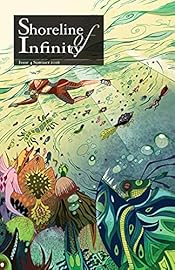
Shoreline of Infinity 4: Summer 2016

The New Curiosity Shop

Shoreline of Infinity 4 cover

In this issue there are interviewsa with Ken Macleod and Tricia Sullivan by Gary Dalkinb. Duncan Lunan reviews Ken Macleod’s The Corporation Wars: Dissidence mainly by way of discussing other works; Iain Maloney mystifyingly likes Yoon Ha Lee’s Ninefox Gambit and praises publisher Unsung Signals for taking a punt on Dan Grace’s long short (or short long) piece of fiction, Winter, not to mention the work itself. Elsa Bouetc likes Lavie Tidhar’s Central Station, Benjamin Thomasd eulogises Guy Gavriel Kay’s Children of Earth and Sky despite its tendency towards info-dumping, Ian Huntere is less generous to Ian Boffard’s Tracer. Ruth EJ Booth’s first column discusses the effect of winning a first award on a writer. Russell Jones’s introductionf to Multiverse (the poetry section) manages to tell us what the poems are about before we read them.
As to the fiction:-
Well Enough Alone1 by Holly Schofield depicts the cognitive decline of an elderly woman. Keen to get rid of her electronic minder by damaging it, she persuades the repair technician to download its programming into her smartcane while awaiting a replacement. The smartcane has programming of its own.
In Senseless2 by Gary Gibson a future National Unity totalitarian government perverts a medical breakthrough by using a device to remove senses from the prisoners it detains. A blind inmate who has developed compensation mechanisms and concocted an escape plan is suspicious of a new cellmate.
Andrew J Wilson’s The Stilt-Men of the Lunar Swamps3 is a typically exuberant piece of Wilsoniana, a Vernian/Wellsian pastiche in which our intrepid adventurers travel into a cavern in the Moon to meet the titular stilt-men and their even more alien controllers. There’s also a character named MacGuffin.
Model Organisms4 by Caroline Grebell relates the last yearnings of a dying life-form.
In Note to Self5 by Michael Stroh a wannabe Science Fiction writer busily piling up the rejection slips receives a package in the post: his first novel, sent to him by his future self.
Robert Neilson’s From the Closet is the somewhat predictable story of a man who tailors himself – literally – to the profile required by his internet dating partner.
The G4.A of geefourdotalpha6 by Clive Tern is a fighting robot which achieves consciousness when brought down in its final battle, surviving hundreds of years before being unearthed by a human anxious to preserve her hunting grounds.
Beachcomber by Mark Toner is a continuation of the graphic/comic strip series introduced in Shoreline of Infinity 3. This episode manages to combine 1950s UFOlogy with the Broons!
Gay Hunter by James Leslie Mitchell (Lewis Grassic Gibbon) is an extract from that author’s novel of the same title, the latest to be considered under Monica Burns’s7 SF Caledonia umbrella.

Pedant’s corner:- aIn the introduction “Ken Macleod and Tricia Sullivan have both have contributed” (remove a “have”.) b“as an writer of the left” (a writer,) “advances are being made bio-engineering” (made in bio-engineering,) “this conservative tenancy” (tendency.) c“the benefits and drawback” (drawbacks make more sense.) dhonorable (honourable, please.) e”the very imposing, nay, ruthless figure, who” (has its second comma misplaced; it ought to be after “ruthless”.) fDodds’ (Dodds’s.) gIn an appeal for subscribers; super nova (supernova.) 1Written in USian, “an sensible-looking brush” (a sensible-looking.) 2”The guard led pushed Bill into a chair” (led, or pushed? Or led/pushed?) plus a missing comma at the end of a piece of direct speech. 3”is audience were in for” (his audience was in for,) there was an unwarranted change in font size part way through, “hoisted by our own petard” (hoist by our own petard.) “There was ghastly, flatulent bang” (a ghastly flatulent bang.) 4”I have laid immersed” (lain immersed,) kilometers (kilometres,) “spermatozoa multiplies in my ovaries” (spermatozoa is plural; so, multiply. Plus spermatozoa are male sex cells, they would multiply in testes, not ovaries.) 5Written in USian. 6Written in USian, “ – hat’s how the file translated” (that’s.) “At the start of its final battle started G4.A controlled the sector” (As its final battle started G4.a; or, At the start of its final battle G4.A,) “advantage point” (it’s vantage point, no “ad”.) 7”The list of his best loved authors ….include (includes,) “the unique SF canon … go virtually ignored” (goes.)

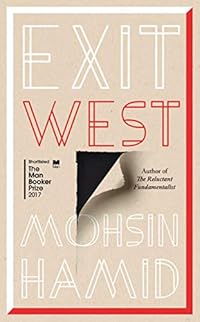
Exit West by Mohsin Hamid

Hamish Hamilton, 2017, 233 p. Another of the novels on this year’s BSFA Award shortlist.

 Exit West cover

In an unnamed Middle-Eastern city on the threshold of becoming embroiled in an insurrection, Saeed and Nadia meet while attending evening class. Despite wearing a black robe that covers her from toe to neck she tells him, “I don’t pray,” and on their first coffee together answers his question about the reason for her attire by saying, “So men don’t fuck with me.” As their relationship develops mysterious black doors are meanwhile beginning to appear at various locations on Earth, allowing people to move from place to place without traversing the ground, air, or sea between.

The relationship between Seed and Nadia becomes closer but when given the opportunity Saeed says he doesn’t want to have sex till they are married. Nadia’s response is pithy. To have Nadia as the less repressed of the two (she was independent enough to live in her own flat and had taken a previous lover,) to be the unreligious one of the pair, is a neat touch by Hamid. History has its own way with them, though, as the insurgents take over the city and life becomes repressive and dangerous. On Saeed’s mother’s death Nadia moves into his family’s apartment. They keep a fake marriage certificate in case of inquiries.

The militants are only ever in the background – though they do give Hamid the chance to convey the flavour of their impact – but they provide the impulse for our lovers to take a chance on escaping via a black door. The doors are essentially a fantasy element. How they work is never gone into, they just appear and do their, effectively magical, work.

Nadia and Saeed first alight on the Greek island of Mykonos, confined to a refugee camp, then later another door transports them to a plush but otherwise unoccupied London flat. Soon the flat fills up with more migrants through the door, unrest at the incomers builds up in the UK and the neighbourhood becomes ghettoised and a microcosm of the wider immigrant experience.

It is perhaps a flaw that Hamid doesn’t quite fully explore this strange new world where borders have been for all practical purposes abolished – and I suspect he is far too sanguine about the political accommodation the British state makes with the migrants, one which, in any case Saeed and Nadia eschew by taking another door to the US. Hamid’s main interest lies in portraying the migrant experience through the arc of Nadia and Saeed’s love affair, the strains their uncertain existence puts on the relationship between. Hamid also does a lot of telling rather than showing, but that is not uncommon among writers more celebrated than he is.

Hamid makes the point that migration is a trauma for the individual, “When we migrate, we murder from our lives those we leave behind,” and that, “We are all children who lose our parents ….. and we too will be lost by those who come after us and love us, and this loss unites humanity.” Then again, “Everyone migrates, even if we stay in the same houses our whole lives, because we can’t help it. We are all migrants through time.” (This is why nostalgia, a yearning for a lost golden age, is such a pernicious emotion.)

Despite Exit West’s nomination for the BSFA Award, nothing in Hamid’s treatment betokens Science Fiction. This is really a mainstream novel (albeit a good mainstream novel) with an SF idea bolted on. The black doors are not necessary for the plot to work and the implications of easier transit between countries are rather skated over.

All three nominees I’ve read so far are lacking in some regards. I really don’t know which novel to place first; only the one I won’t.

Pedant’s corner:- legs akimbo (legs cannot be placed on hips; at least not on the same body’s hips,) fit (fitted.)

Interzone 274 Has Arrived

Interzone 274 cover
Paris Adrift cover

After its brief hiatus, Interzone is back, this time with issue 274.

Among the usual selection of goodies – including no less than seven stories – this issue contains my review of Paris Adrift by E J Swift.

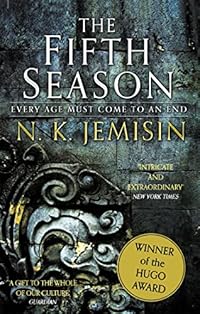
The Fifth Season by N K Jemisin

Orbit, 2016, 443 p

 The Fifth Season cover

The world contains a single supercontinent subject to perennial seismic disturbances via earthquake or volcanic eruption. Its inhabitants call this uncertain land The Stillness. Certain of them have the genetic capability to incite or direct the forces causing the upheavals. This arguably puts the book squarely in Fantasy territory but a Science-Fictional gloss is provided by the information that rogga (or orogenes, the term used depends on the speaker’s kindliness, or lack thereof, towards them) have organs known as sessapinae in their brain stems which confer the ability to sense and alter their surroundings and the rocks beneath, all the way down to the magma. Rogga are viewed with fear by the general populace and may be killed when discovered or else sent off to the Fulcrum in the great central city of Yumenes to be trained by Guardians into controlling their abilities for the greater good. A system of rings denotes adepts’ relative proficiencies (think belts in judo.) For the rest, life is mediated by a body of aphorisms known as stonelore.

The novel has three narrative viewpoints, sequentially interwoven through the early part of the book and carefully chosen by Jemisin to reflect her invented world. One strand is narrated in the second person (though by a woman called Essun whose husband Jija, before running away with their daughter, killed their toddler son when he in turn, in Essun’s absence, inadvertently revealed his rogga nature.) This strand is concerned with Essun’s search to be reunited with her daughter. We also experience the adolescent life of Damaya, a young girl whose frightened parents invite the Guardians to take her away to be trained and through whom the rigours and restrictions placed on an orogene are revealed. The third strand follows Syenite, a four-ring sent by the Fulcrum on a mission to clear the harbor of a town named Allia of an outgrowth of coral blocking shipping access. She is overseen by the ten-ring Alabaster (orogenes take the name of a rock when they achieve their first ring) in the hope the pair will produce orogenically gifted offspring. Neither Syenite nor Alabaster is particularly keen on this requirement. Their lack of agency in this and other regards is explicitly compared to slavery, which of course it is. Though it becomes obvious later on that the three strands are not contemporaneous each is narrated in the present tense. In addition every chapter has an epigraph (derived from stonelore) but only at its end.

Internal evidence implies that this world may be our Earth long after a geological catastrophe killed off most of humanity with only a few surviving to repopulate the world, and their descendants experiencing a series of Fifth Seasons in which environmental consequences of seismic upheavals result in societal breakdowns. There is a degree of technological backwardness but only a degree. Transportation is on a human or animal powered scale (or sail in the case of ships) but yet, curiously, the society still has antibiotics and blood testing.

Jemisin’s characterisation is excellent. With the possible exception of the second person narrator (the choice of that mode inevitably involves a distancing, though Jemisin has good reason to employ it as Essun is trying to be as detached from her situation as possible,) the reader experiences the book’s denizens as real people. They are as complex and flawed as humans usually are. Though we know there must be a connection between Dayama, Syenite and Essun it is a considerable achievement by Jemisin that its form remains opaque till close to the book’s end.

This was certainly worthy of winning the Hugo Award in 2016. Its sequel The Obelisk Gate also won in 2017. I’ll certainly be looking out for both it and the third in Jemisin’s “Broken Earth” trilogy, The Stone Sky, plus her previous novels.

Pedant’s corner:- as if sawed (sawn,) “takes a lot out of a you” (a lot out of you,) “these are just are shakes” (has one “are” too many,) aparatus (apparatus,) “gets ahold of himself” (gets a hold,) “but metal rusts” (metals corrode, but only iron rusts; you cannot get rust from any other metal,) “there’s iron ore in some of it and it’s rusted from the moisture in her skin” (iron ore does not rust; it is rust.) “None of you say anything” (None of you says anything,) Yumenes’ (Yumenes’s, which is used later,) “none of them are allowed to ..” (none of them is allowed to,) no opening quote mark when a chapter starts with a piece of dialogue, prestitious (prestigious,) adaption (context suggests adoption.)

Ursula Le Guin

I’ve just looked at the Locus website and discovered to my deep sadness that Ursula Le Guin has died.

She was one of the greats of Science Fiction and Fantasy and will be sorely missed.

Probably most famous for her “Earthsea” series of books she first came to my attention in the 1960s. I cannot now remember which book of hers I read first but I think it must have been the acclaimed The Left Hand of Darkness. I went on to scour bookshops for her work. I confess I wasn’t as impressed (in my relative youth) by the even more critically praised The Dispossessed – I probably hadn’t enough life experience then to appreciate it fully – but since those days her fiction has always been the background to my SF reading life, my anticipation of each new book never disappointed by its content.

Most recently I always enjoyed her book reviews for The Guardian, which showed a mind as sharp and incisive as ever.

Tonight the world – the universe – feels like a much smaller place.

Ursula Kroeber Le Guin: 21/10/1929 – 22/1/2018. So it goes.

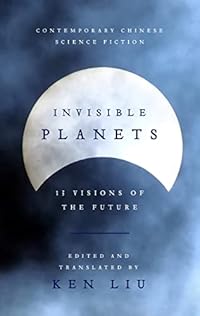
Invisible Planets: 13 visions of the future from China, edited and translated by Ken Liu

Head of Zeus, 2016, 383 p. Reviewed for Interzone 268, Jan-Feb 2017.

 Invisible Planets cover

Chinese SF has been making something of a splash in the wider world of late. This volume – containing thirteen stories (bar one all award winners in China) by seven authors, four women and three men, along with three essays on the form’s Chinese incarnation – provides the opportunity to delve into its ripples but perhaps dangles an invitation to a question. Do these examples of Chinese SF exhibit traits which are specifically Chinese in nature? Is it possible to discern characteristics unique to a culture’s literary output and, within that, to its SF?

In the broad sense, surely yes. Russian literature for example has a very different feel to that written in English. So too its SF. But does Invisible Planets spread its net widely enough to allow any such judgement? (I myself, though, having noted a qualitative difference in the broad sweep of US SF as opposed to that from the UK – which was then all but solely English – and so deliberately set out to write a novel that could only have arisen from a Scottish background, might be the wrong person to ask.)

In his introduction Ken Liu specifically warns us not to expect the contents here to be monolithic, that SF from China will be as diverse in nature as that from anywhere else, and cautions us that the stories he has chosen may not be representative; though he does note that SF from Singapore, the UK and the US “are all quite different” from each other, even if there are “further divisions within and across such geographical boundaries.”

He offers us “science fiction realism” from Chen Qiufan, the self-proclaimed “porridge SF” (neither “hard” nor “soft” – the terms apparently have slightly different meanings in China where hard refers to the inclusion of more technical material) of Xia Jia, “wry, political metaphors” from Ma Boyong, the “surreal imagery” of Tang Fei, “dense language-pictures” from Cheng Jingbo, the “fabulism and sociological speculation” of Hao Jingfang and Cixin Liu’s “hard science-fictional imagination”. Apart from Cixin Liu, most of the authors (whose names are all rendered in Chinese style, family name first) are “rising stars” and all work in professions.

The fiction starts with three stories from Chen Qiufan (Stanley Chan.) The Year of the Rat sees an unemployed graduate forced to join the Rodent-Control Force dealing with the genetically engineered NeoratsTM infesting the Chinese countryside. In The Fish of Lijiang, people exposed to time dilation or compression require occasional readjustment which they obtain by meeting up with those of the yin tendency to their yang. Body films, patches which express personality in response to muscular tension or temperature, feature in The Flower of Shazui which reworks the old tale of a man fascinated by a prostitute who is beyond his reach. She nevertheless requires his help.

Xia Jia also makes three appearances. In the at times dream-like A Hundred Ghosts Parade Tonight foundling Ning is the sole living inhabitant of a village of ghosts whose days as a tourist attraction are gone. He nevertheless does not age beyond seven. Tongtong’s Summer sees Tongtong’s grandfather needing care after a fall. This comes in the shape of Ah Fu, a robot controlled from afar via a telepresence body-suit. Soon grandfather is interacting remotely with others in his position. Packed with invocations of opposites and apparently inspired by the poem “With Dreams as Horses” by Hai Zi, Night Journey of the Dragon-Horse (a story original to this book) sees the dragon-horse awaken after centuries to a world long bereft of humans. It meets a bat and they travel together telling each other stories.

Ma Boyong’s The City of Silence might be taken to be a reflection of Chinese experience in its depiction of a time when web access and everyday discourse is restricted to only allowable words but its explicit reference to Orwell’s 1984 (and implicit one to Fahrenheit 451) implies a wider relevance. The inevitable attempts to circumscribe the rules lead to an ever narrowing list of healthy words. Marring this slightly was that some aspects of the story were seen from our frame of reference rather than its.

Hao Jingfang has two contributions. Invisible Planets uses a Scheherazade type storyteller (without the jeopardy) describing fantastical planets and their inhabitants to suggest how both interactions with others and experiencing stories can change us. Her Hugo Award winning Folding Beijing sees that city – out to the sixth ring road – as a kind of time share, with three Spaces taking turns in occupying the ground over two days before the cycle recurs. During two such Changes Third Space denizen Lao Dao, wishing to earn enough money for his daughter to attend kindergarten, makes the dangerous journey to take a message to the less crowded and much wealthier First Space.

Xiaoyi is the fifteen year-old titular character in Call Girl by Tang Fei. It isn’t sex she sells, though, but stories related to her ability to manipulate space and time. Cheng Jingbo’s Grave of the Fireflies is an almost indescribable admix of fairy tale – princesses, magicians – and end of the universe SF – the stars are going out – in five sequential sections headed three successively apart days in February yet spanning centuries.

We round off with two stories from Liu Cixin. The Circle is a reworking of a chapter from his Hugo winning novel The Three Body Problem. An ancient Chinese mathematician develops a binary calculating machine utilising soldiers carrying flags. In Taking Care of God two billion members of the God civilisation which created the conditions for life on Earth and oversaw its development are deposited on the planet’s surface from a horde of ageing spaceships. In exchange for the Gods’ knowledge their wellbeing is catered for by billeting each of them on a family. Inevitably tensions ensue. Their science turns out to be too far advanced to be intelligible and their daily habits tend to forgetfulness. There are echoes here of Aldiss’s Heresies of the Huge God, Clarke’s The Nine Billion Names of God and a touch of Leinster’s The Greks Bring Gifts. (Whether Liu was aware of, or even intended, these cannot be judged from a distance.)

The three concluding essays delve into various aspects of Chinese SF. Liu Cixin’s “Three Body and Chinese Science Fiction” covers SF’s century-long history in China, its original incarnation optimistic, its later role in the People’s Republic era where it was seen as being only for children, to be educative about technology, the startling absence of Communist Utopias within its purview, its new-found literary credentials and confidence, all as a lead-in to explaining the origins of the pessimistic vision imbuing his trilogy.

Chen Qiufan’s “The Torn Generation” contrasts the anxiety of the younger generation with the thoughtlessness of the older. “Faced with the absurd reality of contemporary China the writer cannot fully explore or express the possibilities of extreme beauty and ugliness without resorting to science fiction.” These are not strictures necessarily confined to China.

In the final essay, where Xia Jia tries to answer the question asked of her at a convention “What Makes Chinese SF Chinese?” she covers some of the same historical background as Liu Cixin, saying the breakaway from science-popularisation was motivated by binary oppositions such as China-the West, underdeveloped-developed, tradition-modernity, and concludes that while the Chinese SF community is full of internal differences she does find some commonality as the stories are written primarily for a Chinese audience, but, “Perhaps Western readers can also read Chinese science fiction and experience an alternative Chinese modernity and be inspired to imagine an alternative future.” Alternative futures. Any SF reader will drink to that.

But it’s the stories that matter. All here work well as SF. Their characters behave as characters do, with love, jealousy, resentment, tenacity, fear, and loathing. Apart from references to aspects of Chinese daily life and culture they could easily have originated from non-Chinese sources. Taken in all, however, I did note a tendency to didacticism, a leaning towards the fantastical, an awareness of contrasting opposites, an air of detachment. None of that would make them uniquely Chinese, though, and whether or not Chinese SF really is a creature all to itself, on this evidence it’s certainly worth reading.

The following did not appear in the published review.

Pedant’s corner:- “the fiction written in Singapore, the United Kingdom, and the United States are all quite different” (is all quite different,) interpretive (interpretative,) one of the China’s most elite colleges (one of China’s,) maw for mouth rather than stomach, Xian Quan (Xiao Quan,) hid (hidden,) “When seven words had been deleted, Arvardan knew it was Sunday. (Only if he’d started on a Sunday.) The structures on two sides of the ground were not even in weight, (is slightly clumsy; balanced in weight?) “has to transfer buses three times to get there” (has to change buses? Has to take three different buses?) “archers loosened volleys from their bows” (loosed volleys.)”There were a total” (there was a total.)

Worldsoul by Liz Williams

Prime, 2012, 310 p.

 Worldsoul cover

This starts promisingly enough in the prologue when the ancient library of Alexandria lifts off into the sky like a rocket with parts of it still burning. What follows after though is a bit of a disappointment by comparison as its settles down into a tale of fantasy and magic which arguably does not need that preamble at all. When we start chapter one the library has for a long while been in Worldsoul, a place in connection with Earth but also on the border of the Liminality – woven by the Skein out of the legends of the ancestors of man – and a kind of limbo known as the nevergone.

A power vacuum has been created by the sudden unexplained disappearance of the Skein, who used to run Worldsoul, and now various entities are trying to muscle in. It falls to librarian Mercy Fane and an alchemist called Shadow to resist.

Since the origins of the Liminality are not revealed till near the end the mythologies the book draws on appear a bit of a mish-mash with djinns and ifrits, not to mention a Shah, mixed in with demons and Norse gods, Loki in particular. Another off note is the short chapters, which do become more appropriate towards the end when the action hots up but at the start prevent the reader getting to know the characters well enough before being flung off into another viewpoint. Then, too, the action sequences are curiously perfunctory and there is too much info dumping, with a lot of telling rather than showing. The ending screams “sequel coming.” I might give that a long time before ever reading it.

Still, fantasies like this are not really my thing and I have found Williams’s work more palatable in the past.

Pedant’s corner:- Plus points for Abbots General as the plural of Abbot General. Otherwise; the Has’ (the Has’s,) descendent (descendant, which was used later but then reverted to descendent,) Sulis’ (Sulis’s,) “is in the cards” (I’ve always known this as on the cards,) “she would say only that it had been a ploy” (she would say that it had only been a ploy,) dreadnaught (dreadnought, which appeared later,) “the bisecting road ran in either direction” (yes, roads do that; but shouldn’t it be each direction?) stood (standing,) “the no-colour of clear glass” (‘clear glass’ does not mean what this implies; clear itself means transparent. It does not mean colourless.) “But she could not more have resisted it than it any more than she could have flown” (has one ‘more’ too many.) That mean a deeper investigation” (meant,) fit (fitted,) “had made a homunculus of her” (a humuncula, then? Maybe not,) humunculus’ (humunculus’s.) “When it was sure it had got its full attention” (her full attention makes more sense,) “‘I wanted to see what you’d so’” (what you’d do,) “‘Something’s happening?’” (It wasn’t a question,) auroch’s (as far as I’m aware the singular of aurochs is aurochs, so aurochs’s) “all was not as predicted” (that not all was as predicted.)

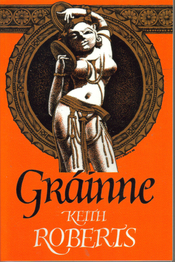
Gráinne by Keith Roberts

Kerosina, 1985, 175 p.

Gráinne cover

A man lies in a hospital bed being asked questions. In answer he begins to tell his life story. It is a curiously detached process: he thinks of himself in the third person, referring to himself as Bevan. (In this Roberts may be utilising aspects of his own young life to flesh out his story – or carrying out a double bluff to make us think so. He used the name Alastair Bevan as an early pseudonym.) The man doesn’t name some of the characters from his early life, merely gives them titles; The Mother, The Headmaster. His early discomfort on dealing with women is well conveyed. Things change when he meets the enigmatic Gráinne, however, though to begin with he only worships her from afar. She is named for the mythical Irish princess.

Roberts’s prose is oblique, meaning is not immediately transparent, it has to be teased out by the reader. By the end, though, the process does become less opaque. The intercutting between “Bevan”’s reminiscences and his interlocutors is an important part of this. It highlights and comments on his tale, allows Roberts to ask the questions the reader might – and answer them. He tells his story in five “sessions” named Anuloma, Abhassara, Brahmacariya, Aranyaka and Upanishad respectively. These titles are not from Irish mythology but relate to Hindu customs and tales.

The Gráinne ‘Bevan’ remembers has aspects of a goddess, or an everywoman, and she has the gift of prophecy. “Right down through history religion had backed the state. She said the end result of money sticks” – some man had invented these centuries ago and things had gone downhill from then on – “was three World Wars. Two down and one to go. She said she wanted something to survive, But not a God. Or it would all start again.”

Some time after their relationship ends she lands a job as a TV presenter on Channel Five (a fifth UK TV channel was fictitious in 1985) and becomes famous. As part of a project she is working on she asks the advertising firm Bevan works for to devise a campaign for her, knowing he will have the idea she wants. The ramifications of her programme cause the authorities some problems and this is the ultimate reason for Bevan’s questioning. It is only at this point that aspects of SF creep in to the novel. In common with most of Roberts’s œuvre the whole, however, has an unsettling effect, always teetering on the borderline of the fantastic, as if Gráinne might have been a figment of ‘Bevan’’s imagination.

For Roberts completists this is a must though those unfamiliar with his work might be best to start with earlier novels.

Pedant’s corner:- I note “mike” as the abbreviation for microphone. Hurrah!
Otherwise; woffle (waffle,) Guy Fawkes’ night (I believe it’s just Guy Fawkes night; if it had an apostrophe it would have to be Guy Fawkes’s night,) staunched (stanched,) “an old tobacconists” (tobacconist’s,) “his Dad had given for his twenty-first” (had given him?) Fitzsimmons’ (Fitzsimmons’s,) Éirann (more usually Éireann,) verandah (I prefer veranda.) “He left the door stood open” (standing open,) “a line of men in saffron robes plod east” (a line plods.)

free hit counter script