Archives » Fantasy

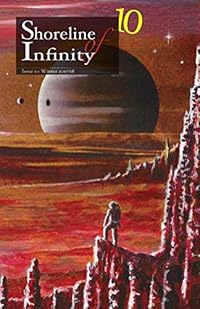
Shoreline of Infinity 10: Winter 2017/18

The New Curiosity Shop, 132 p

 Shoreline of Infinity 10 cover

In Pull up a Log Editor-in-Chief Noel Chidwick rightly notes the achievement of the magazine reaching its tenth edition. There are Judge’s Reports by Eric Brown and Pippa Goldsmith on Shoreline’s flash fiction competition followed by a celebration of The Worthy Winners and shortlisteesb. Three of these stories appear in this edition (see *.) Tales From the Beachcomber riffs on the human fascination with powers of ten via the life and works of Arthur C Clarke, there’s an interview with Helen Sedgwick by Pippa Goldschmidtc, in Noise and Sparks: The Company of Bears, Ruth E J Booth lauds the interactions and memories convention going brings, the tolerance it fosters. Reviewsd considers Ada Palmer’s Too Like the Lightning, the Jonathan Strahan edited Infinity Wars, Kim Stanley Robinson’s New York 2140, The Death and Life of Schneider Wrack by Nate Crowley, 2084 edited by George Sandison, and The Clockwork Dynasty: A Novel by Daniel H Wilson. Multiverse has poems by Rachel Plummer, Jo-Ella Sarich and Rosemary Badcoe. Parabolic Puzzlese challenges the reader to identify twelve SF writers from their photographs and very brief information about them.

Little Freedoms by Ephiny Gale1 is set in a closed room where some sort of endurance test of nine characters is taking place with various tasks to be undertaken – such as not touching, not speaking, not breathing. The winner gains freedom (from an unspecified but clearly onerous existence.) The others are restored to their former state.
Sweet Compulsion by Chris Bailey is told to us rather than shown and overall feels more like a sketch of a story than the complete article. Riddled with quotations from Paradise Lost it features a world in which people’s thoughts are etched onto others’ skins.
In Junk Medicine2 by Die Booth plastic ownership is outlawed but there are still people willing to pay over the odds for items made from it. This story does for plastic what Number Ten Q Street did for real food.
ATU334 The Wise*3 by Marija Smits is a future tale of Baba Yaga and an importuner, the titular ATU334.
If Thine Eyes Offend Thee4 by Daniel Rosen is narrated by Elsa whose ambition was always to be a mermaid. We see the lengths of body reconstruction and skulduggery she will go to to win the Miss Cosmos competition.
Pauline and the Bahnians*5 by S K Farrell is set on a demilitarised outpost turned into a – possibly illegal – smallholding. Its weapons are still there though.
The narrator of The Apple Bee6 by K E McPhee is marooned on an island on a mostly water planet, with no communication with the rest of humanity and only potatoes, apples and corn as a food supply.
Don’t Speak; Don’t Listen7 by Serena Johe explores the ramifications of an implant that prevents the speaker insulting or denigrating anyone.
A Choice for the Golden Age* by Matthew Castle was the overall winner of the flash fiction competition. It’s set on a generation starship which rotates its crew (and holds its genetic cargo permanently) in suspended animation.

Pedant’s corner:- aIn the cover artist’s (Dave Alexander) information paragraph; “His biggest claim to fame were the two front covers he painted for DC Thomson’s Starblazer series” (His biggest claim to fame was the two front covers.) b“As economical a tone-poem … it’s” (As economical as a tone-poem.) cnot mentioned on the contents page. d“if the government get wind of him” (gets,) “while others featuring AIs and a couple are” (the rest of the verb forms in this sentence are indicative so ‘feature’,) “take several different aspects … and extrapolated them” (extrapolate them,) “how will it effect you” (affect was meant,) Watts’ (Watts’s,) a missing full stop at the end of a review, bail out (bail-out,) counsellors (as I remember the book it was councillors,) Eric Morecombe (Morecambe,) political dissension (dissent I would think.) “Although, some readers have taken issue with” (no comma after ‘although’,) as though there maybe” (as though there may be,) “into this under ground world” (underground.) e“The winning team …. were amply rewarded” (The winning team was amply rewarded.)
1“a couple of pair of trousers” (a couple of pairs of trousers.) 2whinging (whingeing,) there’s a missing full stop, “Carbonari’s” (earlier it was Carboneri’s.) 3Written in USian. 4Written in USian – though curiously we have manoeuvre instead of maneuver – there is a full stop instead of a comma at the end of piece of direct speech embedded in a longer sentence. “Scales in every spectrum of the rainbow” (suggests the author doesn’t know what spectrum means.) “I let her wheel me all the way back to my room and offered me another drag of her vaporiser” (offer.) “Auroras antennae flickered” (Aurora’s.) “The voice rumbles like through the water in a sticky molasses bass.” (The only way I can make sense of this sentence is if the ‘like’ is redundant.) 5“(what is a Bahnian, please?).” (doesn’t need the full stop.) 6“Quite early on he’d abandoned the neatly organised rows and began planting” (begun is more grammatical,) we have ‘gotten’ and ‘maneuvered’ (the author is Aussie which wil possibly explain these.) 7“someone shined a light” (shone. It’s shone a light.)

BSFA Awards Booklet 2019

BSFA Awards Booklet for 2019

This year’s booklet arrived this morning.

It contains all the short fiction and non-fiction nominees for the BSFA Awards for works published in 2018 and the artworks nominated for the relevant award.

On perusing it I found the closing date for electronic voting is today so I had a lot of reading to pack in this afternoon.

I have been expecting the booklet’s arrival since the turn of the month and was getting worried it would not be forthcoming in time.

Eastercon, which I will not be attending this year, where the final awards will be announced, is of course this Sunday coming.

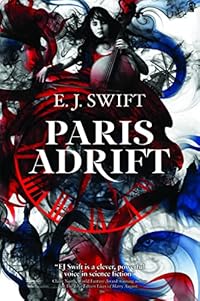
Paris Adrift by E J Swift

Solaris, 2018, 379 p. Reviewed for Interzone 274, Mar-Apr 2018.

Paris Adrift cover

Time travel is one of Science Fiction’s most venerable tropes but in more recent times has taken something of a back seat to other aspects of the genre. In Paris Adrift, E J Swift has adopted an oblique approach to the topic, gaily skipping over any problems with the ethics of non-intervention and avoidance of the grandfather paradox. She does not make anything of, still less explain, the mechanics of the process (which arguably puts us in fantasy territory,) it is simply an integral part of the story she has to tell.

Hallie, an English geology student estranged from her family, is on a gap year in Paris trying to sort her life out. She takes a waiting job at Millie’s, a bar near the Moulin Rouge. Millie’s is a nexus for the strange. Fellow employee Gabriela finds she is always somehow prevented from leaving Paris while Hallie has odd encounters with birds that talk to her, an apparent doppelganger, and customers, while also experiencing odd sensations both in the keg room and in Paris’s catacombs. She still finds space for a relationship with fellow waiter Léon, and Swift charts superbly the overwhelming intensity of a burgeoning love affair.

The narration is almost exclusively from Hallie’s viewpoint, in that pressing present tense which can seem like a default in so much modern SF. Occasional mentions of geological terms underline Hallie’s background.

The incursions of the weird might perhaps have been more unexpected had we not already read a prologue chapter introducing us to the chronometrist, a person seemingly able to take control of other’s bodies at will but whose essence is fading, and to the concept of anomalies and their incumbents. Hallie soon finds out the keg room is a time portal and her future has been mapped out by the Way of Janus.

Her first experience of timefaring takes her to 1875 where she seems to adapt to her new situation remarkably quickly and is befriended by the Millie who will one day found the bar. She also meets the architect designing the Sacré-Coeur. Partly due to Hallie’s interference that building will no longer be erected. In its stead will arise the Moulin Vert which becomes a significant location in the rest of the book (plus inspiration for a political movement) and technically makes the novel an alternative history. However, other aspects of our modern world and its history are unaffected, there are mentions of Whatsapp, plus the Bataclan, Stade de France and Nice attacks.

The anomaly’s next flare sends Hallie to 1942 and a suitably claustrophobic encounter with would-be cellist Rachel Clouarte. Hallie dodges German soldiers and the curfew to reunite Cluarte with her cello and aid her escape in order to ensure her career in music will prevail, so that she will not marry and produce (eventually) the descendant who will contribute to a catastrophic war in the future. This 1942 Paris is lightly affected by the occupation, street life continuing gaily as normal, though of course the deportations from which Clouarte is to be saved proceed apace. I did wonder why Hallie’s intervention in the Clouarte family tree had to be quite so early but of course it does give Swift the opportunity to depict Paris in wartime and up the danger quotient.

Another flare takes Hallie to 2042 and a terribly plausible fascist Paris (complete with Metro station called LePen) and the seeds of the situation which the Way of Janus seeks to avert. Other timefaring trips are mentioned but not gone into in detail.

The 1942 and 2042 excursions lend the novel aspects of a thriller yet there are other scenes which bring to mind Angela Carter’s Nights at the Circus and the work of Tim Powers. Throughout, Swift’s portrayal of her characters is assured. These are people we can believe in even if one of them is prey to the logical fallacy that because the Earth is remarkably suited to humans it is a sign of something miraculous rather than the unfolding of impersonal forces which merely allowed us to arise.

Paris Adrift deals with the heavy theme of totalitarianism and the threat of the far right but never loses sight of the smaller people who live through interesting times. While Léon and Hallie are pivotal to the resolution of the plot (and History itself) its emotional focus, though sometimes sidelined, is on their relationship.

Like a lot of SF this suggests life is hard and pain impossible to avoid but unlike most recent SF it proffers hope along with the sacrifice. Never mind it being good SF/Fantasy, this is a good novel.

The following did not appear in the published review.
Pedant’s corner:- “the night team begin to trickle in” (the night team begins to trickle in,) “the group want shots” (wants,) “a stream of people flow inside,” (a stream flows,) “the confines of the locker room lends an air” (the confines lend an air,) “a travelling company were performing” (a company was performing,) “the shape of the walls change, become smooth and rounded” (the shape changes, becomes smooth,) “Her age and appearance has altered once again” (have altered,) “the floor team are doing the rounds” (the team is doing the rounds.) “None of these people have an anomaly. None are bound to this place” (none has, none is.) “Only a small proportion of the catacombs are maintained for visitors.” (Only a small proportion is maintained,) “as the assault team go through their final checks” (as the team goes through its final checks.) Yet despite all these examples of such failures of agreement of subject and verb Swift obviously knows what’s what as we had the correct “a rickety set of steps leads up to”,) “till I am stood right next to him” (it wasn’t a passive activity, so standing”,) “sat on the gravestones” (sitting,) gotten (in a narrative otherwise so British in tone this USianism jars,) “since she bid me farewell” (bade me farewell,) “preempting the touch that will follow” (the context implied savouring rather than pre-empting,) Dušanka calls Hallie “‘my petit chou.’” She responds, “‘And I’m not a pastry.’” (That response would be to “my petit choux” – chou is a cabbage and “petit chou” a term of endearment. Hallie’s French isn’t supposed to be good but surely she would not confuse the two?) “is sat” (is sitting,) “another woman is stood at the window” (is standing,) dove (USian; the British past tense of dive is dived,) “sat sipping” (sitting sipping,) “glasses pile up on either side” (context implies both sides,) inside of (USian, it’s just inside, no “of”,) descendent (descendant,) focusses (focuses,) syllabi (I prefer syllabuses, though I concede syllabi is a correct Latin plural,) “you’ll be never be happy” (that first “be” is redundant, “‘How can I do that.’” (That is a question so requires a question mark, not a full stop.)

Interzone 278 (Nov-Dec, 2018)

TTA Press

Interzone 278 cover

Tim Lees takes the guest Editorial where he ponders truth and realism in fiction and welcomes more inclusiveness – more truths – in SF. Andy Hedgecock’s Future Interrupteda wonders about the preponderance of negative perceptions of crowds in SF – and more generally – compared to their positive potential. Aliya Whiteley fills the gap left by Nina Alan’s columnistic departure in Climbing Storiesb, arguing that SF tales have no set structure like romances or horror stories do. Instead SF steals from everywhere. In Book Zonec Tade Thompson laments the failure of The Evolution of African Fantasy and Science Fiction edited by Francesca Barbini to treat African Sf&F on its own terms rather than Western ones, Daniel Carpenter says Aliya Whiteley’s The Loosening Skin will haunt the reader long after it is read (and also interviews the author,) John Howard appreciates Gary Westfahl’s reappraisal of Arthur C Clarke in the latest Modern Masters of Science Fiction series, Val Nolan discusses Christopher Priest’s “September 11th” novel An American Story, Duncan Lunan finds The Song my Enemies Sing by James Reich enjoyable hard work – up to a point – and considers carefully E M Brown’s Buying Time, I characterise Death’s End, the culmination of Cixin Liu’s Remembrance of Earth’s Past trilogy, as a bracing intellectual tour-de-force but emotionally unsatisfying, Andy Hedgecock finds Adam Roberts’s By the Pricking of her Thumb too self-indulgent, Stephen Theaker says Unholy Land by Lavie Tidhar is quite terrific – a corker – and Hazards of Time Travel by Joyce Carol Oates to be heavy-handed satire but arguably what this moment needs.

As to the fiction:-
Soldier’s Things1 by Tim Lees tells of a soldier invalided out from an ongoing conflict journey back home only to find nothing familiar, his memory untrustworthy – about anything.
In Doomed Youth2 by Fiona Moore an infestation of giant ants occurred sometime in the 1950s with intermittent rises and falls in their population ever since. The story is supposedly narrated by a Chinese American called Kara Chong in a chatty style that didn’t sit well with the content. The background of a world elsewhere falling apart has led to distrust of foreigners.
The Path to War3 by Louise Hughes sees a storyteller whose audience finds her lacking take a mountain path between two newly-warring countries (after a litany of wars) rather than the coast road in the wake of the army.
In Heart of an Awl4 by Eliza Ruslander an AI that was a car is bequeathed its owner’s body after his death. It and his widow go on a road trip.
Zero Day5 by Sheldon J Pacotti is the story of an off-duty cyber soldier who meets a girl on a bus. Tracking her later online he misses the big cyber attack.
The SF premise of Birnam Platoon by Natalia Thoeodoridou is much the same as that of Green Troops by William King, ie the development of soldiers capable of photosynthesising by themselves. This lot take their mission of promoting world peace seriously though. The story is framed via the post-war trial of one of their commanders for war crimes.

Pedant’s corner:- aZamyati’s (Zamyatin’s.) b“in the same way that there are” (in the same way that they are,) Roberts’ (Roberts’s.) cMaurits’ (Maurits’s,) “And it’s becoming clear is that” (and what’s becoming clear is that,) Roberts’ (Roberts’s,) 1fit (fitted,) 2“I made a final effort” (“I finally made an effort” makes more sense,) “someone beating a tympani” (tympani is plural, one of them is a tympanum.) 3snuck (sneaked,) “stood like marketplace crowds” (standing like marketplace crowds.) 4Written in USian, “she pulls up the hand break” (hand brake.) 5Written in USian, “and diffuse the situation” (defuse.)

Interzone 280 Has Arrived

Interzone 280 cover
The Orphanage of Gods cover

On the doormat this morning: Interzone 280.

This one contains – among all the other goodies – my review of The Orphanage of Gods by Helena Coggan.

My review of The City in the Middle of the Night by Charlie Jane Anders, due in issue 281, has been despatched.

Best Reading of 2018

Listed below in order of reading. 16 in total; 7 by Scottish writers, 4 SF or Fantasy (+ 1 non-fiction about SF,) 3 in translation, 10 by men, 6 by women:-

Living Nowhere by John Burnside
All Our Worldly Goods by Irène Némirovsky
Science Fiction: A Literary History Edited by Roger Luckhurst
The Fifth Season by N K Jemisin
The Black Book by Orhan Pamuk
The Gathering Night by Margaret Elphinstone
When They Lay Bare by Andrew Greig
The Great Chain of Unbeing by Andrew Crumey
Hame by Annalena McAfee
I Remember Pallahaxi by Michael G Coney
Not so Quiet …. stepdaughters of war by Helen Zenna Smith
Memories of My Melancholy Whores by Gabriel García Márquez
Time Was by Ian McDonald
The Shipbuilders by George Blake
Mr Alfred M.A. by George Friel
Moon Tiger by Penelope Lively

A Skinful of Shadows by Frances Hardinge

Macmillan, 2017, 423 p. Reviewed for Interzone 273, Nov-Dec 2017.

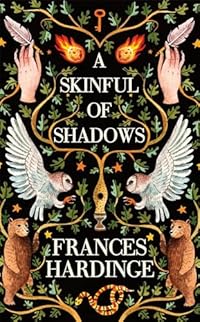
 A Skinful of Shadows cover

A YA novel with the usual quota of incident this is also a book written with a pleasing clarity and focus.

Makepeace Lightfoot is brought up as a Puritan in her aunt’s house in Poplar, sleeping on a straw mattress shared with her mother. More unusually her mother frequently forces her to spend nights in a church so that she might learn to ward off ghosts. Her lack of knowledge of her origins and the conflict this produces induces Makepeace to run off after a man her mother lets slip came from Grizehayes, her father’s home. This leads Makepeace into a mob heading for Lambeth Palace, protesting against the influence Archbishop Laud has over the King. In the confusion her chasing mother loses touch with her. Makepeace encounters wisps emanating from the body of a mistreated dancing bear, whose presence, as Bear, will be with her for ever. When Makepeace’s mother dies in the disturbances the classic ingredient for a children’s story, no parents, is in place but there is a moment of horror as Makepeace battles off her mother’s ghost.

Quickly packed off to Grizehayes, the ancestral seat of the powerful Felmotte family where the patriarch Lord Felmotte is a malevolent presence, calling her ‘the by-blow’, Makepeace is despatched to work in the kitchen where she befriends the domestic animals, despite Bear’s reluctance, and in turn is taken up by her half-brother James, another Felmotte by-blow who tells her a Felmotte’s character changes for the worse when he comes into his inheritance. While the reader has already divined the phenomenon it is only slowly that the extent of Makepeace’s genetic disposition – beyond the Felmotte cleft chin – becomes fully apparent to her.

That the waters we swim in colour our attitudes is indicated by Makepeace’s observation that, “Back in Poplar, everyone had known that the king was being led astray by evil advisers and Catholic plots. …. in Grizehayes it was just as obvious … that a power-hungry Parliament driven to frenzy by crazy Puritans was trying to steal power from the rightful King.”

Up to this point that background conflict seems only colouring but Hardinge integrates it into her plot with the revelation of the existence of a charter bearing the King’s seal acknowledging the Felmottes’ unique strangeness in return for their financial support.

The relatively kindly Sir Thomas Felmotte, who has not yet inherited, reveals to Makepeace, “‘There is a …space inside us. We can host more than ourselves.’” Makepeace realises, “‘We’re hollow. And dead things can get in.’” On death, the Elder Felmottes pass on their personalities to their chosen heir’s body, which acquires exceptional skills as a result. As Sir Thomas rationalises, “‘Imagine how great a family would be, if no experience, no skills, no memories were ever lost.’” The downside? Only the strongest personalities survive among the mix.

Makepeace ponders their toleration by the Elders and begins to understand the danger she and James are in, telling him, “‘We are spares,… somewhere to put the ghosts in an emergency!’”

The dispute between King and Parliament has by now erupted into full blown war, “The world was turning cartwheels … and nobody was sure which way was up any more,” providing Makepeace with the opportunity to flee when that emergency does arise. But James has meanwhile succumbed to Felmotte infiltration.

“Humans always betrayed you sooner or later,” Makepeace reflects, but embarks on a search for a way to restore James to himself and destroy the Felmottes forever. Along the way she incorporates a doctor, a Parliamentary soldier and a Felmotte sent ahead to take her over. These talk to her in a different, lighter font. Her travels take her to the King’s court at Oxford and capture by a Parliamentary detachment where she is accused of witchcraft. She speaks again to our times with the thought, “Humans are strange, adaptable animals, and eventually get used to anything, even the impossible or unbearable. In time, the unthinkable becomes normal.”

Towards the end Hardinge has a playful stab at the author/reader relationship with the doctor’s ghost’s rumination, “I am nothing but a bundle of thoughts, feelings and memories, given life by someone else’s mind. But then again, so is a book.”

The author’s touch is assured and her execution admirable. Apart from some dialogue which (arguably necessarily) doesn’t quite have a 17th century feel there is little to find fault with here.

The following did not appear in the published review.
Pedant’s corner:- Remarkably for these times I found only one typo, “she had had unexpectedly halted” (only one “had”.) Yes the book had a few examples of collective nouns being given a plural verb but these were in dialogue and therefore possibly true to the character – except for “a murder of Crowes were gathered around Lord Felmotte” (was gathered.) The phrase, “‘I had a ringside seat’” is hardly a 17th century expression, I’d have thought, and unfortunately we had an explosion occurring at an “epicentre” (centre.)

Widdershins by Oliver Onions

Penguin, 1939, 244 p.

Widdershins cover

This is a book of eight short stories – well, one is a novella – first published in 1911, by Yorkshireman Onions. He wrote well, each of the stories holds the attention and his characterization is good. All have at least a hint of the strange or unnatural. They stand up even a century after writing.

In the combined ghost and horror story The Beckoning Fair One a writer takes a flat in an otherwise empty house and finds he can no longer continue the novel he has been working on, nor the enthusiasm for much else. I was reminded a bit of Charlotte Perkins Gilman’s The Yellow Wallpaper.
Phantas is the story of the captain of a becalmed – and sinking – galleon out of the port of Rye, who dreams of a means of propulsion which would enable ships to avoid such a predicament. Out of the mists looms a grey, steam-driven modern destroyer.
Rooum is one of those unlettered men who has a natural flair for competency in his trade. He questions our unnamed narrator about molecules and osmosis as he feels he is occasionally subject to a kind of interpersonal merging.
The register in which Benlian is told is a familiar one to readers of Fantasy or Science Fiction, a realist depiction of a weird phenomenon. Benlian is a sculptor whose essence is increasingly opaque to photography, a man passing away, into his sculpture. The possibility that the narrator is mad rather spoils things though.
In Io a young woman who is convalescing tries to remember the dreams she had during her illness so as to enter their reality.
The Accident occurs when a man about to meet an old adversary in an attempt at reconciliation has a vision of how the encounter will – must – turn out.
The Cigarette Case is one of those shaggy dog stories of the “as told me by a friend” variety.
In Hic Jacet a successful author of detective fiction – a thinly veiled model, this – is asked to write the “Life” of an artist friend (who did not compromise his integrity for commercial success) and finds the gods of writing are against the project.

Pedant’s corner:- accidently (accidentally,) a missing end quotation mark. “But an effort of will he put them aside” (either ‘By an effort of will’, or, ‘But by an effort of will.’) “I seemed so natural” (context also supports ‘It seemed so natural.’) “whiskys and soda” (whiskies; but at least we weren’t subjected to ‘whisky and sodas’.) “ A group of scene-shifters were” (a group was,) plaintains (plantains,) pigmy (I prefer pygmy,) “penumbia of shadow” (penumbra,) “I confess that the position had effect of the thing startled me for a moment” (I can’t parse this phrase at all,) “his position involved a premium on which the rich amateur, he merely replied…” (seems to be missing a word after “amateur”, besogne (besoin,) “the abiquitous presence” (ubiquitous, I suspect.)

The Gloaming by Kirsty Logan

Harvill Secker, 2018, 309 p, plus iv p Glossary of Chapter Titles and i p Bibliography.

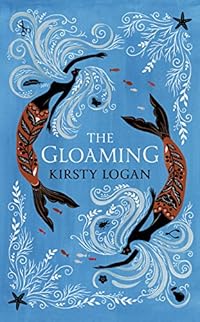
 The Gloaming cover

Set on an unnamed Scottish island, The Gloaming is an extended riff on the selkie legend, with additional elements of the fantastic. Mainly concerned with the lives of Islay, Mara and Barra, the three children of an ex-boxer, Peter, and a former ballerina, Signe, incomers to the island who live in a large house – complete with shark jaw for a doorway – which they intend to convert slowly from dilapidation to a hotel, it also explores familial resentments and duties. Barring the first’s, its chapter titles contain one word – ballet terms for those about Signe, boxing ones for Peter, and Scots for the children. While in some cases these are apposite, in others the connection between the title and the chapter’s content seems more than a little forced, if it exists at all.

When inhabitants of the island are about to die they start to slow down. This is an indication they will turn to stone, a fantastical conceit of Logan’s whereby the bodies end up on a hill as statues, a process usually attended by the island’s inhabitants as a ceremonial act but sometimes undertaken alone. This whimsy is not really explored fully as the hub around which the story revolves is Mara, who suffers a facial disfigurement the night she tries (and fails) to rescue Barra from drowning. In later life she forms an attachment to Pearl, a later incomer to the island, whose house lies within a hill and who at first can be read as the embodiment of the selkie legend. On their first meeting Pearl tells Mara she is a mermaid, by which she means she performs as one in an aquatic travelling show. Their later sojourn away from the island as a double act (selkies always leave) is a brief interlude only though. The pull of family is too strong.

Logan does pull off some tricks with apparent narrative viewpoint but her asides on readerly expectation of a story’s destination prefigure too strongly her intentions.

The Gloaming is fine as far as it goes, certainly better, more cohesive, than the author’s previous novel The Gracekeepers.

Pedant’s corner:- “When he arrived he wouldn’t fail to miss her” (context demands, “he wouldn’t fail to see her”,) “the sort that comes in packs of four at discount shops and only shattered if you threw them hard on a tiled floor” (and only shatter if you throw them.) “Didn’t that use to be…” (used to be,) “‘whatever I have to do make her see’” (to do to make her see.) In the Glossary; besom is defined as “a broom, a woman of loose morals and a cheeky child.” (A broom, definitely but I’ve not heard it used in the context of a woman of loose morals, only of one cheeky or nosy) drouthy is given as thirsty for strong drink (it just means thirsty, not necessarily for strong drink,) mauchit (spelled this way the “ch” would be pronounced as in loch; it isn’t. The online dictionary of Scots language has mockit – one instance of maukit – though I have seen mocket.)

Interzone 275, May-Jun 2018

TTA Press

Interzone 275 cover

Steven J Dines’s Editorial describes the unlikely role of father figure which fiction took in his young life. Andy Hedgecoock takes over Jonathan McCalmont’s Future Interrupted column and hopes to continue his search for SF “that is of value and worthy of our time”. In Time Piecesa Nina Allan looks at the abiding relevance of Mary Shelley’s Frankenstein.

In Book Zone Maureen Kincaid Speller found herself disappointed and frustrated by Annalee Newitz’s Autonomous, Duncan Lunan reviews two anthologies edited by Mike Ashley Moonrise: The Golden Age of Lunar Adventures and Lost Mars: The Golden Age of the Red Planet welcoming some of the choices made and questioning others and laterb looks very favourably on Sisyphean by Dempow Torishima, Duncan Lawiec says he won’t persevere with any sequels to Tristan Palmgren’s Quietus, Ian Hunter findsd The Oddling Prince by Nancy Springer hindered by its first person narrative, Andy Hedgecock warmly welcomes Ursula Le Guin’s collection of non-fiction Dreams Must Explain Themselves, Stephen Theaker laments the enduring topicality of Middle-Eastern woes in his look at The Map of Salt and Stars by Jennifer Zeynab Joukhadar, Elaine Gallagher praises Kirsty Logan’s The Gloaming while I myself find Chris Barnham’s Fifty-One diverting and Andrew Crumey’s The Great Chain of Unbeing totally accomplished. Finally Ian Sales says the stories in the Australian Sean McMullen’s collection Dreams of the Technarion do what SF ought to as it contains a wide range of ideas thoroughly worked out.

In the fiction, Erika L Satifka’s The Fate of the World Reduced to a Ten-Second Pissing Contest is set in a bar which has been abducted into a gap in reality – contents, patrons and all – by aliens with a taste for alcohol.
In Looking for Landau1 by Steven J Dines a man wanders the earth in search of Landau, who introduces people to the gateway to the next world.
The Mark2 by Abi Hynes can be read as a comment on how women are perceived in some quarters as not quite being human. A member of a seemingly uniform far future community (where reproduction has been a technological process now failing) flees up a mountain to escape the consequences of deformity. It soon becomes apparent she has given birth and the bundle she is carrying with her is the child.
The Purpose of the Dodo is to be Extinct3 by Malcolm Devlin is a quasi-philosophical piece centred round a man who dies at the same time in every separate reality (though in different ways depending on each.)
The Christ Loop4 by Leo Vladimirsky is narrated by a Jesus who undergoes every kind of execution possible, and is debriefed after each one in order to discern which will finally be enough to satisfy God.
It is a bit odd that these last two stories both feature the multiple deaths of their main character.

Pedant’s corner:- adescendent (descendant.) bOne Day in the Life of Ian Denisovitch (Ian?) Star Trek – Next Generation (Star Trek – The Next Generation) cIain M Banks’ (Iain M Banks’s,) populus (populace.) d“will not except him as a son” (accept.) 1stood (standing,) focussed (focused.) “A pair of women’s panties sit on the crumpled roof” (a pair sits.) 2“They lay Uncle down” (laid.) 3Iron Bridge (Ironbridge,) “the manner of Prentis O’Rourke’s deaths were documented” (the manners …. were documented,) Mechano (Meccano,) busses (buses.) 4Written in USian, “if they just left all the other me” (all the other me’s,) a question mark at the end of a statement.

free hit counter script